
OET INT FRT GEN EXO LEV NUM DEUT JOB YEHO (JOS) HERO (JDG) RUTH 1 SAM 2 SAM PSA AMOS HOS 1 KI 2 KI 1 CHR 2 CHR PROV ECC SNG YOEL (JOEL) MIC ISA ZEP HAB YIR (JER) LAM YNA (JNA) NAH OBAD DAN EZEK EZRA EST NEH HAG ZEC MAL 2 PS WIS TOB MAN BAR G DAN G ESD L ESD ESG JDT 3 MAC SIR 1 MAC 2 MAC 4 MAC YHN (JHN) MARK MAT LUKE ACTs YAC (JAM) GAL 1 TH 2 TH 1 COR 2 COR ROM COL LAOD PHM EPH PHP 1 TIM TIT 1 PET 2 PET 2 TIM HEB YUD (JUD) 1 YHN (1 JHN) 2 YHN (2 JHN) 3 YHN (3 JHN) REV
OET MAT Intro C1 C2 C3 C4 C5 C6 C7 C8 C9 C10 C11 C12 C13 C14 C15 C16 C17 C18 C19 C20 C21 C22 C23 C24 C25 C27 C28
OET MAT 26 V1 V4 V7 V10 V13 V16 V19 V22 V25 V28 V31 V34 V37 V40 V43 V46 V49 V52 V55 V58 V61 V64 V67 V70 V73
This is still an early look into the drafted text of the Open English Translation of the Bible. Please double-check the text in advance before using in public.
26 After Yeshua (Jesus; Grk. Yesus) had finished teaching, he told his apprentices, 2 “The pass-over celebration is in two more days,[ref] and the son of humanity will be handed over to be executed on a tall post.”
3 At that time, the chief priests and the local elders were gathered together in the courtyard of Kayafa (Caiaphas; Grk. Kaiafas), the chief priest, 4 and they plotted together to devise a way to arrest Yeshua so they could execute him. 5 However, they decided not to do it during the celebrations so it wouldn’t cause a big public disturbance.
6 Meanwhile, Yeshua (Jesus; Grk. Yesus) arrived in Beyt-Ania (Bethany) at Shim’on’s (Simon’s) house—the Shim’on who’d previously had leprosy. 7 A woman inside the house came up to him carrying a carved alabaster flask of very expensive lotion, which she poured over his head while he was sitting down,[ref] 8 but some of his apprentices were upset when they saw that, and complained, “Why all this waste? 9 That could have been sold to raise a lot of money to give to poor people.”
10 But Yeshua knew what they were saying, and responded, “Why are you apprentices causing problems for this woman? After all, she did something beautiful for me. 11 You’ll always have poor people around,[ref] but you won’t always have me here. 12 In a sense, this woman put this lotion on my body as a burial spice. 13 I can assure you apprentices that wherever the good message about me is retold anywhere in the world, this woman and what she did will also be mentioned as a reminder of her.”
14 Then one of the twelve—Yehudah (Judas; Grk. Yudas) Iskariot—went to the chief priests 15 and asked, “How much are you willing to pay me if I hand him over to you?” They offered thirty silver coins,[ref] 16 so from then on, he was looking for an opportunity to hand him over.
26:17 Yeshua gets ready to celebrate Passover
(Mark 14:12-21; Luke 22:7-13; 21-23; Yhn 13:21-30)
17 On the first day of the Flat Bread Celebration, Yeshua’s (Jesus’; Grk. Yesus’) apprentices approached him and asked, “Where do you want us to prepare the pass-over meal for you?”
18 “Go into the city to so-and-so,” answered Yeshua, “and tell him that the teacher said, ‘My time is getting close, but I’ll celebrate the pass-over meal with you, along with my apprentices.’ ”
19 So the apprentices did as Yeshua had instructed them, and then they prepared the pass-over meal.
20 That evening, as Yeshua was sitting with the twelve, 21 and they were still eating, he said to them, “I can assure you that one of you is going to hand me over.”
22 They were very upset, and one by one they asked him, “Surely it won’t be me, master?”
23 “It’s the one who dipped his bread into the bowl at the same time as I did,” Yeshua answered. “He’s the one who’s going to hand me over.[ref] 24 It’s true that the son of humanity is going to suffer what’s already been written about, but on the other hand, it won’t end well for the man who hands him over—in fact it would have been better for him if he’d never been born.”
25 “Surely it won’t be me, honoured teacher?” asked Yehudah (Judas; Grk. Yudas), the one who would hand him over.[fn]
26 Then during the meal, Yeshua (Jesus; Grk. Yesus) took some bread and blessed it. Then he broke it into pieces and gave it to his apprentices, saying, “Take this and eat it—it’s my body.”
27 Then he took a cup of wine, and after giving thanks, he shared it with them, saying, “Everyone drink some, 28 because this is my blood[ref]—blood relating to of the agreement[ref]—which is about to be poured out for the forgiveness of many people’s sins. 29 I can assure you apprentices that I certainly won’t drink this pass-over wine again until I’m able to drink it together with you in my father’s kingdom.”
30 Then they sang some songs before heading out of the city to the Mt. of Olives.
31 Then Yeshua (Jesus; Grk. Yesus) told them, “All of you will flounder tonight concerning me, because it’s been written, ‘I’ll strike the shepherd and the flock will be scattered.’[ref] 32 But after I come back to life, I’ll go to Galil ahead of you apprentices.”[ref]
33 “Even if all the others flounder,” answered Kefa (Peter; Grk. Petros), “I won’t.”
34 “I can assure you,” responded Yeshua, “that you’ll disown me three times tonight before the rooster crows in the morning.”
35 “Even if I have to die with you,” said Kefa, “I’d certainly never disown you,” and all the other apprentices said likewise.
36 Then they went together to a property named Gethsaimanai, where he told his apprentices to sit down while he went on a little further to pray. 37 He took Kefa (Peter; Grk. Petros), Ya’akov (Jacob), and Yohan (John; Grk. Yoannes) with him, and then he was struck by feelings of sorrow and distress, 38 and told them, “My soul is deathly sad. Stay here and look out for me.”
39 He went on a little further, and knelt with his face to the ground, saying, “My father, if it’s possible, let me avoid this suffering. However, it’s not what I want, because I want to do what you want.”
40 Then he went back to the apprentices, but found them napping. He said to Kefa, “Weren’t you even able to stay awake for an hour for me? 41 Stay alert and pray so that you apprentices don’t fall into temptation. Your spirits are eager, but your endurance is lacking.”
42 Then he went off a second time and prayed, “My father, if this can’t be done any other way than me having to suffer, then I’ll submit to your intention.” 43 Returning again, he found the apprentices sleeping, because they were very tired.
44 So he left them there and went back a third time, praying in the same way. 45 Then he went back to his apprentices and said to them, “Are you sleeping and resting? But look, it’s time now, and the son of humanity is about to be handed over to sinners. 46 Get up—we need to move. The one about to hand me over is coming.”
47 While he was still speaking, Yehudah (Judas; Grk. Yudas)—one of the twelve—arrived, and he was accompanied by a large crowd sent by the chief priests and local elders, and they were carrying swords and clubs. 48 The one who was handing him over had prearranged a sign: he would kiss the one they should arrest.
49 He walked straight up to Yeshua (Jesus; Grk. Yesus) and said, “Greetings, my honoured teacher,” and he kissed him.
50 “Friend,” Yeshua asked, “why have you come?”
Then they came up to Yeshua and grabbed and arrested him. 51 But look, one of Yeshua’s group put out a hand to stop them, then drew his sword and attacked the chief priest’s slave, cutting off his ear. 52 “Put your sword back in its sheath,” Yeshua said, “because those who fight with the sword will die by the sword. 53 Don’t you realise that I could just ask my father, and he would put over a dozen divisions of heavenly soldiers here in front of me? 54 But then the scriptures that say what’ll happen wouldn’t get fulfilled.”
55 Then turning to the crowds, Yeshua said, “So you came out with swords and clubs as if you were arresting a thief? 56 I was sitting and teaching every day in the temple,[ref] but you didn’t arrest me there.”
26:57 Yeshua is interrogated by Jewish leaders
(Mark 14:53-65; Luke 22:54-55; 63-71; Yhn 18:13-14; 19-24)
57 Then the people who’d arrested Yeshua (Jesus; Grk. Yesus) led him away to Kayafa (Caiaphas; Grk. Kaiafas) the chief priest, where the religious teachers and local elders had gathered together. 58 Kefa (Peter; Grk. Petros) followed along at a distance. He went into the chief priest’s courtyard, where he sat with the attendants and waited to see what would happen. 59 The chief priests and the whole council tried to find people who would bring false accusations against Yeshua so they could sentence him to death, 60 but even though many people wanted to try, they couldn’t find anyone suitable. Eventually, two people came up 61 and said, “We heard this man say, ‘I’m able to demolish God’s temple and rebuild it in three days.’ ”[ref]
62 So the chief priest stood and asked Yeshua, “Don’t you have any response to what these men are accusing you of?” 63 But Yeshua stayed silent, so then the chief priest asked him, “I order you by the living God to tell us if you’re the messiah, God’s son.”
64 “You said it,” Yeshua responded. “However, I can tell you all that from now on, you’ll see the son of humanity sitting beside God in the position of power and coming in the clouds in the sky.”[ref]
65 Then the chief priest tore his robes and said, “He belittled God. Why would we need more witnesses after that? See here, you all heard him slander God. 66 What do you think now?
“He should get the death penalty,”[ref] they answered.
67 Then they spat in Yeshua’s face, and they beat and slapped him,[ref] 68 saying, “Prophesy to us, messiah. Who was it that just slapped you?”
26:69 Kefa disowns Yeshua
(Mark 14:66-72; Luke 22:56-62; Yhn 18:15-18; 25-27)
69 Meanwhile Kefa (Peter; Grk. Petros) was sitting outside in the courtyard when a servant girl went up to him and said, “You were one of the people with Yeshua (Jesus; Grk. Yesus) from Galil.”
70 But Kefa disowned Yeshua in front of them all, saying, “I’ve got no idea what you’re talking about.” 71 Then he went out through the gate, but someone else saw him, and she told the others, “This man was with Yeshua from Nazaret.”
72 Again, Kefa disowned Yeshua with an oath, “I don’t even know the guy.”
73 A little while later, another person stood up, went to Kefa, and said, “You must be one of them, because we can tell by your accent.”
74 Kefa began to curse and promise, “I don’t know that man.” Just then the rooster crowed, 75 and then Kefa remembered that Yeshua had said that he would deny him three times before the rooster crowed. He left the courtyard, went away, and bawled in shame.

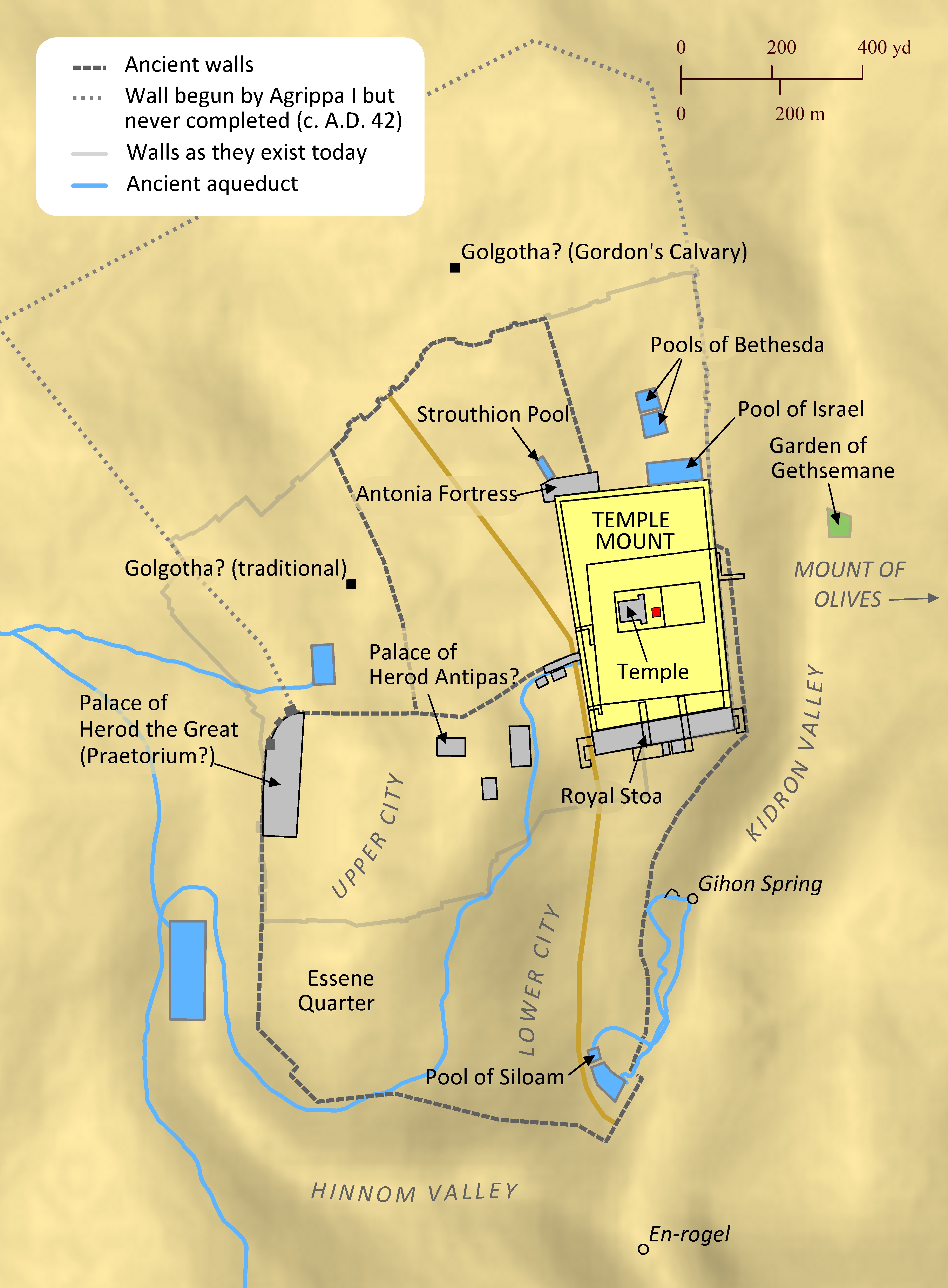
By the time of the New Testament, the ancient city of Jerusalem had been transformed from the relatively small fortress of David’s day (2 Samuel 5:6-10; 1 Chronicles 11:4-9) into a major city with a Temple that rivaled the greatest temples in the Roman world. Just prior to Jesus’ birth, Herod the Great completely renovated and expanded the Temple of the Lord, and he also built a lavish palace for himself, various pools (where Jesus occasionally performed healings), public buildings, and military citadels, including the Antonia Fortress, which overlooked the Temple. Wealthy residents, including the high priest, occupied extravagant houses in the Upper City, while the poorer residents were relegated to less desirable areas like the Lower City. The Essene Quarter was so named because many of its residents belonged to the Essenes, a strict religious sect that was known for its careful attention to the law of Moses. Across the Kidron Valley lay the Garden of Gethsemane, where Jesus often met with his disciples (Matthew 26:36-46; Mark 14:32-53; John 18:1-14). Further east was the Mount of Olives, where Jesus began his triumphal entry one week before his crucifixion (Matthew 21:1-11; Mark 11:1-11; Luke 19:28-40; John 12:12-19), taught his disciples about the last days (Matthew 24-25; Mark 13), and eventually ascended to heaven after his resurrection (Luke 24:50-53; Acts 1:1-11).
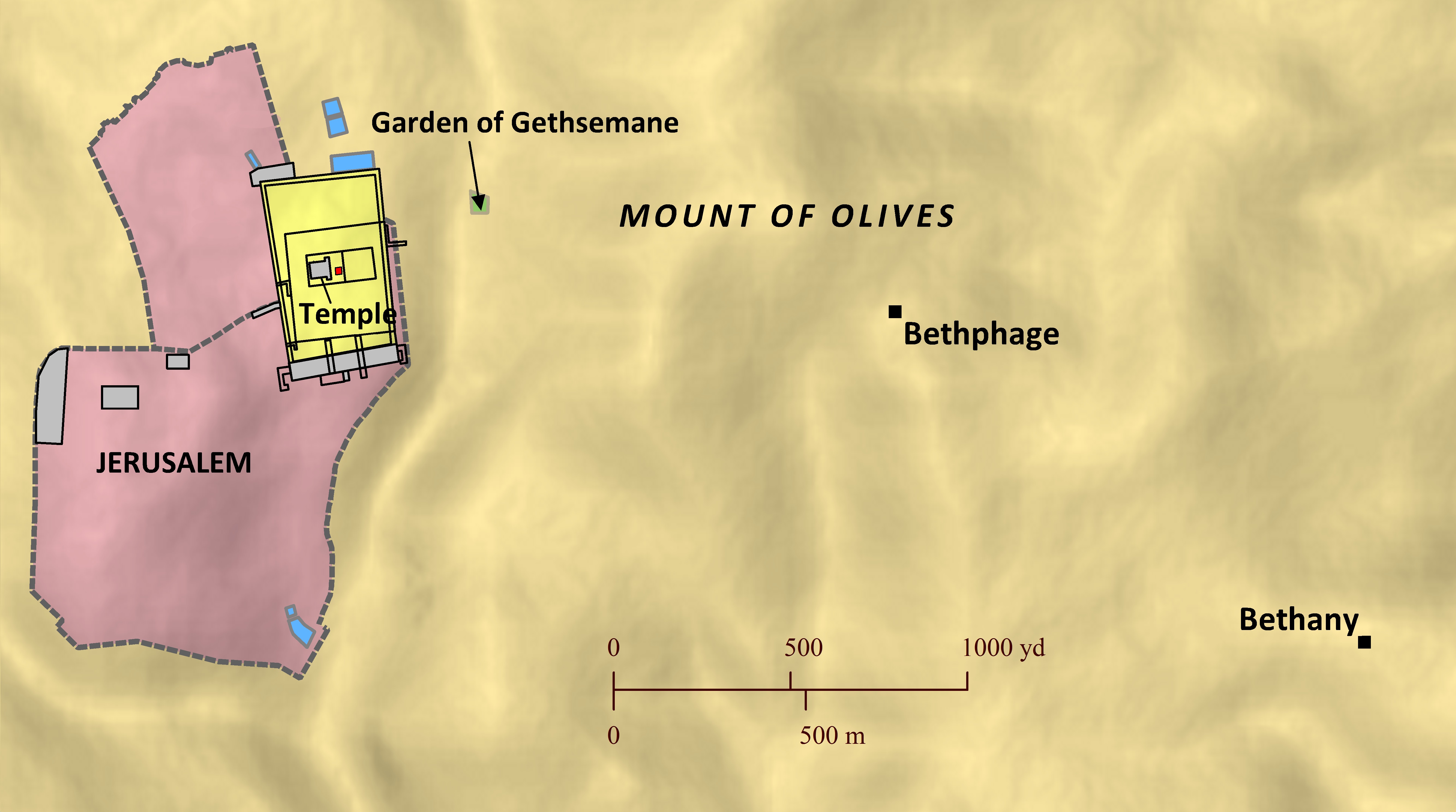
Matthew 21:1-17; Mark 11:1-11; Luke 19:28-48; John 12:1-19; see also Matthew 26:6-13; Mark 14:3-9
At the start of Passover one week before he was crucified, Jesus and his disciples traveled to Jerusalem, approaching the city from the east. When they arrived at the village of Bethphage, Jesus mounted a donkey and rode down the Mount of Olives as a humble king entering his capital city. Along the way, many people laid branches and cloaks in his path to welcome him. After Jesus entered the city, he immediately went up to the Temple and drove out the moneychangers and merchants there, and he healed the blind and the lame. Then he traveled nearly two miles outside the city to the village of Bethany to spend the night, which appears to have been where he typically lodged each night while visiting Jerusalem during the crowded Passover festival. Bethany is also where Jesus’ close friends Mary, Martha, and Lazarus lived. One evening while Jesus was there at a large dinner party given in his honor, Martha served the food, and Mary poured expensive perfume on Jesus’ feet and wiped his feet with her hair.
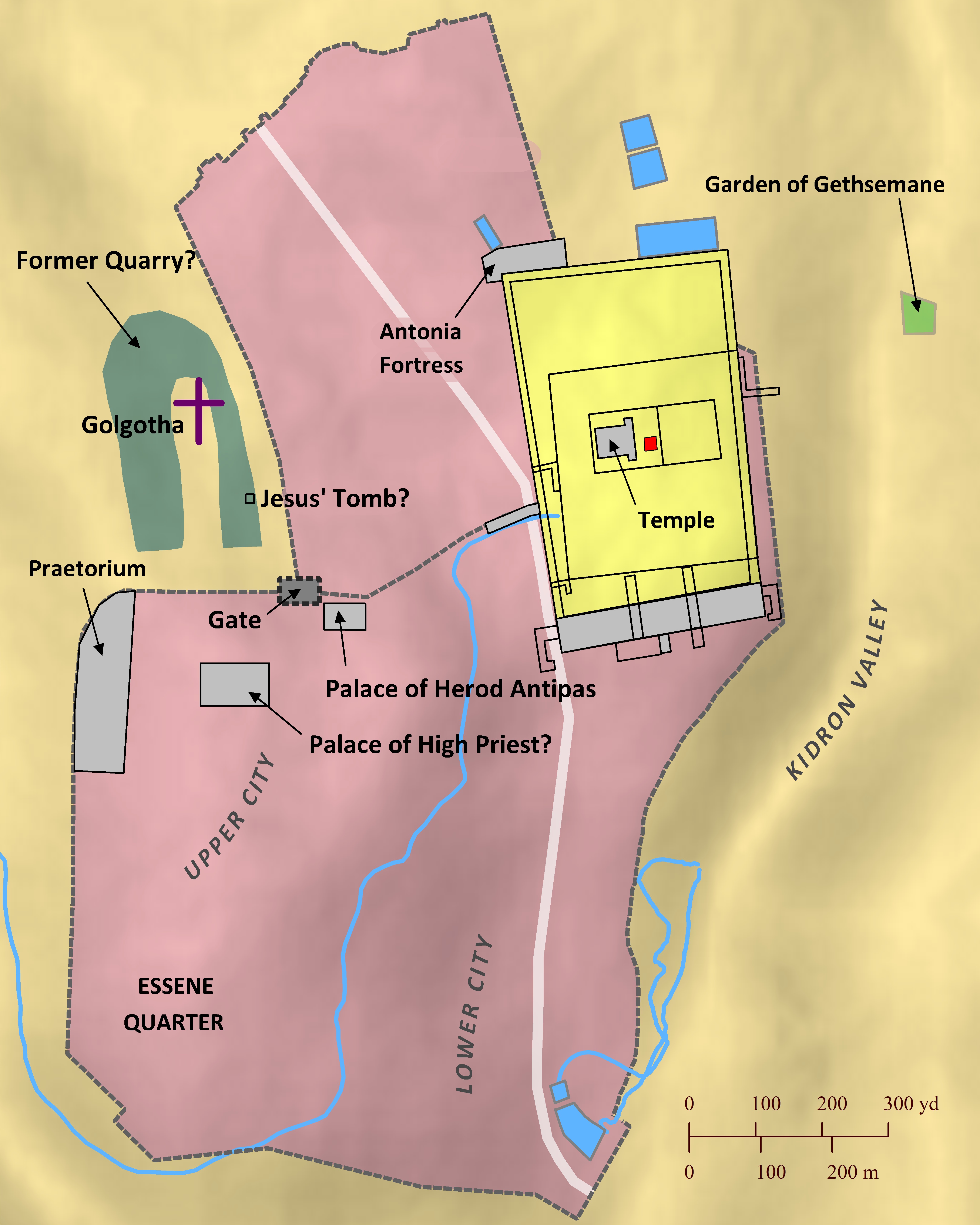
Matthew 26-27; Mark 14-15; Luke 22-23; John 13-19
On the Thursday before he was crucified, Jesus had arranged to share the Passover meal with his disciples in an upper room, traditionally thought to be located in the Essene Quarter of Jerusalem. After they finished the meal, they went to the Garden of Gethsemane, where Jesus often met with his disciples. There Judas Iscariot, one of Jesus’ own disciples, betrayed him to soldiers sent from the High Priest, and they took Jesus to the High Priest’s residence. In the morning the leading priests and teachers of the law put Jesus on trial and found him guilty of blasphemy. The council sent Jesus to stand trial for treason before the Roman governor Pontius Pilate, who resided at the Praetorium while in Jerusalem. The Praetorium was likely located at the former residence of Herod the Great, who had died over 30 years earlier. When Pilate learned that Jesus was from Galilee, he sent him to Herod Antipas, who had jurisdiction over Galilee. But when Jesus gave no answer to Herod’s many questions, Herod and his soldiers sent him back to Pilate, who conceded to the people’s demands that Jesus be crucified. Jesus was forced to carry his cross out of the city gate to Golgotha, meaning Skull Hill, referring to what may have been a small unquarried hill in the middle of an old quarry just outside the gate. After Jesus was unable to carry his cross any further, a man named Simon from Cyrene was forced to carry it for him. There at Golgotha they crucified Jesus. After Jesus died, his body was hurriedly taken down before nightfall and placed in a newly cut, rock tomb owned by Joseph of Arimathea, a member of the Jewish high council. This tomb was likely located at the perimeter of the old quarry.
OET MAT Intro C1 C2 C3 C4 C5 C6 C7 C8 C9 C10 C11 C12 C13 C14 C15 C16 C17 C18 C19 C20 C21 C22 C23 C24 C25 C27 C28