
OET INT FRT GEN EXO LEV NUM DEUT JOB YEHO (JOS) HERO (JDG) RUTH 1 SAM 2 SAM PSA AMOS HOS 1 KI 2 KI 1 CHR 2 CHR PROV ECC SNG YOEL (JOEL) MIC ISA ZEP HAB YIR (JER) LAM YNA (JNA) NAH OBAD DAN EZEK EZRA EST NEH HAG ZEC MAL 2 PS WIS TOB MAN BAR G DAN G ESD L ESD ESG JDT 3 MAC SIR 1 MAC 2 MAC 4 MAC YHN (JHN) MARK MAT LUKE ACTs YAC (JAM) GAL 1 TH 2 TH 1 COR 2 COR ROM COL LAOD PHM EPH PHP 1 TIM TIT 1 PET 2 PET 2 TIM HEB YUD (JUD) 1 YHN (1 JHN) 2 YHN (2 JHN) 3 YHN (3 JHN) REV
OET MAT Intro C1 C2 C3 C4 C5 C6 C7 C8 C9 C10 C11 C12 C13 C14 C15 C16 C17 C18 C19 C20 C21 C22 C23 C24 C25 C26 C28
OET MAT 27 V1 V4 V7 V10 V13 V16 V19 V22 V25 V28 V31 V34 V37 V40 V43 V46 V49 V52 V55 V58 V61 V64
This is still an early look into the drafted text of the Open English Translation of the Bible. Please double-check the text in advance before using in public.
3 When Yehudah (Judas; Grk. Yudas), (the one who had turned him in) saw that he was being sentenced to death, he regretted his actions and returned the payment to the chief priests and elders 4 saying, “I’ve sinned and turned in an innocent man.”
“What’s that got to do with us?” they asked. “You sort out your own problems.”
5 Then Yehudah threw the money down on the temple floor and went off and hanged himself.
6 The chief priests took the money and decided, “We can’t legally deposit the money to the temple treasury because it’s blood money.” 7 They got advice and decided to buy the potter’s field that was for sale to make it a cemetery for people from out of town, 8 so that place got called ‘The field of blood’[ref] until today.
9 And so the message which had been written by the prophet Yirmiyah (Jeremiah) was fulfilled, ‘They took the thirty silver coins, the price of the one who was sold, the price set by the Israelis, 10 and they gave the coins for the potter’s field, as Yahweh directed me.’[ref]
11 Meanwhile Yeshua (Jesus; Grk. Yesus) was stood in front of the governor and the governor asked him, “Are you the king of the Yehudim (Jews)?”
“You said it,”, responded Yeshua, 12 but when he chief priests and the elders brought their accusations against him, he didn’t say anything.
13 Then Pilatos (Pilate) asked him, “Can’t you hear all the evidence against you that they’re listing?”
14 But he didn’t respond, not even a single word, and this greatly surprised the governor.
15 It was the time of the Passover celebrations, and a tradition had been established that the governor would release one prisoner to the people—whoever they chose. 16 At that time, there was a well-known prisoner named Bar-Aba (Grk. Barabbas), 17 so when all the people had gathered, Pilatos (Pilate) shouted down to them, “Who would you all like me to release: Bar-Aba or Yeshua (Jesus; Grk. Yesus) who’s also being called the messiah?” 18 He said this because he knew that Yeshua had been arrested because of the jealousy of the Jewish leaders.
19 But while Pilatos was still making his judgement, his wife sent a note to him, saying, “Don’t touch that guiltless man because I was very distressed by a dream I had about him.”
20 Meanwhile the chief priests and the elders persuaded the crowds to request that Bar-Aba be released and that Yeshua should be sentenced, 21 so when the governor asked them, “Which of these two men should I release?” they called back, “Bar-Aba.”
22 “So what should I do to Yeshua who’s called the messiah?” Pilatos asked.
“Execute him on a stake!” they all responded.
23 “But what crime has he done?” demanded Pilatos.
But they just kept yelling loudly, “Execute him on a stake.”
24 When Pilatos saw that it was going nowhere other than to turn into a riot, got a bowl of water and washed his hands up there in front of the crowd,[ref] announcing, “I’m innocent of the blood of this man who has done nothing wrong. It’s your responsibility now.”
25 ⇔“The responsibility for his blood will be on us and on our children,” the people shouted back.
26 Then Pilatos commanded that Bar-Aba (Grk. Barabbas) be released. He commanded that Yeshua (Jesus; Grk. Yesus) be flogged and then he handed him over to be executed.
27 The governor’s soldiers took Yeshua (Jesus; Grk. Yesus) to the courtyard of his residence and called together all the soldiers in the unit. 28 Then they stripped Yeshua and placed a royal scarlet robe around him. 29 They twisted together a crown made of strips of thorns and plonked it on his head and made him hold a reed as a staff. Then they knelt down in front of him and mocked him, saying, “Greetings, your majesty, King of the Yehudim (Jews).” 30 They spat on him then snatched the reed away and used it to whack him on the head. 31 When they’d finished mocking him, they took the robe off him and dressed him in his own clothes again before they led him away to the place where he’d be executed.
32 When they got out onto the street, they grabbed a man who turned out to be Shim’on (Simon) from Kurainai (Cyrene), and they forced him to carry the stake. 33 When they arrived at the place called Golgotha (which means ‘Place of the skull’), 34 they gave Yeshua (Jesus; Grk. Yesus) some wine mixed with something bitter,[ref] but when he tasted it, he didn’t want to drink any.
35 Then they executed him on the stake and divided his clothes out by throwing dice[ref] 36 as they sat there guarding him. 37 They put a sign above his head that said, ‘This is Yeshua, the king of the Yehudim (Jews).’ 38 Two robbers were also executed on stakes—one on his right and one on his left.[fn]
39 Many of the people passing by bad-mouthed him, shaking their heads[ref] 40 and saying, “Ha, you reckoned you could demolish the temple and rebuild it in three days[ref] so save yourself now—if you’re really God’s son, just step down off that stake.”
41 Similarly, the chief priests and the religious teachers and the elders mocked him saying, 42 “Ha, he saved others but he can’t even save himself. If he’s Yisrael’s (Israel) king, let him come down now from the stake and then we’ll believe in him. 43 He put his trust in God, so let God rescue him now if he wants him,[ref] because he did claim to be God’s son.”
44 Even the robbers who were being executed beside him derided him.
27:38 https://www.billmounce.com/monday-with-mounce/when-then-then-mt-27-38
45 Around noon, the whole country became dark for three hours 46 and then around 3pm, Yeshua (Jesus; Grk. Yesus) shouted with a loud voice, “My god, my god, why have you abandoned me?”[ref]
47 Some of the people standing there heard him and thought that he was calling Eliyah (Elijah)[fn] 48 One of them ran and got a sponge and dipped it in wine vinegar, and then wrapped it around a reed and held it up to his mouth to drink from.[ref]
49 But the others were saying, “Just leave him and we’ll see whether Eliyah comes to save him.”
50 Then Yeshua made a loud cry and sent his spirit away.
51 Then, wow, the curtain inside the temple was torn apart from the top to the bottom,[ref] and there was an earthquake and splitting of rocks. 52 Some tombs came open and many bodies of godly people came alive again 53 and leaving the tombs after his resurrection, they went into God’s city where many people saw them.
54 The Romaios officer and his soldiers who were guarding Yeshua were very frightened when they felt the earthquake and saw what happened, and said, “This man really was a son of God!”
55 There were many women watching all this from a distance—they were those who from Galil who had followed Yeshua and looked after him,[ref] 56 including Miryam (Grk. Maria/Mariam) from Magdala, Miryam the mother of Ya’akov (James; Grk. Yakobos) and Yosef (Joseph), and Zavday’s (Grk. Zebedaios) wife—the mother of Ya’akov and Yohan (John; Grk. Yoannes).
27:47 The original words for ‘My god’ sound a bit similar to the word for ‘Eliyah’.
57 As it moved into evening, a wealthy man named Yosef (Joseph) from Arimathaia came—he’d also been one of Yeshua’s (Jesus; Grk. Yesus) apprentices. 58 He went to Pilatos (Pilate) and requested Yeshua’s body, and Pilatos commanded the soldiers to release it. 59 Yosef took the body and wrapped it in clean, linen cloth 60 and put it in his own tomb which had been newly carved into the rock. Then he rolled a big stone into the door of the tomb and left it. 61 Miryam (Grk. Maria/Mariam) from Magdala and the other Miryam sat there in front of the tomb.
62 The next day was the day after the Passover preparation day and the chief priests and the Farisaios went together to Pilatos (Pilate) 63 and told him, “Master, we were reminded that that deceiver when he was still alive said that he would come back to life after three days[ref] 64 so you should command that the tomb be secured until the third day in case someone steals his body and then tells the people that he has come alive again—that would be a worse deception than his initial teachings.”
65 “Well you all guard it,” answered Pilatos, “and keep it secure as you say.”
66 So they went and secured the tomb by sealing it and placing guards there.

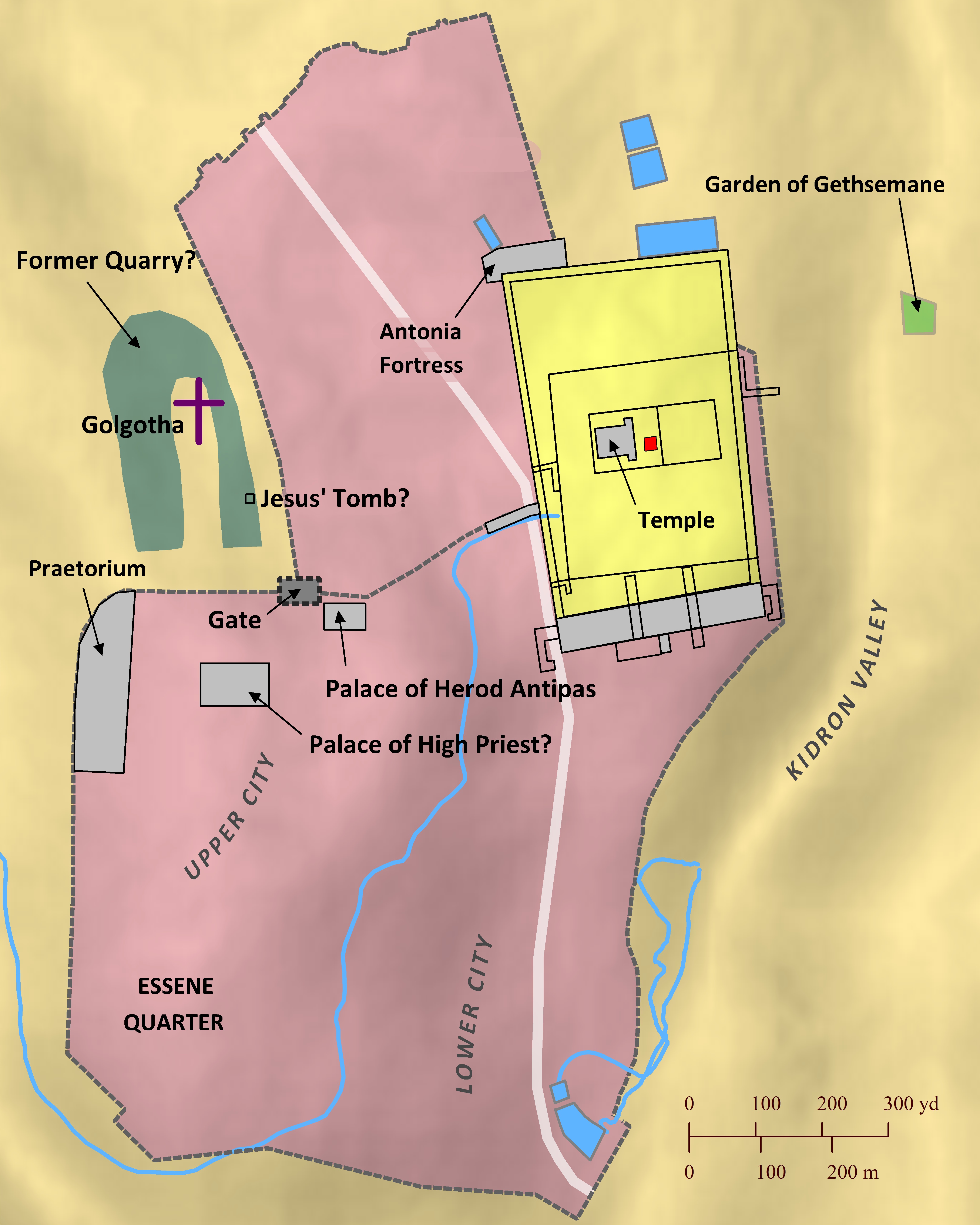
Matthew 26-27; Mark 14-15; Luke 22-23; John 13-19
On the Thursday before he was crucified, Jesus had arranged to share the Passover meal with his disciples in an upper room, traditionally thought to be located in the Essene Quarter of Jerusalem. After they finished the meal, they went to the Garden of Gethsemane, where Jesus often met with his disciples. There Judas Iscariot, one of Jesus’ own disciples, betrayed him to soldiers sent from the High Priest, and they took Jesus to the High Priest’s residence. In the morning the leading priests and teachers of the law put Jesus on trial and found him guilty of blasphemy. The council sent Jesus to stand trial for treason before the Roman governor Pontius Pilate, who resided at the Praetorium while in Jerusalem. The Praetorium was likely located at the former residence of Herod the Great, who had died over 30 years earlier. When Pilate learned that Jesus was from Galilee, he sent him to Herod Antipas, who had jurisdiction over Galilee. But when Jesus gave no answer to Herod’s many questions, Herod and his soldiers sent him back to Pilate, who conceded to the people’s demands that Jesus be crucified. Jesus was forced to carry his cross out of the city gate to Golgotha, meaning Skull Hill, referring to what may have been a small unquarried hill in the middle of an old quarry just outside the gate. After Jesus was unable to carry his cross any further, a man named Simon from Cyrene was forced to carry it for him. There at Golgotha they crucified Jesus. After Jesus died, his body was hurriedly taken down before nightfall and placed in a newly cut, rock tomb owned by Joseph of Arimathea, a member of the Jewish high council. This tomb was likely located at the perimeter of the old quarry.
OET MAT Intro C1 C2 C3 C4 C5 C6 C7 C8 C9 C10 C11 C12 C13 C14 C15 C16 C17 C18 C19 C20 C21 C22 C23 C24 C25 C26 C28