
OET INT FRT GEN EXO LEV NUM DEUT JOB YEHO (JOS) HERO (JDG) RUTH 1 SAM 2 SAM PSA AMOS HOS 1 KI 2 KI 1 CHR 2 CHR PROV ECC SNG YOEL (JOEL) MIC ISA ZEP HAB YIR (JER) LAM YNA (JNA) NAH OBAD DAN EZEK EZRA EST NEH HAG ZEC MAL 2 PS WIS TOB MAN BAR G DAN G ESD L ESD ESG JDT 3 MAC SIR 1 MAC 2 MAC 4 MAC YHN (JHN) MARK MAT LUKE ACTs YAC (JAM) GAL 1 TH 2 TH 1 COR 2 COR ROM COL LAOD PHM EPH PHP 1 TIM TIT 1 PET 2 PET 2 TIM HEB YUD (JUD) 1 YHN (1 JHN) 2 YHN (2 JHN) 3 YHN (3 JHN) REV
OET MAT Intro C1 C2 C3 C4 C5 C6 C7 C8 C9 C10 C11 C12 C13 C14 C15 C16 C17 C18 C19 C20 C21 C22 C23 C25 C26 C27 C28
OET MAT 24 V1 V3 V5 V7 V9 V11 V13 V15 V17 V19 V21 V23 V25 V27 V29 V31 V33 V35 V37 V39 V41 V43 V45 V47 V49 V51
This is still an early look into the drafted text of the Open English Translation of the Bible. Please double-check the text in advance before using in public.
3 When Yeshua (Jesus; Grk. Yesus) was sitting on the Mt. of Olives, his apprentices came up to him by themselves, asking, “Tell us when all those things will happen, and what the signs will be of your arrival and of the end of this age.”
4 ⇔“Watch out in case other people mislead you,” Yeshua answered, 5 “because many will come claiming to be me, saying that they’re the messiah, and misleading many people. 6 You’ll observe wars and hear reports about wars further away. Don’t be alarmed, but keep watching, because these things need to happen, although that’s not yet the end. 7 People groups will turn against each other, and countries rise up against one another, and there’ll be famines and earthquakes. 8 But all of those things are just like the beginning of labour pains.
9 “Then they’ll hand you apprentices over for persecution, and some of you will be killed. All the people groups will hate you because of my name.[ref] 10 They’ll cause many people to stumble and hand each other over and hate each other. 11 Also, many false prophets will appear, and they’ll mislead many people, 12 and as a result, lawlessness will increase, and many people’s love will cool off, 13 but anyone who lasts until the end will be rescued.[ref] 14 This good message about God’s kingdom will be proclaimed right around the world as a witness statement to all the people groups, and then the end will come.
15 “So when you apprentices see the irreverent object that the prophet Daniyel wrote about being placed in the holy place[ref] (anyone reading this should try to understand it), 16 those in Yehudah (Judea) should flee to the hills, 17 anyone outside on the flat roof shouldn’t go back inside to get things out of the house,[ref] 18 and anyone in the field shouldn’t go back to the house to get their coat. 19 It’ll be very difficult for pregnant women and breast-feeding mothers in those days, 20 and you should pray that your escape won’t be in winter or on a rest day. 21 This will be followed by incredible troubles like nothing that’s ever happened in this world, from creation until the present time, and which will never happen again[ref]— 22 in fact, if those days weren’t shortened, nobody would survive. However, because of the chosen people, those days will be shortened.
23 “At that time, if anyone says, ‘Look, here’s the messiah’ or ‘Here he is’, don’t believe it, 24 because false messiahs and false prophets will emerge, and they’ll do amazing miracles that would, if possible, mislead even the chosen people. 25 Listen, I’m telling you apprentices before it happens.
26 “So if they tell you apprentices, ‘Look, he’s out in the wilderness,’ don’t go out there, or if they say, ‘He’s here in these private rooms,’ don’t believe it,[ref] 27 because when the son of humanity comes, it’ll be like how the lightning goes right across the sky from one side to the other.
28 “Wherever there’s something dead, that’s where the vultures will gather.[ref]
29 “But immediately after that troubling time, the sun will go dark[ref] and the moon won’t shine.[ref] The stars will fall from the sky, and the heavenly powers will be shaken.[ref] 30 And then a miracle will appear in the sky as the son of humanity arrives. All of the world’s people groups will be in turmoil, and they’ll see the son of humanity arriving on the clouds in the sky with power and massive splendour.[ref] 31 There’ll be a trumpet blast as he sends out his messengers to bring together all his chosen people from every part of the earth—from one pole to the other.
24:32 Watch the fig tree
32 “So learn the parable about the fig tree: whenever its branches green up and leaves start to sprout out, you know that summer is coming. 33 In the same way, when you see all those things happening, you’ll know then that the end of this age is very close. 34 I can assure you that that generation won’t pass away until all of those things happen. 35 The sky and the earth will pass away, but my messages will certainly not pass away.
24:36 The day of his return isn’t known
(Mark 13:32-37; Luke 17:26-30; 34-36)
36 “No one knows the exact day or time—not even the messengers in the heavens, or even the son—only the father knows it. 37 The son of humanity’s arrival will be just like it was in Noah’s time.[ref] 38 In the days leading up to the flood, people were eating and drinking, and marrying and getting engaged—right until the very day that Noah got into the barge. 39 They didn’t realise that something was coming until the flood came and took everything away.[ref] It’ll be just like that when the son of humanity comes. 40 Two people will be working out on the farm—one will be taken and one left behind. 41 Two people will be grinding grain—one will be taken and one left behind. 42 So keep watching, because none of you know exactly when your master will return. 43 But you do know that if a home-owner knew when a thief was going to come, he’d be there watching, and not allow the thief to break into the house.[ref] 44 Because of that, you apprentices should also get ready, because otherwise you won’t realise when the son of humanity is coming.
45 “As a result, we’ll see who the faithful and watchful slave is—the one who the master appointed to run all of his household affairs. 46 That slave will be rewarded if the master finds him working faithfully when he arrives suddenly. 47 I can assure you that he’ll appoint the slave to supervise everything that he possesses. 48 But if the evil slave says to himself, ‘Ah, the master won’t be back for a long time yet,’ 49 and starts beating his fellow slaves, and spends time eating and drinking with drunks, 50 then his master will arrive when he’s not expecting it 51 and will torture him and send him off with the hypocrites to where there’ll be crying and a lot of anguish.

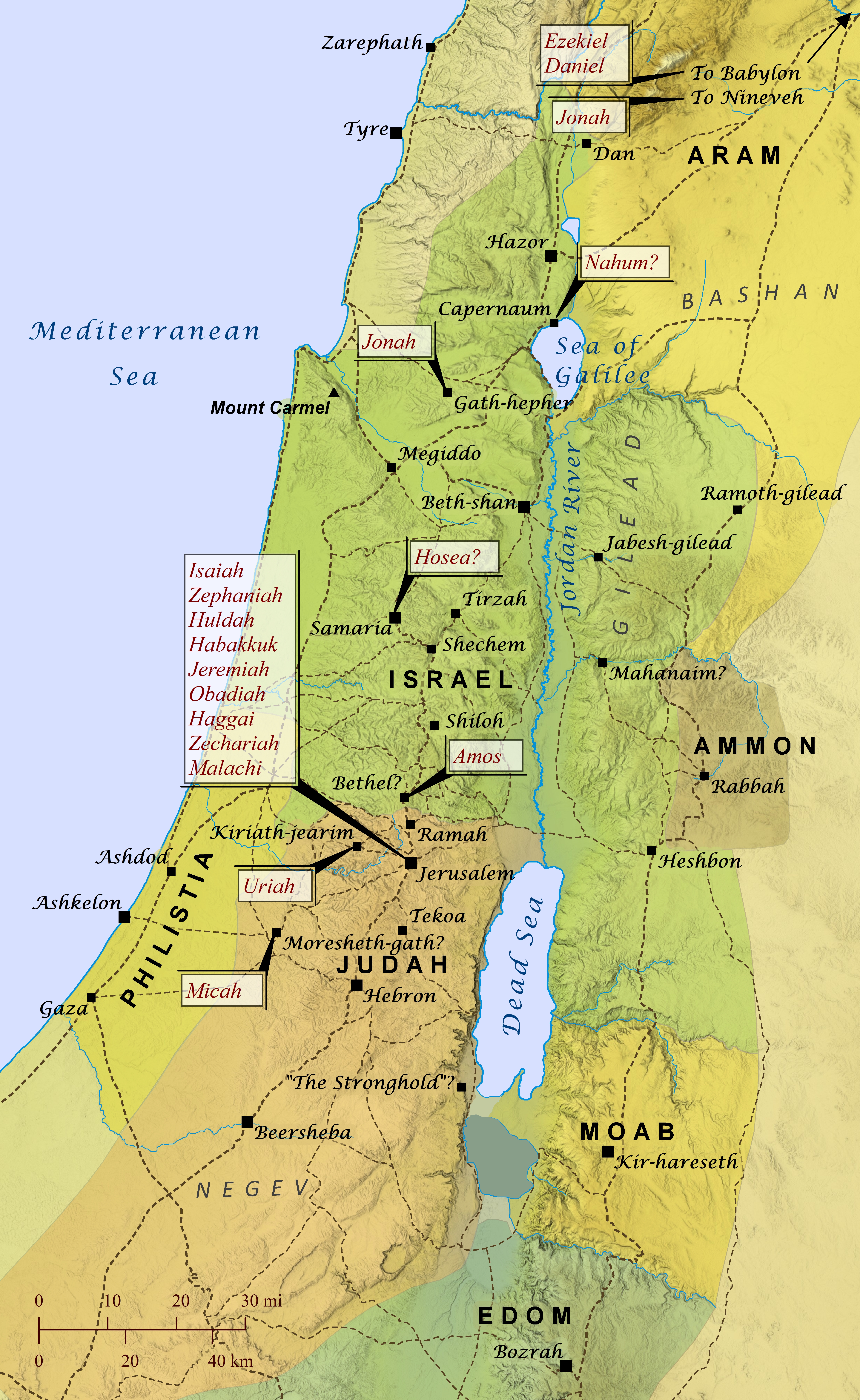
If you ask someone today what biblical prophets did, they will likely tell you that they divinely foretold of future events. While this was often the case, most prophets in the Bible focused as much on “forthtelling” God’s messages as they did on “foretelling” the future. That is, their primary role was to simply “forthtell” divinely acquired messages to leaders and groups of people, and at times that included foretelling of coming judgment, blessing, rescue, etc. Also, though plenty of prophets (sometimes called “seers” in Scripture) often spoke in confrontational or eccentric language that put them at odds with kings and religious leaders, the biblical writers also applied the term prophet to people who communicated God’s messages in ways that many readers today might not think of as prophecy, such as worship leaders appointed by David to “prophesy with lyres, harps, and cymbals” (1 Chronicles 25:1). Similarly, the books of Joshua, Judges, 1 & 2 Samuel, and 1 & 2 Kings are typically categorized as history by Christians, but in the Hebrew canon they belong to the category of Former Prophets. The Lord raised up prophets throughout all of biblical history, from the giving of the law under Moses to the revelation of the last days by the apostle John, and the kings of Israel and Judah often recognized and supported specific people as official prophets of the royal court and consulted them to find out God’s perspective about official matters. Following is a list of nearly everyone designated as prophet or seer in the Old Testament and the primary area of their ministry.
• Zechariah (796 B.C.) [2 Chronicles 24:20] => Jerusalem
• Jonah (780 B.C.) [2 Kings 14:25; Jonah 1:1] => Gath-hepher, Nineveh
• Hosea (770 B.C.) [Hosea 1:1] => Samaria?
• Amos (760 B.C.) [Amos 1:1] => Bethel
• Isaiah (730 B.C.) [2 Kings 19:2; 20:1; 2 Chronicles 26:22; 32:20, 32; Isaiah 1:1] => Jerusalem
• Micah (730 B.C.) [Jeremiah 26:18; Micah 1:1] => Moresheth
• Nahum (650 B.C.) [Nahum 1:1] => Elkosh (Capernaum?)
• Zephaniah (630 B.C.) [Zephaniah 1:1] => Jerusalem?
• Huldah (630 B.C.) [2 Kings 22:14] => Jerusalem
• Habakkuk (600 B.C.) [Habakkuk 1:1; 3:1] => Jerusalem?
• Ezekiel (592 B.C.) [Ezekiel 1:3] => Babylonia/Chebar River
• Uriah (600 B.C.) [Jeremiah 26:20] => Kiriath-jearim
• Jeremiah (587 B.C.) [2 Chronicles 36:12; Jeremiah 1:1; 19:14] => Jerusalem
• Obadiah (586 B.C.) [Obadiah 1:1] => Jerusalem
• Daniel (560 B.C.) [Daniel 7:1; Matthew 24:15] => Babylon
• Haggai (520 B.C.) [Ezra 5:1; Haggai 1:1] => Jerusalem
• Zechariah (520 B.C.) [Ezra 5:1; Zechariah 1:1] => Jerusalem
• Malachi (432 B.C.) [Malachi 1:1] => Jerusalem?
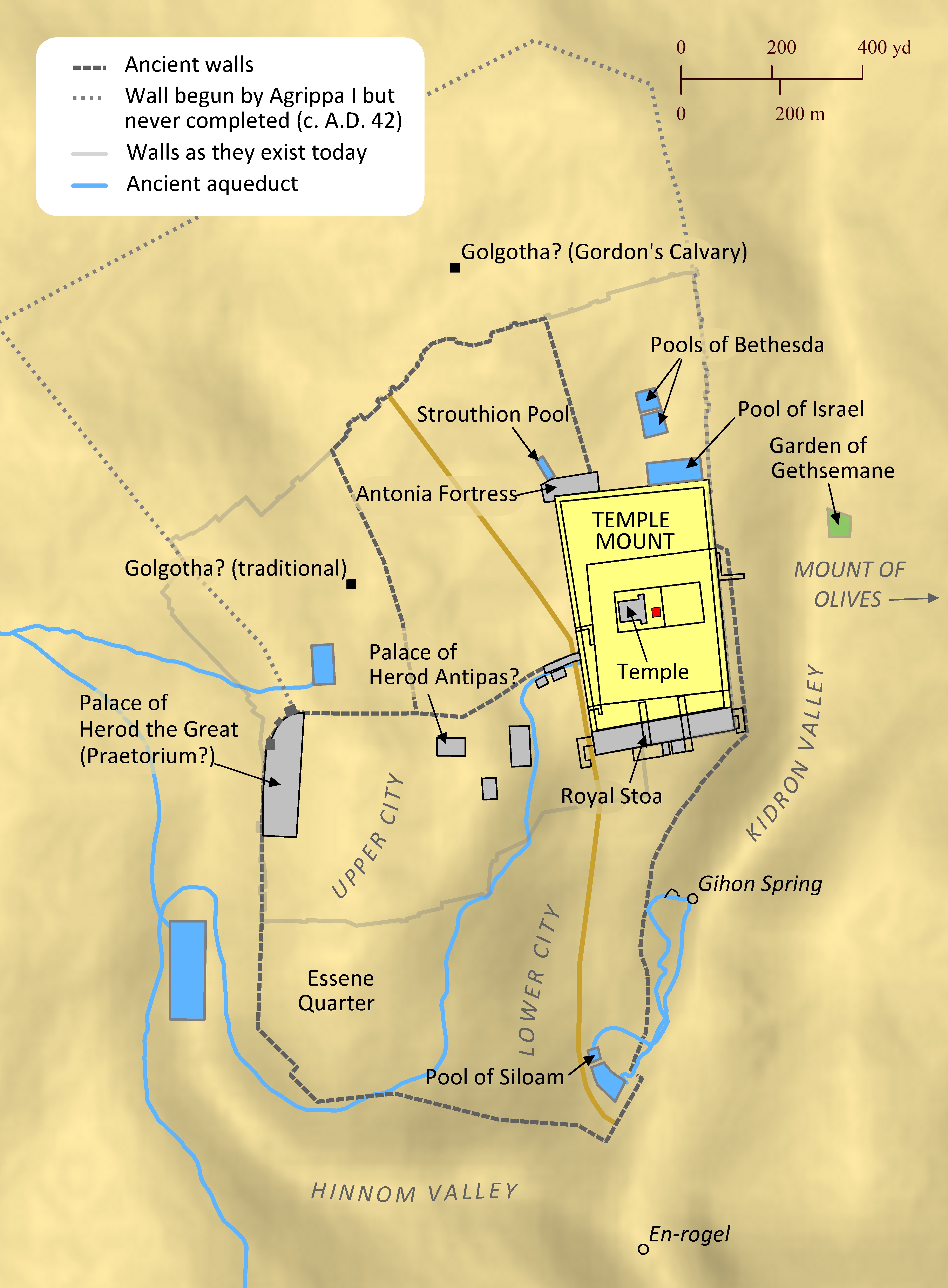
By the time of the New Testament, the ancient city of Jerusalem had been transformed from the relatively small fortress of David’s day (2 Samuel 5:6-10; 1 Chronicles 11:4-9) into a major city with a Temple that rivaled the greatest temples in the Roman world. Just prior to Jesus’ birth, Herod the Great completely renovated and expanded the Temple of the Lord, and he also built a lavish palace for himself, various pools (where Jesus occasionally performed healings), public buildings, and military citadels, including the Antonia Fortress, which overlooked the Temple. Wealthy residents, including the high priest, occupied extravagant houses in the Upper City, while the poorer residents were relegated to less desirable areas like the Lower City. The Essene Quarter was so named because many of its residents belonged to the Essenes, a strict religious sect that was known for its careful attention to the law of Moses. Across the Kidron Valley lay the Garden of Gethsemane, where Jesus often met with his disciples (Matthew 26:36-46; Mark 14:32-53; John 18:1-14). Further east was the Mount of Olives, where Jesus began his triumphal entry one week before his crucifixion (Matthew 21:1-11; Mark 11:1-11; Luke 19:28-40; John 12:12-19), taught his disciples about the last days (Matthew 24-25; Mark 13), and eventually ascended to heaven after his resurrection (Luke 24:50-53; Acts 1:1-11).
OET MAT Intro C1 C2 C3 C4 C5 C6 C7 C8 C9 C10 C11 C12 C13 C14 C15 C16 C17 C18 C19 C20 C21 C22 C23 C25 C26 C27 C28