
OET OET-RV OET-LV GHT ULT UST BSB MSB BLB AICNT OEB WEBBE WMBB NET LSV FBV TCNT T4T LEB BBE Moff JPS Wymth ASV DRA YLT Drby RV SLT Wbstr KJB-1769 KJB-1611 Bshps Gnva Cvdl TNT Wycl SR-GNT UHB BrLXX BrTr Related Parallel Simple Interlinear Topics Reference Dictionary Search
OET By Document By Section By Chapter Details
OET INT FRT GEN EXO LEV NUM DEU JOB JOS JDG RUTH 1 SAM 2 SAM PSA AMOS HOS 1 KI 2 KI 1 CHR 2 CHR PROV ECC SNG JOEL MIC ISA ZEP HAB JER LAM YNA (JNA) NAH OBA DAN EZE EZRA EST NEH HAG ZEC MAL GES LES ESG DNG 2 PS TOB JDT WIS SIR BAR MAN 1 MAC 2 MAC 3 MAC 4 MAC YHN (JHN) MARK MAT LUKE ACTs YAC (JAM) GAL 1 TH 2 TH 1 COR 2 COR ROM COL PHM EPH PHP 1 TIM TIT 1 PET 2 PET 2 TIM HEB YUD (JUD) 1 YHN (1 JHN) 2 YHN (2 JHN) 3 YHN (3 JHN) REV
ACTs Intro C1 C2 C3 C4 C5 C6 C7 C8 C9 C10 C11 C12 C13 C14 C15 C16 C17 C18 C19 C20 C21 C22 C23 C24 C25 C26 C27 C28
This is still an early look into the drafted text of the Open English Translation of the Bible. Please double-check the text in advance before using in public.
28:16 Paul preaches in Rome
16 When we got into Rome proper, Paul was allowed to live by himself, with just a soldier guarding him.
17 After three days, he called together the leaders of the Jews in Rome, and when they’d all gathered he spoke to them, “Men, brothers, I have done nothing against my people or against our ancestral customs. I was taken prisoner in Yerushalem and handed over to the Romans 18 who, after examining me, wanted to release me because I had done nothing worthy of execution. 19 But in defending myself against the Jews there, I felt compelled to appeal to Caesar, although I myself had no complaint against the Jews. 20 So that was why I called for you and wanted to address you, because I am in chains for the sake of Yisrael’s hope—the messiah.”
21 “We haven’t received any correspondence here about you,” they answered. “Nor have any of our brothers from Yerushalem arrived here to report any crimes of yours. 22 But we would very much like to hear from you about your thinking, because we’ve certainly heard about this new sect because everyone is speaking out against it.”
23 Then they set a day when they could visit him where he was staying and so that from morning to evening he could explain about God’s kingdom and show them how Mosheh’s law and the prophets’ writings spoke about Yeshua. 24 Afterwards some were persuaded while others didn’t find it believable. 25 They argued back and forth, and as they were about to leave, Paul shared this final message, “The holy spirit spoke rightly through Yeshayah the prophet to your ancestors, saying:
26 Go to these people and tell them,
When you listen you will hear but not understand,
and when you look you will see but not perceive it.
27 Because these people’s minds have become dull
and they can barely hear with their ears
just in case their eyes might actually see,
and their ears might actually hear,
and they might understand with their minds,
and then I would heal them.[ref]
28 So now let it be known to you all that the message of salvation from God has been sent out to non-Jews and they will listen.”
29 ◘ 30 Paul remained in his own rental accommodation in Rome for two whole years and welcomed everyone who went to see him, 31 telling them about God’s kingdom and boldly teaching about the master Yeshua without any hindrance.

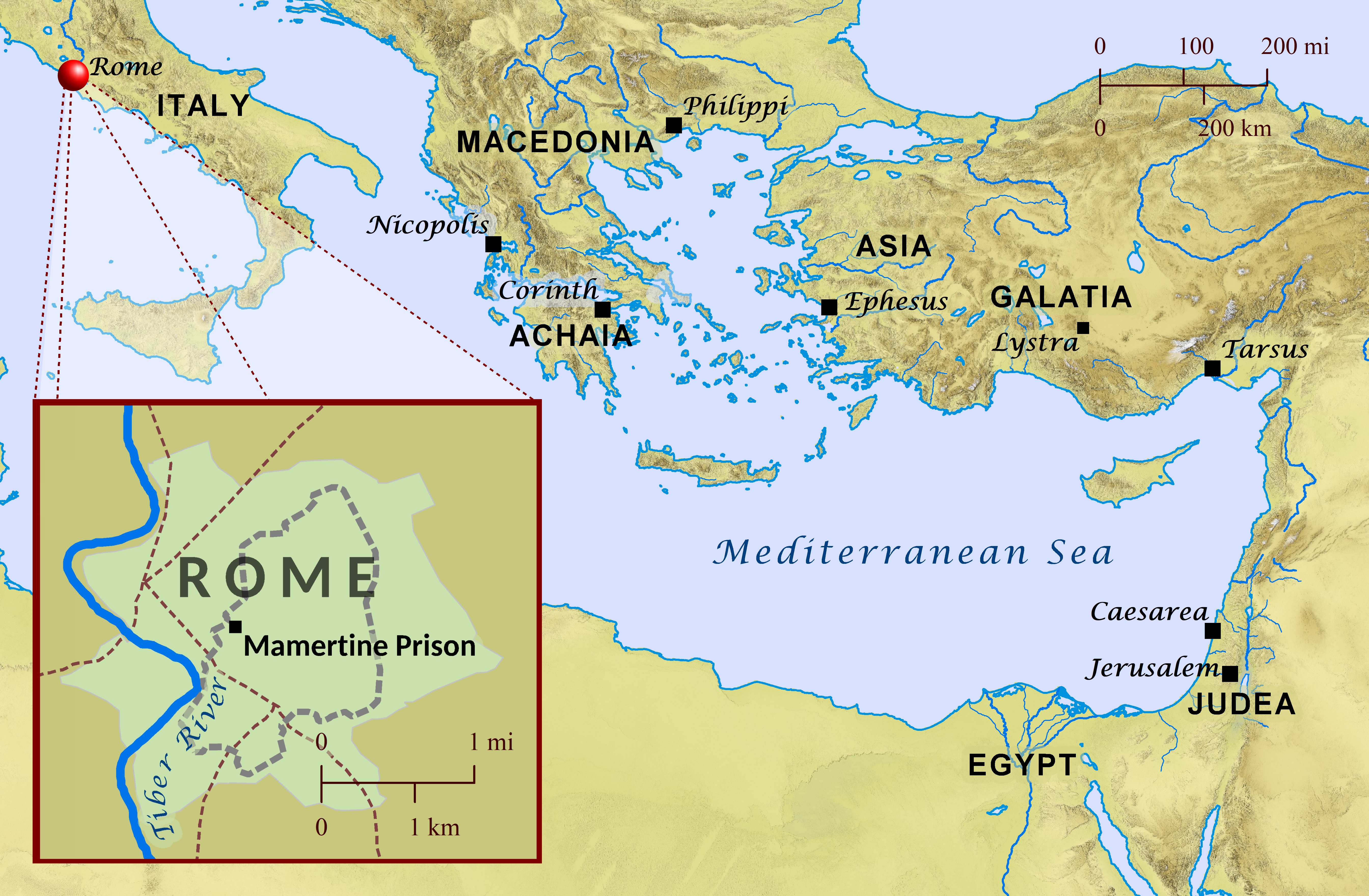
As the book of Acts attests, Paul was no stranger to imprisonment, and he catalogued his incarcerations among his many credentials of suffering that affirmed his legitimacy as an apostle to the Corinthians (2 Corinthians 6:4-5). The first mention of Paul being imprisoned is when he and Silas were arrested in Philippi after exorcising a spirit of divination from a slave girl (Acts 16). Paul’s actions angered the girl’s owners, since the men were no longer able to make money off of the girl’s fortune telling abilities. Later in his letter to the Corinthians, Paul notes that he had already suffered multiple imprisonments (2 Corinthians 11:23), making it clear that not all of Paul’s imprisonments and other sufferings were recorded in Scripture. The next imprisonment explicitly mentioned in Scripture is when Paul was arrested in the Temple in Jerusalem at the end of his third missionary journey (Acts 21:27-34). Soon after this Paul was sent to Caesarea on the Mediterranean coast, where he remained in prison for two years (Acts 23-26; see “Paul Is Transferred to Caesarea” map). This may be where Paul penned the letters commonly known as the Prison Epistles (Ephesians, Philippians, Colossians, and Philemon). At the end of this time Paul appealed his case to Caesar and was sent to Rome, where he spent another two years under house arrest awaiting his trial before Caesar (Acts 28:16-31). If Paul did not write his Prison Epistles while he was at Caesarea, then it is likely that he wrote them from Rome during this time. The next time we hear of Paul being imprisoned is likely several years later in his second letter to Timothy (2 Timothy 1:8-17; 2:9; 4:9-21). Though it is not certain, the tone of Paul’s writing during this time of imprisonment, which seems markedly more somber than the optimistic outlook he seems to have about his incarceration during the writing of the Prison Epistles (e.g., Philippians 1:21-26; Philemon 1:22), suggests that this incarceration was not the same as his house arrest. If so, then it is possible that between his first and second incarcerations in Rome Paul fulfilled his intention to travel to Spain to continue spreading the gospel (Romans 15:22-28). Just prior to his second incarceration in Rome, Paul had informed Titus that he planned to spend the winter in Nicopolis northwest of Achaia and asked him to meet him there (Titus 3:12). Perhaps it was around this time or soon after that he was arrested once again and brought to Rome. Paul’s ultimate fate is not noted in Scripture, but tradition (Clement, Dionysius, Eusebius, and Tertullian) attests that this final imprisonment of Paul took place at what is now called Mamertine Prison. During Paul’s time this was the only prison in Rome and was called simply “the Prison,” and it was not typically used for long term incarceration but rather for holding those awaiting imminent execution. There, during the reign of Nero, Paul met his earthly death by the sword and was received into eternal life by his loving Savior, whom he had served so long.
ACTs Intro C1 C2 C3 C4 C5 C6 C7 C8 C9 C10 C11 C12 C13 C14 C15 C16 C17 C18 C19 C20 C21 C22 C23 C24 C25 C26 C27 C28