
OET OET-RV OET-LV GHT ULT UST BSB MSB BLB AICNT OEB WEBBE WMBB NET LSV FBV TCNT T4T LEB BBE Moff JPS Wymth ASV DRA YLT Drby RV SLT Wbstr KJB-1769 KJB-1611 Bshps Gnva Cvdl TNT Wycl SR-GNT UHB BrLXX BrTr Related Parallel Simple Interlinear Topics Reference Dictionary Search
OET By Document By Section By Chapter Details
OET INT FRT GEN EXO LEV NUM DEU JOB JOS JDG RUTH 1 SAM 2 SAM PSA AMOS HOS 1 KI 2 KI 1 CHR 2 CHR PROV ECC SNG JOEL MIC ISA ZEP HAB JER LAM YNA NAH OBA DAN EZE EZRA EST NEH HAG ZEC MAL GES LES ESG DNG 2 PS TOB JDT WIS SIR BAR MAN 1 MAC 2 MAC 3 MAC 4 MAC YHN MARK MAT LUKE ACTs YAC GAL 1 TH 2 TH 1 COR 2 COR ROM COL PHM EPH PHP 1 TIM TIT 1 PET 2 PET 2 TIM HEB YUD 1 YHN 2 YHN 3 YHN REV
EZRA Intro C1 C2 C3 C5 C6 C7 C8 C9 C10
This is still an early look into the drafted text of the Open English Translation of the Bible. Please double-check the text in advance before using in public.
4 Now the enemies of Yehudah and Benyamin heard that the Israelis who’d come back from exile were building a temple for Yisrael’s god Yahweh. 2 so they went to Zerubavel and to the other clan leaders and they said to them, “Let us help you with the building work, because like you, we worship your god and we’ve been sacrificing to him since the days of the Assyrian king Esar-Haddon—the one who sent us here.”[ref]
3 But Zerubavel, and Yeshua, and the rest of the Israelis clan leaders said to them, “It’s not for you and for us to build a house for our god, but we ourselves together will build for Yisrael’s god Yahweh, just as the Persian King Koresh (Cyrus) has commanded us.”
4 Those local people had been discouraging the people of Yehudah and trying to stop them from building. 5 They’d also hired influencers to work against them throughout the reigns of the Persian kings Koresh (Cyrus) and Dareyavesh (Darius).
6 Now at the beginning of the reign of Ahashverosh (Ahasuerus or Xerxes), they forwarded an accusation against those who lived in Yerushalem and throughout Yehudah.
7 And in the days of Persian King Artahshasta (Artaxerxes), Bishlam, Mitredat, Taveel and the rest of their companions wrote to the king. (The letter was written in Aramaic (Syrian) and using that alphabet).
8 Rehum the high commissioner and Shimshai the provincial secretary wrote a letter to King Artahshasta against Yerushalem as follows:
9 From Rehum the high commissioner and Shimshai the provincial secretary, and the our companions, the judges and the rulers, the officials, the Persians, the Erechites, the Babylonians, the Susaites (that is, the Elamites), 10 and the rest of the nations that the famous and powerful King Asenappar exiled from other nations and forced them to live in the cities of Shomron (Samaria), and the province went of the Euphrates river.
And now 11 this is what the letter said that they sent to him:
To Artahshasta (Artaxerxes) the king from your servants on this side of the river.
And now 12 let it be known to the king that the Jews who left your region have come to us at Yerushalem to rebuild that rebellious and evil city—they’re currently finishing the walls and repairing the building foundations. 13 Now let it be known to the king that if that city is built and the walls are completed, those people won’t pay taxes, or send tributes, and your royal treasury will lose out. 14 Now, because we’ve had the favour of the palace, and because we don’t want to see the king dishonoured, that’s why we’ve sent this letter to update the king, 15 so that he can search in the official records of the kingdom. You’ll discover and learn that that city of Yerushalem is a rebellious city and one that has caused harm to kings and provinces, and has harboured rebellion there for decades past—that’s why that city was destroyed. 16 We are letting the king know that if that city is rebuilt and its walls are completed, then you’ll lose control of this province on this side of the Euphrates.”
“To Rehum the high commissioner and Shimshai the provincial secretary, and the rest of their companions who live in Shomron (Samaria), and the rest of the people in the province west of the Euphrates: Peace.
And now 18 the letter that you all sent to us has been carefully read aloud to me. 19 I ordered my officials to search the records and discovered that it’s true that that city has been rebellious and seditious since ancient times. 20 Powerful kings have reigned from Yerushalem and ruled the entire region that side of the river, and had taxes and tributes paid to them. 21 So command those Jews to stop rebuilding the city until such time as I make a decree. 22 Don’t be negligent in doing that or the damage to this kingdom might get worse.”
23 When King Artahshasta’s letter reached Rehum, Shimshai the secretary, and their companions, and was read aloud to them all, they immediately went to Yerushalem and used force to stop the Jews from their rebuilding.
24 So there was a period when the rebuilding of the temple in Yerushalem stopped, and it remained paused until the second year of King Dareyavesh’s reign in Persia.[ref]
4:2 OSHB variant note: ו/לא: (x-qere) ’וְ/ל֣/וֹ’: lemma_c/l n_0.1.2.0 morph_HC/R/Sp3ms id_15ozy וְ/ל֣/וֹ
4:4 OSHB variant note: ו/מבלהים: (x-qere) ’וּֽ/מְבַהֲלִ֥ים’: lemma_c/926 morph_HC/Vprmpa id_15Atm וּֽ/מְבַהֲלִ֥ים
4:7 OSHB variant note: כנות/ו: (x-qere) ’כְּנָוֺתָ֔י/ו’: lemma_3674 n_1.1 morph_HNcmpc/Pp3ms id_15to2 כְּנָוֺתָ֔י/ו
4:7 OSHB variant note: ארתחששתא: (x-qere) ’אַרְתַּחְשַׁ֖שְׂתְּ’: lemma_783 a n_1.0 morph_HNp id_15dPn אַרְתַּחְשַׁ֖שְׂתְּ
4:7 OSHB note: We read one or more accents in L differently from BHQ.
4:9 OSHB exegesis note: WLC has this word divided as דִּ֠ינָיֵא
4:9 OSHB variant note: ארכוי: (x-qere) ’אַרְכְּוָיֵ֤/א’: lemma_756 morph_ANgmpd/Td id_15mQU אַרְכְּוָיֵ֤/א
4:9 OSHB variant note: ד/הוא: (x-qere) ’דֶּהָיֵ֖/א’: lemma_1723 n_0.0 morph_ANgmpd/Td id_15QHV דֶּהָיֵ֖/א
4:11 OSHB note: Marks a place where we agree with BHQ against BHS in reading L.
4:11 OSHB note: We have abandoned or added a ketib/qere relative to BHS. In doing this we agree with L against BHS.
4:12 OSHB variant note: ו/באישת/א: (x-qere) ’וּ/בִֽישְׁתָּ/א֙’: lemma_c/873 n_0.2.0 morph_AC/Aafsd/Td id_15DK9 וּ/בִֽישְׁתָּ/א֙
4:12 OSHB note: Yathir readings in L which we have designated as Qeres when both Dothan and BHS list a Qere.
4:12 OSHB variant note: ו/שורי: (x-qere) ’וְ/שׁוּרַיָּ֣/א’: lemma_c/7792 morph_AC/Ncmpd/Td id_15Zzg וְ/שׁוּרַיָּ֣/א
4:12 OSHB variant note: אשכללו: (x-qere) ’שַׁכְלִ֔ילוּ’: lemma_3635 a n_0.1 morph_AVep3mp id_15Q2N שַׁכְלִ֔ילוּ
4:21 OSHB note: We read the punctuation in L differently from BHQ.
4:23 OSHB variant note: ארתחששתא: (x-qere) ’אַרְתַּחְשַׁ֣שְׂתְּ’: lemma_783 b morph_ANp id_155hr אַרְתַּחְשַׁ֣שְׂתְּ

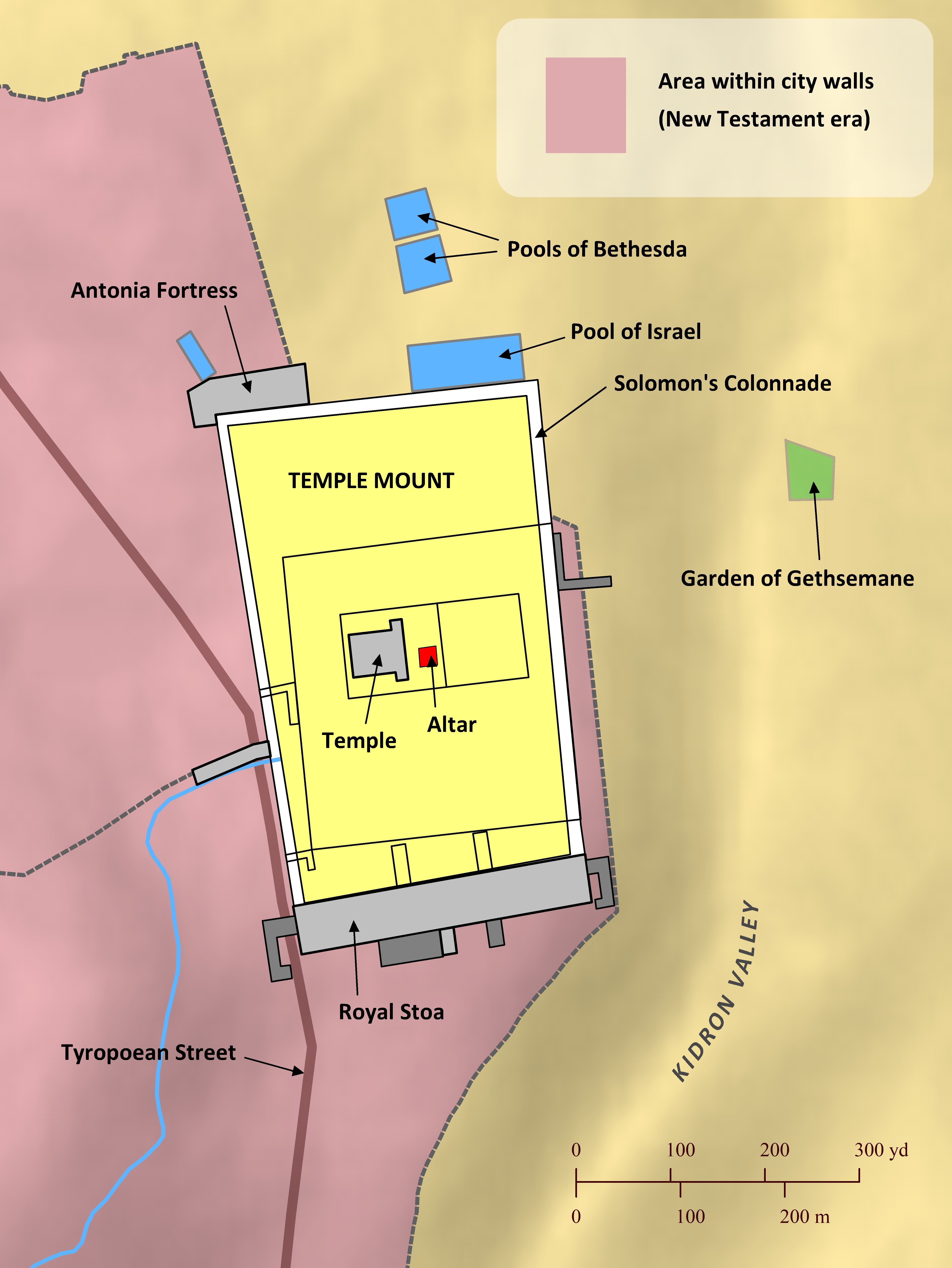
The Temple of the Lord in Jerusalem, where all Israelite males were commanded to offer sacrifices to the Lord (Exodus 23:14-19; Deuteronomy 16:16-17), underwent several stages of reconstruction and development over hundreds of years. The first Temple was built by King Solomon to replace the aging Tabernacle, and it was constructed on a threshing floor on high ground on the north side of the city (2 Samuel 24; 1 Chronicles 21). Hundreds of years later King Hezekiah expanded the platform surrounding the Temple. When Jerusalem fell to the Babylonians in 586 B.C., the Temple was completely destroyed (2 Kings 25:1-21; 2 Chronicles 36:17-21; Jeremiah 39:1-10; 52:1-30). It was rebuilt in 515 B.C. after a group of Jews returned to Judea from exile in Babylon (Ezra 1:5-6:15; Nehemiah 7:5-65). Herod the Great completely rebuilt and expanded the Temple once again around 20 B.C., making it one of the largest temples in the Roman world. Jesus’ first believers often met together in Solomon’s Colonnade, a columned porch that encircled the Temple Mount, perhaps carrying on a tradition started by Jesus himself (John 10:23; Acts 3:11; 5:12). But Herod’s Temple did not last long: After many Jews revolted against Rome, the Romans eventually recaptured Jerusalem and destroyed the Temple in A.D. 70.