
OET OET-RV OET-LV GHT ULT UST BSB MSB BLB AICNT OEB WEBBE WMBB NET LSV FBV TCNT T4T LEB BBE Moff JPS Wymth ASV DRA YLT Drby RV SLT Wbstr KJB-1769 KJB-1611 Bshps Gnva Cvdl TNT Wycl SR-GNT UHB BrLXX BrTr Related Parallel Simple Interlinear Topics Reference Dictionary Search
ParallelVerse GEN EXO LEV NUM DEU JOB JOS JDG RUTH 1 SAM 2 SAM PSA AMOS HOS 1 KI 2 KI 1 CHR 2 CHR PROV ECC SNG JOEL MIC ISA ZEP HAB JER LAM YNA (JNA) NAH OBA DAN EZE EZRA EST NEH HAG ZEC MAL LAO GES LES ESG DNG 2 PS TOB JDT WIS SIR BAR LJE PAZ SUS BEL MAN 1 MAC 2 MAC 3 MAC 4 MAC YHN (JHN) MARK MAT LUKE ACTs YAC (JAM) GAL 1 TH 2 TH 1 COR 2 COR ROM COL PHM EPH PHP 1 TIM TIT 1 PET 2 PET 2 TIM HEB YUD (JUD) 1 YHN (1 JHN) 2 YHN (2 JHN) 3 YHN (3 JHN) REV
Ezra Intro C1 C2 C3 C5 C6 C7 C8 C9 C10
Ezra 4 V1 V2 V3 V5 V6 V7 V8 V9 V10 V11 V12 V13 V14 V15 V16 V17 V18 V19 V20 V21 V22 V23 V24
Note: This view shows ‘verses’ which are not necessarily natural language units and hence sometimes only part of a sentence will be visible—click on any Bible version abbreviation down the left-hand side to see the verse in more of its context. Normally the OET discourages the reading of individual ‘verses’, but this view is only designed as a tool for Bible-translators and others doing comparisons of different translations—the older translations are further down the page (so you can read up from the bottom to trace the English translation history). The OET segments on this page are still early looks into the drafted texts of the Open English Translation of the Bible—please double-check these texts in advance before using in public.
Text critical issues=small word differences Clarity of original=clear Importance to us=normal Speaker(s)=Narrator (All still tentative.)
OET (OET-RV) Those local people had been discouraging the people of Yehudah and trying to stop them from building.
OET-LV And_he/it_was the_people_of the_earth/land were_making_drop the_hands_of the_people_of Yəhūdāh and[fn] them to_build.
4:4 OSHB variant note: ו/מבלהים: (x-qere) ’וּֽ/מְבַהֲלִ֥ים’: lemma=c/926 morph=HC/Vprmpa id=15Atm וּֽ/מְבַהֲלִ֥ים
UHB וַיְהִי֙ עַם־הָאָ֔רֶץ מְרַפִּ֖ים יְדֵ֣י עַם־יְהוּדָ֑ה וּֽמְבַהֲלִ֥ים [fn] אוֹתָ֖ם לִבְנֽוֹת׃ ‡
(vayəhī ˊam-hāʼāreʦ mərapim yədēy ˊam-yəhūdāh ūməⱱahₐlim ʼōtām liⱱənōt.)
Key: khaki:verbs.
Note: Automatic aligning of the OET-RV to the LV is done by some temporary software, hence the OET-RV alignments are incomplete (and may occasionally be wrong).
K ומבלהים
BrLXX Καὶ ἦν ὁ λαὸς τῆς γῆς ἐκλύων τὰς χεῖρας τοῦ λαοῦ Ἰούδα, καὶ ἐνεπόδιζον αὐτοὺς οἰκοδομεῖν,
(Kai aʸn ho laos taʸs gaʸs ekluōn tas ⱪeiras tou laou Youda, kai enepodizon autous oikodomein,)
BrTr And the people of the land weakened the hands of the people of Juda, and hindered them in building,
ULT And it happened that the people of the land were making the hands of the people of Judah weak, and making them afraid to build,
UST Then the people who had been living in that land before the Israelites returned there started doing things to make the Jews discouraged and afraid to continue building the temple.
BSB & MSB Then the people of the land set out to discourage the people of Judah and make them afraid to build.
OEB No OEB EZR 4:4 book available
WEBBE & WMBB Then the people of the land weakened the hands of the people of Judah, and troubled them in building.
NET Then the local people began to discourage the people of Judah and to dishearten them from building.
LSV And it comes to pass, the people of the land are making the hands of the people of Judah feeble, and troubling them in building,
FBV Then the local people set out to intimidate the people of Judah and make them too scared to go on building.
T4T Then the people who had been living in that land before the Israelis returned tried to cause the Jews to become discouraged and become afraid, and to cause them to stop building the temple.
LEB Then the people of the land discouraged ⌊the people of Judah⌋[fn] and made them afraid to build
4:4 Literally “the hands of the people of Judah”
BBE Then the people of the land made the hands of the people of Judah feeble, troubling them with fear in their building;
Moff Whereupon the people of the land thwarted the people of Judah and were a trouble to them as they were building;
JPS Then the people of the land weakened the hands of the people of Judah, and harried them while they were building,
ASV Then the people of the land weakened the hands of the people of Judah, and troubled them in building,
DRA Then the people of the land hindered the hands of the people of Juda, and troubled them in building.
YLT And it cometh to pass, the people of the land are making the hands of the people of Judah feeble, and troubling them in building,
Drby And the people of the land weakened the hands of the people of Judah, and troubled them in building;
RV Then the people of the land weakened the hands of the people of Judah, and troubled them in building,
(Then the people of the land weakened the hands of the people of Yudah, and troubled them in building,)
SLT And the people of the land will be slackening the hands of the people of Judah, and terrifying them in building,
Wbstr Then the people of the land weakened the hands of the people of Judah, and troubled them in building,
KJB-1769 Then the people of the land weakened the hands of the people of Judah, and troubled them in building,
(Then the people of the land weakened the hands of the people of Yudah, and troubled them in building,)
KJB-1611 Then the people of the land weakened the handes of the people of Iudah, and troubled them in building,
(Modernised spelling is same as from KJB-1769 above)
Bshps And it came to passe, that the folke of the lande discouraged the people of Iuda, & troubled them as they were building:
(And it came to pass, that the folk/people of the land discouraged the people of Yuda, and troubled them as they were building:)
Gnva Wherefore the people of the land discouraged the people of Iudah, and troubled them in buylding,
(Wherefore the people of the land discouraged the people of Yudah, and troubled them in building,)
Cvdl Then the folke of the londe hyndered the people of Iuda, and made them afrayed to buylde,
(Then the folk/people of the land hindered the people of Yuda, and made them afraid to build,)
Wycl Forsothe it was doon, that the puple of the lond lettide the hondis of the puple of Juda, and trobliden hem in bildyng.
(For_certain/Truly it was done, that the people of the land hindered the hands of the people of Yuda, and troubled hem in building.)
Luth Da hinderte das Volk im Lande die Hand des Volks Juda und schreckten sie ab im Bauen.
(So hindered the people in_the land the hand the peoples Yuda and frightened they/she/them ab in_the building(n).)
ClVg Factum est igitur ut populus terræ impediret manus populi Judæ, et turbaret eos in ædificando.[fn]
(Done it_is therefore as the_people of_the_earth/land(pl) would_hinder hands of_the_people Yudah, and would_disturb them in/into/on to_be_built.)
4.4 Populi Judæ. Populum Juda, id est confidentem et glorificantem, dicit eum qui integramente Domino ædificare, id est ad voluntatem ejus faciendam et gloriam quærendam omnium quos potest animos et ora convertere quærit.
4.4 Peoples Yudah. The_people Yuda, that it_is trusting and glorifying, he_says him who/which wholeente Master to_build, that it_is to will(n) his/her to_be_done and glory to_be_sought of_all which can in_minds and pray to_convert seeks.
Note 1 topic: writing-newevent
וַיְהִי֙
and=he/it_was
The phrase and it happened that introduces a new series of events in the story. Use a natural way in your language for introducing something new or different.
Note 2 topic: figures-of-speech / idiom
עַם־הָאָ֔רֶץ
people the=earth/land
This expression refers to the non-Israelite people groups, listed in [4:9](../04/09.md), whom the Assyrian kings Esarhaddon and Ashurbanipal had brought to live in the area just north of Judah in the century before the Jews were taken away into exile themselves. When the Jews returned to their homeland, those foreign groups were still living nearby. Alternate translation: [the foreign people groups living nearby]
Note 3 topic: figures-of-speech / parallelism
וַיְהִי֙ & מְרַפִּ֖ים יְדֵ֣י עַם־יְהוּדָ֑ה וּֽמְבַהֲלִ֥ים אוֹתָ֖ם לִבְנֽוֹת
and=he/it_was & (Some words not found in UHB: and=he/it_was people the=earth/land ones_discouraging hands_of people Yehuda and, ,them to,build )
These two phrases mean similar things. If it would be helpful in your language, you could combine them. Alternate translation: [making the people of Judah so intimidated that they stopped working on the temple] However, there is a slight distinction between the phrases. The first one describes how the people felt inwardly, and the second one explains what effect this had on their outward actions. So you could also translate the phrases separately. Alternate translation: [were intimidating the people of Judah so that they were afraid to keep working on the temple]
Note 4 topic: figures-of-speech / metaphor
וַיְהִי֙ & מְרַפִּ֖ים יְדֵ֣י עַם־יְהוּדָ֑ה
and=he/it_was & (Some words not found in UHB: and=he/it_was people the=earth/land ones_discouraging hands_of people Yehuda and, ,them to,build )
Here, hands represents power and action, so making the hands weak means to make someone so discouraged or intimidated that they do not use their power to act. Alternate translation: [were intimidating the people of Judah]
עַם־יְהוּדָ֑ה
people people Yehuda
In this context, this expression does not refer to all of the inhabitants of the province of Judah, whatever their nationality, but rather it specifically refers to the Jews who returned from exile and settled there. In this book, the people of Judah and “the people of Israel” both refer to the Jewish people and mean the same thing. Alternate translation: [the Jews who had returned from exile and settled in the province of Judah]
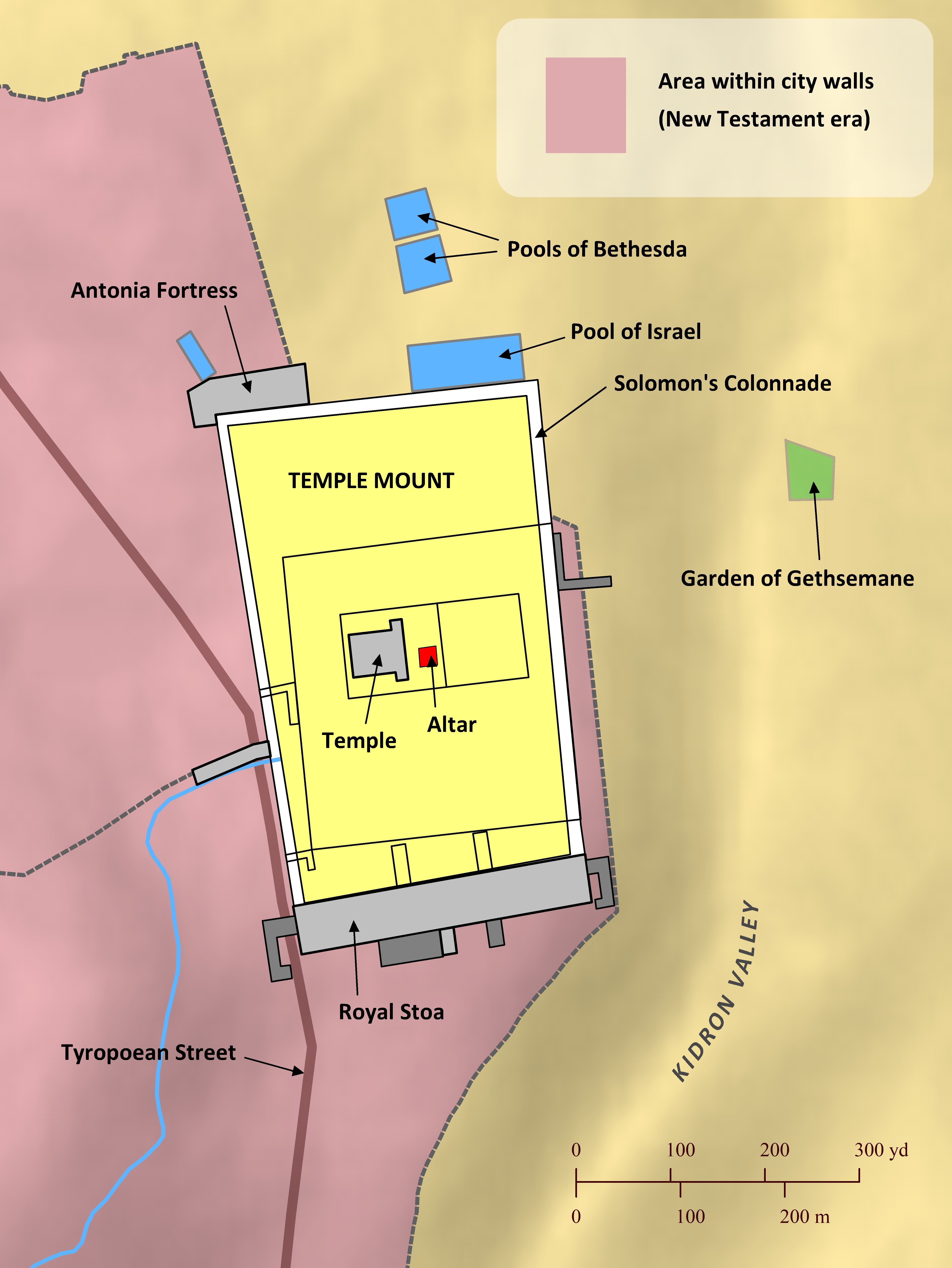
The Temple of the Lord in Jerusalem, where all Israelite males were commanded to offer sacrifices to the Lord (Exodus 23:14-19; Deuteronomy 16:16-17), underwent several stages of reconstruction and development over hundreds of years. The first Temple was built by King Solomon to replace the aging Tabernacle, and it was constructed on a threshing floor on high ground on the north side of the city (2 Samuel 24; 1 Chronicles 21). Hundreds of years later King Hezekiah expanded the platform surrounding the Temple. When Jerusalem fell to the Babylonians in 586 B.C., the Temple was completely destroyed (2 Kings 25:1-21; 2 Chronicles 36:17-21; Jeremiah 39:1-10; 52:1-30). It was rebuilt in 515 B.C. after a group of Jews returned to Judea from exile in Babylon (Ezra 1:5-6:15; Nehemiah 7:5-65). Herod the Great completely rebuilt and expanded the Temple once again around 20 B.C., making it one of the largest temples in the Roman world. Jesus’ first believers often met together in Solomon’s Colonnade, a columned porch that encircled the Temple Mount, perhaps carrying on a tradition started by Jesus himself (John 10:23; Acts 3:11; 5:12). But Herod’s Temple did not last long: After many Jews revolted against Rome, the Romans eventually recaptured Jerusalem and destroyed the Temple in A.D. 70.
Open Bible Data site copyright © 2023–2026 Freely-Given.org.
Python source code for creating these static pages is available on GitHub under an open licence.
For Bible data copyrights, see the details for each displayed Bible version.
The Open English Translation (OET) main site is at OpenEnglishTranslation.Bible or OET.Bible.