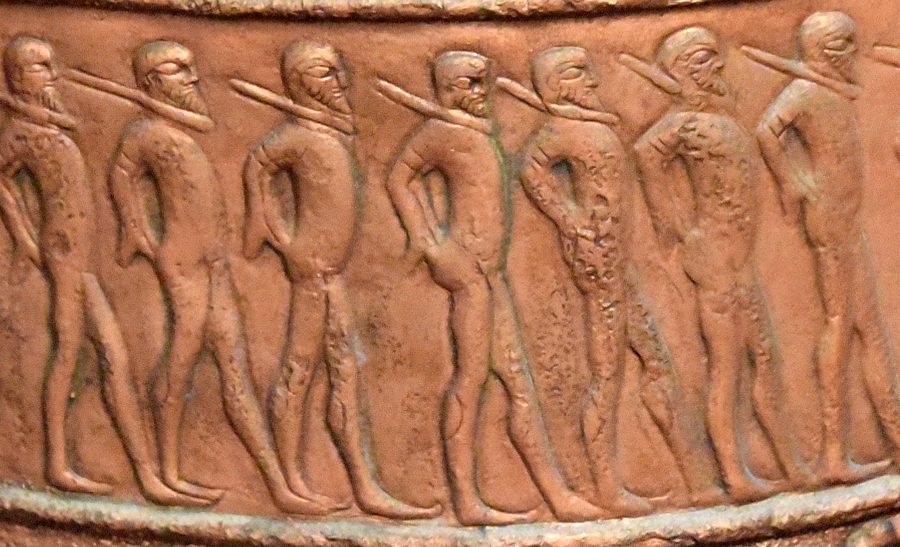
Slaves in yokes (© Osama Shukir Muhammed Amin FRCP(Glasg), CC BY-SA 4.0, via Wikimedia Commons)
References
- Hebrew מוֹט, מוֹטָה mot, motah: LEV 26:13, ISA 58:6, ISA 58:9, YIR 27:2, YIR 28:10, YIR 28:12, YIR 28:13, EZEK 30:18
- Hebrew עֹל ‘ol: GEN 27:40, LEV 26:13, NUM 19:2, DEUT 21:3, DEUT 28:48, 1 SAM 6:7, 1 KI 12:4, 1 KI 12:11
22 more references
1 KI 12:14, 2 CHR 10:4, 2 CHR 10:11, 2 CHR 10:14, ISA 9:4, ISA 10:27, ISA 14:25, ISA 47:6, YIR 2:20, YIR 5:5, YIR 27:8, YIR 27:11, YIR 27:12, YIR 28:2, YIR 28:4, YIR 28:11, YIR 28:14, YIR 30:8, LAM 1:14, LAM 3:27, EZEK 34:27, HOS 11:4 - Greek βοοζύγιον boozugion: SIR 26:7
- Greek ἑτεροζυγέω heterozugeō: 2 COR 6:14
- Greek κλοιός kloios: SIR 6:24, SIR 6:29
- Greek ζυγός zugos: MAT 11:29, MAT 11:30, ACTs 15:10, GAL 5:1, 1 TIM 6:1, SIR 21:25, SIR 28:19, SIR 28:20
11 more references
SIR 28:25, SIR 33:27, SIR 40:1, SIR 42:4, SIR 51:26, 1 MAC 8:18, 1 MAC 8:31, 1 MAC 13:41, 3 MAC 4:9, PSS 7:9, PSS 17:30
Description
The yoke was a bar or frame of wood by which two draft animals were joined at the neck so that they could work together effectively in pulling a plow, threshing board, harrow, or wagon. A similar device was used on human beings, but then it was usually a single harness, not the double one used for animals.
———
Usage
The yoke was secured to the necks of the animals by means of a kind of collar made of wood, cane, or rope. The center of the yoke was attached, by means of a rope or a bar, to the object to be drawn. The animals pulled together, side by side. A yoke was sometimes placed on a human being who had been taken captive (YIR 28:10) or made a slave, to restrict movement or to prevent escape.
———
Translation
Where the yoking of draft animals is unknown or unfamiliar, in NUM 19:2 (and similarly for DEUT 21:3) translators may follow GNT, which renders the literal text “on which a yoke has never been placed” as “which has never been worked.”
Always in the New Testament and frequently in the Old Testament, “yoke” appears in figurative contexts. It then becomes a symbol of the subjection and servitude of slaves. In such cases (for example, LEV 26:13; ISA 10:27; YIR 28:2, YIR 28:14; YIR 30:8; EZEK 34:27; NAH 1:13; ACTs 15:10; GAL 5:1; 1 TIM 6:1), translators may avoid the literal meaning and translate the figurative sense (LEV 26:13: “… I broke the power that held you down …” [GNT]). Similarly, in SIR 40:1GNT has “… A heavy burden lies on all of us ….”
For the possible reference to a yoke at LAM 5:5, see the comments in A Handbook on Lamentations, page 134.
In SIR 33:27 a yoke is associated with the wearing of a special “harness” or “collar.” This was a device of rope, leather, cane, or wood worn around the neck. The yoke was attached to it. Since it is associated in this verse with control of the animal’s movements, the Italia (Italian) common language translation (ITCL) renders the word as “reins.” The use of kloios in SIR 6:24, SIR 6:29 is symbolic. In many languages it will be possible to retain the reference to chains and the yoke. However, where a language does not permit such usage, we may say something like “Let all of your actions be ruled by Wisdom” (verse 24) and “If you allow Wisdom to rule you, you will be kept safe, and you will be in control of what happens to you” (verse 29).
 Open English Translation (OET)