
OET OET-RV OET-LV GHT ULT UST BSB MSB BLB AICNT OEB WEBBE WMBB NET LSV FBV TCNT T4T LEB BBE Moff JPS Wymth ASV DRA YLT Drby RV SLT Wbstr KJB-1769 KJB-1611 Bshps Gnva Cvdl TNT Wycl SR-GNT UHB BrLXX BrTr Related Parallel Simple Interlinear Topics Reference Dictionary Search
OET By Document By Section By Chapter Details
OET INT FRT GEN EXO LEV NUM DEU JOB JOS JDG RUTH 1 SAM 2 SAM PSA AMOS HOS 1 KI 2 KI 1 CHR 2 CHR PROV ECC SNG JOEL MIC ISA ZEP HAB JER LAM YNA NAH OBA DAN EZE EZRA EST NEH HAG ZEC MAL GES LES ESG DNG 2 PS TOB JDT WIS SIR BAR MAN 1 MAC 2 MAC 3 MAC 4 MAC YHN MARK MAT LUKE ACTs YAC GAL 1 TH 2 TH 1 COR 2 COR ROM COL PHM EPH PHP 1 TIM TIT 1 PET 2 PET 2 TIM HEB YUD 1 YHN 2 YHN 3 YHN REV
2 SAM Intro C1 C2 C3 C4 C5 C7 C8 C9 C10 C11 C12 C13 C14 C15 C16 C17 C18 C19 C20 C21 C22 C23 C24
This is still an early look into the drafted text of the Open English Translation of the Bible. Please double-check the text in advance before using in public.
6:1 The Box with the agreement is brought to Yerushalem
(1 Chr. 13:1-14; 15:25–16:6; 43)
6 Then David selected thirty thousand Israeli warriors and gathered them together. 2 He led them to Kiriat-Yearim (formerly called Baalah) in Yehudah to get the box of God (whose name is Yahweh the army commander) who lives between the two winged creatures on the top of it.[ref] 3 They placed the sacred chest on a newly-made cart and started moving it from Abinadab’s house which was on a hill. Uzzah and Ahyo (Abinadab’s sons) were leading the cart.[ref] 4 They took it from Abinadab’s house and Ahyo took the lead in front. 5 David and all the Israelis were celebrating in God’s presence with wooden harps and lyres, along with tambourines, shakers, and cymbals.
6 But when they reached Nakon’s threshing floor the oxen stumbled so Uzzah reached out to steady the sacred chest. 7 Yahweh became furious with Uzzah and killed him right there by the sacred chest because he’d touched it. 8 Now David got angry because of Yahweh’s outburst against Uzzah, and that place has been called Perets-Uzzah (meaning ‘The punishment of Uzzah’) until today. 9 David was afraid of Yahweh that day and asked, “How will Yahweh’s box get to Yerushalem?” 10 So he decided not to take Yahweh’s box there and redirected it instead to the house of Obed-Edom (a Gittite). 11 The sacred chest stayed at Obed-Edom’s house for three months, and Yahweh blessed him and all the household.[ref]
12 Someone told King David, “Yahweh has blessed Obed-Edom’s household because of the sacred chest,” so David went and brought God’s Box from Obed-Edom’s house to Yerushalem with much happiness. 13 When the men who were carrying the sacred chest had walked six steps, they stopped and David sacrificed a bull and a fattened calf there. 14 Then David, wearing a linen apron, danced in front of Yahweh, putting everything into it. 15 David and all the Israelis brought the sacred chest into Yerushalem with shouting and trumpet blasts.
16 However, as they were entering the city, David’s wife Mikal (Sha’ul’s daughter) looked out the window and saw King David leaping and dancing in front of Yahweh, and she felt only despite for him. 17 They took Yahweh’s box and placed it in the middle of the tent that David had erected for it. Then David offered burnt sacrifices to Yahweh, as well as peace offerings. 18 When David had finished offering those sacrifices, he blessed the people in commander Yahweh’s name. 19 He handed out a large bread roll, a cake of pressed dates, and a cake of pressed raisins to each man and woman there, then they all returned to their homes.[ref]
20 Then David returned to bless his own house, but his wife Mikal came out to meet him complaining, “What disgraceful behaviour for Yisrael’s king today—dancing when he was wearing so little and exposing himself to his female servants like some brainless person!”
21 “It was to thank Yahweh,” David responded, “who chose me (rather than your father and any of his family) by appointing me as leader over Yahweh’s people Yisrael. I was celebrating in front of Yahweh 22 and I will humiliate and humble myself even more than that. Yet I will end up being honoured by those female servants that you were talking about.”
23 After that, Sha’ul’s daughter Mikal never had any more children.

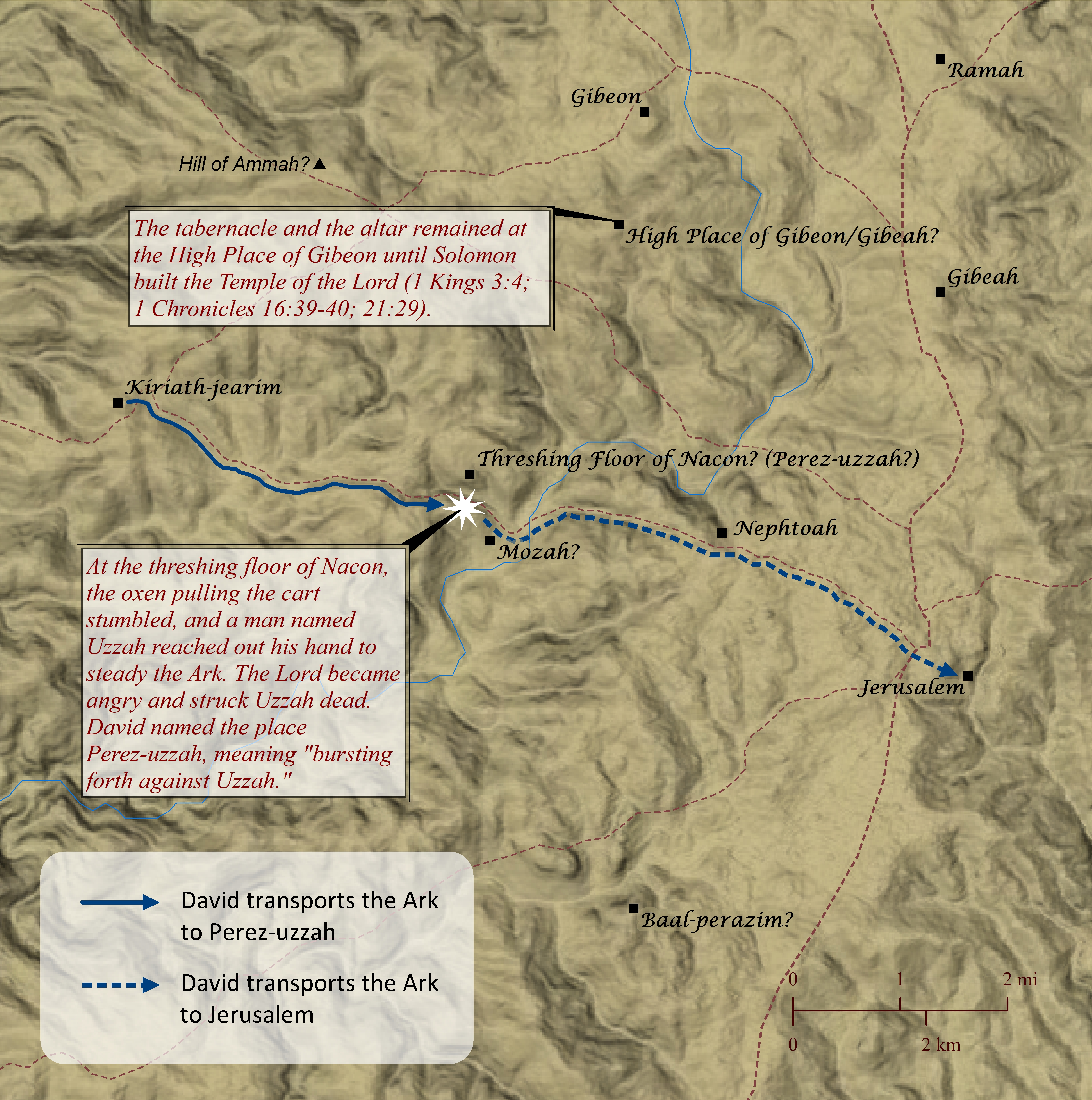
2 Samuel 6; 1 Chronicles 13
Perhaps no other event in David’s life demonstrates his zealous love for God than his efforts to move the Ark from Kiriath-jearim to Jerusalem. The story takes place about twenty years after the Ark had been captured by the Philistines but was later returned to Israel, where it was kept at Kiriath-jearim (1 Samuel 6:1-7:2; see “The Ark of the Covenant Is Captured and Returned” map). The Tabernacle and altar appear to have been relocated to the High Place of Gibeon/Gibeah after the Philistines overran Shiloh as well (1 Kings 3:4; 1 Chronicles 16:39-40; 21:29). By this time David had secured his grip on the throne of all Israel and had established Jerusalem (also called the City of David) as his new capital, and he wished to bring the Ark into it. So David called together all the leaders of Israel and placed the Ark on a new cart, and they all danced before the Lord as the Ark was brought from Kiriath-jearim to Jerusalem. When the Ark reached the threshing floor of Nacon (1 Chronicles 13:9 calls him “Chidon”), the oxen stumbled, and a man named Uzzah, who was helping to move the Ark, reached out to steady the Ark. The Lord immediately struck Uzzah dead for touching the Ark, and after this David was angry and afraid of the Lord. David called the place Perez-uzzah, meaning “bursting forth against Uzzah”. This parallels an earlier instance (or perhaps later; see 2 Samuel 5:20; 1 Chronicles 14:11) when David named a place Baal-perazim, meaning “the Lord of bursting forth,” because the Lord had enabled him to win a battle against the Philistines (2 Samuel 5; 23:13-17 ; 1 Chronicles 11:15-19; 14:10-17; also see map “David Defeats the Philistines in the Valley of Rephaim”). In both cases, David may have been using the term for “bursting forth” as a double entendre to describe both the actions of the Lord and the presence of springs in the area. If so, this author has found that a good candidate for Perez-uzzah is located just to the north of what was likely ancient Mozah, because there are multiple springs in the area, including one at the top of the hill that may have been the location of the threshing floor of Nacon. After Uzzah’s death, the Ark was temporarily taken to the house of Obed-edom, presumeably located nearby, for three months. Though the Lord’s actions against Uzzah might seem harsh to the modern reader, especially given David’s desire to honor the Lord through his efforts, the biblical writers provide clues as to why the Lord must have responded as he did. By noting that the Ark was put on a “new cart,” just as the Philistines had done when they returned the Ark (1 Samuel 6:7), the writers were likely indicating that David was going about his efforts in a pagan way instead of in accordance with God’s commands for transporting the Ark, which required that it be carried with poles (Numbers 4:15; also see 1 Chronicles 15:12–15). This is underscored by David’s renewed–and successful–efforts to transport the Ark again, this time using poles (note “those who bore the Ark of the Lord” in 2 Samuel 6:13) and making sacrifices along the way. David and all Israel danced and shouted as the Ark made its way to Jerusalem, with David wearing only a linen ephod, essentially an undergarment. After the Ark arrived in the city, David placed it in a tent and offered sacrifices to the Lord. But David’s wife Michal sarcastically noted that David had “honored” himself that day by uncovering himself before all the young servant girls. David responded by insisting that he was willing to abase himself even further to worship the Lord.
2 SAM Intro C1 C2 C3 C4 C5 C7 C8 C9 C10 C11 C12 C13 C14 C15 C16 C17 C18 C19 C20 C21 C22 C23 C24