
ParallelVerse GEN EXO LEV NUM DEUT JOB YEHO (JOS) HERO (JDG) RUTH 1 SAM 2 SAM PSA AMOS HOS 1 KI 2 KI 1 CHR 2 CHR PROV ECC SNG YOEL (JOEL) MIC ISA ZEP HAB YIR (JER) LAM YNA (JNA) NAH OBAD DAN EZEK EZRA EST NEH HAG ZEC MAL 2 PS WIS TOB MAN BAR L JER G DAN SUS PR AZ BEL G ESD L ESD ESG JDT 3 MAC SIR 1 MAC 2 MAC 4 MAC YHN (JHN) MARK MAT LUKE ACTs YAC (JAM) GAL 1 TH 2 TH 1 COR 2 COR ROM COL LAOD PHM EPH PHP 1 TIM TIT 1 PET 2 PET 2 TIM HEB YUD (JUD) 1 YHN (1 JHN) 2 YHN (2 JHN) 3 YHN (3 JHN) REV
ParallelVerse 2 Sam Intro C1 C2 C3 C4 C5 C7 C8 C9 C10 C11 C12 C13 C14 C15 C16 C17 C18 C19 C20 C21 C22 C23 C24
2 Sam 6 V0 V1 V2 V3 V5 V6 V7 V8 V9 V10 V11 V12 V13 V14 V15 V16 V17 V18 V19 V20 V21 V22 V23
Note: This view shows ‘verses’ which are not necessarily natural language units and hence sometimes only part of a sentence will be visible—click on any Bible version abbreviation down the left-hand side to see the verse in more of its context. Normally the OET discourages the reading of individual ‘verses’, but this view is only designed as a tool for Bible-translators and others doing comparisons of different translations—the older translations are further down the page (so you can read up from the bottom to trace the English translation history). The OET segments on this page are still early looks into the drafted texts of the Open English Translation of the Bible—please double-check these texts in advance before using in public.
Text critical issues=none Clarity of original=clear Importance to us=normal Speaker(s)=Narrator (All still tentative.)
OET (OET-RV) They took it from Avinadav’s house and Ahyo took the lead in front.
OET-LV And_they_carried_it from_the_house_of ʼAⱱīnādāⱱ which was_on_hill with the_box_of the_ʼElohīm and_ʼAḩyō was_walking to_(the)_face_of/in_front_of/before the_box.
UHB וַיִּשָּׂאֻ֗הוּ מִבֵּ֤ית אֲבִֽינָדָב֙ אֲשֶׁ֣ר בַּגִּבְעָ֔ה עִ֖ם אֲר֣וֹן הָאֱלֹהִ֑ים וְאַחְי֕וֹ הֹלֵ֖ךְ לִפְנֵ֥י הָאָרֽוֹן׃ ‡
(vayyissāʼuhū mibēyt ʼₐⱱinādāⱱ ʼₐsher baggiⱱˊāh ˊim ʼₐrōn hāʼₑlohim vəʼaḩyō holēk lifənēy hāʼārōn.)
Key: khaki:verbs.
Note: Automatic aligning of the OET-RV to the LV is done by some temporary software, hence the OET-RV alignments are incomplete (and may occasionally be wrong).
People tagged in the matching LV passage: Abinadab (SA1 7:1) · Ahio (SA2 6:3) · God
BrLXX Καὶ οἱ ἀδελφοὶ αὐτοῦ ἐπορεύοντο ἔμπροσθεν τῆς κιβωτοῦ.
(Kai hoi adelfoi autou eporeuonto emprosthen taʸs kibōtou.)
BrTr And his brethren went before the ark.
ULT And they bore it from the house of Abinadab, which was on the hill, with the Box of God, and Ahio was walking to the face of the Box.
UST In order to bring the sacred chest from Abinadab’s hilltop house, Ahio walked in front of the cart, while Uzzah walked alongside it.
BSB bringing with it the ark of God.[fn] And Ahio was walking in front of the ark.
6:4 DSS and some LXX manuscripts; MT includes from the house of Abinadab, which was on the hill.
OEB No OEB SA2 6:4 book available
WEBBE They brought it out of Abinadab’s house which was in the hill, with God’s ark; and Ahio went before the ark.
NET They brought it with the ark of God up from the house of Abinadab on the hill. Ahio was walking in front of the ark,
LSV and they lift it up from the house of Abinadab, which [is] in the height, with the Ark of God, and Ahio is going before the Ark,
FBV with the Ark of God on it, with Ahio walking in front of it.[fn]
6:4 Septuagint reading, supported by one of the Dead Sea Scrolls.
T4T Uzzah walked alongside the cart, and Ahio walked in front of it.
LEB So they brought it out from the house of Abinadab, which was on the hill with the ark of God, and Ahio was going before the ark.
BBE And Uzzah went by the side of the ark, while Ahio went before it.
Moff No Moff SA2 6:4 book available
JPS And they brought it out of the house of Abinadab, which was in the hill, with the ark of God, and Ahio went before the ark.
ASV And they brought it out of the house of Abinadab, which was in the hill, with the ark of God: and Ahio went before the ark.
DRA And when they had taken it out of the house of Abinadab, who was in Gabaa, Ahio having care of the ark of God went before the ark.
YLT and they lift it up from the house of Abinadab, which [is] in the height, with the ark of God, and Ahio is going before the ark,
Drby And they brought it with the ark of [fn]God out of the house of Abinadab which was upon the hill; and Ahio went before the ark.
6.4 Elohim
RV And they brought it out of the house of Abinadab, which was in the hill, with the ark of God: and Ahio went before the ark.
(And they brought it out of the house of Abinadab, which was in the hill, with the ark/box of God: and Ahio went before the ark.)
SLT And they will lift it up from the house of Abinadab, which is in the hill, with the ark of God: and Ahio went before the ark.
Wbstr And they brought it out of the house of Abinadab, which was at Gibeah, accompanying the ark of God: and Ahio went before the ark.
KJB-1769 And they brought it out of the house of Abinadab which was at Gibeah, accompanying the ark of God: and Ahio went before the ark.[fn]
(And they brought it out of the house of Abinadab which was at Gibeah, accompanying the ark/box of God: and Ahio went before the ark.)
6.4 accompanying: Heb. with
KJB-1611 And they brought it out of the house of Abinadab which was at Gibeah, [fn]accompanying the Arke of God; and Ahio went before the Arke.
(And they brought it out of the house of Abinadab which was at Gibeah, accompanying the Ark/Box of God; and Ahio went before the Ark/Box.)
6:4 Hebr. with.
Bshps And when they brought the arke of God out of the house of Abinadab that was at Gibea, Ahio went before the arke.
(And when they brought the ark/box of God out of the house of Abinadab that was at Gibea, Ahio went before the ark/box.)
Gnva And when they brought the Arke of God out of the house of Abinadab, that was at Gibeah, Ahio went before the Arke,
(And when they brought the Ark/Box of God out of the house of Abinadab, that was at Gibeah, Ahio went before the Ark/Box,)
Cvdl And whan they broughte it with the Arke from the house of Abinadab which dwelt at Gibea, Ahio wente before the Arke:
(And when they brought it with the Ark/Box from the house of Abinadab which dwelt at Gibea, Ahio went before the Ark:)
Wycl And whanne thei hadden take it fro the hows of Amynadab, that was in Gabaa, and kepte the arke of God, Haio yede bifor the arke.
(And when they had take it from the house of Amminadab, that was in Gabaa, and kept the ark/box of God, Haio went before the ark/box.)
Luth Und da sie ihn mit der Lade Gottes aus dem Hause Abinadabs führeten, der zu Gibea wohnete, und Ahio vor der Lade her ging,
(And there they/she/them him/it with the/of_the box/chest God’s out_of to_him house(n) Abinadab’s led, the/of_the to/for Gibea lived/resided, and Ahio before/in_front_of the/of_the box/chest her went,)
ClVg Cumque tulissent eam de domo Abinadab, qui erat in Gabaa, custodiens arcam Dei Ahio præcedebat arcam.
(And_when they_would_have_carried her from/about at_home Abinadab, who/which was in/into/on Gibeah, keeping/guarding the_box of_God Ahio preceded the_box.)
6:1-23 Except for the brief reference in 1 Sam 14:18 (see note), the Ark of the Covenant has not been mentioned since 1 Sam 7:1-2, when the Pelishtim (Philistines) returned the captured Ark to Beyt-Shemesh (Beth-shemesh) and then to Kiryat-Yearim (Kiriath-jearim), where it was placed in Avinadav’s (Abinadab’s) home. The Ark’s virtual absence during Sha’ul’s (Saul’s) forty-year reign highlights that Sha’ul, in his spiritual insensitivity, did not seek the Lord (see 1 Chr 10:13-14; 13:3). David brought the Ark into Yerushalem (Jerusalem), effectively acknowledging and enthroning (see 2 Sam 6:2) Yahweh as the true king over Yisrael (Israel) in the new capital.
Celebration
God welcomes exuberant expressions of joy and delight from those who worship and praise him (Isa 30:29; Jer 30:19; 31:13; Zeph 3:17; Eph 5:19; Col 3:16).
David’s two attempts to bring the Ark of the Covenant to Yerushalem (Jerusalem) (2 Sam 6:1-11, 12-23) were marked by celebration. Three Hebrew terms for “danced/dancing” are found in the account of the second procession of the Ark (see also 1 Chr 15:25-29): karar (2 Sam 6:14, 16), pazaz (NLT, “leaping,” 6:16), and raqad (1 Chr 15:29, “skipping about”). All three words refer to vigorous physical expression beyond the meaning of the Hebrew term for “celebrate” used in David’s first attempt (2 Sam 6:5). Thus, in the first procession, David celebrated; in the second procession he engaged in exultant dancing and extravagant merrymaking with intensified musical expression through the addition of shouting and trumpets.
Musical instruments played a significant role in Temple worship. In 1 Chronicles 25:1-31, David assigned various groups to the ministry of music. Many psalms refer to playing musical instruments in praise and worship of God (see Pss 33:2-3; 57:8; 81:2; 92:1-3; 98:4-6). In Pss 149 and 150, dance and music are combined as a praise offering. Similarly, music and dancing were heard in the father’s house in the parable of the lost son (Luke 15:25), as the son’s return was truly a joyful occasion.
The book of Revelation gives a picture of the eternal celebration that awaits the faithful—a celebration characterized by worship in the presence of God (Rev 4:1-11; 5:8-14; 15:1-4). This celebration is described as a wedding feast, in which the bridegroom (Christ) and the bride (his church) are joined together forever (Rev 19:9; see also Matt 22:1-14).
Passages for Further Study
Exod 5:1; 12:17; 15:20-21; 1 Sam 18:6; 2 Sam 6:1-15; 2 Chr 7:6-10; Ezra 3:10-11; Pss 30:11; 69:30; 98:4-6; 107:32; 149:1-9; 150:1-6; Isa 30:29; 54:1; Jer 30:18-19; 31:4, 13; Lam 5:14-15; Zeph 3:17; Luke 15:22-25; 1 Cor 5:8; Eph 5:18-20; Col 3:16; Rev 18:20
Note 1 topic: translate-textvariants
וַיִּשָּׂאֻ֗הוּ מִבֵּ֤ית אֲבִֽינָדָב֙ אֲשֶׁ֣ר בַּגִּבְעָ֔ה
(Some words not found in UHB: and,they,carried_it from,the_house_of ʼAⱱīnādāⱱ which/who [was]_on,hill with ark_of the=ʼElohīm and,Ahio walking to=(the)_face_of/in_front_of/before the,ark )
The Septuagint (an ancient Greek translation of the Hebrew Bible) and the parallel passage in 1 Chronicles do not have this sentence, which seems to have been repeated accidentally from the previous verse. Without it, the text of verses 3–4 would sensibly read, “And Uzzah and Ahio, the sons of Abinadab, were leading the new cart with the Box of God” (that is, the new cart that had the Box of God on it). Many versions of the Bible do not include this sentence. If a translation of the Bible exists in your region, you may wish to omit the sentence if it does.
Note 2 topic: figures-of-speech / explicit
וְאַחְי֕וֹ הֹלֵ֖ךְ לִפְנֵ֥י הָאָרֽוֹן
and,Ahio walking to=(the)_face_of/in_front_of/before the,ark
The author assumes that his readers will know that Ahio and Uzzah were following the custom of this culture for steadying a load on a cart that animals were pulling. One person would walk ahead of the cart, leading and guiding the animals, while another person would walk next to the cart to make sure that the load did not fall off. By saying that Ahio was walking to the face of the Box, he also means that Uzzah was walking alongside the cart that was carrying it, as the story itself indicates in 6:6. You could indicate this explicitly in your translation if that would be helpful to your readers. The UST models one way to do that.
Note 3 topic: figures-of-speech / metonymy
לִפְנֵ֥י
to=(the)_face_of/in_front_of/before
Here, to the face of represents “in front of.” If it would be helpful in your language, you could use an equivalent expression or plain language. Alternate translation: [in front of]
Note 4 topic: figures-of-speech / metonymy
הָאָרֽוֹן
the,ark
Here, the Box represents the oxen that were pulling the cart that was carrying the Box. If it would be helpful in your language, you could use an equivalent expression or plain language. Alternate translation: [the oxen that were pulling the cart that was carrying the Box]
2 Samuel 6; 1 Chronicles 13
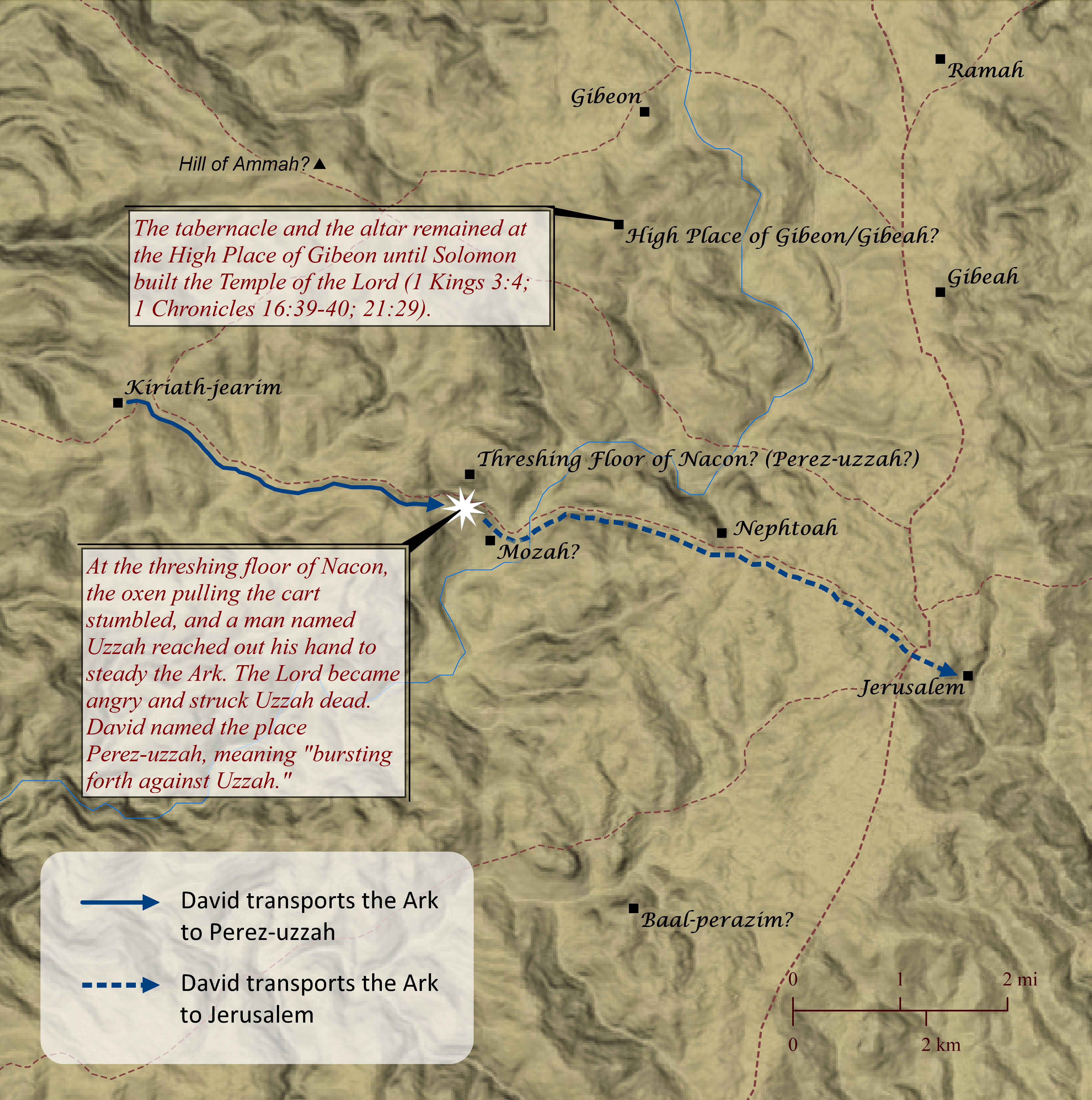
Perhaps no other event in David’s life demonstrates his zealous love for God than his efforts to move the Ark from Kiriath-jearim to Jerusalem. The story takes place about twenty years after the Ark had been captured by the Philistines but was later returned to Israel, where it was kept at Kiriath-jearim (1 Samuel 6:1-7:2; see “The Ark of the Covenant Is Captured and Returned” map). The Tabernacle and altar appear to have been relocated to the High Place of Gibeon/Gibeah after the Philistines overran Shiloh as well (1 Kings 3:4; 1 Chronicles 16:39-40; 21:29). By this time David had secured his grip on the throne of all Israel and had established Jerusalem (also called the City of David) as his new capital, and he wished to bring the Ark into it. So David called together all the leaders of Israel and placed the Ark on a new cart, and they all danced before the Lord as the Ark was brought from Kiriath-jearim to Jerusalem. When the Ark reached the threshing floor of Nacon (1 Chronicles 13:9 calls him “Chidon”), the oxen stumbled, and a man named Uzzah, who was helping to move the Ark, reached out to steady the Ark. The Lord immediately struck Uzzah dead for touching the Ark, and after this David was angry and afraid of the Lord. David called the place Perez-uzzah, meaning “bursting forth against Uzzah”. This parallels an earlier instance (or perhaps later; see 2 Samuel 5:20; 1 Chronicles 14:11) when David named a place Baal-perazim, meaning “the Lord of bursting forth,” because the Lord had enabled him to win a battle against the Philistines (2 Samuel 5; 23:13-17 ; 1 Chronicles 11:15-19; 14:10-17; also see map “David Defeats the Philistines in the Valley of Rephaim”). In both cases, David may have been using the term for “bursting forth” as a double entendre to describe both the actions of the Lord and the presence of springs in the area. If so, this author has found that a good candidate for Perez-uzzah is located just to the north of what was likely ancient Mozah, because there are multiple springs in the area, including one at the top of the hill that may have been the location of the threshing floor of Nacon. After Uzzah’s death, the Ark was temporarily taken to the house of Obed-edom, presumeably located nearby, for three months. Though the Lord’s actions against Uzzah might seem harsh to the modern reader, especially given David’s desire to honor the Lord through his efforts, the biblical writers provide clues as to why the Lord must have responded as he did. By noting that the Ark was put on a “new cart,” just as the Philistines had done when they returned the Ark (1 Samuel 6:7), the writers were likely indicating that David was going about his efforts in a pagan way instead of in accordance with God’s commands for transporting the Ark, which required that it be carried with poles (Numbers 4:15; also see 1 Chronicles 15:12–15). This is underscored by David’s renewed–and successful–efforts to transport the Ark again, this time using poles (note “those who bore the Ark of the Lord” in 2 Samuel 6:13) and making sacrifices along the way. David and all Israel danced and shouted as the Ark made its way to Jerusalem, with David wearing only a linen ephod, essentially an undergarment. After the Ark arrived in the city, David placed it in a tent and offered sacrifices to the Lord. But David’s wife Michal sarcastically noted that David had “honored” himself that day by uncovering himself before all the young servant girls. David responded by insisting that he was willing to abase himself even further to worship the Lord.
Open Bible Data site copyright © 2023–2026 Freely-Given.org.
Python source code for creating these static pages is available on GitHub under an open licence.
For Bible data copyrights, see the details for each displayed Bible version.
Visit the Open English Translation (OET) main site.