
OET OET-RV OET-LV GHT ULT UST BSB MSB BLB AICNT OEB WEBBE WMBB NET LSV FBV TCNT T4T LEB BBE Moff JPS Wymth ASV DRA YLT Drby RV SLT Wbstr KJB-1769 KJB-1611 Bshps Gnva Cvdl TNT Wycl SR-GNT UHB BrLXX BrTr Related Parallel Simple Interlinear Topics Reference Dictionary Search
OET By Document By Section By Chapter Details
OET INT FRT GEN EXO LEV NUM DEU JOB JOS JDG RUTH 1 SAM 2 SAM PSA AMOS HOS 1 KI 2 KI 1 CHR 2 CHR PROV ECC SNG JOEL MIC ISA ZEP HAB JER LAM YNA NAH OBA DAN EZE EZRA EST NEH HAG ZEC MAL GES LES ESG DNG 2 PS TOB JDT WIS SIR BAR MAN 1 MAC 2 MAC 3 MAC 4 MAC YHN MARK MAT LUKE ACTs YAC GAL 1 TH 2 TH 1 COR 2 COR ROM COL PHM EPH PHP 1 TIM TIT 1 PET 2 PET 2 TIM HEB YUD 1 YHN 2 YHN 3 YHN REV
2 CHR Intro C1 C2 C3 C4 C5 C6 C7 C8 C9 C10 C11 C12 C14 C15 C16 C17 C18 C19 C20 C21 C22 C23 C24 C25 C26 C27 C28 C29 C30 C31 C32 C33 C34 C35 C36
This is still an early look into the drafted text of the Open English Translation of the Bible. Please double-check the text in advance before using in public.
13 In the eighteenth year of King Yaraveam’s (Jeroboam’s) reign, Aviyah started his reign over Yehudah (Judah). 2 He ruled from Yerushalem for three years. (His mother was Uriel’s daughter Mikayah from Giveah.)
However, war started between Aviyah and Yaraveam.
3 Aviyah launched the attack with four-hundred thousand strong warriors, and Yaraveam drew up in formation against him with eight-hundred thousand strong warriors in his army.
4 Aviyah stood on the top of Mt. Tsemarayim in the Efrayim hill-country and shouted, “Yaraveam and all of Yisrael, listen to me. 5 Don’t you all understand that Yisrael’s god Yahweh made a formal agreement that the kingdom of Yisrael was given forever to David and his descendants? 6 But Nevat’s son Yaraveam, who was a servant of David’s son Shelomoh, took action and rebelled against his master, 7 and a bunch of wicked good-for-nothings gathered around Yaraveam and created a force against Shelomoh’s son, Rehaveam, when Rehaveam was still an inexperienced, young man and couldn’t stand up to them. 8 So now you Israelis are saying that you’ll stand against the kingdom that Yahweh established through David’s descendants. There are certainly many of you, and you have the gold calves that Yaraveam made as gods for you. 9 Didn’t you people drive out the Levites, as well as Yahweh’s priests who were Aharon’s descendants? Then you appointed for yourselves ‘priests’ like they have in other countries, so that anyone who comes to consecrate himself by bringing a young bull from the herd and seven rams can become a ‘priest’ of your non-gods.
10 “But as for us, Yahweh is our god and we haven’t abandoned him. Our priests who minister to Yahweh are Aharon’s descendants, and the Levites assist them. 11 Every morning and every evening, they sacrifice burnt offerings to Yahweh, and spiced incense. There’s sacred bread on the display table, and the lamps in the gold lampstand give light every evening because we’re following our god Yahweh’s instructions, but you people have abandoned him. 12 So listen! God is guiding us, and his priests will blast their trumpets to signal battle against you people. Listen, you Israelis: don’t fight against Yahweh, your ancestors’ god, because you won’t succeed.”
13 But meanwhile, Yaraveam had sent some men around to ambush them from behind, so they were both in front of the army from Yehudah and in ambush behind them.
14 When the warriors from Yehudah turned, wow, they realised they were being attacked from in front and from behind. They called out to Yahweh for help while the priests blew their trumpets. 15 Then the men from Yehudah shouted a loud battle cry, and God defeated Yaraveam and all of Yisrael in front of Aviyah and Yehudah. 16 Yisrael’s soldiers fled away from Yehudah’s army, and God enabled Yehudah to defeat them. 17 Aviyah and his men thrashed them badly, and some five-hundred thousand of their chosen warriors were killed. 18 So the Israelis were subdued at that time, and the people from Yehudah were victorious because they trusted in Yahweh, their ancestors’ god.
19 Aviyah chased after Yaraveam and they captured from Yisrael the cities of Beyt-El, Yeshanah, and Efron, and their surrounding villages. 20 Yaraveam never regained military strength during Aviyah’s reign, and after a time Yahweh struck him with sickness and he died.
21 Meanwhile, Aviyah became more powerful. He took fourteen wives for himself, and had twenty-two sons and sixteen daughters. 22 The rest of what Aviyah did, including his sayings and his behaviour, was written down by the prophet Iddo.

1 Kings 15:1-8; 2 Chronicles 13

From Sunday School lessons to inspiring sermons, modern portrayals of biblical characters often suffer from overly simplistic, two-dimensional perspectives on people’s moral character and deeds, but a careful reading of Scripture often shows reality to be more complex. The story of Abijah is ripe for similar misunderstanding unless one reads both biblical accounts of his reign. Abijah (also called Abijam) son of Rehoboam reigned for only three short years over Judah, and 1 Kings 15:3 tersely notes that “he committed all the sins that his father did before him; his heart was not true to the Lord his God.” It also notes that Abijah’s entire reign was marked by war with Jeroboam (1 Kings 15:6). From this it would be easy to assume that his reign was characterized only by wickedness and moral decline. Yet 2 Chronicles, though silent on the final assessment of Abijah’s overall character, seems to present Abijah as a leader who takes up the righteous cause of bringing the rebellious northern tribes of Israel back under the fold of Judah’s Davidic dynasty and Aaronic priesthood, though he was ultimately unsuccessful. As part of this effort, Abijah makes a foray into the northern tribes’ territory and arrives at Mount Zemaraim, but Jeroboam confronts him there with twice the amount of forces. The location of Mount Zemaraim is not certain, but it may have been located at the twin hills (which may explain the dual form of the name) of Ras ez Zemara, which suggests Abijah was advancing along a secondary route to avoid initial detection or fortifications along the main Central Ridge Route. There Abijah calls upon Jeroboam and all Israel to return to the leadership of David and Aaron. While Abijah is making his appeal, however, Jeroboam positions some of his forces in ambush behind Abijah’s forces, but Abijah’s men win a great victory over them and capture the towns of Bethel, Jeshanah, and Ephron (also called Ophrah). The writer of Chronicles notes that Abijah’s forces were victorious “because they relied on the Lord” and that Jeroboam never recovered from his weakened power for the rest of his reign, while Abijah grew strong (though Abijah’s reign was only for three years).
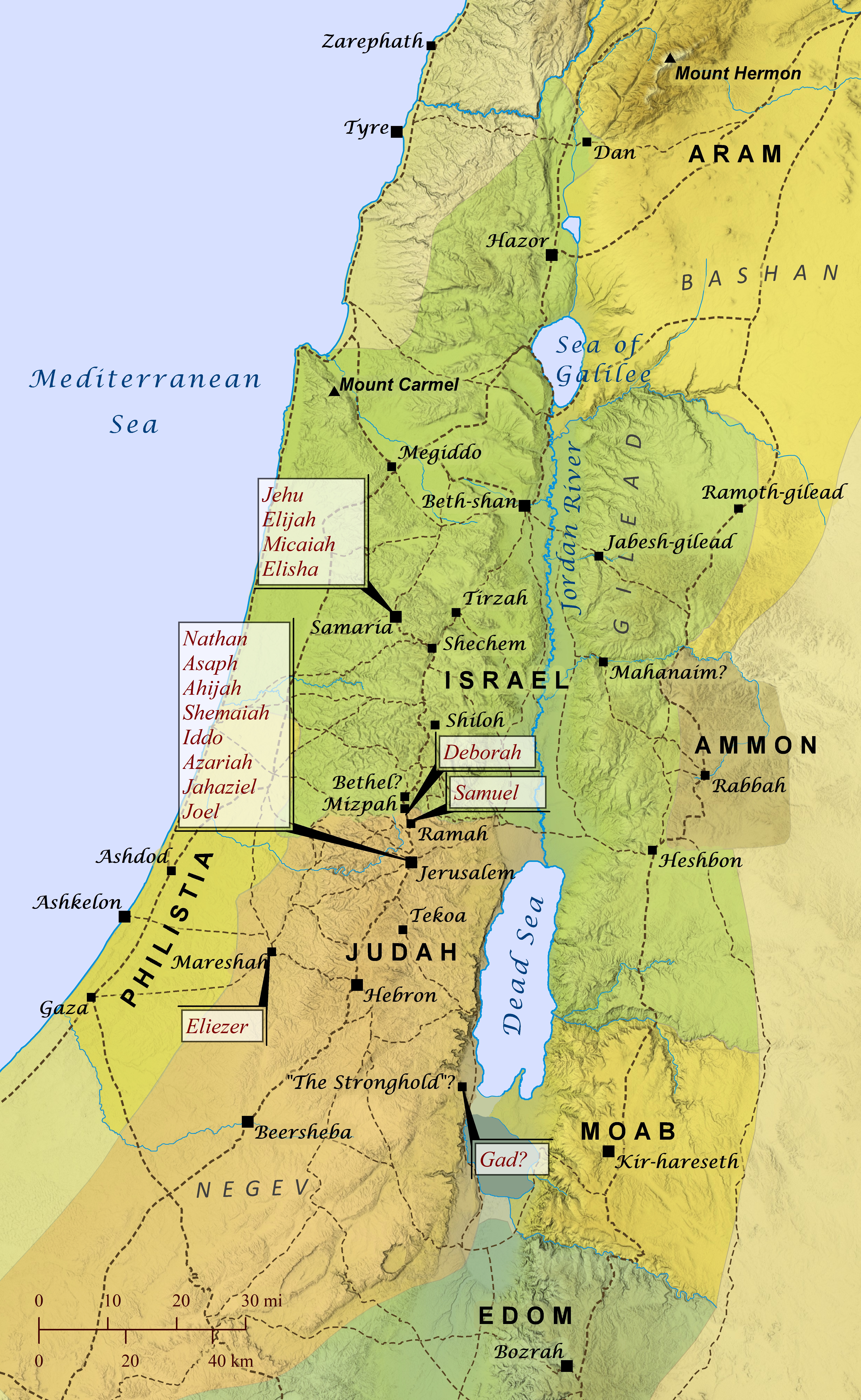
If you ask someone today what biblical prophets did, they will likely tell you that they divinely foretold of future events. While this was often the case, most prophets in the Bible focused as much on “forthtelling” God’s messages as they did on “foretelling” the future. That is, their primary role was to simply “forthtell” divinely acquired messages to leaders and groups of people, and at times that included foretelling of coming judgment, blessing, rescue, etc. Also, though plenty of prophets (sometimes called “seers” in Scripture) often spoke in confrontational or eccentric language that put them at odds with kings and religious leaders, the biblical writers also applied the term prophet to people who communicated God’s messages in ways that many readers today might not think of as prophecy, such as worship leaders appointed by David to “prophesy with lyres, harps, and cymbals” (1 Chronicles 25:1). Similarly, the books of Joshua, Judges, 1 & 2 Samuel, and 1 & 2 Kings are typically categorized as history by Christians, but in the Hebrew canon they belong to the category of Former Prophets. The Lord raised up prophets throughout all of biblical history, from the giving of the law under Moses to the revelation of the last days by the apostle John, and the kings of Israel and Judah often recognized and supported specific people as official prophets of the royal court and consulted them to find out God’s perspective about official matters. Following is a list of nearly everyone designated as prophet or seer in the Old Testament and the primary area of their ministry.
• Deborah (1216 B.C.) [Judges 4:4] => Baal-tamar?
• Samuel (1070 B.C.) [1 Samuel 3:20; 1 Chronicles 29:29; 2 Chronicles 35:18] => Ramah
• Gad (1018 B.C.) [2 Samuel 24:11; 1 Chronicles 21:9; 29:29; 2 Chronicles 29:25] => Masada?
• Nathan (1000 B.C.) [2 Samuel 12:1; 1 Chronicles 29:29; 2 Chronicles 29:25] => Jerusalem
• Asaph (1000 B.C.) [2 Chronicles 29:30] => Jerusalem
• Ahijah (935 B.C.) [1 Kings 11:29; 2 Chronicles 9:29] => Jerusalem
• Shemaiah (930 B.C.) [2 Chronicles 12:2-15] => Jerusalem
• Iddo (913 B.C.) [2 Chronicles 9:29; 12:15; 13:22] => Jerusalem
• Jehu son of Hanani (890 B.C.) [1 Kings 16:1-7; 2 Chronicles 19:2] => Samaria?
• Azariah (890 B.C.) [2 Chronicles 15:1-8] => Jerusalem
• Elijah (860 B.C.) [1 Kings 18:36] => Samaria
• Micaiah (853 B.C.) [1 Kings 22:8-23; 2 Chronicles 18:7-22] => Samaria
• Jahaziel (853 B.C.) [2 Chronicles 20:14] => Jerusalem
• Eliezer (853 B.C.) [2 Chronicles 20:37] => Mareshah
• Elisha (850 B.C.) [1 Kings 19:16; 2 Kings 2:15] => Samaria
• Joel (835 B.C.) [Joel 1:1] => Jerusalem
2 CHR Intro C1 C2 C3 C4 C5 C6 C7 C8 C9 C10 C11 C12 C14 C15 C16 C17 C18 C19 C20 C21 C22 C23 C24 C25 C26 C27 C28 C29 C30 C31 C32 C33 C34 C35 C36