
OET OET-RV OET-LV GHT ULT UST BSB MSB BLB AICNT OEB WEBBE WMBB NET LSV FBV TCNT T4T LEB BBE Moff JPS Wymth ASV DRA YLT Drby RV SLT Wbstr KJB-1769 KJB-1611 Bshps Gnva Cvdl TNT Wycl SR-GNT UHB BrLXX BrTr Related Parallel Simple Interlinear Topics Reference Dictionary Search
OET By Document By Section By Chapter Details
OET INT FRT GEN EXO LEV NUM DEU JOB JOS JDG RUTH 1 SAM 2 SAM PSA AMOS HOS 1 KI 2 KI 1 CHR 2 CHR PROV ECC SNG JOEL MIC ISA ZEP HAB JER LAM YNA NAH OBA DAN EZE EZRA EST NEH HAG ZEC MAL GES LES ESG DNG 2 PS TOB JDT WIS SIR BAR MAN 1 MAC 2 MAC 3 MAC 4 MAC YHN MARK MAT LUKE ACTs YAC GAL 1 TH 2 TH 1 COR 2 COR ROM COL PHM EPH PHP 1 TIM TIT 1 PET 2 PET 2 TIM HEB YUD 1 YHN 2 YHN 3 YHN REV
2 CHR Intro C1 C2 C3 C4 C5 C6 C7 C8 C9 C10 C11 C12 C13 C14 C15 C16 C17 C19 C20 C21 C22 C23 C24 C25 C26 C27 C28 C29 C30 C31 C32 C33 C34 C35 C36
This is still an early look into the drafted text of the Open English Translation of the Bible. Please double-check the text in advance before using in public.
18 King Yehoshafat became very wealthy, and was highly honoured, but then he allied himself by marriage to Yisrael’s King Ahav. 2 Some years later, he went up to Ahav in Shomron (Samaria), and Ahav sacrificed lots of sheep and cattle for him and for the people who were with him, and he incited him to attack Ramot-Gilead—3 Yisrael’s King Ahav suggested to Yehudah’s King Yehoshafat, “Will you join me to attack Ramot-Gilead?”
“Wherever you’ll be, I’ll be there,” he responded. “Your people are like my own people, and we’re with you in battle.” 4 Then he added, “But we should get Yahweh’s advice first.”
5 So Yisrael’s king gathered four hundred of his prophets and asked them, “Should we attack Ramot-Gilead or not?”
“Go ahead,” they answered, “and God will give victory to the king.”
6 But Yehoshafat asked, “Is there no prophet of Yahweh here that we can ask?”
7 Yisrael’s king told Yehoshafat, “There’s still one man who would ask Yahweh, but personally I hate him because he never prophesies anything good about me—it’s always something evil. He’s Yimlah’s son, Mikayah.”
“You shouldn’t talk like that,” said Yehoshafat.
8 So Yisrael’s king ordered an official, “Get Yimlah’s son Mikayah here as quick as possible.”
9 Now the kings of Yisrael and Yehudah were both clothed in their royal robes and sitting there on their thrones near Shomron’s (Samaria’s) entrance gate. They were up on a threshing floor, and all the prophets were prophesying in front of them. 10 Kenaanah’s son Tsidkiyah made himself some iron horns and said, “Yahweh says you’ll use these to gore Aram and destroy them.” 11 All the rest of Ahav’s prophets agreed, saying, “Yes, go and attack Ramot-Gilead and you’ll succeed—Yahweh will give the king victory.”
12 The messenger who went to fetch Mikayah warned him, “Listen, the king is pleased with what the other prophets agreed on. Just say the same as them and give a favourable message.”
13 But Mikayah responded, “As sure as Yahweh lives, I’ll only say what my god tells me to say.”
14 When he got to the king, King Ahav asked him, “Mikayah, should we attack Ramot-Gilead for battle, or should I hold back?”
“Go ahead and succeed,” he answered. “You’ll be given victory over them.”
15 But the king said to him, “How many times must I keep making you promise that you’ll only say what Yahweh says—not just what I want to hear?” 16 So Mikayah responded, “I saw all of Yisrael scattered on the hills like sheep without shepherds, and Yahweh said, ‘They don’t have any master, so they’ll all just go home in peace.’ ”[ref]
17 Ahav remarked to Yehoshafat, “Didn’t I tell you that he wouldn’t prophesy anything good about me—only disaster?”
18 But Mikayah continued, “Well, listen to what Yahweh says. I saw Yahweh sitting on his throne, and all the heavenly soldiers standing on each side of him, 19 and Yahweh said, ‘Who’ll entice Yisrael’s King Ahav so he’ll attack and then die at Ramot-Gilead?’ Some suggested one thing, and others suggested something else. 20 Then a spirit went out and stood in front of Yahweh and said, ‘I myself will entice him.’ ‘How would you do it?’ Yahweh asked him. 21 The spirit replied, ‘I’ll go and inspire all of Ahav’s prophets to tell lies.’ Yahweh said, ‘That’ll work. Go and do it.’
22 “So now, listen. Yahweh placed a deceiving spirit in the mouths of those prophets of yours, and Yahweh has decreed that you’ll face disaster.”
23 Then Kenaanah’s son Tsidkiyah went up to Mikayah and slapped him hard on the cheek, saying, “Yeah? Since when did Yahweh’s spirit leave me and start speaking to you?”
24 “Well, you’ll find out soon,” answered Mikayah, “on the day when you go room by room in some house to try to hide.”
25 “Arrest Mikayah,” ordered King Ahav, “and return him to Amon the city governor, and to my son Yoash. 26 Tell them that the king’s ordered that this man be put in prison, and be given only strictly-rationed bread and water until I return safely.”
27 “If you return safely,” Mikayah retorted, “then Yahweh mustn’t have spoken to me.”
28 So Yisrael’s King Ahav and Yehudah’s king Yehoshafat went to Ramot-Gilead. 29 Ahav told Yehoshafat, “I’ll get changed, so I’m not recognised, and go into the battle, but you wear your royal robe.” So Yisrael’s king disguised himself, and they went into the battle.
30 Meanwhile, Aram’s king had ordered his chariot commanders, “Only attack Yisrael’s king—don’t bother fighting anyone else.” 31 However, when those chariot commanders saw King Yehoshafat, they mistook him for Yisrael’s king, and wheeled around to fight him, but Yehoshafat cried out to Yahweh for help, and he helped him—God drew them away from him, 32 because when the chariot commanders realised that it wasn’t Yisrael’s king, they turned back from chasing him. 33 However, one Aramean warrior drew his bow without knowing where Ahav was, and struck Yisrael’s king at a joint in his armour. Ahav ordered the charioteer, “Turn around and get me out of here, because I’ve been seriously wounded.” 34 The battle continued for the whole day, and Yisrael’s king was propped up in his chariot to watch the Arameans, but he died as the sun was setting.
18:33 OSHB variant note: ידי/ך: (x-qere) ’יָדְ/ךָ֛’: lemma_3027 n_0.0.0 morph_HNcbsc/Sp2ms id_14sbC יָדְ/ךָ֛

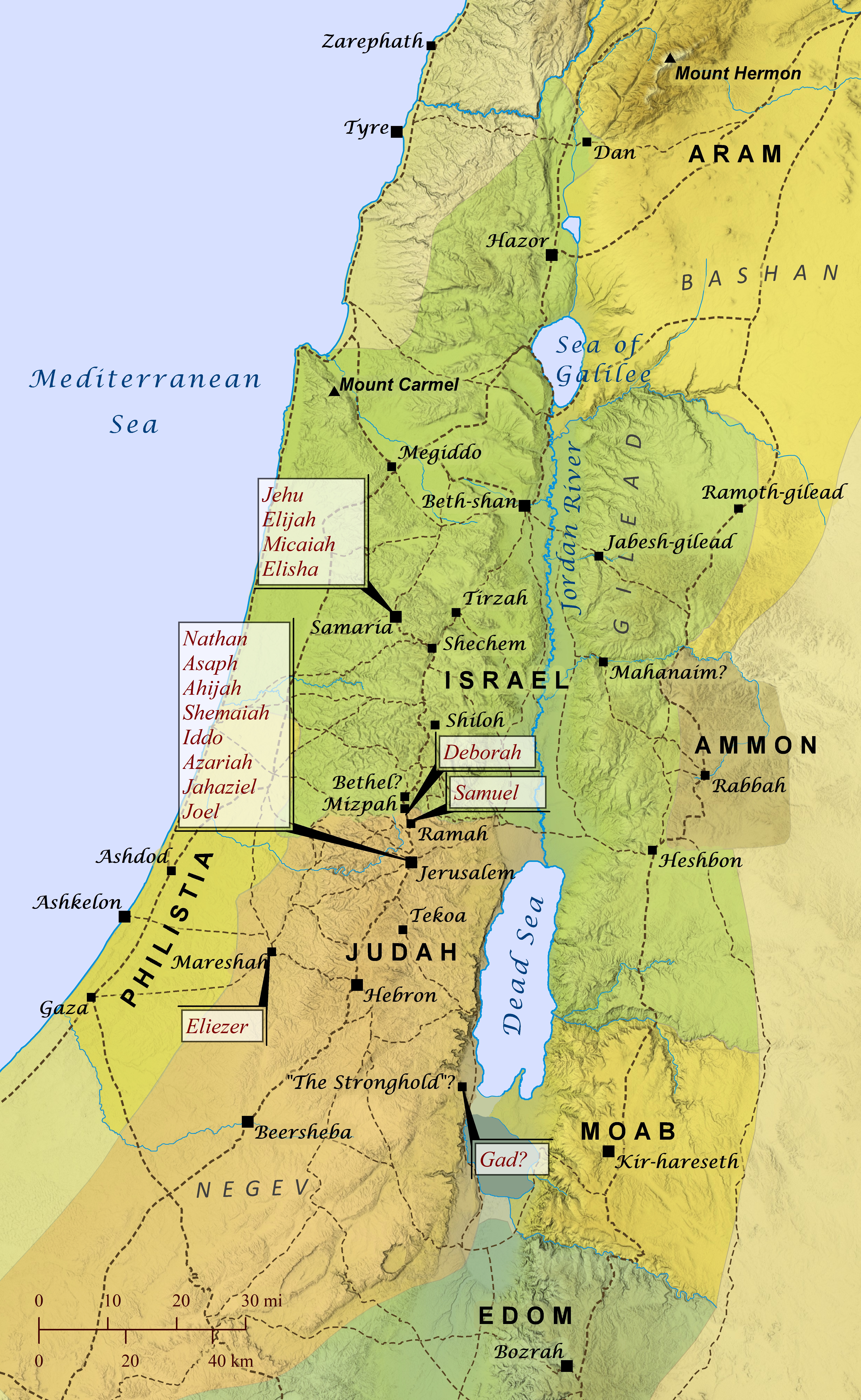
If you ask someone today what biblical prophets did, they will likely tell you that they divinely foretold of future events. While this was often the case, most prophets in the Bible focused as much on “forthtelling” God’s messages as they did on “foretelling” the future. That is, their primary role was to simply “forthtell” divinely acquired messages to leaders and groups of people, and at times that included foretelling of coming judgment, blessing, rescue, etc. Also, though plenty of prophets (sometimes called “seers” in Scripture) often spoke in confrontational or eccentric language that put them at odds with kings and religious leaders, the biblical writers also applied the term prophet to people who communicated God’s messages in ways that many readers today might not think of as prophecy, such as worship leaders appointed by David to “prophesy with lyres, harps, and cymbals” (1 Chronicles 25:1). Similarly, the books of Joshua, Judges, 1 & 2 Samuel, and 1 & 2 Kings are typically categorized as history by Christians, but in the Hebrew canon they belong to the category of Former Prophets. The Lord raised up prophets throughout all of biblical history, from the giving of the law under Moses to the revelation of the last days by the apostle John, and the kings of Israel and Judah often recognized and supported specific people as official prophets of the royal court and consulted them to find out God’s perspective about official matters. Following is a list of nearly everyone designated as prophet or seer in the Old Testament and the primary area of their ministry.
• Deborah (1216 B.C.) [Judges 4:4] => Baal-tamar?
• Samuel (1070 B.C.) [1 Samuel 3:20; 1 Chronicles 29:29; 2 Chronicles 35:18] => Ramah
• Gad (1018 B.C.) [2 Samuel 24:11; 1 Chronicles 21:9; 29:29; 2 Chronicles 29:25] => Masada?
• Nathan (1000 B.C.) [2 Samuel 12:1; 1 Chronicles 29:29; 2 Chronicles 29:25] => Jerusalem
• Asaph (1000 B.C.) [2 Chronicles 29:30] => Jerusalem
• Ahijah (935 B.C.) [1 Kings 11:29; 2 Chronicles 9:29] => Jerusalem
• Shemaiah (930 B.C.) [2 Chronicles 12:2-15] => Jerusalem
• Iddo (913 B.C.) [2 Chronicles 9:29; 12:15; 13:22] => Jerusalem
• Jehu son of Hanani (890 B.C.) [1 Kings 16:1-7; 2 Chronicles 19:2] => Samaria?
• Azariah (890 B.C.) [2 Chronicles 15:1-8] => Jerusalem
• Elijah (860 B.C.) [1 Kings 18:36] => Samaria
• Micaiah (853 B.C.) [1 Kings 22:8-23; 2 Chronicles 18:7-22] => Samaria
• Jahaziel (853 B.C.) [2 Chronicles 20:14] => Jerusalem
• Eliezer (853 B.C.) [2 Chronicles 20:37] => Mareshah
• Elisha (850 B.C.) [1 Kings 19:16; 2 Kings 2:15] => Samaria
• Joel (835 B.C.) [Joel 1:1] => Jerusalem
2 CHR Intro C1 C2 C3 C4 C5 C6 C7 C8 C9 C10 C11 C12 C13 C14 C15 C16 C17 C19 C20 C21 C22 C23 C24 C25 C26 C27 C28 C29 C30 C31 C32 C33 C34 C35 C36