
OET OET-RV OET-LV GHT ULT UST BSB MSB BLB AICNT OEB WEBBE WMBB NET LSV FBV TCNT T4T LEB BBE Moff JPS Wymth ASV DRA YLT Drby RV SLT Wbstr KJB-1769 KJB-1611 Bshps Gnva Cvdl TNT Wycl SR-GNT UHB BrLXX BrTr Related Parallel Simple Interlinear Topics Reference Dictionary Search
OET By Document By Section By Chapter Details
OET INT FRT GEN EXO LEV NUM DEU JOB JOS JDG RUTH 1 SAM 2 SAM PSA AMOS HOS 1 KI 2 KI 1 CHR 2 CHR PROV ECC SNG JOEL MIC ISA ZEP HAB JER LAM YNA NAH OBA DAN EZE EZRA EST NEH HAG ZEC MAL GES LES ESG DNG 2 PS TOB JDT WIS SIR BAR MAN 1 MAC 2 MAC 3 MAC 4 MAC YHN MARK MAT LUKE ACTs YAC GAL 1 TH 2 TH 1 COR 2 COR ROM COL PHM EPH PHP 1 TIM TIT 1 PET 2 PET 2 TIM HEB YUD 1 YHN 2 YHN 3 YHN REV
2 CHR Intro C1 C2 C3 C4 C5 C6 C7 C8 C10 C11 C12 C13 C14 C15 C16 C17 C18 C19 C20 C21 C22 C23 C24 C25 C26 C27 C28 C29 C30 C31 C32 C33 C34 C35 C36
This is still an early look into the drafted text of the Open English Translation of the Bible. Please double-check the text in advance before using in public.
9 The queen from the Sheva region had heard all about Shelomoh, and she came to Yerushalem with some hard questions. Her party included a large number of camels carrying lots of spices and gold and valuable gemstones. She came to Shelomoh and discussed with him everything that was on her mind.[ref] 2 Shelomoh responded to all her queries, and there wasn’t any subject that he wasn’t able to speak about. 3 When the queen from Sheva saw Shelomoh’s wisdom, and saw the palace that he’d built 4 and the food at his table, as well as his servants’ stations, his well-dressed ministers standing by, his cup-bearers in their uniforms, and the burnt offerings that he sacrificed at Yahweh’s temple, it took her breath away 5 and she told the king, “Everything I heard in my own country about you and your wisdom was true. 6 I didn’t believe what they reported to me until I saw it with my own eyes, and wow, the reports I heard didn’t even cover half the extent of your wisdom! 7 Your men are blessed, and even your servants are blessed to be able to continually stand in front of you and listen to your wisdom. 8 Your god Yahweh ought to be blessed—the one who delighted in you and placed you on his throne as his king. Your god loved Yisrael and wanted to establish them forever, so he’s placed you over them as king—to give justice and do what’s right.”
9 Then she gave the king four tonnes of gold, a very large quantity of spices, and valuable gemstones. Nobody before had ever seen such a large amount of spices as what the queen from Sheva gave to King Shelomoh.
10 (Also, King Huram’s servants working together with Shelomoh’s servants brought gold from Ofir, as well as algum wood and valuable gemstones. 11 The king made the algum wood into staircases for Yahweh’s temple and for the king’s palace, and into lyres and harps for the singers. Nothing like that had been seen before in Yehudah.)
12 King Shelomoh gave the queen from Sheva everything she wanted—more than what she’d brought to the king. Then she departed with her servants and went back to her country.
9:10 OSHB variant note: חירם: (x-qere) ’חוּרָם֙’: lemma_2361 n_1.1.0 morph_HNp id_14VEv חוּרָם֙
13 In one year, Shelomoh received about twenty tonnes of gold, 14 as well as what the merchants and traders brought in. All the Arabian kings and all the local governors brought gold and silver to Shelomoh. 15 King Shelomoh made two hundred large shields of beaten gold—six hundred gold coins’ worth of beaten gold went into each shield. 16 Also, three hundred smaller shields—three hundred gold coins’ worth of beaten gold went into each shield.
17 Then the king made a large ivory throne and overlaid it with pure gold. 18 There were six steps leading up to the throne, and a gold footstool was attached to it. It had an armrest on each side, with a lion statue beside each armrest. 19 There were twelve statues of lions standing on the six steps—one at each end of each step. No throne like that existed in any other kingdom.
20 All of King Shelomoh’s cups were made of gold, and all the various dishes in ‘The House of the Lebanon Forest’ were refined gold. Nothing was made of silver, because during Shelomoh’s reign, silver wasn’t considered valuable, 21 because the king’s ships went to Tarshish with Huram’s servants. Every three years the fleet would bring back gold, silver, ivory, and apes and baboons, 22 so King Shelomoh became greater than all the other kings in the world, both in wealth and in wisdom.
23 Kings from all over the world wanted to come and listen to the wisdom that God had given Shelomoh. 24 Each of them would bring gifts: gold and silver items, clothes, myrrh and spices, horses and mules. (This continued year after year.)
25 Shelomoh had four thousand stalls for horses and chariots, and twelve thousand horsemen, and he kept some in the chariot cities and some close by in Yerushalem.[ref] 26 He ended up ruling over all the kings in the region, from the Euphrates River in the northeast, west to the area of the Philistines, and south down to the Egyptian border.[ref] 27 The king made silver as common as stones, and cedar timber as common as the sycamore fig trees in the lowlands. 28 Horses were brought in from Egypt (Heb. Mitsrayim) for Shelomoh, and from other countries as well.[ref]
29 Everything else that Shelomoh did, from the beginning to the end, was written down by the prophet Natan, and in the prophecy by Ahiyah (from Shiloh), and the prophet Iddo’s visions about Nevat’s son Yaraveam (Jeroboam) were also written down. 30 Shelomoh reigned from Yerushalem over all of Yisrael for forty years, 31 then he died and was buried with his father in ‘The City of David’, and his son Rehaveam (Rehoboam) replaced him as king.
9:29 OSHB variant note: יעדי: (x-qere) ’יֶעְדּ֣וֹ’: lemma_3260 morph_HNp id_14KEV יֶעְדּ֣וֹ

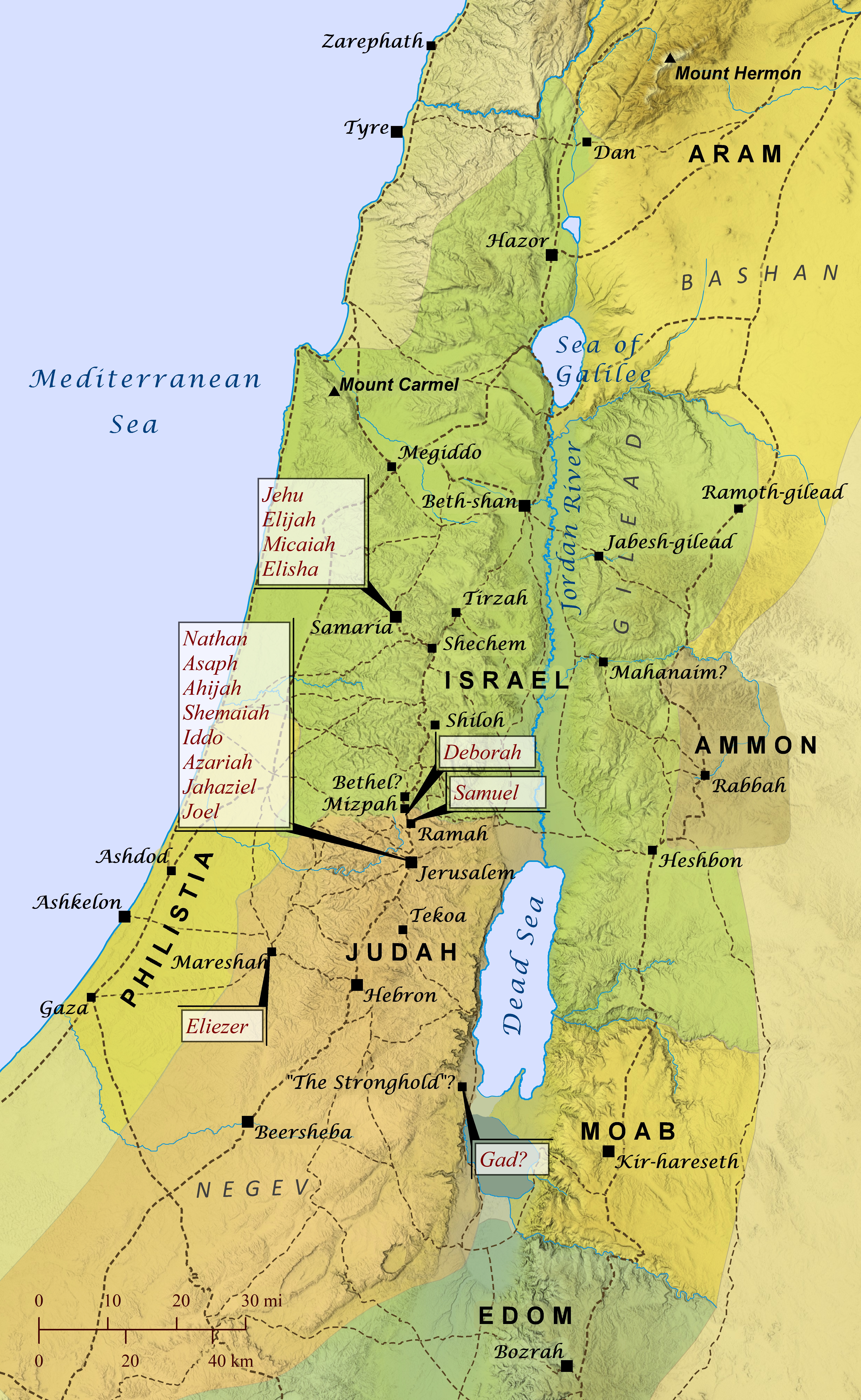
If you ask someone today what biblical prophets did, they will likely tell you that they divinely foretold of future events. While this was often the case, most prophets in the Bible focused as much on “forthtelling” God’s messages as they did on “foretelling” the future. That is, their primary role was to simply “forthtell” divinely acquired messages to leaders and groups of people, and at times that included foretelling of coming judgment, blessing, rescue, etc. Also, though plenty of prophets (sometimes called “seers” in Scripture) often spoke in confrontational or eccentric language that put them at odds with kings and religious leaders, the biblical writers also applied the term prophet to people who communicated God’s messages in ways that many readers today might not think of as prophecy, such as worship leaders appointed by David to “prophesy with lyres, harps, and cymbals” (1 Chronicles 25:1). Similarly, the books of Joshua, Judges, 1 & 2 Samuel, and 1 & 2 Kings are typically categorized as history by Christians, but in the Hebrew canon they belong to the category of Former Prophets. The Lord raised up prophets throughout all of biblical history, from the giving of the law under Moses to the revelation of the last days by the apostle John, and the kings of Israel and Judah often recognized and supported specific people as official prophets of the royal court and consulted them to find out God’s perspective about official matters. Following is a list of nearly everyone designated as prophet or seer in the Old Testament and the primary area of their ministry.
• Deborah (1216 B.C.) [Judges 4:4] => Baal-tamar?
• Samuel (1070 B.C.) [1 Samuel 3:20; 1 Chronicles 29:29; 2 Chronicles 35:18] => Ramah
• Gad (1018 B.C.) [2 Samuel 24:11; 1 Chronicles 21:9; 29:29; 2 Chronicles 29:25] => Masada?
• Nathan (1000 B.C.) [2 Samuel 12:1; 1 Chronicles 29:29; 2 Chronicles 29:25] => Jerusalem
• Asaph (1000 B.C.) [2 Chronicles 29:30] => Jerusalem
• Ahijah (935 B.C.) [1 Kings 11:29; 2 Chronicles 9:29] => Jerusalem
• Shemaiah (930 B.C.) [2 Chronicles 12:2-15] => Jerusalem
• Iddo (913 B.C.) [2 Chronicles 9:29; 12:15; 13:22] => Jerusalem
• Jehu son of Hanani (890 B.C.) [1 Kings 16:1-7; 2 Chronicles 19:2] => Samaria?
• Azariah (890 B.C.) [2 Chronicles 15:1-8] => Jerusalem
• Elijah (860 B.C.) [1 Kings 18:36] => Samaria
• Micaiah (853 B.C.) [1 Kings 22:8-23; 2 Chronicles 18:7-22] => Samaria
• Jahaziel (853 B.C.) [2 Chronicles 20:14] => Jerusalem
• Eliezer (853 B.C.) [2 Chronicles 20:37] => Mareshah
• Elisha (850 B.C.) [1 Kings 19:16; 2 Kings 2:15] => Samaria
• Joel (835 B.C.) [Joel 1:1] => Jerusalem
2 CHR Intro C1 C2 C3 C4 C5 C6 C7 C8 C10 C11 C12 C13 C14 C15 C16 C17 C18 C19 C20 C21 C22 C23 C24 C25 C26 C27 C28 C29 C30 C31 C32 C33 C34 C35 C36