
OET OET-RV OET-LV GHT ULT UST BSB MSB BLB AICNT OEB WEBBE WMBB NET LSV FBV TCNT T4T LEB BBE Moff JPS Wymth ASV DRA YLT Drby RV SLT Wbstr KJB-1769 KJB-1611 Bshps Gnva Cvdl TNT Wycl SR-GNT UHB BrLXX BrTr Related Parallel Simple Interlinear Topics Reference Dictionary Search
OET By Document By Section By Chapter Details
OET INT FRT GEN EXO LEV NUM DEU JOB JOS JDG RUTH 1 SAM 2 SAM PSA AMOS HOS 1 KI 2 KI 1 CHR 2 CHR PROV ECC SNG JOEL MIC ISA ZEP HAB JER LAM YNA NAH OBA DAN EZE EZRA EST NEH HAG ZEC MAL GES LES ESG DNG 2 PS TOB JDT WIS SIR BAR MAN 1 MAC 2 MAC 3 MAC 4 MAC YHN MARK MAT LUKE ACTs YAC GAL 1 TH 2 TH 1 COR 2 COR ROM COL PHM EPH PHP 1 TIM TIT 1 PET 2 PET 2 TIM HEB YUD 1 YHN 2 YHN 3 YHN REV
2 CHR Intro C1 C2 C3 C4 C5 C6 C7 C8 C9 C10 C11 C12 C13 C14 C15 C16 C17 C18 C19 C20 C21 C22 C23 C24 C25 C27 C28 C29 C30 C31 C32 C33 C34 C35 C36
This is still an early look into the drafted text of the Open English Translation of the Bible. Please double-check the text in advance before using in public.
26 Then all the people took sixteen-year-old Uzziyah and made him king to replace his father Amatsyah. 2 Uzziyah restored Eylat City to Yehudah and rebuilt it after his father’s death.
3 Uzziyah was sixteen when he became king, and he reigned from Yerushalem for fifty-two years. His mother was Yekolyah from Yerushalem. 4 He did the things that Yahweh said were good, like his father Amatsyah had done. 5 He strived to follow God during the lifetime of Zekaryah, who instructed him. During the time that he obeyed Yahweh, God made him successful.
6 Uzziyah went to attack the Philistines, and successfully broke through the walls at Gat, Yavneh, and Ashdod. He rebuilt Ashdod and other cities in the Philistia region. 7 God helped him against the Philistines, against the Arabians who were living in Gurbaal, and against the Meunites. 8 The Ammonites paid tribute to Uzziyah, and his fame spread as far as the Egyptian border because he was becoming more powerful.
9 King Uzziyah built fortified towers in Yerushalem at the Corner Gate, the Valley Gate, and at the angle in the wall. 10 He also built towers in the wilderness, and dug a lot of wells, because he had a lot of cattle—both in the lowlands and in the plains. He was also interested in horticulture, so he had workers stationed in his vineyards and in his fertile fields.
11 Uzziyah’s army was trained for fighting battles, and organised into divisions set up by Yeiel the scribe and the commander Maaseyah, under the supervision of Hananyah, one of the king’s officials. 12 There were 2,600 clan leaders who led the powerful warriors, 13 and the full force of 37,500 was under their authority, to support the king against his enemies. 14 Uzziyah supplied shields, spears, helmets, armoured vests, bows, and slingshots for the entire army. 15 Using a local invention, he made war machines in Yerushalem to be placed on the towers and corners of the walls to fire arrows and large stones. His fame now spread widely because he’d received a lot of help that had made him very powerful.
16 However, at the peak of his strength, he became very arrogant, and that led to his destruction. He disobeyed his god Yahweh and went into the temple to burn incense on the incense altar. 17 The high priest Azaryah and eighty other brave priests went in after him. 18 They confronted King Uzziyah and challenged him, “It’s not permitted for you, Uzziyah, to sacrifice to Yahweh, only for Aharon’s descendants the priests—the ones consecrated to sacrifice. Leave the sanctuary, because you’ve disobeyed Yahweh God, so now he won’t honour you.”[ref]
19 Then Uzziyah, who was holding an incense pan, became very angry, but when he started raging at the priests, spots of leprosy suddenly appeared on his forehead while he was still there beside the incense altar in front of the priests. 20 The high priest Azaryah looked more closely, and confirming that it was indeed leprosy on his forehead, hurried him outside. The king was now also in a hurry, because Yahweh had afflicted him.
21 King Uzziyah had leprosy until he died, so he had to live in an isolated residence and wasn’t allowed to approach the temple. His son Yotam (Jotham) stood in for him—supervising the palace and ruling Yehudah.
22 The record of all the other things Uzziyah did while he was king was written by the prophet Yeshayah (Isaiah) (son of Amots). 23 When Uzziyah died, because of his leprosy they buried him with his ancestors in a royal grave in the countryside, and his son Yotam replaced him as king.[ref]
26:3 OSHB variant note: יכיליה: (x-qere) ’יְכָלְיָ֖ה’: lemma_3203 n_0.0 morph_HNp id_14cKK יְכָלְיָ֖ה
26:7 OSHB variant note: ה/ערביים: (x-qere) ’הָֽ/עַרְבִ֛ים’: lemma_d/6163 b n_0.0.0 morph_HTd/Ngmpa id_14dbh הָֽ/עַרְבִ֛ים
26:8 OSHB exegesis note: WLC has this word divided as לְב֣וֹא
26:11 OSHB variant note: יעואל: (x-qere) ’יְעִיאֵ֣ל’: lemma_3273 morph_HNp id_14fYJ יְעִיאֵ֣ל
26:21 OSHB variant note: ה/חפשות: (x-qere) ’הַֽ/חָפְשִׁית֙’: lemma_d/2669 n_1.1.0 morph_HTd/Ncfsa id_14DcB הַֽ/חָפְשִׁית֙
26:22 OSHB note: BHS has been faithful to the Leningrad Codex where there might be a question of the validity of the form and we keep the same form as BHS.

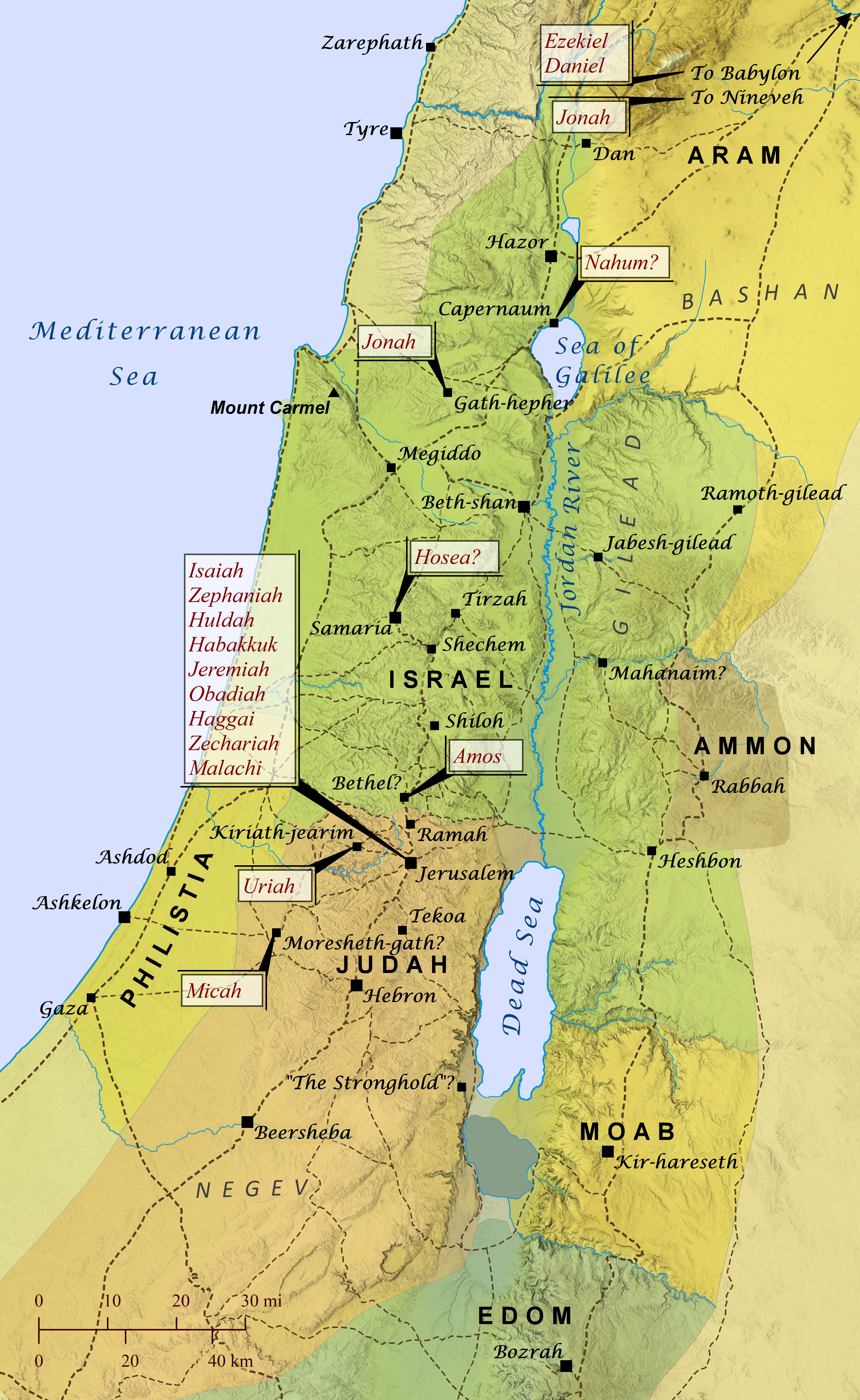
If you ask someone today what biblical prophets did, they will likely tell you that they divinely foretold of future events. While this was often the case, most prophets in the Bible focused as much on “forthtelling” God’s messages as they did on “foretelling” the future. That is, their primary role was to simply “forthtell” divinely acquired messages to leaders and groups of people, and at times that included foretelling of coming judgment, blessing, rescue, etc. Also, though plenty of prophets (sometimes called “seers” in Scripture) often spoke in confrontational or eccentric language that put them at odds with kings and religious leaders, the biblical writers also applied the term prophet to people who communicated God’s messages in ways that many readers today might not think of as prophecy, such as worship leaders appointed by David to “prophesy with lyres, harps, and cymbals” (1 Chronicles 25:1). Similarly, the books of Joshua, Judges, 1 & 2 Samuel, and 1 & 2 Kings are typically categorized as history by Christians, but in the Hebrew canon they belong to the category of Former Prophets. The Lord raised up prophets throughout all of biblical history, from the giving of the law under Moses to the revelation of the last days by the apostle John, and the kings of Israel and Judah often recognized and supported specific people as official prophets of the royal court and consulted them to find out God’s perspective about official matters. Following is a list of nearly everyone designated as prophet or seer in the Old Testament and the primary area of their ministry.
• Zechariah (796 B.C.) [2 Chronicles 24:20] => Jerusalem
• Jonah (780 B.C.) [2 Kings 14:25; Jonah 1:1] => Gath-hepher, Nineveh
• Hosea (770 B.C.) [Hosea 1:1] => Samaria?
• Amos (760 B.C.) [Amos 1:1] => Bethel
• Isaiah (730 B.C.) [2 Kings 19:2; 20:1; 2 Chronicles 26:22; 32:20, 32; Isaiah 1:1] => Jerusalem
• Micah (730 B.C.) [Jeremiah 26:18; Micah 1:1] => Moresheth
• Nahum (650 B.C.) [Nahum 1:1] => Elkosh (Capernaum?)
• Zephaniah (630 B.C.) [Zephaniah 1:1] => Jerusalem?
• Huldah (630 B.C.) [2 Kings 22:14] => Jerusalem
• Habakkuk (600 B.C.) [Habakkuk 1:1; 3:1] => Jerusalem?
• Ezekiel (592 B.C.) [Ezekiel 1:3] => Babylonia/Chebar River
• Uriah (600 B.C.) [Jeremiah 26:20] => Kiriath-jearim
• Jeremiah (587 B.C.) [2 Chronicles 36:12; Jeremiah 1:1; 19:14] => Jerusalem
• Obadiah (586 B.C.) [Obadiah 1:1] => Jerusalem
• Daniel (560 B.C.) [Daniel 7:1; Matthew 24:15] => Babylon
• Haggai (520 B.C.) [Ezra 5:1; Haggai 1:1] => Jerusalem
• Zechariah (520 B.C.) [Ezra 5:1; Zechariah 1:1] => Jerusalem
• Malachi (432 B.C.) [Malachi 1:1] => Jerusalem?

2 Kings 14:23-29; 15:1-7; 2 Chronicles 26
The long, concurrent reigns of Jeroboam II of Israel and Uzziah (also called Azariah) of Judah marked a period of resurgence after their nations had suffered nearly sixty years of decline and unrest. By the time both kings ascended to the throne in 793 B.C. and 792 B.C., Moab had revolted from Israel and seized land belonging to the tribe of Reuben (2 Kings 1:1; see “The Nation of Moab and the Tribe of Reuben”), and Edom and Libnah had revolted from Judah (2 Kings 8:16-24; 2 Chronicles 21:1-11; see “Edom and Libnah Revolt”). Jehu then brutally overthrew Ahab’s dynasty, but he later suffered the loss of all Gilead to the rising power of Aram (2 Kings 1:1; 3:1-27; 8:12; 10:32-33; 2 Chronicles 21:8-10; see “Aram Captures Gilead”). Soon after this, however, the Assyrian king Adad-nirari III (who may be the “savior” of 2 Kings 13:5) attacked Aram, but then he withdrew, thus creating a power vacuum to the north. Jeroboam of Israel took advantage of this opportunity and captured much of Aram, though it is unclear how firmly he held Aram or for how long. During this same time, king Uzziah of Judah captured the Red Sea port city of Elath in the far south, which belonged to Edom, and he also attacked the Arabs of Gur, who were likely located nearby. He also attacked the Meunites who lived in Seir, the formerly Edomite region south of the Judean Negev, though the Meunites themselves do not appear to have been Edomites. The Meunites are probably the same as the “Maonites” mentioned in Judges 10:12, and they also joined the Moabite alliance that attacked king Jehoshaphat of Judah (2 Chronicles 20). About a century after Uzziah’s time, during the reign of Hezekiah, some Simeonites attacked some Meunites in the Negev and seized their land (1 Chronicles 4:41-43). According to the Septuagint, the Meunites also paid Uzziah tribute (2 Chronicles 26:7-8), and Uzziah likely captured some of the Meunites and gave them as servants for the Temple of the Lord, which appears to have been a common practice in Israel since the time of Moses and Joshua (see Numbers 31:30; Joshua 9:27; Ezra 8:20). Their descendants are listed among the “Nethinim,” who served at the Temple during time of Ezra and Nehemiah (Ezra 2:50; Nehemiah 7:52). Uzziah also attacked the Philistine cities of Gath, Ashdod, and Jabneh and established other cities throughout Philistia. He built towers in Jerusalem at the Corner Gate, the Valley Gate, and the Angle as well as towers in the wilderness. He also dug many cisterns to store water for his large herds, both in the Shephelah (the foothills near Gath) and in the plain. He also had large farms and vineyards and strengthened Judah’s army. As far as moral leadership, the writer of Kings deems Jeroboam as a bad king for allowing idolatry to continue in Israel, but Uzziah is deemed as good, though he later sinned and was afflicted with leprosy for making an offering on the altar of incense.
2 CHR Intro C1 C2 C3 C4 C5 C6 C7 C8 C9 C10 C11 C12 C13 C14 C15 C16 C17 C18 C19 C20 C21 C22 C23 C24 C25 C27 C28 C29 C30 C31 C32 C33 C34 C35 C36