
OET OET-RV OET-LV GHT ULT UST BSB MSB BLB AICNT OEB WEBBE WMBB NET LSV FBV TCNT T4T LEB BBE Moff JPS Wymth ASV DRA YLT Drby RV SLT Wbstr KJB-1769 KJB-1611 Bshps Gnva Cvdl TNT Wycl SR-GNT UHB BrLXX BrTr Related Parallel Simple Interlinear Topics Reference Dictionary Search
OET By Document By Section By Chapter Details
OET INT FRT GEN EXO LEV NUM DEU JOB JOS JDG RUTH 1 SAM 2 SAM PSA AMOS HOS 1 KI 2 KI 1 CHR 2 CHR PROV ECC SNG JOEL MIC ISA ZEP HAB JER LAM YNA NAH OBA DAN EZE EZRA EST NEH HAG ZEC MAL GES LES ESG DNG 2 PS TOB JDT WIS SIR BAR MAN 1 MAC 2 MAC 3 MAC 4 MAC YHN MARK MAT LUKE ACTs YAC GAL 1 TH 2 TH 1 COR 2 COR ROM COL PHM EPH PHP 1 TIM TIT 1 PET 2 PET 2 TIM HEB YUD 1 YHN 2 YHN 3 YHN REV
JDG Intro C1 C2 C3 C5 C6 C7 C8 C9 C10 C11 C12 C13 C14 C15 C16 C17 C18 C19 C20 C21
This is still an early look into the drafted text of the Open English Translation of the Bible. Please double-check the text in advance before using in public.
4 After Ehud died, the Israelis again started doing things considered evil by Yahweh, 2 so he handed them over to King Yabin of Canaan who reigned in Hatsor. Sisera was the commander of his army, and he lived in Haroshet-Haggoyim. 3 The Israelis cried out to Yahweh because Sisera had nine hundred chariots with iron on them, and he cruelly oppressed them for twenty years.
4 Now the prophetess Deborah (Lappidot’s wife) was leading Yisrael at that time. 5 She would sit under the palm tree between Ramah and Beyt-El (in the Efrayimite hill country), and people would come to her to have their disputes settled. 6 One day she summoned Barak (Abinoam’s son from Kedesh in Naftali) and told him, “Yisrael’s god, Yahweh commands you to draft ten thousand men from Naftali and Zebulun and assemble at Mt. Tabor. 7 Yahweh will lure King Yabin’s army commander, Sisera bring his warriors and chariots to the Kishon river, and Yahweh will enable you to defeat them there.”
8 “I’ll go if you’ll come with me,” replied Barak, “but if you won’t come with me, I won’t go.”
9 “I’ll certainly go with you,” she said, “but it won’t be you that’s honoured afterwards, but rather Yahweh will use a woman to defeat Sisera.” So Deborah accompanied Barak to Kedesh. 10 There he summoned warriors from Zebulun and Naftali and ten thousand men came, and they all went together with Deborah to Mt. Tabor.
11 Now Heber had moved with his wife Yael and their family away from the other Kenites (and from Mosheh’s father-in-law Hobab’s descendants) and set up his tent by the oak tree at Zaanannim near Kedesh.
12 When Sisera was told that Barak (Abinoam’s son) had gone to Mt. Tabor, 13 he assembled his warriors and their nine hundred chariots (with iron on them) and went from Haroshet-Haggoyim to the Kishon riverbed.
14 “Get going,” Deborah told Barak, “because it’s today that Yahweh has gone ahead of you and will help you defeat Sisera.” So Barak led his ten thousand warriors down from Mt. Tabor. 15 Then Yahweh caused Sisera and all his warriors and chariots to be confused as Barak advanced, so Sisera jumped down from his chariot and took off on foot. 16 Barak pursued the men and chariots as far as Haroshet-Haggoyim and they killed them all—not a single one survived.
17 But Sisera had fled on foot and ran to Yael’s tent (Heber the Kenite’s wife) because there was peace between King Yabin of Hatsor and the house of Heber the Kenite. 18 Yael went out to meet Sisera and told him, “Stop and rest, my master. Stop and rest here. Don’t be afraid.” So he turned and went into her tent, and she covered him with a blanket.
19 “I’m thirsty,” he said. “Could you get me a little water to drink.” Yael opened a goatskin container and gave him milk to drink, then she covered him again. 20 “Stand at the tent doorway,” he said, “and if anyone comes and asks you if you’ve seen a man, say, ‘No.’ ”
21 Then Heber’s wife Yael got a hammer and a tent peg and crept in silently, driving the peg through his temple and pounding it into the ground,. He’d been tired and was sleeping soundly, and it killed him. 22 Meanwhile Barak had been searching for Sisera, and Yael went out to meet him. “Come in here,” she told him, “and I’ll show you the man you’ve been searching for.” He followed her into the tent and wow—Sisera was lying there dead with the peg still through his temple.
23 So that day God defeated Canaanite King Yabin’s army in front of the Israelis, 24 and as they became stronger against him, they destroyed King Yabin of Canaan.
4:9 OSHB note: Marks a place where we agree with BHQ against BHS in reading L.
4:9 OSHB note: Marks an anomalous form.
4:9 OSHB note: We read one or more vowels in L differently from BHS.
4:11 OSHB variant note: ב/צענים: (x-qere) ’בְּ/צַעֲנַנִּ֖ים’: lemma_b/6815 n_0.0 morph_HR/Np id_07aFY בְּ/צַעֲנַנִּ֖ים
4:17 OSHB note: Marks a place where we agree with BHQ against BHS in reading L.
4:17 OSHB note: Marks an anomalous form.
4:17 OSHB note: We read punctuation in L differently from BHS.

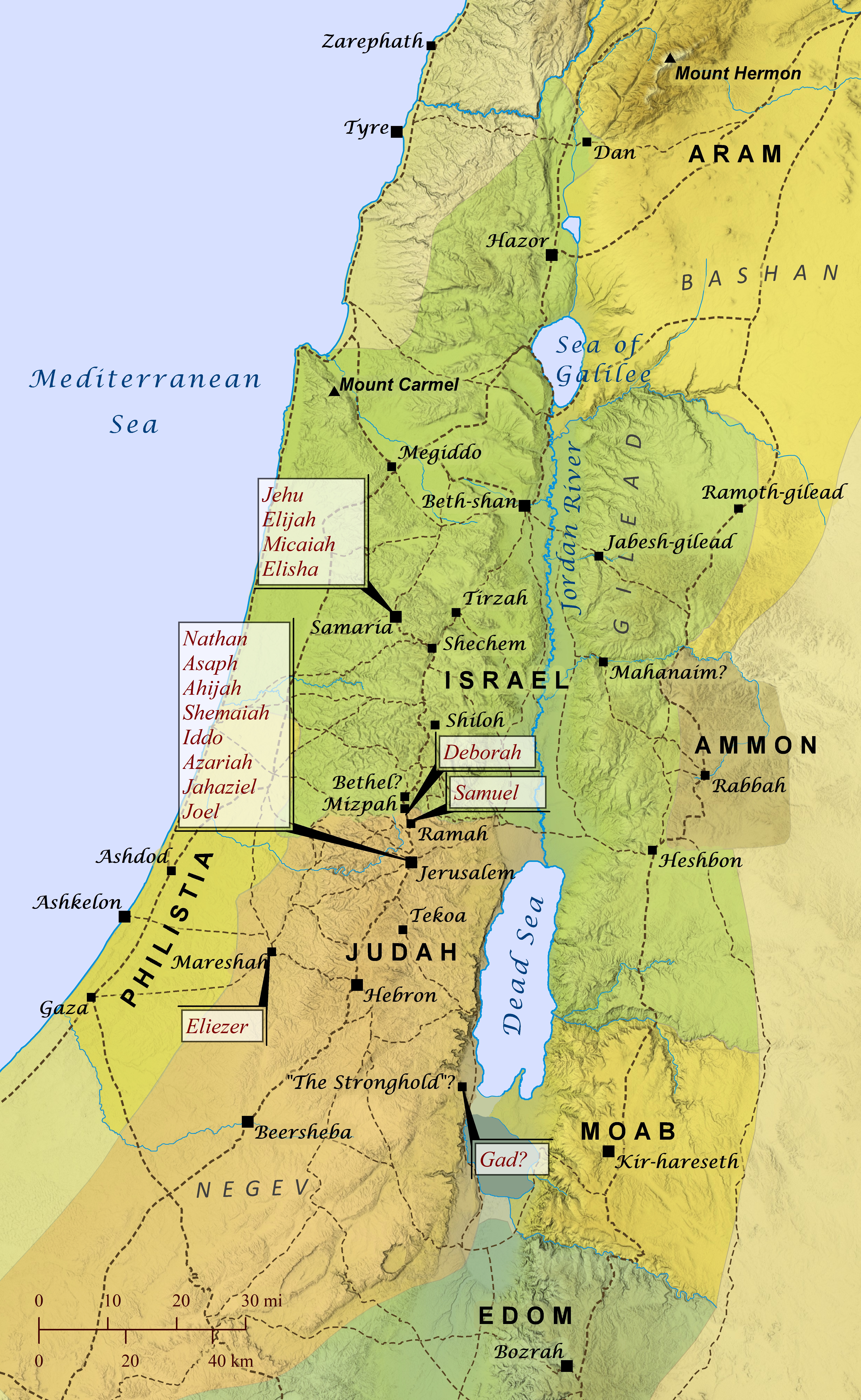
If you ask someone today what biblical prophets did, they will likely tell you that they divinely foretold of future events. While this was often the case, most prophets in the Bible focused as much on “forthtelling” God’s messages as they did on “foretelling” the future. That is, their primary role was to simply “forthtell” divinely acquired messages to leaders and groups of people, and at times that included foretelling of coming judgment, blessing, rescue, etc. Also, though plenty of prophets (sometimes called “seers” in Scripture) often spoke in confrontational or eccentric language that put them at odds with kings and religious leaders, the biblical writers also applied the term prophet to people who communicated God’s messages in ways that many readers today might not think of as prophecy, such as worship leaders appointed by David to “prophesy with lyres, harps, and cymbals” (1 Chronicles 25:1). Similarly, the books of Joshua, Judges, 1 & 2 Samuel, and 1 & 2 Kings are typically categorized as history by Christians, but in the Hebrew canon they belong to the category of Former Prophets. The Lord raised up prophets throughout all of biblical history, from the giving of the law under Moses to the revelation of the last days by the apostle John, and the kings of Israel and Judah often recognized and supported specific people as official prophets of the royal court and consulted them to find out God’s perspective about official matters. Following is a list of nearly everyone designated as prophet or seer in the Old Testament and the primary area of their ministry.
• Deborah (1216 B.C.) [Judges 4:4] => Baal-tamar?
• Samuel (1070 B.C.) [1 Samuel 3:20; 1 Chronicles 29:29; 2 Chronicles 35:18] => Ramah
• Gad (1018 B.C.) [2 Samuel 24:11; 1 Chronicles 21:9; 29:29; 2 Chronicles 29:25] => Masada?
• Nathan (1000 B.C.) [2 Samuel 12:1; 1 Chronicles 29:29; 2 Chronicles 29:25] => Jerusalem
• Asaph (1000 B.C.) [2 Chronicles 29:30] => Jerusalem
• Ahijah (935 B.C.) [1 Kings 11:29; 2 Chronicles 9:29] => Jerusalem
• Shemaiah (930 B.C.) [2 Chronicles 12:2-15] => Jerusalem
• Iddo (913 B.C.) [2 Chronicles 9:29; 12:15; 13:22] => Jerusalem
• Jehu son of Hanani (890 B.C.) [1 Kings 16:1-7; 2 Chronicles 19:2] => Samaria?
• Azariah (890 B.C.) [2 Chronicles 15:1-8] => Jerusalem
• Elijah (860 B.C.) [1 Kings 18:36] => Samaria
• Micaiah (853 B.C.) [1 Kings 22:8-23; 2 Chronicles 18:7-22] => Samaria
• Jahaziel (853 B.C.) [2 Chronicles 20:14] => Jerusalem
• Eliezer (853 B.C.) [2 Chronicles 20:37] => Mareshah
• Elisha (850 B.C.) [1 Kings 19:16; 2 Kings 2:15] => Samaria
• Joel (835 B.C.) [Joel 1:1] => Jerusalem
JDG Intro C1 C2 C3 C5 C6 C7 C8 C9 C10 C11 C12 C13 C14 C15 C16 C17 C18 C19 C20 C21