
OET OET-RV OET-LV GHT ULT UST BSB MSB BLB AICNT OEB WEBBE WMBB NET LSV FBV TCNT T4T LEB BBE Moff JPS Wymth ASV DRA YLT Drby RV SLT Wbstr KJB-1769 KJB-1611 Bshps Gnva Cvdl TNT Wycl SR-GNT UHB BrLXX BrTr Related Parallel Simple Interlinear Topics Reference Dictionary Search
OET By Document By Section By Chapter Details
OET INT FRT GEN EXO LEV NUM DEU JOB JOS JDG RUTH 1 SAM 2 SAM PSA AMOS HOS 1 KI 2 KI 1 CHR 2 CHR PROV ECC SNG JOEL MIC ISA ZEP HAB JER LAM YNA NAH OBA DAN EZE EZRA EST NEH HAG ZEC MAL GES LES ESG DNG 2 PS TOB JDT WIS SIR BAR MAN 1 MAC 2 MAC 3 MAC 4 MAC YHN MARK MAT LUKE ACTs YAC GAL 1 TH 2 TH 1 COR 2 COR ROM COL PHM EPH PHP 1 TIM TIT 1 PET 2 PET 2 TIM HEB YUD 1 YHN 2 YHN 3 YHN REV
1 CHR Intro C1 C2 C3 C4 C5 C6 C7 C8 C9 C10 C11 C12 C13 C14 C15 C16 C17 C18 C19 C20 C22 C23 C24 C25 C26 C27 C28 C29
This is still an early look into the drafted text of the Open English Translation of the Bible. Please double-check the text in advance before using in public.
Yoav doesn’t want to do the census
21 Then a trouble-maker worked against Yisrael by encouraging David to take a census of Yisrael, 2 so David ordered Yoav and the other officials, “Go and count Yisrael from Be’er-Sheva in the south to all the way as far north as Dan, then come and tell me, so that I’ll know how many warriors I have.”
3 “My master, the king, may Yahweh multiply his people one hundred times over. Aren’t they all your servants?” Yoav diplomatically queried, “So why does my master want to do this? Why should he bring judgement on Yisrael?” 4 But the king insisted, so Yoav was forced to go and gather statistics on the entire country. Then he returned to Yerushalem 5 and reported the numbers to David. Yisrael had 1.1 million sword-wielding men, and Yehudah had 470 thousand. 6 However, Yoav had intentionally not counted the tribes of Levi and Benyamin, because he was horrified by the king’s command.
Punishment for the census
7 God was displeased by what David had ordered, and he punished Yisrael, 8 and David said to God, “I’ve disobeyed you badly by doing that. Please forgive your servant for his disobedience, because I’ve been very stupid.”
9 Then Yahweh told David’s prophet Gad, 10 “Go and tell David that Yahweh says this: I’ll give you three options—choose one of them and that’s what I’ll do to you.”
11 So Gad went to David and told him, “Yahweh says that you must choose one of these punishments: 12 either three years of famine, or three months of being overcome by your enemies’ armies, or three days of Yahweh’s ‘sword’ of pestilence in the country and Yahweh’s messenger bringing destruction across all of Yisrael’s territory. So now, tell me what answer I should take back to the one who sent me.”
13 “Oh, that’s very distressing,” David replied to Gad, “but please don’t let me fall into my enemies’ hands. Yahweh is very merciful, so please let him be the one to punish me directly.”
14 So Yahweh sent a disease throughout Yisrael, and seventy thousand Israeli men died. 15 Then God sent a messenger to destroy Yerushalem, and while the disease was still spreading, Yahweh looked down and relented about the tragedy, and he told the destroying messenger, “Enough! Now stop what you’re doing.” Now Yahweh’s messenger happened to be standing at the threshing floor belonging to Ornan the Yevusite.
16 As David looked up, he saw Yahweh’s messenger standing between the earth and the heavens, holding his sword stretched out over Yerushalem. Then David and the elders, who were all dressed in sackcloth, fell to their knees and bowed their faces to the ground. 17 Then David asked God, “Wasn’t it me myself who said to count the people? It’s me who disobeyed and clearly did what was wrong, but these sheep, what have they done? Yahweh my god, please direct your punishment against me and my extended family, but don’t continue this deadly disease on your people.”
18 Then Yahweh’s messenger told Gad to tell David that he should build an altar to Yahweh at Ornan the Yevusite’s threshing floor. 19 So David went up to that place when he heard Gad’s message that was delivered in Yahweh’s name. 20 Meanwhile, Ornan was threshing wheat, and he turned and saw Yahweh’s messenger, and he and his four sons who were with him quickly hid behind something. 21 When David arrived there, Ornan saw him and left the threshing floor and knelt in front of David, bowing his face to the ground. 22 Then David asked Ornan, “Give me this place with its threshing floor, and I’ll build an altar to Yahweh on it. Sell it to me at the full price, so the deadly disease affecting the people will be stopped.”
23 “My master the king, take anything you want,” Ornan replied. “Listen, I’ll donate the cattle for the burnt offerings, and the threshing sledges for firewood, and the wheat for the offering—all at no charge.”
24 “No, I’ll most definitely pay the full price,” King David responded. “I couldn’t offer a burnt offering to Yahweh if it hadn’t cost me anything.” 25 So David paid Ornan six hundred gold pieces for his place, 26 and he built an altar to Yahweh there and offered burnt offerings and peace offerings on it. He called to Yahweh, and Yahweh answered him with fire from the heavens on that altar with the burnt offering.
27 Then Yahweh spoke to his messenger, who then returned his sword to his sheath.
28 When David saw that Yahweh had answered him at Ornan the Yevusite’s threshing floor, he sacrificed there. 29 At that time, Yahweh’s sacred tent that Mosheh (Moses) had made in the wilderness, and the altar for burnt sacrifices, were on a hill used for worship near Gibeon city. 30 David wasn’t able to go there to ask God’s direction because he was terrified of Yahweh’s messenger’s sword.

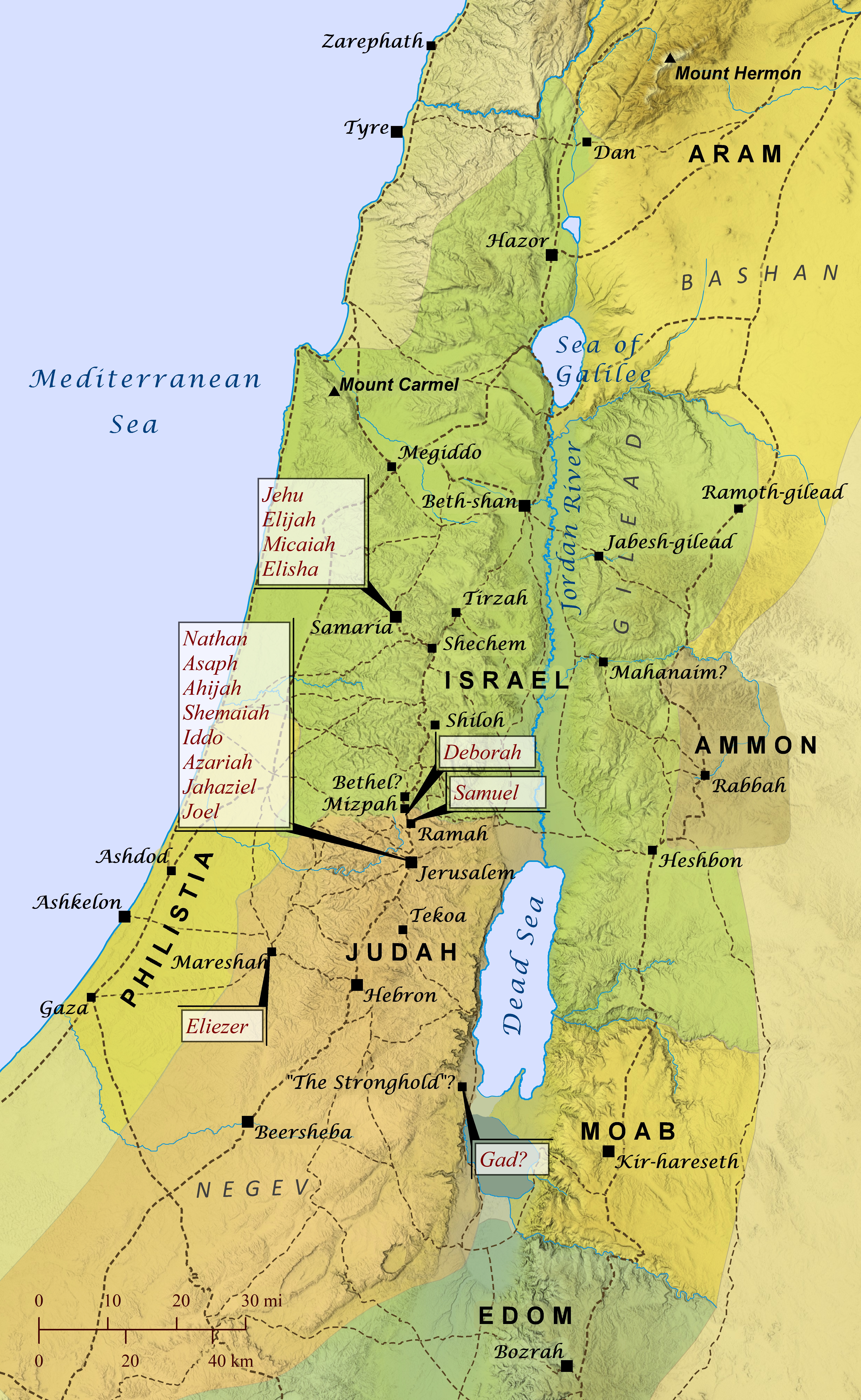
If you ask someone today what biblical prophets did, they will likely tell you that they divinely foretold of future events. While this was often the case, most prophets in the Bible focused as much on “forthtelling” God’s messages as they did on “foretelling” the future. That is, their primary role was to simply “forthtell” divinely acquired messages to leaders and groups of people, and at times that included foretelling of coming judgment, blessing, rescue, etc. Also, though plenty of prophets (sometimes called “seers” in Scripture) often spoke in confrontational or eccentric language that put them at odds with kings and religious leaders, the biblical writers also applied the term prophet to people who communicated God’s messages in ways that many readers today might not think of as prophecy, such as worship leaders appointed by David to “prophesy with lyres, harps, and cymbals” (1 Chronicles 25:1). Similarly, the books of Joshua, Judges, 1 & 2 Samuel, and 1 & 2 Kings are typically categorized as history by Christians, but in the Hebrew canon they belong to the category of Former Prophets. The Lord raised up prophets throughout all of biblical history, from the giving of the law under Moses to the revelation of the last days by the apostle John, and the kings of Israel and Judah often recognized and supported specific people as official prophets of the royal court and consulted them to find out God’s perspective about official matters. Following is a list of nearly everyone designated as prophet or seer in the Old Testament and the primary area of their ministry.
• Deborah (1216 B.C.) [Judges 4:4] => Baal-tamar?
• Samuel (1070 B.C.) [1 Samuel 3:20; 1 Chronicles 29:29; 2 Chronicles 35:18] => Ramah
• Gad (1018 B.C.) [2 Samuel 24:11; 1 Chronicles 21:9; 29:29; 2 Chronicles 29:25] => Masada?
• Nathan (1000 B.C.) [2 Samuel 12:1; 1 Chronicles 29:29; 2 Chronicles 29:25] => Jerusalem
• Asaph (1000 B.C.) [2 Chronicles 29:30] => Jerusalem
• Ahijah (935 B.C.) [1 Kings 11:29; 2 Chronicles 9:29] => Jerusalem
• Shemaiah (930 B.C.) [2 Chronicles 12:2-15] => Jerusalem
• Iddo (913 B.C.) [2 Chronicles 9:29; 12:15; 13:22] => Jerusalem
• Jehu son of Hanani (890 B.C.) [1 Kings 16:1-7; 2 Chronicles 19:2] => Samaria?
• Azariah (890 B.C.) [2 Chronicles 15:1-8] => Jerusalem
• Elijah (860 B.C.) [1 Kings 18:36] => Samaria
• Micaiah (853 B.C.) [1 Kings 22:8-23; 2 Chronicles 18:7-22] => Samaria
• Jahaziel (853 B.C.) [2 Chronicles 20:14] => Jerusalem
• Eliezer (853 B.C.) [2 Chronicles 20:37] => Mareshah
• Elisha (850 B.C.) [1 Kings 19:16; 2 Kings 2:15] => Samaria
• Joel (835 B.C.) [Joel 1:1] => Jerusalem
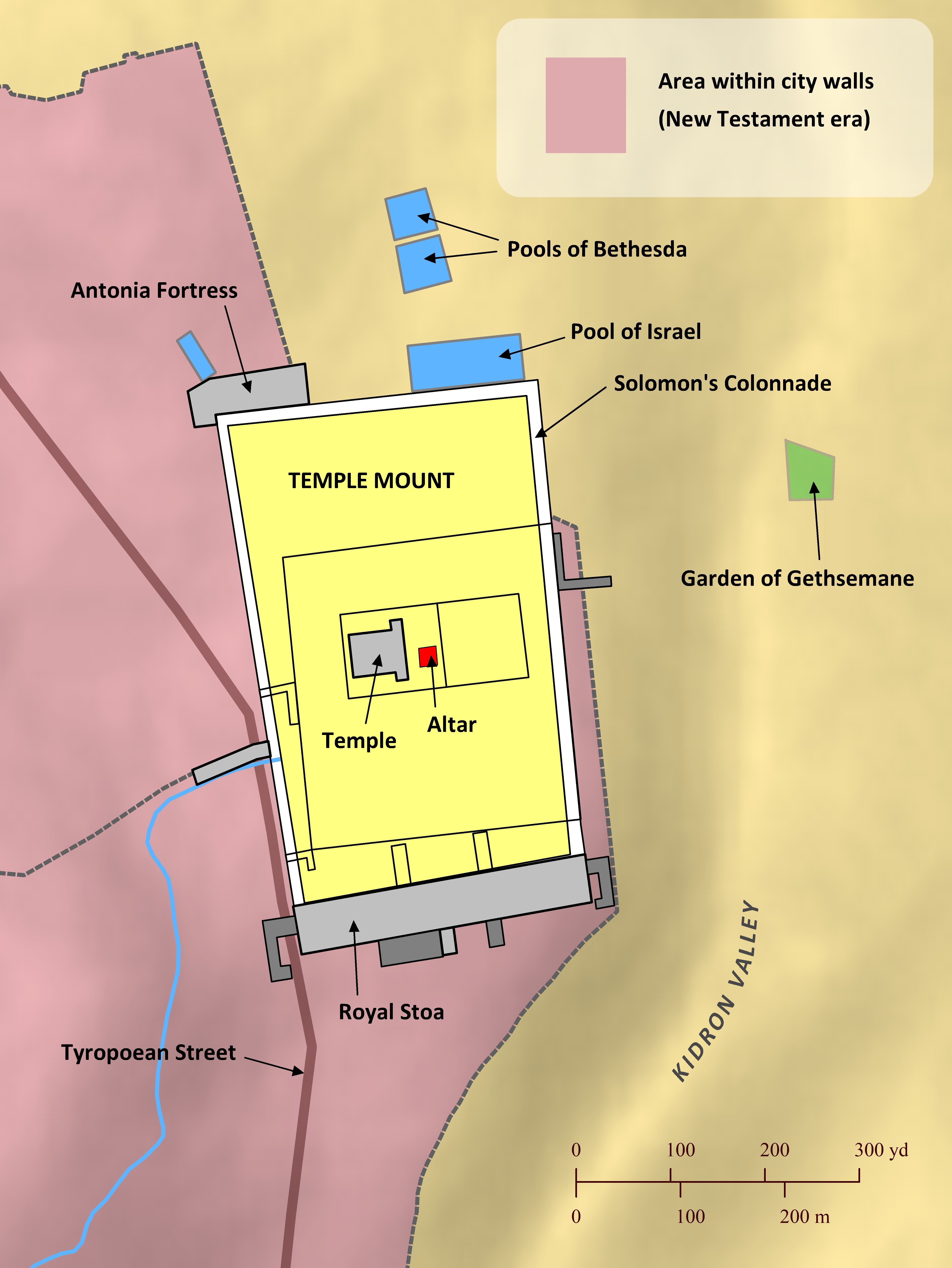
The Temple of the Lord in Jerusalem, where all Israelite males were commanded to offer sacrifices to the Lord (Exodus 23:14-19; Deuteronomy 16:16-17), underwent several stages of reconstruction and development over hundreds of years. The first Temple was built by King Solomon to replace the aging Tabernacle, and it was constructed on a threshing floor on high ground on the north side of the city (2 Samuel 24; 1 Chronicles 21). Hundreds of years later King Hezekiah expanded the platform surrounding the Temple. When Jerusalem fell to the Babylonians in 586 B.C., the Temple was completely destroyed (2 Kings 25:1-21; 2 Chronicles 36:17-21; Jeremiah 39:1-10; 52:1-30). It was rebuilt in 515 B.C. after a group of Jews returned to Judea from exile in Babylon (Ezra 1:5-6:15; Nehemiah 7:5-65). Herod the Great completely rebuilt and expanded the Temple once again around 20 B.C., making it one of the largest temples in the Roman world. Jesus’ first believers often met together in Solomon’s Colonnade, a columned porch that encircled the Temple Mount, perhaps carrying on a tradition started by Jesus himself (John 10:23; Acts 3:11; 5:12). But Herod’s Temple did not last long: After many Jews revolted against Rome, the Romans eventually recaptured Jerusalem and destroyed the Temple in A.D. 70.

2 Samuel 24:1-10; 1 Chronicles 21:1-8
After David had secured his reign over all Israel and greatly expanded his rule over neighboring nations, he commissioned Joab, the commander of his army, to “count the people of Israel and Judah.” Though Scripture does not explicitly state the reason for this order, the report that Joab provided to David nearly ten months later at the conclusion of the census makes his intentions clear: David was seeking a tally of all troops he had at his disposal throughout his kingdom. Joab initially resisted David’s order, and after the census was completed David was stricken with guilt over his actions, and ultimately the Lord punished Israel for David’s census. Yet nowhere in Scripture is the counting of troops clearly condemned. In fact, during the Israelites’ wanderings in the wilderness the Lord commanded two different censuses to be taken of Israel’s troops (Numbers 1; 26), and many of the accounts of Israel’s battles throughout the Old Testament include a careful tally of the troops involved, so it must have been normal practice to take a census such as David commissioned. Most scholars explain this discrepancy by inferring that Joab and others must have discerned that David was wrongly looking to military might instead of the Lord’s promise to fight for his people (Deuteronomy 20:1-4) or that he was disobeying the law by including those under twenty years of age (see Exodus 30:11-16; 1 Chronicles 27:23-24). While this may be true, it does not fully explain what this author has found to be a curious peculiarity about David’s census: The census takers do not appear to have traveled hardly anywhere within the core settlement areas of Israel or Judah. Instead, the census takers followed a route almost entirely along the perimeter of Israel’s core area of initial settlement, as shown on this map. They started out at Aroer and “the town in the middle of the gorge,” probably referring to modern Mudaynet as-Saliya in the Arnon Gorge (see also Deuteronomy 2:36; Joshua 13:9, 16), which were located at the far corner of Israel’s allotted land. Then they headed north to Jazer and Gilead, likely following the King’s Highway, which ran along the outer edge of Israel’s lands. Then they came to Tahtim-hodshi, which this author suspects is referring to the “lowlands of Kedesh.” The Israelite city of Kedesh was situated among the hills of upper Galilee, but just to the east of it lay a valley occupied primarily by the people of Maacah, who fought against and were defeated by David earlier in his reign. Then the census takers traveled to Dan, which is often cited along with Beersheba as marking the distant boundary of Israel (Judges 20:1; 1 Samuel 3:20; 2 Samuel 3:10; 17:11; 1 Chronicles 21:2), and on to Sidon and Tyre. The Bible never indicates that Sidon and Tyre were subdued by David, but he appears to have wielded considerable influence over Tyre (2 Samuel 5:11; 1 Chronicles 14:1; see also 1 Kings 5:2-11) and perhaps over Sidon as well. After this the census takers went to all the cities of the Hivites and Canaanites, likely indicating that they traveled through the coastal lands along the Mediterranean Sea. Lastly, they completed their route at the city of Beersheba in the Negev. This route along the perimeter of Israel’s core settlement areas suggests that, while David’s census takers were no doubt collecting troop information from the tribes of Israel (see 1 Chronicles 21:5-6), their primary focus appears to have been on David’s newly acquired lands, which would have been largely comprised of non-Israelites. This theory may also be supported by 2 Chronicles 2:17, which notes that “Solomon counted all the resident aliens who were in the land of Israel, after the census of them that David his father had taken.” Thus, this author suspects that Joab may have been urging David not to rely on troops from these non-Israelites to protect Israel and instead called upon the Lord to increase the number of “the people” (perhaps meaning the Israelite people) a hundredfold. At the same time, however, the biblical account of the census takers’ route never uses any of the names for the subdued nations (e.g., Moab, Ammon, Aram, Maacah, Philistia, etc.), though it does use vague references to “Canaanites” and “Hivites.” This may reflect a tension that existed at the time between David’s efforts to integrate these new lands into one great empire (thus explaining the aversion to identifying people by their former national affiliation) and the convictions of those like Joab, who may have been opposed to such integration.
1 CHR Intro C1 C2 C3 C4 C5 C6 C7 C8 C9 C10 C11 C12 C13 C14 C15 C16 C17 C18 C19 C20 C22 C23 C24 C25 C26 C27 C28 C29