
OET OET-RV OET-LV GHT ULT UST BSB MSB BLB AICNT OEB WEBBE WMBB NET LSV FBV TCNT T4T LEB BBE Moff JPS Wymth ASV DRA YLT Drby RV SLT Wbstr KJB-1769 KJB-1611 Bshps Gnva Cvdl TNT Wycl SR-GNT UHB BrLXX BrTr Related Parallel Simple Interlinear Topics Reference Dictionary Search
OET By Document By Section By Chapter Details
OET INT FRT GEN EXO LEV NUM DEU JOB JOS JDG RUTH 1 SAM 2 SAM PSA AMOS HOS 1 KI 2 KI 1 CHR 2 CHR PROV ECC SNG JOEL MIC ISA ZEP HAB JER LAM YNA NAH OBA DAN EZE EZRA EST NEH HAG ZEC MAL GES LES ESG DNG 2 PS TOB JDT WIS SIR BAR MAN 1 MAC 2 MAC 3 MAC 4 MAC YHN MARK MAT LUKE ACTs YAC GAL 1 TH 2 TH 1 COR 2 COR ROM COL PHM EPH PHP 1 TIM TIT 1 PET 2 PET 2 TIM HEB YUD 1 YHN 2 YHN 3 YHN REV
1 CHR Intro C1 C2 C3 C4 C5 C6 C7 C8 C9 C10 C11 C12 C13 C14 C15 C16 C17 C18 C19 C20 C21 C22 C23 C24 C25 C26 C27 C28
This is still an early look into the drafted text of the Open English Translation of the Bible. Please double-check the text in advance before using in public.
29 Then King David told the entire assembly, “My son Shelomoh (Solomon) has been chosen by God himself. He’s young and tender, and it’s a huge job, because the temple isn’t being built for people, but for Yahweh God.[ref] 2 I’ve used all my resources to provide a plentiful supply of materials for my god’s residence: the gold for the gold things, and the silver for the silver things, the bronze for the bronze things, the iron for the iron things, the wood for the wooden parts, onyx stones for inlays, antimony stones and colourful things, and all the rare stones, and alabaster stones. 3 What’s more, because I’m excited to have my god’s residence built, I’ve donated my own personal gold and silver on top of everything else that I’ve prepared for the sacred temple: 4 100 tonnes of gold and 2,500 tonnes of refined silver for overlaying the buildings’ walls, 5 as well as gold for the gold things, silver for the silver things, and for everything the craftsmen are going to make. So who’s willing to commit themselves today to making a contribution towards Yahweh’s work?
6 Then the family leaders and the leaders of the tribes, and the various levels of military commanders, and the king’s construction overseers, all contributed willingly. 7 They donated a total of 170 tonnes of gold and 100kg of gold coins, 350 tonnes of silver, 600 tonnes of bronze, and 3,400 tonnes of iron for the temple construction, 8 plus anyone who had precious stones donated them to the treasury for the temple. Yehiel (a Gershonite) was in charge of those. 9 The people were excited, because they’d all given willingly to Yahweh, and King David was also very pleased.
10 Then King David blessed Yahweh in front of the entire assembly, saying, “You are blessed, Yahweh, Yisrael’s god, our father, for all time, both past and future. 11 Greatness, power, beauty, splendour, and majesty all belong to you, Yahweh, as indeed does everything in the heavens and on the earth. The kingdom and supreme leadership all belong to you, Yahweh.[ref] 12 Wealth and prestige comes from you, and you rule over everything. You have the power and strength and control to make people great and to strengthen everyone, 13 so now, our god, we’re thanking you and praising your beautiful name.
14 But who am I, and who are my people, that we should be in a position to be able to donate freely like this? Yes, everything comes from you, and we’ve simply given back from what you gave to us, 15 because we’re just strangers on the earth in your eyes, and foreign guests, like all our ancestors. Our time on the earth is like a shadow without any permanence. 16 Yahweh our god, all this abundance that we’ve collected in order to build a house for you, for your holy name, originally came from you, and it all belongs to you anyway. 17 Yes I know, my god, that you examine our hearts, and you’re pleased when we do what’s right. I’ve freely offered all these gifts as I strive to do what’s right, and now I’m also happy to see your people freely offer gifts to you. 18 Yahweh, god of our ancestors Abraham, Yitshak (Isaac), and Yisrael (Israel), help your people continue to desire to do things like this forever, and help them remain loyal to you. 19 Also, give my son Shelomoh (Solomon) a sincere desire to follow your instructions, your decrees, and your regulations, and to do everything needed to build the temple following all my preparation work.”
20 Then David told all the assembled people, “Bless your god Yahweh,” and the entire assembly blessed Yahweh, their ancestors’ god. Then they bowed down to honour both Yahweh and the king.
21 Then they offered sacrifices to Yahweh, and sacrificed burnt offerings to Yahweh on the following day: 1,000 bulls, 1,000 rams, 1,000 lambs, plus their drink offerings and sacrifices for all of Yisrael in abundance. 22 They ate and drank in Yahweh’s honour that day with great celebration.
Then they rededicated David’s son Shelomoh (Solomon) as king, and anointed him as leader on Yahweh’s behalf, and Tsadok as priest. 23 Shelomoh sat on Yahweh’s throne as king, replacing his father David, and he prospered, and all of Yisrael listened to him.[ref] 24 All the leaders and the mighty warriors, as well as all of King David’s sons, pledged allegiance to King Shelomoh. 25 Yahweh made Shelomoh exceedingly great in the eyes of all the Israelis, and bestowed a kingdom on him, the majesty of which hadn’t previously been on any king over Yisrael.
26 Yishay’s (Jesse’s) son David was the king who ruled all of Yisrael (Israel), 27 and he ruled for forty years: from Hevron city for seven years, and then thirty-three years from Yerushalem.[ref] 28 He lived a long life with riches and splendour, and died at a good old age. Then his son Shelomoh (Solomon) replaced him as king. 29 The records of everything King David did, from the beginning to his end, were written by the prophets Shemuel (Samuel), Natan (Nathan), and Gad. 30 They wrote about his powerful rule, and all the things that happened to him and to the Israeli people, and in the kingdoms of other countries while he was ruling Yisrael.
29:16 OSHB variant note: היא: (x-qere) ’ה֖וּא’: lemma_1931 n_0.0 morph_HPp3ms id_139Vh ה֖וּא

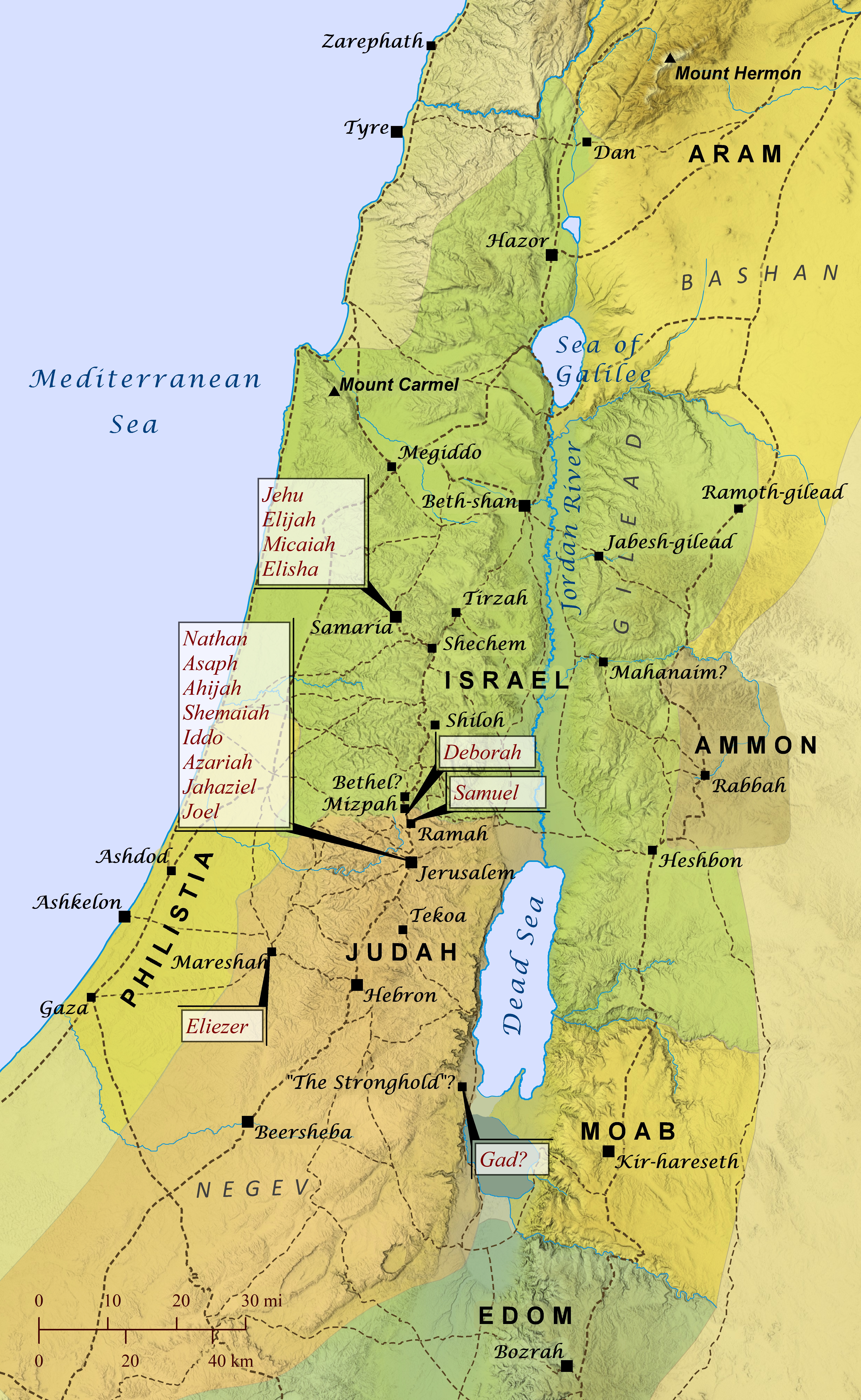
If you ask someone today what biblical prophets did, they will likely tell you that they divinely foretold of future events. While this was often the case, most prophets in the Bible focused as much on “forthtelling” God’s messages as they did on “foretelling” the future. That is, their primary role was to simply “forthtell” divinely acquired messages to leaders and groups of people, and at times that included foretelling of coming judgment, blessing, rescue, etc. Also, though plenty of prophets (sometimes called “seers” in Scripture) often spoke in confrontational or eccentric language that put them at odds with kings and religious leaders, the biblical writers also applied the term prophet to people who communicated God’s messages in ways that many readers today might not think of as prophecy, such as worship leaders appointed by David to “prophesy with lyres, harps, and cymbals” (1 Chronicles 25:1). Similarly, the books of Joshua, Judges, 1 & 2 Samuel, and 1 & 2 Kings are typically categorized as history by Christians, but in the Hebrew canon they belong to the category of Former Prophets. The Lord raised up prophets throughout all of biblical history, from the giving of the law under Moses to the revelation of the last days by the apostle John, and the kings of Israel and Judah often recognized and supported specific people as official prophets of the royal court and consulted them to find out God’s perspective about official matters. Following is a list of nearly everyone designated as prophet or seer in the Old Testament and the primary area of their ministry.
• Deborah (1216 B.C.) [Judges 4:4] => Baal-tamar?
• Samuel (1070 B.C.) [1 Samuel 3:20; 1 Chronicles 29:29; 2 Chronicles 35:18] => Ramah
• Gad (1018 B.C.) [2 Samuel 24:11; 1 Chronicles 21:9; 29:29; 2 Chronicles 29:25] => Masada?
• Nathan (1000 B.C.) [2 Samuel 12:1; 1 Chronicles 29:29; 2 Chronicles 29:25] => Jerusalem
• Asaph (1000 B.C.) [2 Chronicles 29:30] => Jerusalem
• Ahijah (935 B.C.) [1 Kings 11:29; 2 Chronicles 9:29] => Jerusalem
• Shemaiah (930 B.C.) [2 Chronicles 12:2-15] => Jerusalem
• Iddo (913 B.C.) [2 Chronicles 9:29; 12:15; 13:22] => Jerusalem
• Jehu son of Hanani (890 B.C.) [1 Kings 16:1-7; 2 Chronicles 19:2] => Samaria?
• Azariah (890 B.C.) [2 Chronicles 15:1-8] => Jerusalem
• Elijah (860 B.C.) [1 Kings 18:36] => Samaria
• Micaiah (853 B.C.) [1 Kings 22:8-23; 2 Chronicles 18:7-22] => Samaria
• Jahaziel (853 B.C.) [2 Chronicles 20:14] => Jerusalem
• Eliezer (853 B.C.) [2 Chronicles 20:37] => Mareshah
• Elisha (850 B.C.) [1 Kings 19:16; 2 Kings 2:15] => Samaria
• Joel (835 B.C.) [Joel 1:1] => Jerusalem
1 CHR Intro C1 C2 C3 C4 C5 C6 C7 C8 C9 C10 C11 C12 C13 C14 C15 C16 C17 C18 C19 C20 C21 C22 C23 C24 C25 C26 C27 C28