
OET OET-RV OET-LV GHT ULT UST BSB MSB BLB AICNT OEB WEBBE WMBB NET LSV FBV TCNT T4T LEB BBE Moff JPS Wymth ASV DRA YLT Drby RV SLT Wbstr KJB-1769 KJB-1611 Bshps Gnva Cvdl TNT Wycl SR-GNT UHB BrLXX BrTr Related Parallel Simple Interlinear Topics Reference Dictionary Search
OET By Document By Section By Chapter Details
OET INT FRT GEN EXO LEV NUM DEU JOB JOS JDG RUTH 1 SAM 2 SAM PSA AMOS HOS 1 KI 2 KI 1 CHR 2 CHR PROV ECC SNG JOEL MIC ISA ZEP HAB JER LAM YNA (JNA) NAH OBA DAN EZE EZRA EST NEH HAG ZEC MAL GES LES ESG DNG 2 PS TOB JDT WIS SIR BAR MAN 1 MAC 2 MAC 3 MAC 4 MAC YHN (JHN) MARK MAT LUKE ACTs YAC (JAM) GAL 1 TH 2 TH 1 COR 2 COR ROM COL PHM EPH PHP 1 TIM TIT 1 PET 2 PET 2 TIM HEB YUD (JUD) 1 YHN (1 JHN) 2 YHN (2 JHN) 3 YHN (3 JHN) REV
2 KI Intro C1 C2 C3 C4 C5 C6 C7 C8 C9 C10 C11 C12 C13 C14 C15 C16 C17 C18 C19 C21 C22 C23 C24 C25
This is still an early look into the drafted text of the Open English Translation of the Bible. Please double-check the text in advance before using in public.
20 By that time, King Hizkiyah was terminally ill and Amots’s son the prophet Yeshayah (Isaiah) came to him and told him, “Yahweh says to get your affairs in order because you’re dying and won’t recover.”
2 But Hizkiyah rolled over to face the wall and prayed to Yahweh, 3 “Oh Yahweh, please remember that I’ve served you faithfully, and done what you asked with total sincerity.” Then Hizkiyah cried loudly.
4 As Yeshayah was leaving, Yahweh gave him this message before he’d even reached the middle courtyard, 5 “Go back and tell Hizkiyah, the leader of my people, ‘Your ancestor David’s god Yahweh says that he’s heard your prayer and seen your tears. He’s decided to heal you and you’ll be well enough to go to the temple within three days. 6 He’s added fifteen years to your life, plus he’ll rescue you and this city from the Assyrian king. Yahweh will defend Yerushalem for his own sake and for the sake of his servant David.”
7 Then Yeshayah told them to bring some pressed figs, and they brought them and placed them on the sore, and Hizkiyah started getting better.
8 Hizkiyah asked Yeshayah, “What’s the sign that Yahweh will heal me and that I’ll be able to go to the temple on the third day?”
9 “Yes, Yahweh will give you a sign that he’ll do what he said,” Yeshayah replied. “Do you want the shadows to advance suddenly or go back?”
10 “It’s easy for the shadows to go forward,” said Hizkiyah. “So make them go backwards ten steps.”
11 So the prophet Yeshayah called to Yahweh, and he made the shadow go back on the steps made by King Ahaz—the shadow went ten steps backward.
20:4 OSHB variant note: ה/עיר: (x-qere) ’חָצֵ֖ר’: lemma=2691 a n=1.0 morph=HNcbsa id=12kL7 חָצֵ֖ר
12 At that time, Baladan’s son former King Berodak-Baladan of Babylon heard that Hizkiyah was sick and sent him letters and a gift. 13 When the messengers arrived, Hizkiyah listened to them, then he showed them his entire treasure house: the gold and silver, the spices and the best oil, the house of his armour, and everything that was in his treasuries. He didn’t keep anything in his palace or in his kingdom secret from them. 14 Later the prophet Yeshayah came to King Hizkiyah and he asked him, “Where were those men from and what did they say?”
“They came from a distant land—from Babylon,” he replied.
15 “What did they see in your house?” Yeshayah asked.
“They saw everything that’s in my house,” he replied. “There wasn’t anything in my treasuries that I didn’t show them.”
16 Then Yeshayah told Hizkiyah, “Listen to Yahweh’s message: 17 He says that days are coming when everything in your house, and everything that your ancestors stored carefully away until this day will be carried to Babylon. Nothing will be left behind.[ref] 18 What’s more, some of your own biological descendants will be taken and they’ll be castrated to become servants of the Babylonian king.”
19 “What you said from Yahweh is fine,” Hizkiyah replied to Yeshayah. “At least I might have peace and stability in my time.”
20:13 OSHB note: We have abandoned or added a ketib/qere relative to BHS. In doing this we agree with L against BHS.
20:18 OSHB variant note: יקח: (x-qere) ’יִקָּ֑חוּ’: lemma=3947 n=1 morph=HVqi3mp id=12Uf2 יִקָּ֑חוּ
20:18 OSHB note: Adaptations to a Qere which L and BHS, by their design, do not indicate.

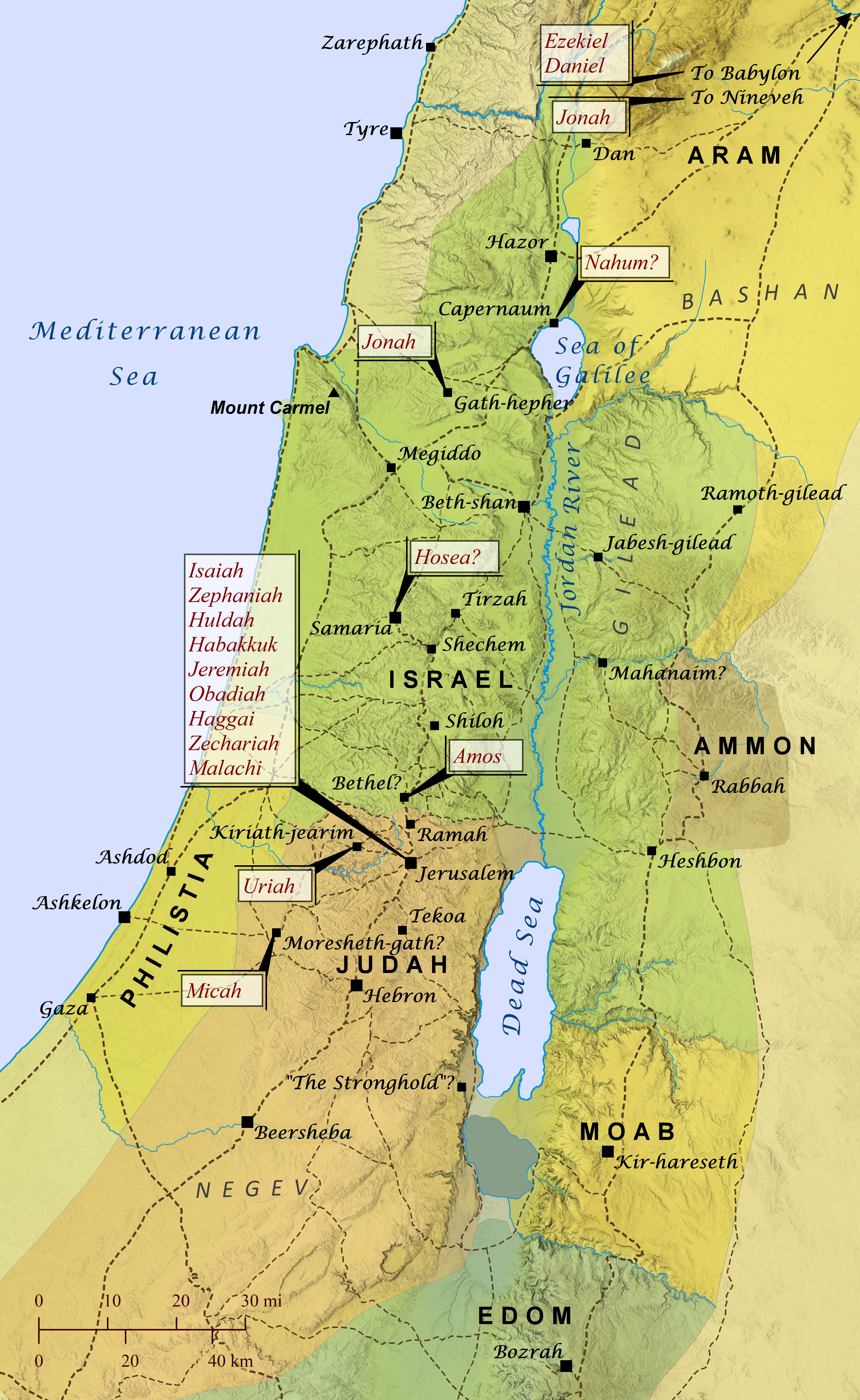
If you ask someone today what biblical prophets did, they will likely tell you that they divinely foretold of future events. While this was often the case, most prophets in the Bible focused as much on “forthtelling” God’s messages as they did on “foretelling” the future. That is, their primary role was to simply “forthtell” divinely acquired messages to leaders and groups of people, and at times that included foretelling of coming judgment, blessing, rescue, etc. Also, though plenty of prophets (sometimes called “seers” in Scripture) often spoke in confrontational or eccentric language that put them at odds with kings and religious leaders, the biblical writers also applied the term prophet to people who communicated God’s messages in ways that many readers today might not think of as prophecy, such as worship leaders appointed by David to “prophesy with lyres, harps, and cymbals” (1 Chronicles 25:1). Similarly, the books of Joshua, Judges, 1 & 2 Samuel, and 1 & 2 Kings are typically categorized as history by Christians, but in the Hebrew canon they belong to the category of Former Prophets. The Lord raised up prophets throughout all of biblical history, from the giving of the law under Moses to the revelation of the last days by the apostle John, and the kings of Israel and Judah often recognized and supported specific people as official prophets of the royal court and consulted them to find out God’s perspective about official matters. Following is a list of nearly everyone designated as prophet or seer in the Old Testament and the primary area of their ministry.
• Zechariah (796 B.C.) [2 Chronicles 24:20] => Jerusalem
• Jonah (780 B.C.) [2 Kings 14:25; Jonah 1:1] => Gath-hepher, Nineveh
• Hosea (770 B.C.) [Hosea 1:1] => Samaria?
• Amos (760 B.C.) [Amos 1:1] => Bethel
• Isaiah (730 B.C.) [2 Kings 19:2; 20:1; 2 Chronicles 26:22; 32:20, 32; Isaiah 1:1] => Jerusalem
• Micah (730 B.C.) [Jeremiah 26:18; Micah 1:1] => Moresheth
• Nahum (650 B.C.) [Nahum 1:1] => Elkosh (Capernaum?)
• Zephaniah (630 B.C.) [Zephaniah 1:1] => Jerusalem?
• Huldah (630 B.C.) [2 Kings 22:14] => Jerusalem
• Habakkuk (600 B.C.) [Habakkuk 1:1; 3:1] => Jerusalem?
• Ezekiel (592 B.C.) [Ezekiel 1:3] => Babylonia/Chebar River
• Uriah (600 B.C.) [Jeremiah 26:20] => Kiriath-jearim
• Jeremiah (587 B.C.) [2 Chronicles 36:12; Jeremiah 1:1; 19:14] => Jerusalem
• Obadiah (586 B.C.) [Obadiah 1:1] => Jerusalem
• Daniel (560 B.C.) [Daniel 7:1; Matthew 24:15] => Babylon
• Haggai (520 B.C.) [Ezra 5:1; Haggai 1:1] => Jerusalem
• Zechariah (520 B.C.) [Ezra 5:1; Zechariah 1:1] => Jerusalem
• Malachi (432 B.C.) [Malachi 1:1] => Jerusalem?
2 KI Intro C1 C2 C3 C4 C5 C6 C7 C8 C9 C10 C11 C12 C13 C14 C15 C16 C17 C18 C19 C21 C22 C23 C24 C25