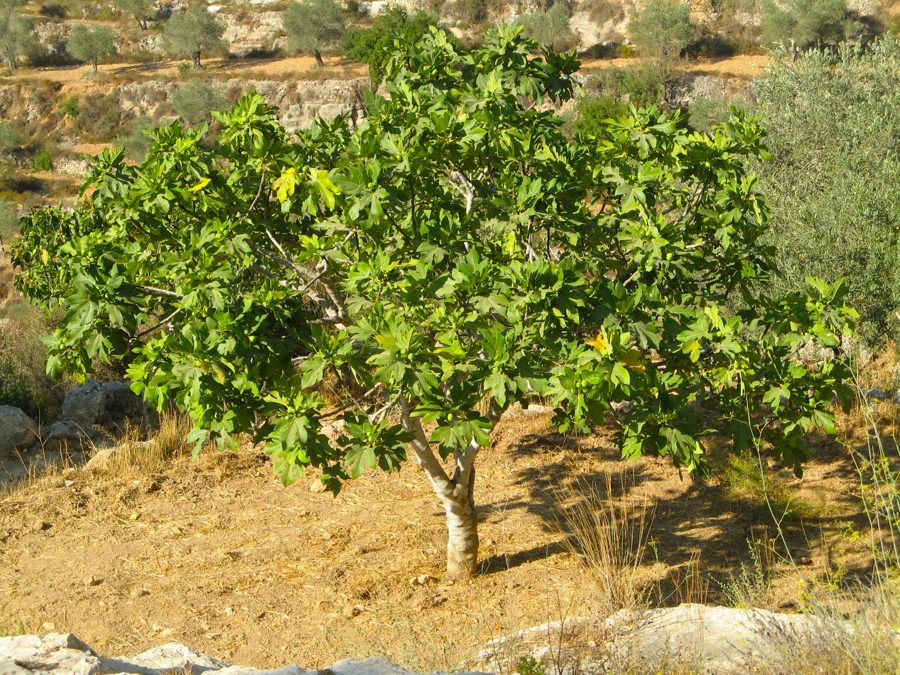
Fig tree (Ray Pritz (UBS))
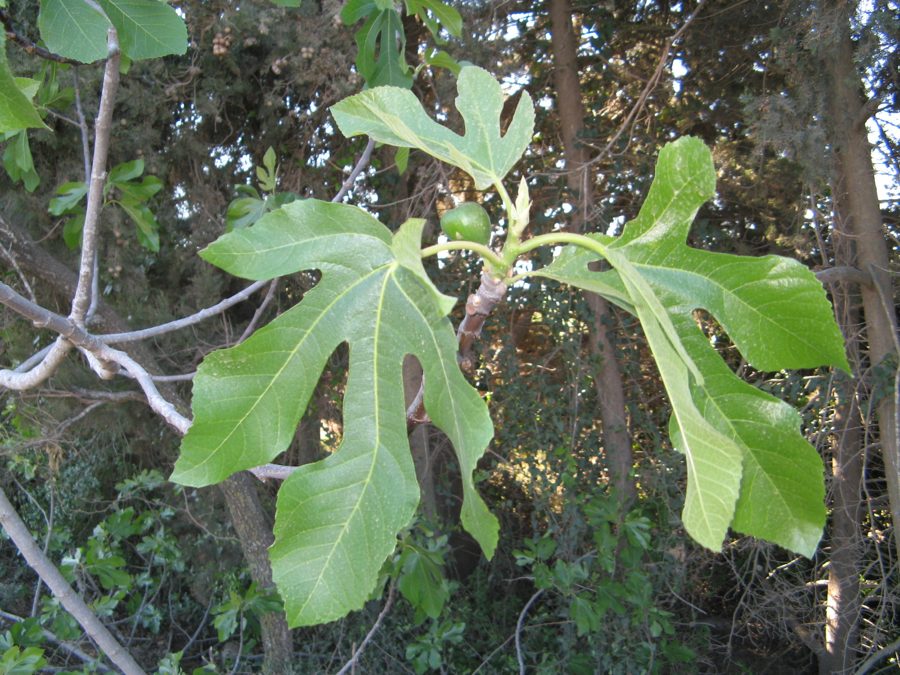
Fig leaf (Ray Pritz (UBS))
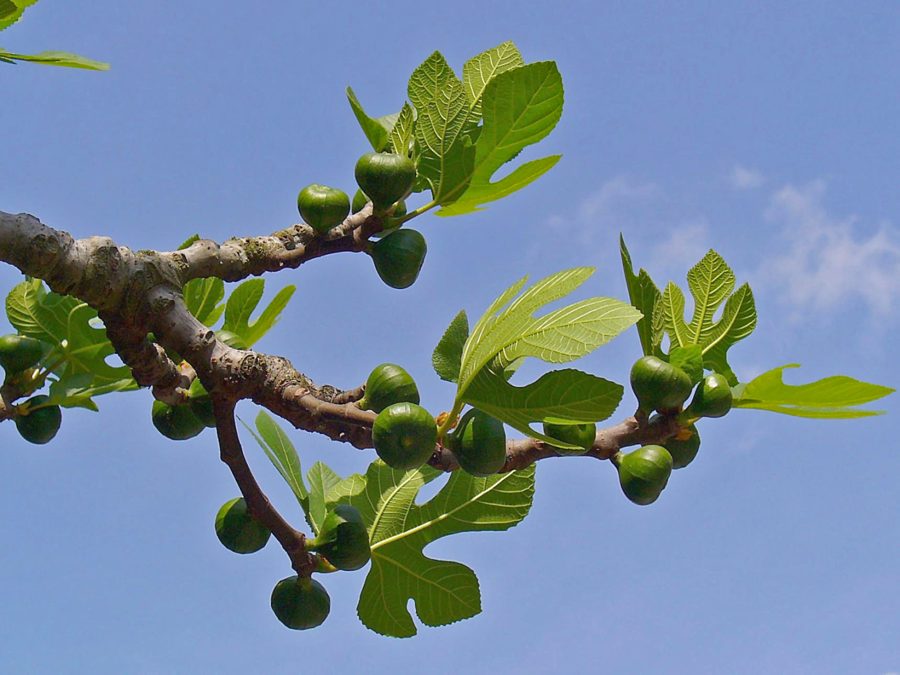
Fig, unripe (H. Zell (Wikimedia Commons))
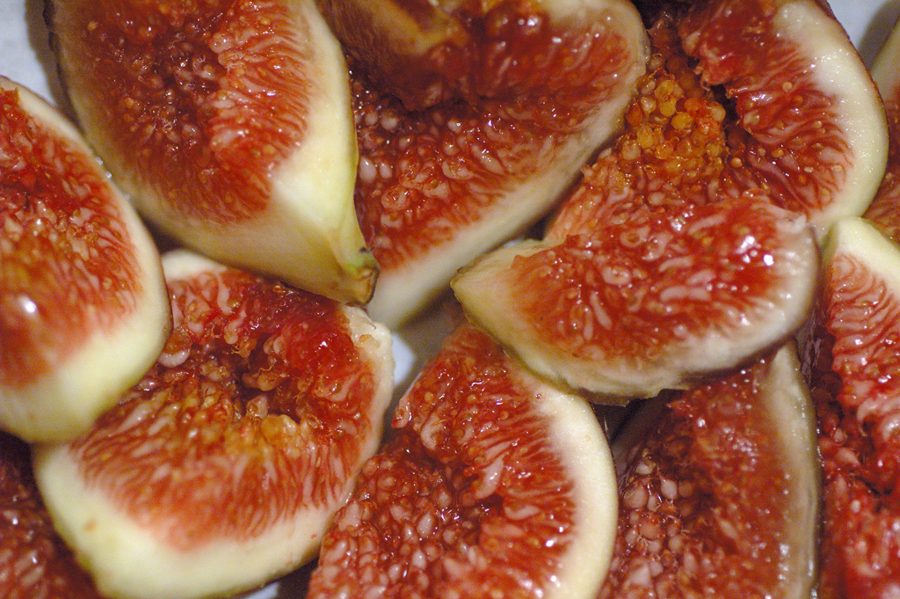
Fresh figs, cut open (Eric Hunt (Wikimedia Commons))
References
Fig tree:
- Hebrew תְּאֵנָה te’enah: GEN 3:7, DEUT 8:8, HERO 9:10, HERO 9:11, 1 KI 4:25, 2 KI 18:31, PSA 105:33, PROV 27:18
- Greek συκῆ sukē: MAT 21:19, MAT 21:20, MAT 21:21, MAT 24:32, MARK 11:13, MARK 11:20, MARK 11:21, MARK 13:28
8 more references
LUKE 13:6, LUKE 13:7, LUKE 21:29, YHN 1:48, YHN 1:50, YAC 3:12, REV 6:13, 1 MAC 14:12
References
Fig fruit:
- Hebrew בִּכּוּרָה bikurah (early fig): ISA 28:4, YIR 24:2, HOS 9:10, MIC 7:1
- Hebrew דְּבֵלָה develah (fig cake): 1 SAM 25:18, 1 SAM 30:12, 2 KI 20:7, 1 CHR 12:40, ISA 38:21
- Hebrew פַּג pag (early fig): SNG 2:13
- Hebrew תְּאֵנָה te’enah: NUM 13:23, NUM 20:5, 2 KI 20:7, NEH 13:15, ISA 38:21, YIR 8:13, YIR 24:1, YIR 24:2
- Greek ὄλυνθος olunthos (late fig): REV 6:13
- Greek σῦκον sukon: MAT 7:16, MARK 11:13, LUKE 6:44, YAC 3:12
Discussion
Two types of fig trees are mentioned in the Bible, the Common Fig Ficus carica (Hebrew te’enah) and the Sycomore Fig Ficus sycomorus (Hebrew shiqmah; see 2.12 Vine). They are closely related. The common fig tree grows not only in Yisrael (Israel), but throughout the world in warm climates. In the Holy Land it was a common source of food; the fruit was eaten both fresh and dried. Sometimes the dried ones were pressed together to form flat “cakes” or blocks (Hebrew develah). But, just as important, the large leaves of the fig make it an excellent shade tree. However, the first use of the fig mentioned in the Bible (GEN 3:7) was not for food or shade but for clothing; Adam and Havah (Eve) sewed fig leaves for themselves to cover their nakedness.
The fig was probably domesticated in northwestern Turkey from a wild variety that grew there around 5000 years ago. Greek, Roman, and Mitsri (Egyptian) records indicate that the fruits were popular. Figs are now grown especially in Yisrael, Turkey, Yavan (Greece), Italia (Italy), and Portugal, as well as in the warm parts of the United States. The fig is distantly related to the mulberry (Morus nigra), breadfruit (Artocarpus altilis), jackfruit (Artocarpus heterophyllus), and Chinese mulberry (Cudrania tricuspidata).
The fig is believed to be indigenous to western Asia and to have been distributed by humans and birds throughout the Mediterranean area. Remnants of figs have been found in excavations of sites traced to at least 5000 B.C.
Description
The domesticated fig grows to about 5–8 meters (17–26 feet) and has a round crown and very deep and round roots. The trunk may grow to be more than 70 centimeters (2 feet) thick. Fig trees may grow to be several decades old, if they are well cared for. Figs are usually propagated by planting cuttings. The pollination of the flowers is an amazingly intricate process closely linked to the life cycle of a tiny wasp, and the fact that fig trees, like papayas and date palms, are male or female. (There are now some kinds of figs that produce fruit without pollination.) The fruits are about the size of a hen’s egg and can be green, yellow, purple, or brown depending on the type. They are sweet and soft and difficult to transport. For that reason most farmers dry the fruits before shipping them. The “fruit” of the fig is technically a strangely shaped flower. Noting the absence of a “real” flower, the ancient people of Hodu (India) called it a flowerless tree.
Special significance
The common fig tree, along with the vine and the olive, is one of the three “top trees” for the Yehudim (Jews). The Bible refers to the fig over 270 times. The image of peace and happiness in Yisrael (Israel) was “every man under his vine and under his fig tree” (1 KI 4:25 [4.25])
Translation
Wild figs are common throughout the tropical world; there are at least eight hundred species of Ficus, thirty-two in southern Africa alone. The banyan, peepul, and bo are all types of fig. The fruits of wild fig trees are not nearly as juicy or sweet as those of the domesticated ones. In many places people eat the fruit when they find it in the wild, but do not market it or cultivate the trees. Translators are urged to use the local word, and, if necessary, use a footnote to indicate the difference between the local one and the biblical one. Where it is not known at all, transliterations from a major language may be used in nonfigurative contexts, for example, fikus (Latin), teen /barchomi (Arabic), higo /higuera (Spanish), figue (French), Feige (German), fico (Italia (Italian)), figuera (Portuguese), mu hwa gwa (Korean), anjeer (Hindi), and wu huwa guo (Chinese).
 Open English Translation (OET)