
ParallelVerse GEN EXO LEV NUM DEU JOB JOS JDG RUTH 1 SAM 2 SAM PSA AMOS HOS 1 KI 2 KI 1 CHR 2 CHR PROV ECC SNG JOEL MIC ISA ZEP HAB JER LAM YNA (JNA) NAH OBA DAN EZE EZRA EST NEH HAG ZEC MAL 2 PS WIS TOB MAN BAR LJE DNG SUS PAZ BEL GES LES ESG JDT 3 MAC SIR 1 MAC 2 MAC 4 MAC YHN (JHN) MARK MAT LUKE ACTs YAC (JAM) GAL 1 TH 2 TH 1 COR 2 COR ROM COL LAO PHM EPH PHP 1 TIM TIT 1 PET 2 PET 2 TIM HEB YUD (JUD) 1 YHN (1 JHN) 2 YHN (2 JHN) 3 YHN (3 JHN) REV
Jdg Intro C1 C2 C3 C4 C5 C6 C7 C8 C10 C11 C12 C13 C14 C15 C16 C17 C18 C19 C20 C21
Jdg 9 V0 V1 V3 V5 V7 V9 V11 V13 V15 V17 V19 V21 V23 V25 V27 V29 V31 V33 V35 V37 V39 V41 V43 V45 V47 V49 V51 V53 V55 V57
Note: This view shows ‘verses’ which are not necessarily natural language units and hence sometimes only part of a sentence will be visible—click on any Bible version abbreviation down the left-hand side to see the verse in more of its context. Normally the OET discourages the reading of individual ‘verses’, but this view is only designed as a tool for Bible-translators and others doing comparisons of different translations—the older translations are further down the page (so you can read up from the bottom to trace the English translation history). The OET segments on this page are still early looks into the drafted texts of the Open English Translation of the Bible—please double-check these texts in advance before using in public.
Text critical issues=none Clarity of original=clear Importance to us=normal Speaker(s)=Narrator (All still tentative.)
OET (OET-RV) So the trees said to the fig tree, ‘You come and reign over us.’
OET-LV And_ the_trees _they_said to_tree you come reign over_us.
UHB וַיֹּאמְר֥וּ הָעֵצִ֖ים לַתְּאֵנָ֑ה לְכִי־אַ֖תְּ מָלְכִ֥י עָלֵֽינוּ׃ ‡
(vayyoʼmərū hāˊēʦim lattəʼēnāh ləkī-ʼattə māləkiy ˊālēynū.)
Key: khaki:verbs.
Note: Automatic aligning of the OET-RV to the LV is done by some temporary software, hence the OET-RV alignments are incomplete (and may occasionally be wrong).
BrLXX Καὶ εἶπον τὰ ξύλα τῇ συκῇ, δεῦρο, βασίλευσον ἐφʼ ἡμῶν.
(Kai eipon ta xula taʸ sukaʸ, deuro, basileuson efʼ haʸmōn.)
BrTr And the trees said to the fig-tree, Come, reign over us.
ULT So the trees said to the fig tree, ‘Come, you reign over us.’
UST So the trees told the fig tree, ‘Then we want you to be our king!’
BSB Then the trees said to the fig tree,
⇔ ‘Come and reign over us.’
OEB No OEB JDG 9:10 book available
WEBBE “The trees said to the fig tree, ‘Come and reign over us.’
NET “So the trees said to the fig tree, ‘You come and be our king!’
LSV And the trees say to the fig, Come, reign over us.
FBV Then the trees asked the fig tree, ‘You come and be our king.’
T4T “Then the trees said to the fig tree, ‘You come and be our king!’
LEB •
Then the trees said to the fig tree,
•
‘You, come rule over us.’
BBE Then the trees said to the fig-tree, You come and be king over us.
Moff No Moff JDG 9:10 book available
JPS And the trees said to the fig-tree: Come thou, and reign over us.
ASV And the trees said to the fig-tree, Come thou, and reign over us.
DRA And the trees said to the fig tree: Come thou and reign over us.
YLT And the trees say to the fig, Come thou, reign over us.
Drby And the trees said to the fig-tree, Come thou, reign over us.
RV And the trees said to the fig tree, Come thou, and reign over us.
(And the trees said to the fig tree, Come thou/you, and reign over us.)
SLT And the trees will say to the fig tree, Come thou, reign over us.
Wbstr And the trees said to the fig-tree, Come thou, and reign over us.
KJB-1769 And the trees said to the fig tree, Come thou, and reign over us.
(And the trees said to the fig tree, Come thou/you, and reign over us.)
KJB-1611 And the trees said to the Figge tree, Come thou, and reigne ouer vs.
(Modernised spelling is same as from KJB-1769 above, apart from capitalisation)
Bshps And the trees sayd to the figge tree: Come thou, and be kyng ouer vs.
(And the trees said to the fig tree: Come thou/you, and be king over us.)
Gnva Then the trees sayde to the fig tree, Come thou, and be King ouer vs.
(Then the trees said to the fig tree, Come thou/you, and be King over us.)
Cvdl Then sayde the trees vnto the fygge tre: Come thou and be kynge ouer vs.
(Then said the trees unto the fig tree: Come thou/you and be king over us.)
Wycl And the trees seiden to the fige tree, Come thou, and take the rewme on vs.
(And the trees said to the fig tree, Come thou/you, and take the realm on us.)
Luth Da sprachen die Bäume zum Feigenbaum: Komm du und sei unser König!
(So said the trees for_the fig_tree: Come you(sg) and be our king!)
ClVg Dixeruntque ligna ad arborem ficum: Veni, et super nos regnum accipe.[fn]
(And_they_said wood to tree fig_tree: I_came, and over us kingdom take_it.)
9.10 Dixeruntque. ID., ibid. Ligna silvæ sunt homines infructuosi, etc., usque ad et suavissimam pinguedinem Christi cum gloria et honore perduxit. ID., ibid. Vitis autem Christus est qui dixit: Ego sum vitis vera Joan. 15.. Quia ergo populus qui Antichristo servit in reprobum sensum datur ut credat mendacio, id est, Antichristo, qui veritati, id est Christo credere noluit, a regno vitis, id est Christi; et ab oliva, id est Spiritus sancti gratia et a ficu, id est divinæ legis dulcedine reprobatur. Dixeruntque. ID. Rhamnus est genus rubi, quem vulgo senticem ursinam appellant, asperum nimis et spinosum, per quod Antichristus significatur cum omni asperitate et feritate humanum genus vastaturus: et exiet ignis de rhamno, id est, iniquitas de Antichristo, et omnes qui in illo confidunt pariter cum illo devorabit.
9.10 And_they_said. ID., there. Wood forest are people/men unfruitful, etc., until to and sweetest fatness of_Christ when/with glory and with_honour led. ID., there. Grape-vine however Christ/Messiah it_is who/which he/she_said: I I_am grape-vine true Yohan. 15.. Because therefore the_people who/which Antichrist serves in/into/on reprobate/rejected sense given as believe lie, that it_is, Antichrist, who/which to_the_truth, that it_is to_Christ/Messiah to_believe he_did_not_want, from kingdom grape-vine, that it_is Christi; and away olive, that it_is Spirit holy grace and from fig_tree, that it_is divine law sweetness is_rejected. And_they_said. ID. Rhamnus it_is kind/class bramble, which generally senticem of_a_bear they_call, rough too_much and thorny, through that Antichrist is_indicated when/with all roughness and wildness human(n) kind/class about_to_devastate: and will_go_out fire from/about buckthorn, that it_is, iniquity from/about Antichrist, and everyone who/which in/into/on that/there they_trust as_well when/with that/there will_devour.
Note 1 topic: figures-of-speech / quotesinquotes
וַיֹּאמְר֥וּ הָעֵצִ֖ים לַתְּאֵנָ֑ה לְכִי־אַ֖תְּ מָלְכִ֥י עָלֵֽינוּ
(Some words not found in UHB: and=they_said the,trees to,tree come you reign over,us )
If it would be clearer in your language, you could translate this so that there is not a quotation within a quotation. Alternate translation: [So the trees asked the fig tree to come and reign over them]
Note 2 topic: writing-pronouns
לְכִי־אַ֖תְּ מָלְכִ֥י עָלֵֽינוּ
come (Some words not found in UHB: and=they_said the,trees to,tree come you reign over,us )
The trees are stating the pronoun you separately, even though the verb translated as reign already includes this meaning. They are doing that to emphasize what they want the personal role of the fig tree to be. The idea is that if the olive tree will not be their king, then the trees would like the fig tree to be their king. If a speaker of your language would use an explicit pronoun for the same purpose, you may want to use that construction in your translation. If not, your language may have other ways of showing the meaning here. Alternate translation: [Then you be the one to reign over us]
Judges 9
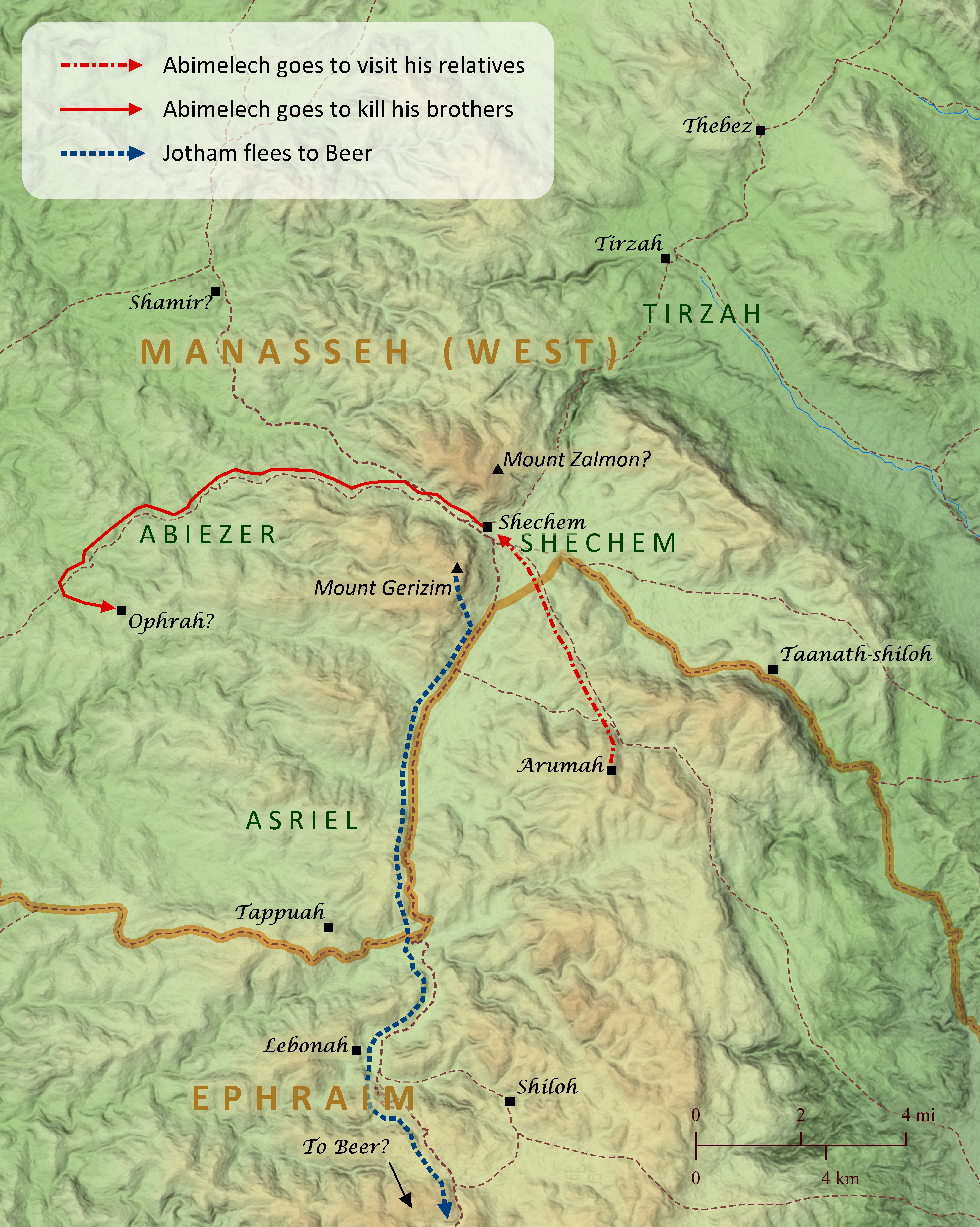
Virtually every account in the book of Judges paints this formative period in Israel’s history as a very dark, brutal time when everyone did what was right in their own eyes (Judges 17:6; 21:25). The story of Abimelech’s rise to power is no exception. Judges 6-8 recounts the heroic deeds of Gideon, a Manassite from the clan of Abiezer who rescued the Israelites from the Midianites. After Gideon’s victory, he returned to his hometown of Ophrah, and Israel enjoyed peace for the rest of his lifetime. But Gideon also left a legacy of idolatry by him, by his family, and by many Israelites. Gideon had many wives and seventy sons, as well as a concubine in Shechem who gave birth to another son named Abimelech (Judges 8:29-32). It appears that when Abimelech grew up, he settled in Arumah, (Judges 9:31), just outside Manassite territory in the tribal allotment of Ephraim (Joshua 16-17; see “Poster Map of the Tribe of Manasseh (West) and Its Surroundings, circa 1200 B.C.” map). Perhaps this move to non-Manassite territory reflected Abimelech’s lack of a legitimate heritage from his Manassite father. Later, Abimelech visited his relatives in Shechem and convinced them to persuade the leaders of Shechem to make him ruler over the city. To ensure that none of his seventy brothers, who were legitimate heirs to Gideon, challenged his authority, Abimelech went to Ophrah and killed all but one of them. The only brother to escape was Jotham, the youngest, and he went to the top of Mount Gerizim and warned them against betraying Gideon by making Abimelech king. Then he fled to the town of Beer, perhaps the same as Beeroth near the town of Gibeon. After three years, however, the leaders of Shechem began to grow dissatisfied with Abimelech as their king, and a man named Gaal offered to rule in place of him. Abimelech’s ally Zebul, who was one of the leaders of Shechem, went to Arumah and told Abimelech what Gaal was planning to do. So Gideon and his men split up into four groups and secretly surrounded the city at night. Then they attacked Gaal’s men, and Gaal’s men retreated into Shechem. Zebul drove them back out into the fields, and Abimelech’s men defeated them and captured the city. Some of the leaders of Shechem fled into the temple of El-berith (or Baal-berith), but Abimelech and his men cut down branches from Mount Zalmon (likely Mount Ebal just north of Shechem) and set fire to the temple, killing about 1000 people inside. Then Abimelech and his men went to Thebez and attacked the city. Many of the citizens took refuge inside a strong tower in the town, and Abimelech prepared to set fire to the entrance. But a woman on the roof dropped a millstone on his head, crushing his skull, so Abimelech commanded his armor bearer to kill him.
Open Bible Data site copyright © 2023–2026 Freely-Given.org.
Python source code for creating these static pages is available on GitHub under an open licence.
For Bible data copyrights, see the details for each displayed Bible version.
The Open English Translation (OET) main site is at OpenEnglishTranslation.Bible or OET.Bible.