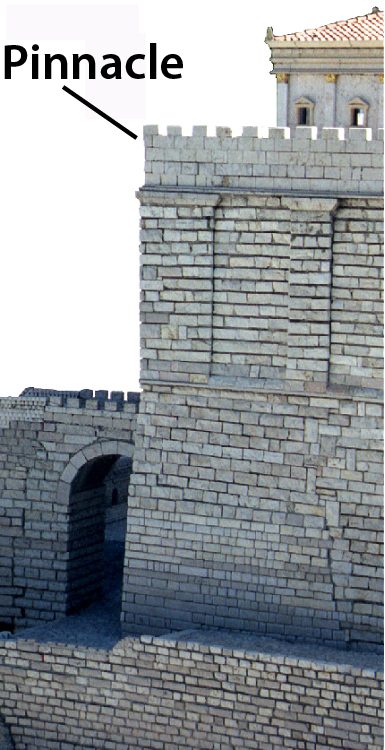
Southwest corner of the temple mount (model) (© Ray Pritz by United Bible Societies)
References
- Hebrew אֲרוֹן ’aron: 2 KI 12:9, 2 KI 12:10, 2 CHR 24:8, 2 CHR 24:10, 2 CHR 24:11
- Hebrew בַּיִת, אָסֹף (beyth) ’asupim: 1 CHR 26:15, 1 CHR 26:17
- Hebrew בַּיִת, אוֹצָר (beyth) ’otsar: DEUT 28:12, DEUT 32:34, YEHO 6:19, YEHO 6:24, 1 KI 7:51, 1 KI 15:18, 2 KI 12:18, 2 KI 14:14
28 more references
2 KI 16:8, 2 KI 18:15, 2 KI 20:13, 2 KI 20:15, 2 KI 24:13, 1 CHR 9:26, 1 CHR 26:20, 1 CHR 26:22, 1 CHR 26:24, 1 CHR 26:26, 1 CHR 27:25, 1 CHR 28:12, 1 CHR 29:8, 2 CHR 5:1, 2 CHR 8:15, 2 CHR 12:9, 2 CHR 16:2, 2 CHR 25:24, 2 CHR 32:27, EZRA 2:69, NEH 7:70, NEH 7:71, NEH 10:38, PROV 8:21, EZEK 28:4, DAN 1:2, HOS 13:15, MAL 3:10 - Hebrew בַּיִת, נְכֹאת beth nkoth: 2 KI 20:13, ISA 39:2
- Aramaic גְּנַז gnaz: EZRA 7:20
- Hebrew גֶּנֶז genez: EST 3:9, EST 4:7
- Hebrew גַּנְזַךְ ganzak: 1 CHR 28:11
- Greek γαζοφυλάκιον gazofulakion: MARK 12:41, MARK 12:43, LUKE 21:1, YHN 8:20, 1 MAC 3:28, 1 MAC 14:49, 2 MAC 3:6, 2 MAC 3:24
9 more references
2 MAC 3:28, 2 MAC 3:40, 2 MAC 4:42, 2 MAC 5:18, 4 MAC 4:3, 4 MAC 4:6, G ESD 5:44, G ESD 8:18, G ESD 8:44 - Greek θησαυρός thēsauros: SIR 1:25, 1 MAC 3:29
- Greek κορβανᾶς korbanas: MAT 27:6
- Greek ταμιεῖον tamieion: SIR 29:12
- Greek θησαυρός thesaurus: 4 MAC 4:7
- Latin thesaurus: L ESD 6:40
Description and usage
The treasury was a place for storing valuables belonging to a king or other national authorities. The Temple in Yerushalem (Jerusalem) had its own treasury. There was no standard size or structure of a treasury.
———
Translation
The Hebrew word ’aron in 2 KI 12:8, 2 KI 12:9 and 2 CHR 24:8, 2 CHR 24:10, 2 CHR 24:11 refers to a large collection box. According to 2 KI 12:8, a hole was cut in its “door.” This would refer to one surface of the box, presumably its top. People could bring their donations (not coins, which were not yet invented) and insert them into the box through the hole. The donations could then be removed by opening or removing the top.
In some passages the Hebrew word ’otsar refers to treasure (for example, 2 KI 24:13, 2 CHR 12:9), while in other places it indicates the place where treasure was stored, that is, a treasury (for example, 2 KI 20:13, 2 CHR 32:27). The first half of 1 KI 15:18 says literally “And Asa took all the remaining silver and gold in the treasuries of the house of Yahweh and [he took] the treasures of the king’s house.” No translation consulted makes the distinction, although some render both words “treasures” (RSV), while others render both words “treasuries” (NJPSV). In fact, in many of the references under ’otsar it is not easy to determine if the meaning is “treasure” or “treasure storehouse.” In only three places is there specific reference in Hebrew to a “treasure house” (NEH 10:38, DAN 1:2, MAL 3:10).
Where a word for “treasury” is not available, it may be rendered with a descriptive phrase, such as “safe place where the king’s [or, Temple’s] valuables were kept/were guarded.” An alternative model for the last half of MAT 27:6 is “It is against our Law to put it with the money that belongs to the Temple since it is blood money.”
In the New Testament the Greek word gazofulakion also refers to a box in which donations were collected. According to Jewish tradition, there were thirteen such offering boxes in the Temple, and the receptacles that channeled the money down to the boxes were in the form of trumpets or rams’ horns. As a result, the sound of coins falling into the boxes was rather conspicuous. In some cultures such a collection box may be unknown, or at best people know the container that is passed around to collect money in church. If possible, the translation should indicate that the offering box was in a fixed place and not something passed around. In LUKE 21:1NCV has “Temple money box” and adds this note: “A special box in the Jewish place of worship where people put their gifts to God.” PV uses a longer expression, saying “place reserved for them [gifts].”
 Open English Translation (OET)