• the descendants Sotay, Soferet, Peruda,

ParallelVerse GEN EXO LEV NUM DEUT JOB YEHO (JOS) HERO (JDG) RUTH 1 SAM 2 SAM PSA AMOS HOS 1 KI 2 KI 1 CHR 2 CHR PROV ECC SNG YOEL (JOEL) MIC ISA ZEP HAB YIR (JER) LAM YNA (JNA) NAH OBAD DAN EZEK EZRA EST NEH HAG ZEC MAL 2 PS WIS TOB MAN BAR L JER G DAN SUS PR AZ BEL G ESD L ESD ESG JDT 3 MAC SIR 1 MAC 2 MAC 4 MAC YHN (JHN) MARK MAT LUKE ACTs YAC (JAM) GAL 1 TH 2 TH 1 COR 2 COR ROM COL LAOD PHM EPH PHP 1 TIM TIT 1 PET 2 PET 2 TIM HEB YUD (JUD) 1 YHN (1 JHN) 2 YHN (2 JHN) 3 YHN (3 JHN) REV
ParallelVerse Ezra Intro C1 C3 C4 C5 C6 C7 C8 C9 C10
Ezra 2 V0 V1 V4 V7 V10 V13 V16 V19 V22 V25 V28 V31 V34 V37 V40 V43 V46 V49 V52 V58 V61 V64 V67 V70
Note: This view shows ‘verses’ which are not necessarily natural language units and hence sometimes only part of a sentence will be visible—click on any Bible version abbreviation down the left-hand side to see the verse in more of its context. Normally the OET discourages the reading of individual ‘verses’, but this view is only designed as a tool for Bible-translators and others doing comparisons of different translations—the older translations are further down the page (so you can read up from the bottom to trace the English translation history). The OET segments on this page are still early looks into the drafted texts of the Open English Translation of the Bible—please double-check these texts in advance before using in public.
Text critical issues=none Clarity of original=clear Importance to us=trivial Speaker(s)=Narrator (All still tentative.)
OET (OET-RV) The descendants of Shelomoh’s (Solomon’s) servants who returned:
•
the descendants Sotay, Soferet, Peruda,
OET-LV The_descendants_of the_servants_of Shəlomoh/(Solomon) the_descendants_of Şōţay the_descendants_of Şoferet the_descendants_of Pərūdāʼ.
UHB בְּנֵ֖י עַבְדֵ֣י שְׁלֹמֹ֑ה בְּנֵי־סֹטַ֥י בְּנֵי־הַסֹּפֶ֖רֶת בְּנֵ֥י פְרוּדָֽא׃ ‡
(bənēy ˊaⱱdēy shəlomoh bənēy-şoţay bənēy-haşşoferet bənēy fərūdāʼ.)
BrLXX Υἱοὶ δούλων Σαλωμὼν, υἱοὶ Σωταῒ, υἱοὶ Σεφηρὰ, υἱοὶ Φαδουρὰ,
(Huioi doulōn Salōmōn, huioi Sōtai, huioi Sefaʸra, huioi Fadoura,)
BrTr The children of the servants of Solomon: the children of Sotai, the children of Sephera, the children of Phadura,
ULT The sons of the servants of Solomon: the sons of Sotai, the sons of Hassophereth, the sons of Peruda,
UST The following descendants of King Solomon’s servants returned to Jerusalem. They were the descendants of these men: Sotai, Hassophereth, Peruda,
BSB The descendants of the servants of Solomon:
•
the descendants of Sotai,
•
the descendants of Hassophereth,
•
the descendants of Peruda,[fn]
2:55 Peruda is a variant of Perida; see Nehemiah 7:57.
OEB No OEB EZR 2:55 book available
WEBBE The children of Solomon’s servants: the children of Sotai, the children of Hassophereth, the children of Peruda,
NET The descendants of the servants of Solomon: the descendants of Sotai, the descendants of Hassophereth, the descendants of Peruda,
LSV Sons of the servants of Solomon: sons of Sotai, sons of Sophereth, sons of Peruda,
FBV The descendants of King Solomon's servants: Sotai, Hassophereth, Peruda,
T4T ¶ These descendants of King Solomon’s servants returned:
•
Sotai, Hassophereth, Peruda,
LEB The descendants[fn] of Solomon’s servants: the descendants[fn] of Sotai, the descendants[fn] of Hassophereth, the descendants[fn] of Peruda,
BBE The children of Solomon's servants: the children of Sotai, the children of Hassophereth, the children of Peruda,
Moff The sons of Solomon’s servants: the clans of Sotai, Hasso-phereth, Peruda,
JPS The children of Solomon's servants: the children of Sotai, the children of Hassophereth, the children of Peruda;
ASV The children of Solomon’s servants: the children of Sotai, the children of Hassophereth, the children of Peruda,
DRA The children of the servants of Solomon, the children of Sotai, the children of Sopheret, the children of Pharuda,
YLT Sons of the servants of Solomon: sons of Sotai, sons of Sophereth, sons of Peruda,
Drby The children of Solomon's servants: the children of Sotai, the children of Sophereth, the children of Peruda,
RV The children of Solomon’s servants: the children of Sotai, the children of Hassophereth, the children of Peruda;
SLT The sons of Solomon’s servants: the sons of Sotai, the sons of Sophereth, the sons of Peruda,
Wbstr The children of Solomon's servants: the children of Sotai, the children of Sophereth, the children of Peruda,
KJB-1769 ¶ The children of Solomon’s servants: the children of Sotai, the children of Sophereth, the children of Peruda,[fn]
2.55 Peruda: also called, Perida
KJB-1611 ¶ The children of Solomons seruants. The children of Sotai, the children of Sophereth, the children of [fn]Peruda,
(Modernised spelling is same as from KJB-1769 above, apart from capitalisation and punctuation and footnotes)
2:55 Or, Perida, as Nehem. 7.57.
Bshps The children of Solomons seruautes, the children of Sotai, the children of Sophereth, the children of Peruda,
(Modernised spelling is same as from KJB-1769 above, apart from punctuation)
Gnva The sonnes of Salomons seruantes: the sonnes of Sotai, the sonnes of Sophereth, the sonnes of Peruda,
(The sons of Solomons servants: the sons of Sotai, the sons of Sophereth, the sons of Peruda,)
Cvdl The children of Salomons seruauntes. The children of Sotai, the children of Sophereth, the children of Pruda,
(The children of Solomons servants. The children of Sotai, the children of Sophereth, the children of Pruda,)
Wycl the sones of the seruauntis of Salomon, the sones of Sothelthei, the sones of Soforeth, the sones of Pharuda, the sones of Asa,
(the sons of the servants of Solomon, the sons of Sothelthei, the sons of Soforeth, the sons of Pharuda, the sons of Asa,)
Luth die Kinder der Knechte Salomos: die Kinder Sotai, die Kinder Sophereth, die Kinder Pruda,
(the children the/of_the servant(s) Solomon’s: the children Sotai, the children Sophereth, the children Perida,)
ClVg filii servorum Salomonis, filii Sotai, filii Sophereth, filii Pharuda,
(children of_servants Solomon, children Sotai, children Sophereth, children Pharuda,)
Note 1 topic: figures-of-speech / metaphor
בְּנֵ֖י עַבְדֵ֣י שְׁלֹמֹ֑ה
(Some words not found in UHB: sons_of servants_of Shəlomoh/(Solomon)'s sons_of Şōţay sons_of of,Hassophereth sons_of Pərūdāʼ )
Here, sons means descendants. Alternate translation: [Some of the descendants of the laborers who had worked for the kingdom also returned]
Note 2 topic: translate-unknown
עַבְדֵ֣י שְׁלֹמֹ֑ה
servants_of (Some words not found in UHB: sons_of servants_of Shəlomoh/(Solomon)'s sons_of Şōţay sons_of of,Hassophereth sons_of Pərūdāʼ )
By servants of Solomon, this list does not mean officials who served in Solomon’s court. Rather, this phrase refers to people whom Solomon first conscripted as laborers. They were descendants of the groups that were living in the land of Canaan before the Israelites occupied it. They and their descendants remained conscripted laborers (slaves) under later kings. Alternate translation: [the laborers that King Solomon first conscripted] or [the laborers who had worked for the kingdom under Solomon]
Note 3 topic: figures-of-speech / metaphor
בְּנֵי־סֹטַ֥י בְּנֵי־הַסֹּפֶ֖רֶת בְּנֵ֥י פְרוּדָֽא
(Some words not found in UHB: sons_of servants_of Shəlomoh/(Solomon)'s sons_of Şōţay sons_of of,Hassophereth sons_of Pərūdāʼ )
Here, sons means descendants. Alternate translation: [they were from the descendants of Sotai, Hassophereth, Peruda,] beginning a series that will continue through 2:57.
Note 4 topic: translate-names
סֹטַ֥י & הַסֹּפֶ֖רֶת & פְרוּדָֽא
Şōţay & (Some words not found in UHB: sons_of servants_of Shəlomoh/(Solomon)'s sons_of Şōţay sons_of of,Hassophereth sons_of Pərūdāʼ )
These are the names of three men.
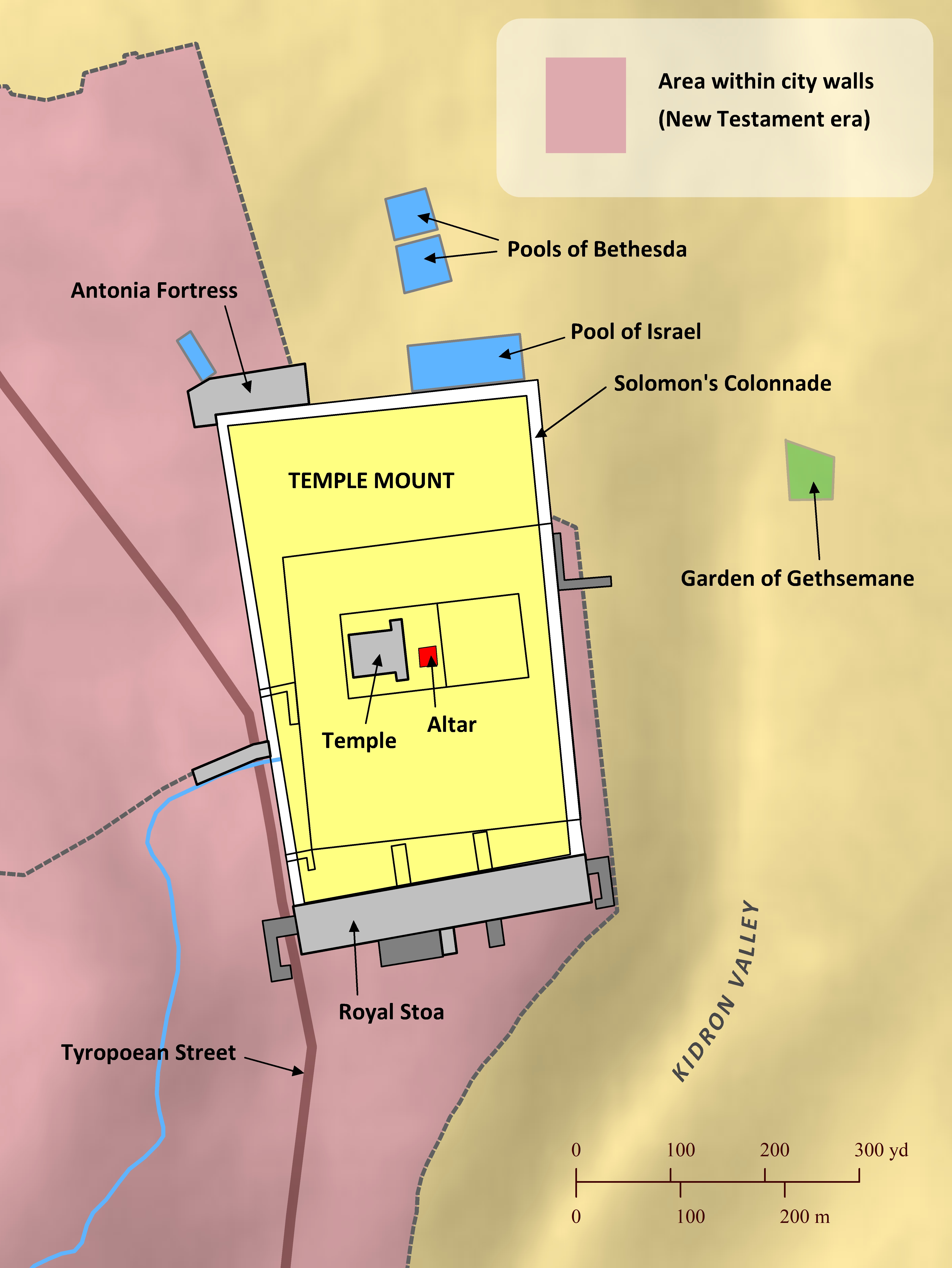
The Temple of the Lord in Jerusalem, where all Israelite males were commanded to offer sacrifices to the Lord (Exodus 23:14-19; Deuteronomy 16:16-17), underwent several stages of reconstruction and development over hundreds of years. The first Temple was built by King Solomon to replace the aging Tabernacle, and it was constructed on a threshing floor on high ground on the north side of the city (2 Samuel 24; 1 Chronicles 21). Hundreds of years later King Hezekiah expanded the platform surrounding the Temple. When Jerusalem fell to the Babylonians in 586 B.C., the Temple was completely destroyed (2 Kings 25:1-21; 2 Chronicles 36:17-21; Jeremiah 39:1-10; 52:1-30). It was rebuilt in 515 B.C. after a group of Jews returned to Judea from exile in Babylon (Ezra 1:5-6:15; Nehemiah 7:5-65). Herod the Great completely rebuilt and expanded the Temple once again around 20 B.C., making it one of the largest temples in the Roman world. Jesus’ first believers often met together in Solomon’s Colonnade, a columned porch that encircled the Temple Mount, perhaps carrying on a tradition started by Jesus himself (John 10:23; Acts 3:11; 5:12). But Herod’s Temple did not last long: After many Jews revolted against Rome, the Romans eventually recaptured Jerusalem and destroyed the Temple in A.D. 70.
Open Bible Data site copyright © 2023–2026 Freely-Given.org.
Python source code for creating these static pages is available on GitHub under an open licence.
For Bible data copyrights, see the details for each displayed Bible version.
Visit the Open English Translation (OET) main site.