
OET OET-RV OET-LV GHT ULT UST BSB MSB BLB AICNT OEB WEBBE WMBB NET LSV FBV TCNT T4T LEB BBE Moff JPS Wymth ASV DRA YLT Drby RV SLT Wbstr KJB-1769 KJB-1611 Bshps Gnva Cvdl TNT Wycl SR-GNT UHB BrLXX BrTr Related Parallel Simple Interlinear Topics Reference Dictionary Search
OET By Document By Section By Chapter Details
OET INT FRT GEN EXO LEV NUM DEU JOB JOS JDG RUTH 1 SAM 2 SAM PSA AMOS HOS 1 KI 2 KI 1 CHR 2 CHR PROV ECC SNG JOEL MIC ISA ZEP HAB JER LAM YNA (JNA) NAH OBA DAN EZE EZRA EST NEH HAG ZEC MAL GES LES ESG DNG 2 PS TOB JDT WIS SIR BAR MAN 1 MAC 2 MAC 3 MAC 4 MAC YHN (JHN) MARK MAT LUKE ACTs YAC (JAM) GAL 1 TH 2 TH 1 COR 2 COR ROM COL PHM EPH PHP 1 TIM TIT 1 PET 2 PET 2 TIM HEB YUD (JUD) 1 YHN (1 JHN) 2 YHN (2 JHN) 3 YHN (3 JHN) REV
GEN Intro C1 C2 C3 C4 C5 C6 C7 C8 C9 C10 C11 C12 C13 C14 C15 C17 C18 C19 C20 C21 C22 C23 C24 C25 C26 C27 C28 C29 C30 C31 C32 C33 C34 C35 C36 C37 C38 C39 C40 C41 C42 C43 C44 C45 C46 C47 C48 C49 C50
This is still an early look into the drafted text of the Open English Translation of the Bible. Please double-check the text in advance before using in public.
16 Now Abram’s wife Sarai hadn’t been able to give him any children, but she had an Egyptian slave named Hagar, 2 so Sarai said to Abram, “Listen, Yahweh has prevented me from having children so please sleep with my slave. Perhaps I can have a family through her.” Abram agreed to what Sarai had suggested. 3 So Sarai, the wife of Abram, took Hagar, her Egyptian slave, after Abram had lived ten years in the land of Canaan, and gave her to Abram her husband as a wife for him. 4 So he slept with Hagar and she got pregnant, but once she realised that she began to despise her mistress.
5 So Sarai complained to Abram, “This is all your fault. I let you sleep with my slave, but now that she’s pregnant she looks down on me. May Yahweh judge between me and you.”
6 “Listen,” Abram replied, “She’s your slave to do what she’s told. Do whatever you think best.” So Sarai started mistreating Hagar, and so she ran away.
7 Then Yahweh’s messenger found her in the wilderness at a spring—the spring beside the road to Shur, 8 and asked her, “Hagar, Sarai’s slave, where have you come from and where are you going?”
“I am running away from Sarai, my mistress,” she replied.
9 Then Yahweh’s messenger instructed her, “Return to your mistress and do whatever she tells you,” 10 then added, “I’ll give you so many descendants that they won’t even be able to be counted because there’ll be so many.” 11 Then the messenger told her,
“Listen here: you’re pregnant and will give birth to a son,
and you’ll name him ‘Yishma’el’ (which means ‘God hears’)
because Yahweh has heard your cries of misery.
12 He’ll be a wild donkey of a man
and he’ll be hostile to everyone
and everyone will be against him.
He’ll live right in front of his brothers.”
13 Then Hagar realised that it was Yahweh who had spoken to her and said, “You’re ‘The god who sees me’,” because she thought, “Did I really just see the back of the god who sees me?” 14 So that’s why that well between Kadesh and Bered is now called ‘The well of the living one who sees me’.
15 Then Hagar gave birth to a son for Abram, and Abram named him Yishma’el.[ref] 16 Abram was eighty-six years old when Hagar bore Yishma’el for him.

Genesis 16
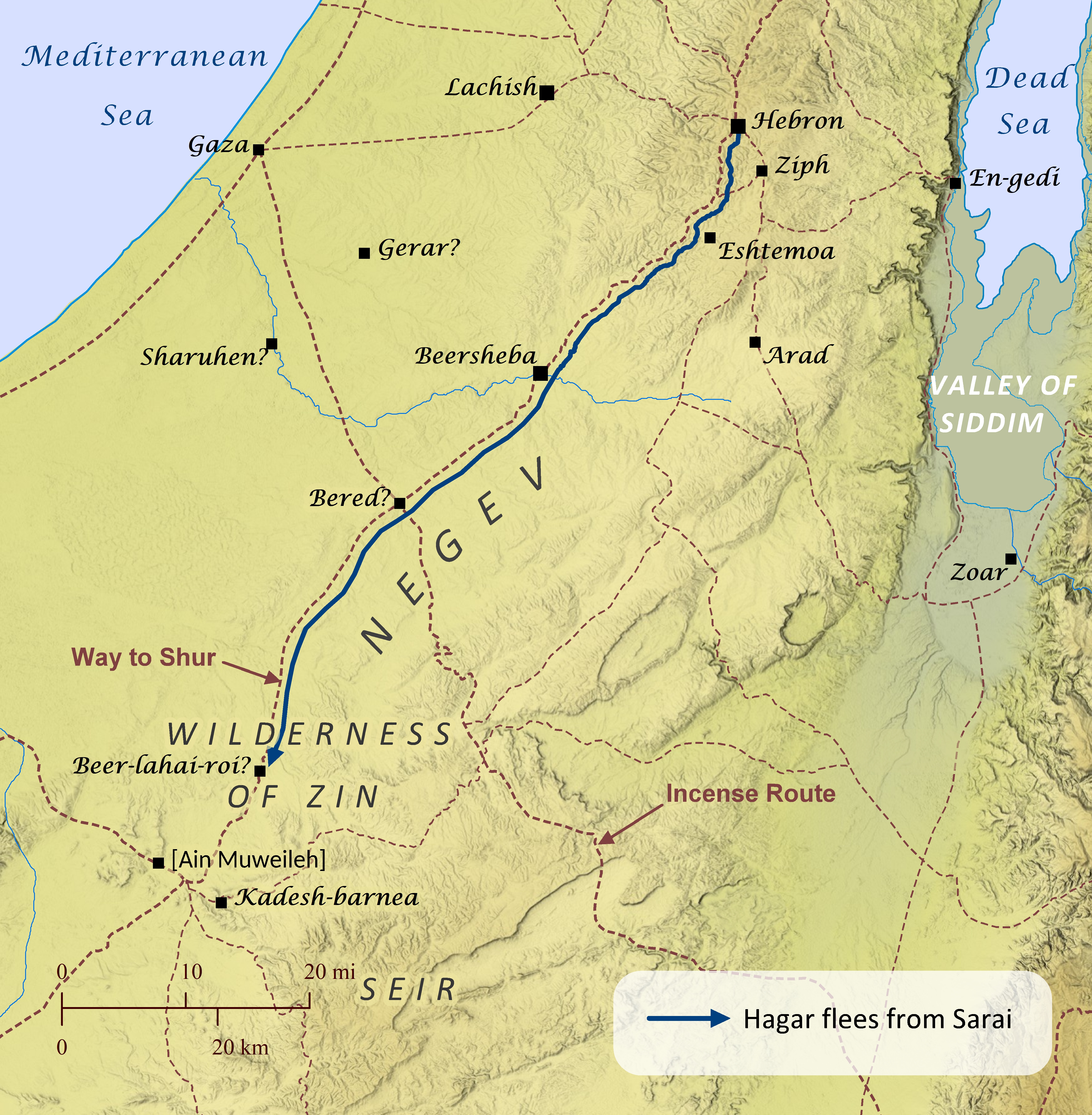
The Lord had promised repeatedly to raise up a great nation from Abram’s descendants (Genesis 12:2; 13:16; 15:5), but several years passed from the time this promise was given until Abram’s wife Sarai bore a child. During this time, Sarai sought to acquire a child for Abram through Hagar, her Egyptian servant-girl–a common practice at this time. When Hagar conceived, she began to regard Sarai with contempt, and Sarai responded by treating her harshly. Eventually Hagar ran away, heading south from Hebron (see Genesis 13:18) and following the way to Shur toward the wilderness and Kadesh-barnea. Along the way the angel of the Lord found her by a spring (also called a well in verse 14). He told her to return to her mistress Sarai, but he also promised that Hagar would bear a son, Ishmael, and that his descendants would become a great nation. In response, Hagar named the well Beer-lahai-roi, meaning “the well of the Living One who sees me.” She then returned to Sarai at Hebron and gave birth to Ishmael. The well at Beer-lahai-roi may also be the place where Hagar later found water to give to Ishmael after they were sent away from Abraham and Sarah (Genesis 21). Isaac also moved to Beer-lai-roi for a time after his father Abraham died (Genesis 25:11). Some scholars locate Beer-lahai-roi at a well called Ain Muweileh, about 6 miles (9.5 km) northwest of Kadesh-barnea, based on speculation that the modern name is a corruption of an Arabic phrase meaning “water of the living one seeing.” But the Bible makes it clear that Beer-lai-roi “lies between Kadesh and Bered,” and Bered was likely located at what was later called Elusa (based on the Jerusalem Targum and possibly Jerome), as shown on this map. Given this location for Bered, this author has identified the most likely location for Beer-lahai-roi to be Bi’ren–the only well located along the way to Shur between Bered and Kadesh-barnea.
GEN Intro C1 C2 C3 C4 C5 C6 C7 C8 C9 C10 C11 C12 C13 C14 C15 C17 C18 C19 C20 C21 C22 C23 C24 C25 C26 C27 C28 C29 C30 C31 C32 C33 C34 C35 C36 C37 C38 C39 C40 C41 C42 C43 C44 C45 C46 C47 C48 C49 C50