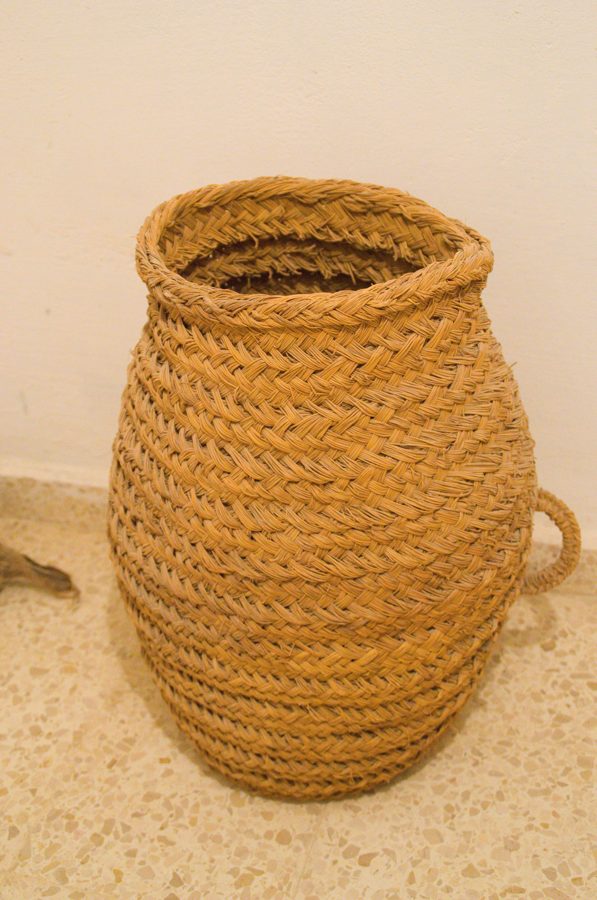
Large woven basket for storing and transporting goods (© Habib M’henni, CC BY-SA 3.0, via Wikimedia Commons)
References
- Hebrew אֵיפָה ’eyfah: EXO 16:36, LEV 5:11, LEV 6:20, LEV 19:36, NUM 5:15, NUM 28:5, DEUT 25:14, DEUT 25:15
21 more references
HERO 6:19, RUTH 2:17, 1 SAM 1:24, 1 SAM 17:17, PROV 20:10, ISA 5:10, EZEK 45:10, EZEK 45:11, EZEK 45:13, EZEK 45:24, EZEK 46:5, EZEK 46:7, EZEK 46:11, EZEK 46:14, AMOS 8:5, MIC 6:10, ZEC 5:6, ZEC 5:7, ZEC 5:8, ZEC 5:9, ZEC 5:10 - Hebrew דּוּד dud, dudai: 2 KI 10:7, PSA 81:6, YIR 24:1, YIR 24:2
- Hebrew טֶנֶא tene’: DEUT 26:2, DEUT 26:4, DEUT 28:5, DEUT 28:17
- Hebrew כְּלוּב kluv: YIR 5:27, AMOS 8:1, AMOS 8:2
- Hebrew סַל sal, salsiloth: GEN 40:16, GEN 40:17, GEN 40:18, EXO 29:3, EXO 29:23, EXO 29:32, LEV 8:2, LEV 8:26
- Hebrew תֵּבָה tevah: EXO 2:3, EXO 2:5
- Greek κόφινος kofinos: MAT 14:20, MAT 16:9, MARK 6:43, MARK 8:19, LUKE 9:17, YHN 6:13
- Greek σαργάνη sarganē: 2 COR 11:33
- Greek σπυρίς spuris: MAT 15:37, MAT 16:10, MARK 8:8, MARK 8:20, ACTs 9:25
Description and usage
The basket was a container made of woven material, usually grass or reeds. Baskets could vary widely in size, depending on their intended use. Baskets were used for carrying a great variety of things, including food and produce and even for moving soil from one place to another.
———
Translation
The Hebrew word ’eyfah sometimes refers to a volume of measure and sometimes to the basket used to hold that measure. The translator will need to pay special attention to the context.
In ZEC 5:7 there is reference to something that serves as a lid or cover (kikar in Hebrew) for a basket. This object is said to be made of lead and does not seem to be a normal feature of a basket. Most translations render it “lid made of lead” (GNT) or “lead cover” (CEV, GW).
The Hebrew word kluv in YIR 5:27 seems to refer to a very specialized type of basket, in fact, a cage for holding birds. RSV begins the verse with “Like a basket full of birds,” implying that the birds must be dead. However, instead of the word “basket,” most other translations prefer the word “cage,” which seems to sustain the imagery of the previous verse better. On the other hand, in AMOS 8:1, AMOS 8:2kluv is no doubt a general term for “receptacle.” The translation should have a general word if possible, one that would be appropriate for showing fruit for sale in the marketplace, carrying it, or storing it. If no kind of basket is suitable, then any container used for such purposes would be acceptable.
It is impossible to determine precisely the differences in meaning among the three New Testament terms for baskets listed above. In 2 COR 11:33, which is the only place where the Greek word sarganē occurs, the basket was evidently rather large, since it was used to let Paulos (Paul) down from an opening in the wall of Damesek (Damascus). The same basket is referred to in ACTs 9:25 with the Greek word spuris.
Translators often find it difficult to find satisfactory equivalents for the Greek words spuris and kofinos, since in various receptor languages there are highly specific terms for particular kinds of baskets depending upon the type of construction and size. Unfortunately, there is no way of determining from the Greek text precisely the size or type of baskets involved. The translator should be careful not to use a word that indicates a container made of modern materials such as plastic or rubber.
 Open English Translation (OET)