
OET OET-RV OET-LV GHT ULT UST BSB MSB BLB AICNT OEB WEBBE WMBB NET LSV FBV TCNT T4T LEB BBE Moff JPS Wymth ASV DRA YLT Drby RV SLT Wbstr KJB-1769 KJB-1611 Bshps Gnva Cvdl TNT Wycl SR-GNT UHB BrLXX BrTr Related Parallel Simple Interlinear Topics Reference Dictionary Search
OET By Document By Section By Chapter Details
OET INT FRT GEN EXO LEV NUM DEU JOB JOS JDG RUTH 1 SAM 2 SAM PSA AMOS HOS 1 KI 2 KI 1 CHR 2 CHR PROV ECC SNG JOEL MIC ISA ZEP HAB JER LAM YNA NAH OBA DAN EZE EZRA EST NEH HAG ZEC MAL GES LES ESG DNG 2 PS TOB JDT WIS SIR BAR MAN 1 MAC 2 MAC 3 MAC 4 MAC YHN MARK MAT LUKE ACTs YAC GAL 1 TH 2 TH 1 COR 2 COR ROM COL PHM EPH PHP 1 TIM TIT 1 PET 2 PET 2 TIM HEB YUD 1 YHN 2 YHN 3 YHN REV
JER Intro C2 C3 C4 C5 C6 C7 C8 C9 C10 C11 C12 C13 C14 C15 C16 C17 C18 C19 C20 C21 C22 C23 C24 C25 C26 C27 C28 C29 C30 C31 C32 C33 C34 C35 C36 C37 C38 C39 C40 C41 C42 C43 C44 C45 C46 C47 C48 C49 C50 C51 C52
This is still an early look into the drafted text of the Open English Translation of the Bible. Please double-check the text in advance before using in public.
1 These are the messages from Hilkiyah’s son, Yirmeyah—one of the priests who were in Anatot in Benyamin’s territory. 2 Yahweh’s messages started coming to him when Yehudah’s King Yoshiyah (Josiah, Amon’s son) was in the thirteenth year of his reign.[ref] 3 It continued through the reign of Yoshiyah’s son, King Yehoyakim (Jehoiakim) until the end of the eleventh year of the reign of Yoshiyah’s son, King Hizkiyah (Hezekiah)—Yerushalem (Jerusalem) was exiled in the fifth month of that year.[ref]
4 Now Yahweh’s message came to me:
5 “Before I formed you in your mother, I already knew you,
≈ and before you came out of the womb, I had a plan for you.
I appointed you as a prophet to the nations.”
6 But I said, “Oh no, Yahweh, my master. Listen, I don’t know how to speak, because I’m just a young lad.”
7 but Yahweh told me, “Don’t say that you’re only a child, because you must go to everyone I send you to and you must tell them everything that I command you to say. 8 Don’t be afraid of them, because I’ll be with you to rescue you.”
9 Then Yahweh stretched out his hand and touched my mouth and said, “Listen, I’ve put my messages into your mouth. 10 I’m appointing you today over the nations and kingdoms—to uproot and to break down, to destroy and to pull down, to build and to plant.”
11 Another time, Yahweh’s message came to me, saying, “Yirmeyah (Jeremiah), what do you see?”
“I see a branch from an almond tree,” I replied.
12 Then Yahweh told me, “You’ve done well to see that, because I keep watch[fn] on my message to make sure it happens.”
13 Then Yahweh asked me a second time what I was seeing, and I replied, “I see a pot full of boiling water and it’s tipping towards the north.”
14 ⇔“Yes, disaster will come from the north and be released onto all the inhabitants of this region,” Yahweh continued. 15 “Listen, I’m about to summon all the clans of the northern kingdoms, and they’ll come and attack the walls around Yerushalem and all of Yehudah’s other cities, then each king will place his throne at the entrance to Yerushalem’s gates.” That is Yahweh’s declaration. 16 “That’s how I’ll judge my people for their wickedness as they’ve abandoned me and sacrificed to other gods and bowed down to idols that they made with their own hands. 17 So Yirmeyah, get yourself ready and go and tell them everything that I’ll tell you. Don’t be scared in front of them or else I’ll scare you right there in front of them! 18 And listen, today I’ve you as strong as a fortified city and an iron pillar and bronze walls, as far as the kings of Yehudah are concerned, along with their officials and priests, and the general population. 19 They’ll oppose you but they won’t be able to defeat you because I’ll be with you to rescue you,” says Yahweh.
1:12 There’s a play on words in the original here, as the Hebrew word for ‘keeping watch’ has the same consonants as the word for ‘almond’.

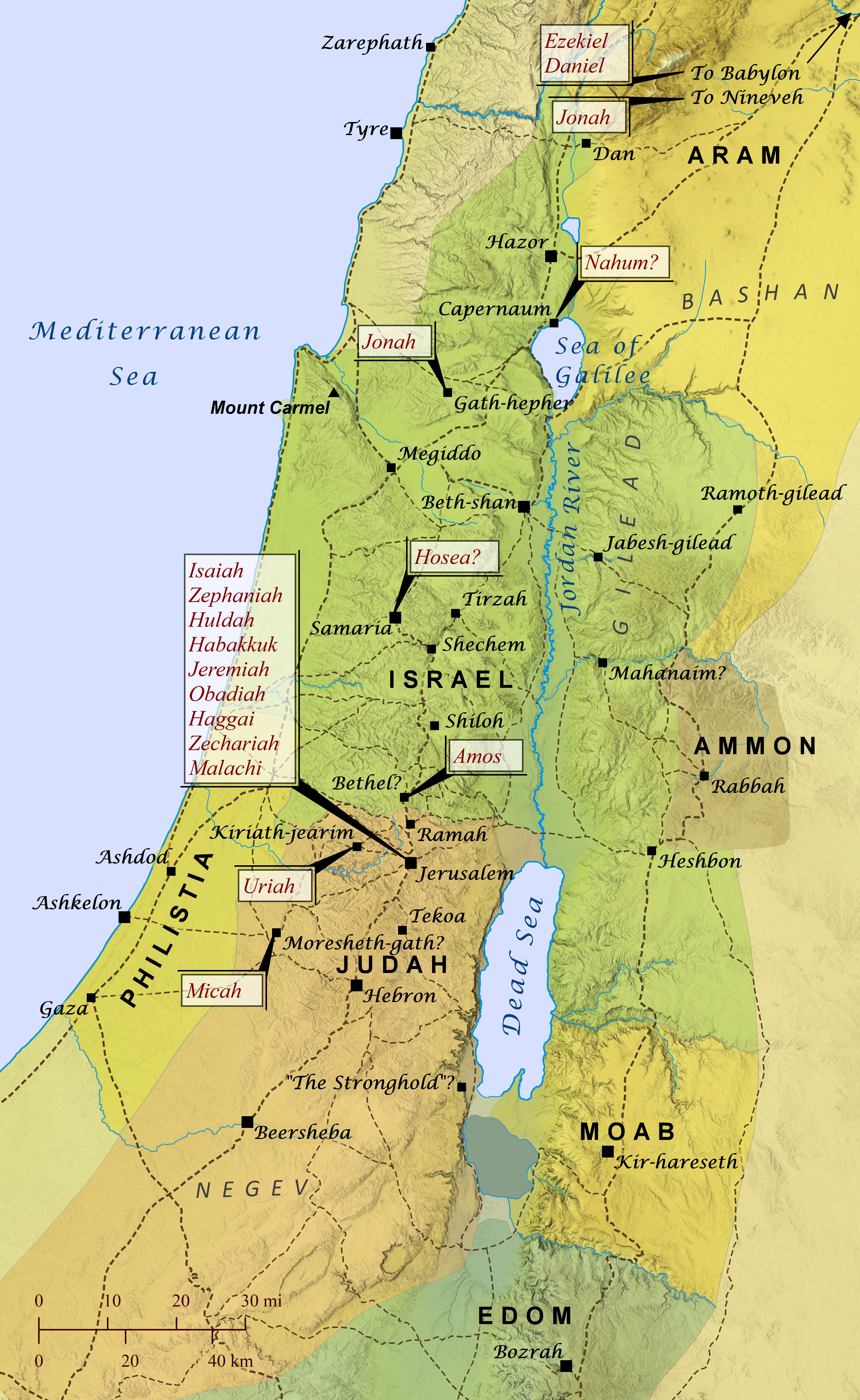
If you ask someone today what biblical prophets did, they will likely tell you that they divinely foretold of future events. While this was often the case, most prophets in the Bible focused as much on “forthtelling” God’s messages as they did on “foretelling” the future. That is, their primary role was to simply “forthtell” divinely acquired messages to leaders and groups of people, and at times that included foretelling of coming judgment, blessing, rescue, etc. Also, though plenty of prophets (sometimes called “seers” in Scripture) often spoke in confrontational or eccentric language that put them at odds with kings and religious leaders, the biblical writers also applied the term prophet to people who communicated God’s messages in ways that many readers today might not think of as prophecy, such as worship leaders appointed by David to “prophesy with lyres, harps, and cymbals” (1 Chronicles 25:1). Similarly, the books of Joshua, Judges, 1 & 2 Samuel, and 1 & 2 Kings are typically categorized as history by Christians, but in the Hebrew canon they belong to the category of Former Prophets. The Lord raised up prophets throughout all of biblical history, from the giving of the law under Moses to the revelation of the last days by the apostle John, and the kings of Israel and Judah often recognized and supported specific people as official prophets of the royal court and consulted them to find out God’s perspective about official matters. Following is a list of nearly everyone designated as prophet or seer in the Old Testament and the primary area of their ministry.
• Zechariah (796 B.C.) [2 Chronicles 24:20] => Jerusalem
• Jonah (780 B.C.) [2 Kings 14:25; Jonah 1:1] => Gath-hepher, Nineveh
• Hosea (770 B.C.) [Hosea 1:1] => Samaria?
• Amos (760 B.C.) [Amos 1:1] => Bethel
• Isaiah (730 B.C.) [2 Kings 19:2; 20:1; 2 Chronicles 26:22; 32:20, 32; Isaiah 1:1] => Jerusalem
• Micah (730 B.C.) [Jeremiah 26:18; Micah 1:1] => Moresheth
• Nahum (650 B.C.) [Nahum 1:1] => Elkosh (Capernaum?)
• Zephaniah (630 B.C.) [Zephaniah 1:1] => Jerusalem?
• Huldah (630 B.C.) [2 Kings 22:14] => Jerusalem
• Habakkuk (600 B.C.) [Habakkuk 1:1; 3:1] => Jerusalem?
• Ezekiel (592 B.C.) [Ezekiel 1:3] => Babylonia/Chebar River
• Uriah (600 B.C.) [Jeremiah 26:20] => Kiriath-jearim
• Jeremiah (587 B.C.) [2 Chronicles 36:12; Jeremiah 1:1; 19:14] => Jerusalem
• Obadiah (586 B.C.) [Obadiah 1:1] => Jerusalem
• Daniel (560 B.C.) [Daniel 7:1; Matthew 24:15] => Babylon
• Haggai (520 B.C.) [Ezra 5:1; Haggai 1:1] => Jerusalem
• Zechariah (520 B.C.) [Ezra 5:1; Zechariah 1:1] => Jerusalem
• Malachi (432 B.C.) [Malachi 1:1] => Jerusalem?
JER Intro C2 C3 C4 C5 C6 C7 C8 C9 C10 C11 C12 C13 C14 C15 C16 C17 C18 C19 C20 C21 C22 C23 C24 C25 C26 C27 C28 C29 C30 C31 C32 C33 C34 C35 C36 C37 C38 C39 C40 C41 C42 C43 C44 C45 C46 C47 C48 C49 C50 C51 C52