
OET OET-RV OET-LV GHT ULT UST BSB MSB BLB AICNT OEB WEBBE WMBB NET LSV FBV TCNT T4T LEB BBE Moff JPS Wymth ASV DRA YLT Drby RV SLT Wbstr KJB-1769 KJB-1611 Bshps Gnva Cvdl TNT Wycl SR-GNT UHB BrLXX BrTr Related Parallel Simple Interlinear Topics Reference Dictionary Search
OET By Document By Section By Chapter Details
OET INT FRT GEN EXO LEV NUM DEU JOB JOS JDG RUTH 1 SAM 2 SAM PSA AMOS HOS 1 KI 2 KI 1 CHR 2 CHR PROV ECC SNG JOEL MIC ISA ZEP HAB JER LAM YNA NAH OBA DAN EZE EZRA EST NEH HAG ZEC MAL GES LES ESG DNG 2 PS TOB JDT WIS SIR BAR MAN 1 MAC 2 MAC 3 MAC 4 MAC YHN MARK MAT LUKE ACTs YAC GAL 1 TH 2 TH 1 COR 2 COR ROM COL PHM EPH PHP 1 TIM TIT 1 PET 2 PET 2 TIM HEB YUD 1 YHN 2 YHN 3 YHN REV
JOS Intro C1 C2 C3 C4 C5 C6 C7 C8 C9 C10 C11 C12 C13 C14 C15 C16 C17 C18 C20 C21 C22 C23 C24
This is still an early look into the drafted text of the Open English Translation of the Bible. Please double-check the text in advance before using in public.
19 The second draw went to Shimeon’s (Simeon’s) descendants and the land for their clans was in the middle of Yehudah’s territory. 2 Shimeon’s inheritance included: Beer-Sheba,[fn] Moladah,[ref] 3 Hazarshual, Balah, Ezem, 4 Eltolad, Betul, Hormah, 5 Ziklag, Beyt-Markabot. Hatsarsusah, 6 Beyt-Lebaot, and Sharuhen—thirteen cities as well as their surrounding villages.
7 Also Ain, Rimmon, Eter, and Asha—four cities as well as their surrounding villages, 8 and all the further villages around those cities as far as Baalat-Beer (also called Ramah of the Negev). That was Shimeon’s descendants’ inheritance according to their clans. 9 This took away some of Yehudah’s inheritance and gave it to Shimeons descendants because Yehudah’s initial area was more than they needed.
10 The third draw went to Zebulun’s descendants according to their clans. The southern border for their inheritance started at Sarid 11 and went west to Maralah and Dabbeshet then to the riverbed facing Yokneam. 12 Also from Sarid it went toward the east beside the border with Kislot-Tabor and then on to Daberat and then to Yafia. 13 From there it extended east to Gittah-Hefer and Ittah-Katsin and north to Rimmon before turning to Neah. 14 Then it passed north of Hannaton ending at Yiftah-El valley. 15 It included the cities of Kattat, Nahalal, Shimron, Idalah, and Bethlehem—a total of twelve cities as well as their surrounding villages. 16 That was Zebulun’s descendants’ inheritance according to their clans, including those cities as well as their surrounding villages.
17 The fourth draw went to Yissakar’s descendants according to their clans. 18 Their land included the cities of Yezreel, Kesulot, Shunem, 19 Hafaraim, Shion, Anaharat, 20 Rabbit, Kishion, Ebets, 21 Remet, Eyn-Gannim, Eyn-Haddah, and Beyt-Pazzets. 22 The border of their allotment met with Tabor, Shahazumah, and Beyt-Shemesh, coming out in the east at the Yordan—a total of sixteen cities as well as their surrounding villages. 23 That was Yissakar’s descendants’ inheritance according to their clans, including those cities as well as their surrounding villages.
24 The fifth draw went to Asher’s descendants according to their clans. 25 Their land included the cities of Helkat, Hali, Beten, Akshaf, 26 Allammelek, Amad, and Mishal. Their western border started at Mt. Karmel and Shihorlibnat 27 and turned back to the east to Beyt-Dagon and the border with Zebulun and the Yiftah-El valley to the north. Then it went to Beyt-Emek and Neiel and north to Kabul, 28 Abdon, Rehob, Hammon and Kanah, as far as Greater Sidon. 29 The border then turned back to Ramah and to the fortified city of Tsor (commonly known as Tyre) and turns west to Hosah coming out at the Mediterranean near Akzib. 30 It also included Ummah, Afek, and Rehob—a total of twenty-two cities as well as their surrounding villages. 31 That was Asher’s descendants’ inheritance according to their clans, including those cities as well as their surrounding villages.
32 The sixth draw went to Naftali’s descendants according to their clans. 33 Their border started in Helef (where there was an oak tree at Zaanannim) then Adami-Nekeb and Yabneel and on to Lakkum before exiting at the Yordan. 34 Then it turned west to Aznot-Tabor and from there to Hukkok, meeting the border with Zebulun on the south, the border with Asher on the west, and the border with Yehudah on the east. 35 The fortified cities were Tsiddim, Tser, Hammat, Rakkat, Kinneret, 36 Adamah, Ramah, Hatsor, 37 Kedesh, Edrei, Eyn-Hatsor, 38 Yiron, Migdal-El, Horem, Beyt-Anat, and Beyt-Shemesh—a total of nineteen cities as well as their surrounding villages. 39 That was Naftali’s descendants’ inheritance according to their clans, including those cities as well as their surrounding villages.
40 The final seventh draw went to Dan’s descendants according to their clans. 41 Their land included the cities of Tsorah, Eshtaol, Ir-Shemesh, 42 Shaalabbin, Ayyalon, and Yitlah, 43 Elon, Timnah, Ekron, 44 Eltekeh, Gibbeton, Baalat, 45 Yehud, Bene-Berak, Gat-Rimmon, 46 Meyarkon, Rakkon, and the area opposite Yafo (Joppa). 47 Dan’s border went out from them.[fn] Then Dan’s descendants battled against Leshem and captured it and slaughtered their inhabitants. So they took it over and settled in Leshem but they renamed it to ‘Dan’ after their ancestor.[ref] 48 That was Dan’s descendants’ inheritance according to their clans, including those cities as well as their surrounding villages.
49 After the allocation of the blocks of land to the various tribes, the Israelis gave Yehoshua (Nun’s son) his own inheritance among them.
50 Following Yahweh’s instructions to give Yehoshua whatever city he asked for, he was given Timnat-Serah in the hill country of Efrayim and he built up that city and lived in it.
51 Those were the allotments that Eleazar the priest and Yehoshua (Nun’s son) gave to the leaders of the Israeli tribes as their inheritances. It was done by throwing dice there in Shiloh in front of Yahweh at the opening of the sacred tent, and so the land division was completed.
19:2 TC: Ancient manuscripts differ, with some adding Sheba (possibly a mistaken reduplication) or Shema here (but that would make the total number wrong that’s given in v6).
19:47 Translations vary widely here because we’re not sure what is meant by the literal rendering that we’ve kept here.

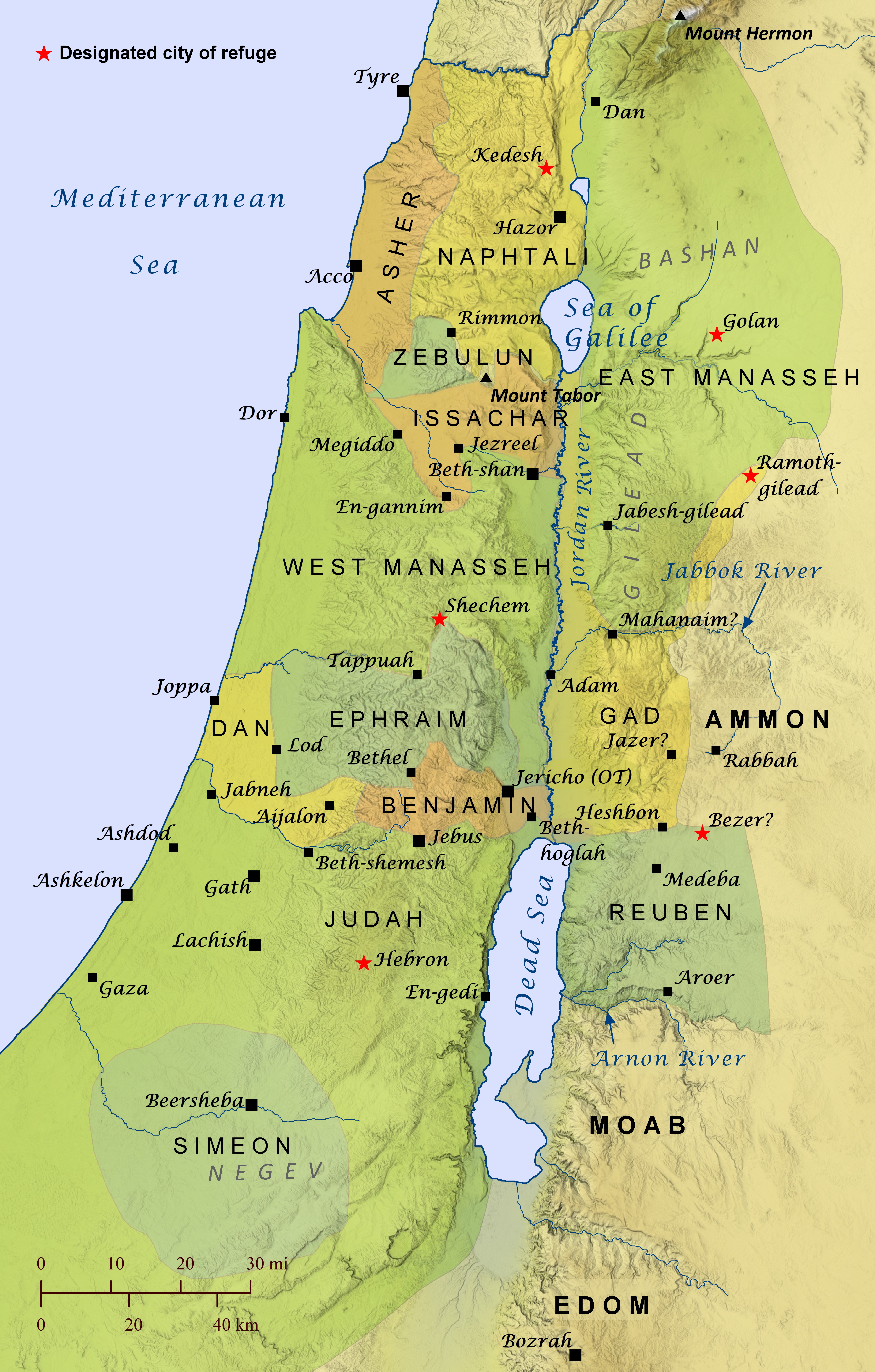
After the Israelites had conquered portions of the Promised Land and Joshua had grown old, the Lord directed him to divide the rest of the land among the tribes of Israel as their inheritance (Joshua 13-20). The eastern tribes had already been allotted their land under Moses’ leadership (Numbers 32), but they continued to help the other tribes drive out the Canaanites from land west of the Jordan River. The Lord also instructed the Israelites to designate several cities of refuge, where someone could flee for protection from an avenger if they accidentally killed someone (Numbers 35; Joshua 20).
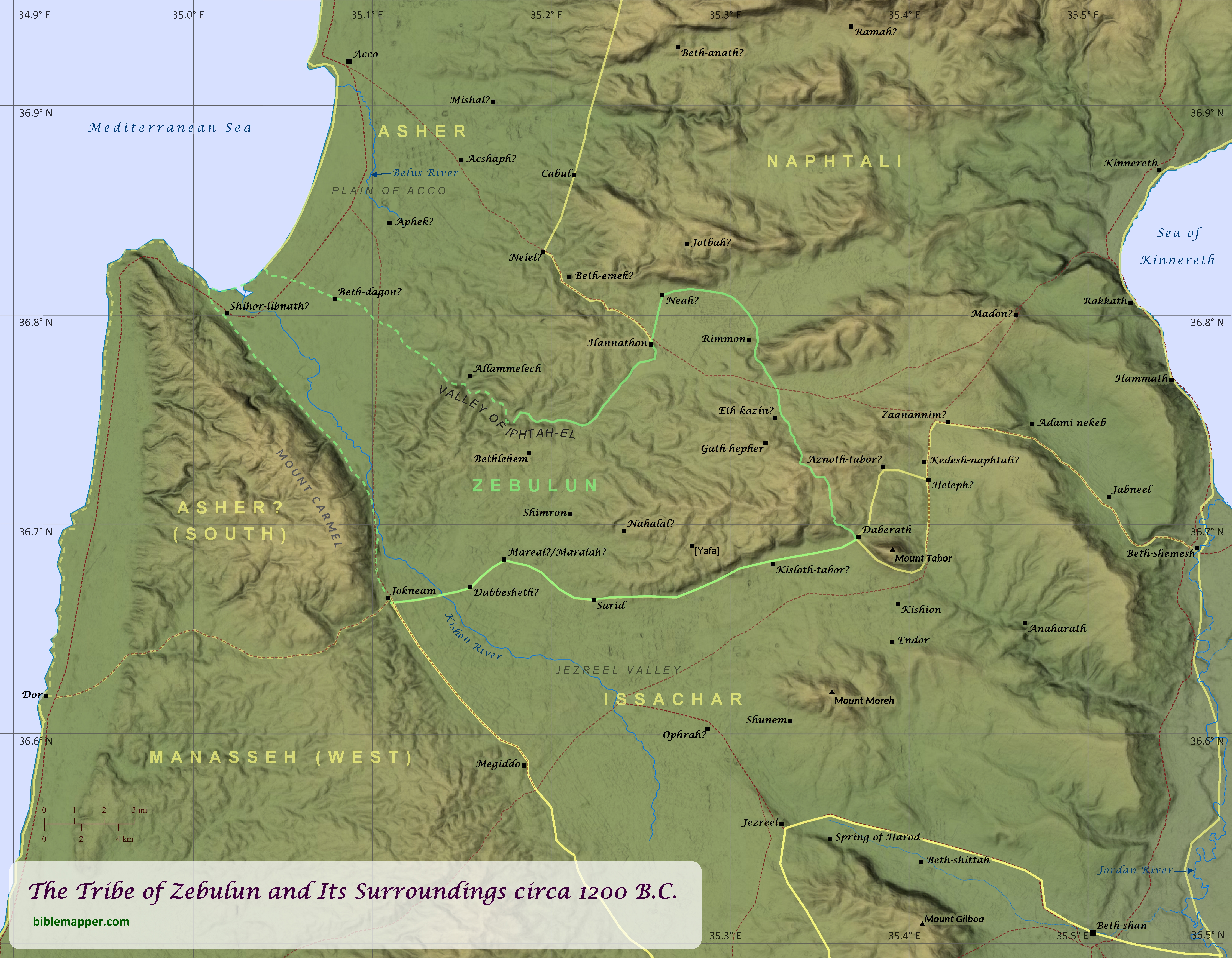
When recounting which Israelite tribes played an important role the history of the nation, it is unlikely that Zebulun and its neighboring tribes would be among the first named by most Bible readers. Yet a careful study of Scripture reveals that this region played a key role in the life of Israel from its earliest years until the time of Jesus. During the time of Israel’s conquest of Canaan, this region was the site of a momentous victory over the forces of the Canaanite King Jabin of Hazor (Joshua 11; see “The Conquest of Canaan: The Northern Campaign” map). Likewise the prophet Deborah called upon Barak to lead an army of Israelites from the tribes of Naphtali and Zebulun to fight against another King Jabin near Mount Tabor (Judges 4-5; see “Deborah and Barak Defeat Sisera” map). Later in the time of the judges, Gideon and his men from Manasseh, Asher, Zebulun, and Naphtali ambushed a vast army of Midianites, Amalekites, and peoples of the East in the Jezreel Valley (Judges 6-8; see “Gideon Defeats the Midianites” map). Mount Tabor also appears to have been a common cultic center for the surrounding tribes throughout the Old Testament (see Deuteronomy 33:18-19). As such, Tabor does not appear to have been included within any of the tribes’ allotted territory (see Joshua 19), although three of the tribes bordered it (see “Mount Tabor and Its Surrounding Tribal Boundaries” map), and Tabor is reckoned as belonging to Zebulun in the assignment of towns for the Levites (1 Chronicles 6:77). Saul also led the Israelites into battle against a coalition of of Philistine forces in the Jezreel Valley, and he and his sons were killed on Mount Gilboa (1 Samuel 28-31; 1 Chronicles 10; see “The Battle at Mount Gilboa” map).
Over the next few centuries, the northern tribes of Israel experienced multiple attacks and occupations by foreign powers, including by Aram and Babylonia (2 Kings 16-17; 2 Chronicles 28; Isaiah 7-8; see “Border Conflict between Israel and Judah” and “The Final Days of the Northern Kingdom of Israel” maps). In the time of Elijah, King Ahab had a palace in Jezreel, and Elijah challenged the prophets of Baal to a contest on Mount Carmel to see whether Baal or the Lord was truly God. After the people saw that the Lord indeed was God, they killed the prophets of Baal at the Kishon River (1 Kings 18-19; see “Elijah Challenges Ahab” map). Elijah’s student Elisha sometimes stayed at the home of a woman in Shunem, and after her son died, Elisha raised him back to life (2 Kings 4:1-37). Later, King Josiah of Judah was killed at Megiddo as he tried to stop Pharaoh Neco from coming to the aid of the collapsing Assyrian Empire (2 Kings 22-23; 2 Chronicles 34-35; see “Josiah Battles Neco” map). Centuries later the tiny village of Nazareth, located in the tribe of Zebulun, became home to Jesus the Messiah (Matthew 2:19-23; see “Nazareth and Its Surroundings” map), fulfilling the prophecy of Isaiah that “the land of Zebulun and the land of Naphtali, the way of the sea, beyond the Jordan, Galilee of the Gentiles–the people dwelling in darkness have seen a great light, and for those dwelling in the region and shadow of death, on them a light has dawned” (Matthew 4:15-16).
The exact borders of these northern tribes, specifically of Zebulun, Asher, and Manasseh, has been the subject of some debate over the centuries. The borders are carefully delineated in Joshua 19. There the boundaries given for Asher do not include the region of Mount Carmel and Dor, yet two chapters earlier (see Joshua 17:11) the author indicates that Dor (and probably Mount Carmel) did fall within the boundaries of Asher, though it was occupied by Manasseh. Adding to the confusion is Joshua 19:26, which notes that Asher’s territory bordered (“touches”) Carmel and Shihor-libnath, which may have referred to a specific town, but it may also have encompassed the greater alluvial plain of the lower Kishon River. The mouth of the Kishon River as well as the mouth of the Belus River further north were known in ancient times for their glassmaking industries (it is mentioned by both Tacitus, The Histories, 5.7, and Pliny the Elder, Natural History, 5.19), and the name Shihor-libnath means “river of glass/whiteness.” This description of Asher’s border seems to suggest that Zebulun was landlocked, and it is shown this way in virtually every map of the region available today. Yet in the blessings of both Jacob and Moses, Zebulun is associated with the abundance of the sea (Genesis 49:13; Deuteronomy 33:18-19), suggesting that it bordered the sea. A possible resolution for both of these questions (whether Dor was within Asher’s territory and whether Zebulun bordered the sea) may be found in this author’s new understanding of Zebulun’s western border, as shown on this map. (I have since found two maps from 1823 by that display similar borders; see footnote below.) Given that Asher’s border is described as starting at the edge of Carmel and Shihor-libnath and then heading east (not southeast; Joshua 19:26), it stands to reason that a different tribe occupied the area to the southeast of Shihor-libnath. The most fitting candidate for this other tribe is Zebulun, since this would also explain its association with the sea. This may also explain why the region of Dor and Carmel, which would have been separated from northern Asher by Zebulun and was occupied by Manasseh even by the time of the completion of the book of Joshua, does not appear to have been regarded as part of the principle territory of Asher.
Two older works containing similar boundaries for Zebulun are:
Geographia Sacra, or Scripture Atlas, Comprising A Complete Set of Maps adapted to elucidate the Events of Sacred History which point out the Situation of every place mentioned in the Old & New Testaments. By J. Wyld, 1823.
The Bible Atlas; or, Sacred Geography Delineated, In A Complete Series of Scriptural Maps, Drawn From The Latest and Best Authorities, and Engraved By Richard Palmer, 1823.
JOS Intro C1 C2 C3 C4 C5 C6 C7 C8 C9 C10 C11 C12 C13 C14 C15 C16 C17 C18 C20 C21 C22 C23 C24