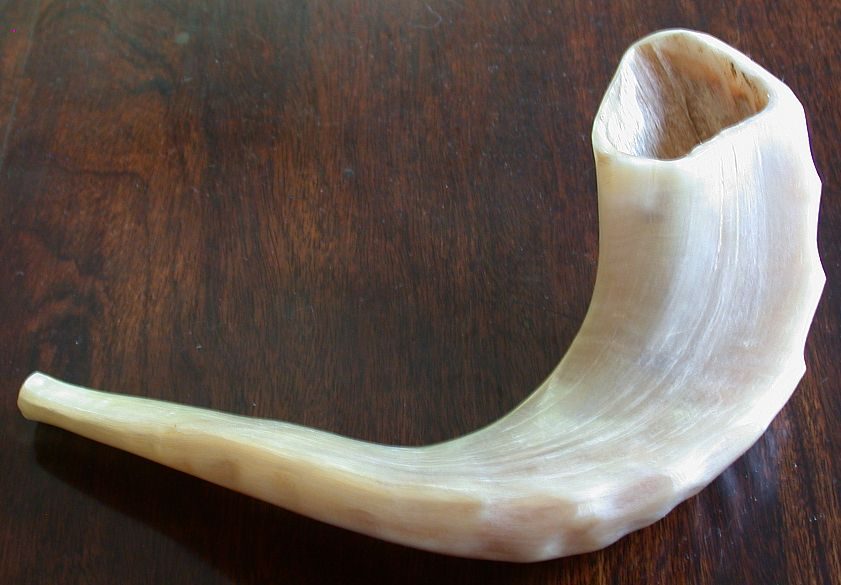
A small shofar made from a ram's horn (© Olve Utne, CC BY-SA 2.5, via Wikimedia Commons)
References
- Hebrew יוֹבֵל yovel: EXO 19:13, YEHO 6:4, YEHO 6:5, YEHO 6:6, YEHO 6:8, YEHO 6:13
- Hebrew קֶרֶן qeren: YEHO 6:5, DAN 3:5, DAN 3:7, DAN 3:10, DAN 3:15
- Hebrew שׁוֹפָר shofar: EXO 19:16, EXO 19:19, EXO 20:18, LEV 25:9, YEHO 6:4, YEHO 6:5, YEHO 6:6, YEHO 6:8
55 more references
YEHO 6:9, YEHO 6:13, YEHO 6:16, YEHO 6:20, HERO 3:27, HERO 6:34, HERO 7:8, HERO 7:16, HERO 7:18, HERO 7:19, HERO 7:20, HERO 7:22, 1 SAM 13:3, 2 SAM 2:28, 2 SAM 6:15, 2 SAM 15:10, 2 SAM 18:16, 2 SAM 20:1, 2 SAM 20:22, 1 KI 1:34, 1 KI 1:39, 1 KI 1:41, 2 KI 9:13, 1 CHR 15:28, 2 CHR 15:14, NEH 4:18, NEH 4:20, JOB 39:24, JOB 39:25, PSA 47:5, PSA 81:3, PSA 98:6, PSA 150:3, ISA 18:3, ISA 27:13, ISA 58:1, YIR 4:5, YIR 4:19, YIR 4:21, YIR 6:1, YIR 6:17, YIR 42:14, YIR 51:27, EZEK 33:3, EZEK 33:4, EZEK 33:5, EZEK 33:6, HOS 5:8, HOS 8:1, YOEL 2:1, YOEL 2:15, AMOS 2:2, AMOS 3:6, ZEP 1:16, ZEC 9:14 - Hebrew תָּקוֹעַ taqo‘a: EZEK 7:14
- Greek σάλπιγξ salpigx: MAT 24:31, 1 COR 14:8, 1 COR 15:52, 1 TH 4:16, HEB 12:19, REV 1:10, REV 4:1, REV 8:2
Description
The horn was a wind instrument made from the horn of an animal, usually a male sheep.
———
Usage
The animal horn was softened so that it could be shaped. The point of the horn was cut off to leave a small opening through which the user blew. The vibration of the lips produced the sound.
The ram’s horn served two general purposes:
1. It was blown in certain religious contexts, not as musical accompaniment to worship but as a signal for important events. Some of these events were the giving of the Law on Mount Sinay (Sinai), the Day of Atonement, the bringing of the Ark of the Covenant into Yerushalem (Jerusalem), and the coronation of kings.
2. It also served as a signal or alarm when war was approaching. Such references are particularly common in the prophetic books, when the prophets are calling the people to repent (HOS 5:8, HOS 8:1, YOEL 2:1, YOEL 2:15, AMOS 3:6).
———
Translation
In many passages the purpose of the ram’s horn called shofar in Hebrew was to sound an alarm. This will be easy to express in those cultures where the horns of animals are used as musical instruments to give signals to large groups of people. In other cultures it may be possible to find another instrument that is used for an equivalent purpose. In some languages, for example, instruments such as bells or drums are the warnings for war. Some translations have transliterated the word shofar. Unless the instrument is well known, such a borrowing should normally be accompanied by a footnote or a glossary entry.
The Hebrew words yovel and qeren (literally “animal horn”) in EXO 19:13 and YEHO 6 are used as parallel to shofar and can be treated as equivalent to shofar. Some scholars have suggested that the Hebrew word taqo‘a (literally “blowing”) in EZEK 7:14 refers not to an instrument but to the town of Tekoa (compare YIR 6:1). It is more likely, however, that the word refers to the object on which the alarm was blown, that is, the ram’s horn.
In some passages it will be necessary to expand the translation in order to indicate that the blowing of the ram’s horn was not just for music; for example, in EZEK 7:14CEV has “A signal has been blown on the trumpet,” and GECL says “An alarm is sounded.”
It may be possible to follow NCV ’s descriptive phrase for “ram’s horn” in LEV 25:9, where it has “horn of a male sheep.”
In ZEP 1:16GNT has “sound of war trumpets,” which emphasizes the function of the ram’s horn, and in the same place NCV avoids a translation of the instrument with “alarms.”
 Open English Translation (OET)