OET OET-RV OET-LV GHT ULT UST BSB MSB BLB AICNT OEB WEBBE WMBB NET LSV FBV TCNT T4T LEB BBE Moff JPS Wymth ASV DRA YLT Drby RV SLT Wbstr KJB-1769 KJB-1611 Bshps Gnva Cvdl TNT Wycl SR-GNT UHB BrLXX BrTr Related Parallel Simple Interlinear Topics Reference Dictionary Search
ParallelVerse GEN EXO LEV NUM DEU JOB JOS JDG RUTH 1 SAM 2 SAM PSA AMOS HOS 1 KI 2 KI 1 CHR 2 CHR PROV ECC SNG JOEL MIC ISA ZEP HAB JER LAM YNA (JNA) NAH OBA DAN EZE EZRA EST NEH HAG ZEC MAL LAO GES LES ESG DNG 2 PS TOB JDT WIS SIR BAR LJE PAZ SUS BEL MAN 1 MAC 2 MAC 3 MAC 4 MAC YHN (JHN) MARK MAT LUKE ACTs YAC (JAM) GAL 1 TH 2 TH 1 COR 2 COR ROM COL PHM EPH PHP 1 TIM TIT 1 PET 2 PET 2 TIM HEB YUD (JUD) 1 YHN (1 JHN) 2 YHN (2 JHN) 3 YHN (3 JHN) REV
Luke Intro C1 C2 C3 C4 C5 C6 C7 C8 C9 C10 C11 C12 C13 C14 C15 C16 C17 C18 C19 C20 C21 C23 C24
Luke 22 V1 V4 V7 V10 V13 V16 V19 V22 V25 V28 V31 V34 V37 V40 V43 V46 V49 V52 V55 V58 V61 V64 V67 V70
Note: This view shows ‘verses’ which are not necessarily natural language units and hence sometimes only part of a sentence will be visible—click on any Bible version abbreviation down the left-hand side to see the verse in more of its context. Normally the OET discourages the reading of individual ‘verses’, but this view is only designed as a tool for Bible-translators and others doing comparisons of different translations—the older translations are further down the page (so you can read up from the bottom to trace the English translation history). The OET segments on this page are still early looks into the drafted texts of the Open English Translation of the Bible—please double-check these texts in advance before using in public.
B I ◄ ← Luke 22:30 ↓ → ► ≡ ═ ©
Text critical issues=small word differences Clarity of original=clear Importance to us=normal Speaker(s)=Yeshua (All still tentative.)
OET (OET-RV) so that you all will be able to eat and drink at my table in my kingdom, and you’ll sit on thrones judging the twelve tribes of Yisrael.[ref]
OET-LV in_order_that you_all_may_be_eating and you_all_may_be_drinking at the table of_me in the kingdom of_me, and you_all_are_sitting on thrones, judging the twelve tribes of_ the _Israaʸl/(Yisrāʼēl).
SR-GNT ἵνα ἔσθητε καὶ πίνητε ἐπὶ τῆς τραπέζης μου ἐν τῇ βασιλείᾳ μου, καὶ καθῆσθε ἐπὶ θρόνων, τὰς δώδεκα φυλὰς κρίνοντες τοῦ Ἰσραήλ. ‡
(hina esthaʸte kai pinaʸte epi taʸs trapezaʸs mou en taʸ basileia mou, kai kathaʸsthe epi thronōn, tas dōdeka fulas krinontes tou Israaʸl.)
Key: khaki:verbs, orange:accusative/object, pink:genitive/possessor, cyan:dative/indirect object.
Note: Automatic aligning of the OET-RV to the LV is done by some temporary software, hence the RV alignments are incomplete (and may occasionally be wrong).
GHT in-which-place you-may-be-eating and may-be-drinking upon of {the table} of {me} in to {the kingdom} of {me}, and will-sit-down upon of {thrones} judging the twelve tribes of {the} Israel."
ULT so that you may eat and drink at my table in my kingdom and sit on thrones judging the 12 tribes of Israel.
UST You will sit and eat and drink with me when I become king. In fact, you will sit on thrones and judge the people of the 12 tribes of Israel.”
BSB so that you may eat and drink at My table in My kingdom and sit on thrones, judging the twelve tribes of Israel.
MSB so that you may eat and drink at My table[fn] and sit on thrones, judging the twelve tribes of Israel.”
22:30 CT and TR include in My kingdom.
BLB so that you may eat and may drink at My table in My kingdom, and may sit on thrones, judging the twelve tribes of Israel.
AICNT so that you may eat and {drink}[fn] at my table in {my}[fn] kingdom and you will sit on thrones judging the [twelve][fn] tribes of Israel.
22:30, drink: D(05) reads “be hungry.”
22:30, my: D(05) reads “the.”
22:30, twelve: Absent from Latin(e).
OEB so that you may eat and drink at my table in my kingdom, and be seated on twelve thrones as judges of the twelve tribes of Israel.
WEBBE & WMBB that you may eat and drink at my table in my Kingdom. You will sit on thrones, judging the twelve tribes of Israel.”
NET that you may eat and drink at my table in my kingdom, and you will sit on thrones judging the twelve tribes of Israel.
LSV that you may eat and may drink at My table, in My kingdom, and may sit on thrones, judging the twelve tribes of Israel.”
FBV so that you may eat and drink at my table in my kingdom, and sit on thrones judging the twelve tribes of Israel.”
TCNT so that you may eat and drink at my [fn]table. [fn]And you will sit on thrones judging the twelve tribes of [fn]Israel.”
22:30 table ¦ table in my kingdom ANT CT HF PCK TR
22:30 And you will ¦ and TH TR WH {Note: The reading of TH, TR, and WH would eliminate the preceding period.}
22:30 Israel.” Then the Lord said, ¦ Israel. NA SBL WH
T4T so that you can sit and eat and rule [MET] with me when I become king. You will sit on thrones to judge the people of the twelve tribes of Israel.”
LEB that you may eat and drink at my table in my kingdom, and you will sit on thrones judging the twelve tribes of Israel.
BBE So that you may take food and drink at my table in my kingdom, and be seated like kings, judging the twelve tribes of Israel.
Moff I assign you the right of eating and drinking at my table in my Realm and of sitting on thrones to rule the twelve tribes of Israel.
Wymth so that you shall eat and drink at my table in my Kingdom, and sit on thrones as judges over the twelve tribes of Israel.
ASV that ye may eat and drink at my table in my kingdom; and ye shall sit on thrones judging the twelve tribes of Israel.
DRA That you may eat and drink at my table, in my kingdom: and may sit upon thrones, judging the twelve tribes of Israel.
YLT that ye may eat and may drink at my table, in my kingdom, and may sit on thrones, judging the twelve tribes of Israel.'
Drby that ye may eat and drink at my table in my kingdom, and sit on thrones judging the twelve tribes of Israel.
RV that ye may eat and drink at my table in my kingdom; and ye shall sit on thrones judging the twelve tribes of Israel.
(that ye/you_all may eat and drink at my table in my kingdom; and ye/you_all shall sit on thrones judging the twelve tribes of Israel.)
SLT That ye might eat and drink at my table in my kingdom, and might sit upon thrones, judging the twelve tribes of Israel.
Wbstr That ye may eat and drink at my table in my kingdom, and sit on thrones, judging the twelve tribes of Israel.
KJB-1769 That ye may eat and drink at my table in my kingdom, and sit on thrones judging the twelve tribes of Israel.
( That ye/you_all may eat and drink at my table in my kingdom, and sit on thrones judging the twelve tribes of Israel.)
KJB-1611 That yee may eate and drinke at my table in my kingdome, and sit on thrones iudging the twelue Tribes of Israel.
(Modernised spelling is same as from KJB-1769 above, apart from capitalisation)
Bshps That ye may eate and drynke at my table in my kyngdome, & sit on seates iudgyng the twelue tribes of Israel.
(That ye/you_all may eat and drink at my table in my kingdom, and sit on seats judging the twelve tribes of Israel.)
Gnva That ye may eate, and drinke at my table in my kingdome, and sit on seates, and iudge the twelue tribes of Israel.
(That ye/you_all may eat, and drink at my table in my kingdom, and sit on seats, and judge the twelve tribes of Israel.)
Cvdl that ye maye eate and drynke at my table in my kyngdome, and syt vpon seates, and iudge the twolue trybes of Israel.
(that ye/you_all may eat and drink at my table in my kingdom, and sit upon seats, and judge the twelve tribes of Israel.)
TNT that ye maye eate and drynke at my table in my kyngdome and sit on seates and iudge the twelve tribes of Israell.
(that ye/you_all may eat and drink at my table in my kingdom and sit on seats and judge the twelve tribes of Israell.)
Wycl a rewme, that ye ete and drynke on my boord in my rewme, and sitte on trones, and deme the twelue kynredis of Israel.
(a realm, that ye/you_all eat and drink on my table in my realm, and sit on thrones, and deem the twelve kindreds of Israel.)
Luth daß ihr essen und trinken sollt über meinem Tische in meinem Reich und sitzen auf Stühlen und richten die zwölf Geschlechter Israels.
(that you(pl)/their/her eat and drink(v) should above my tables in my kingdom and sit on/in/to stools/chairs and direct the twelve descendants Israel’s.)
ClVg ut edatis et bibatis super mensam meam in regno meo, et sedeatis super thronos judicantes duodecim tribus Israël.[fn]
(as you(pl)_eject and you(pl)_may_drink over the_table of_mine in/into/on kingdom mine, and you(pl)_may_sit over thrones judging twelve tribe Israel.)
22.30 Et sedeatis super thronos. Hæc mutatio dextræ Excelsi, ut qui humiles nunc gaudent ministrare conservis, tunc sublimes super mensam Domini perpetuis dapibus alantur, et qui in tentationibus injuste judicati cum Domino permanent, illic cum eo super tentatores suos justi judices veniant. Quanto enim hic despectiores, tanto illic majori culmine potestatis excrescent. Judicantes duodecim. Per duodecim, non duodecim personæ, sed multitudo judicantium significatur, propter duas partes septenarii, quo universitas significatur, id est tria et quatuor per quas duodecim multiplicantur.
22.30 And you(pl)_may_sit over thrones. These change right Exalted, as who/which humbles now they_rejoice to_serve fellow_servant, then sublimes over the_table Master perpetuals sacrificial_feasts they_may_be_fed, and who/which in/into/on temptations unjustly judged when/with Master they_continue, there when/with by_him over tempteres his_own just judges they_come. How_much because this/here contemptres, so_much there older summit powers excrescent. Judging twelve. Through twelve, not/no twelve persons, but multitude/crowd judging is_indicated, because two parts sevenfold, where universe is_indicated, that it_is three and four through which twelve they_are_multiplied.
UGNT ἵνα ἔσθητε καὶ πίνητε ἐπὶ τῆς τραπέζης μου ἐν τῇ βασιλείᾳ μου; καὶ καθῆσθε ἐπὶ θρόνων, τὰς δώδεκα φυλὰς κρίνοντες τοῦ Ἰσραήλ.
(hina esthaʸte kai pinaʸte epi taʸs trapezaʸs mou en taʸ basileia mou; kai kathaʸsthe epi thronōn, tas dōdeka fulas krinontes tou Israaʸl.)
SBL-GNT ἵνα ⸀ἔσθητε καὶ πίνητε ἐπὶ τῆς τραπέζης μου ⸂ἐν τῇ βασιλείᾳ μου⸃, καὶ ⸀καθήσεσθε ἐπὶ θρόνων ⸂τὰς δώδεκα φυλὰς κρίνοντες⸃ τοῦ Ἰσραήλ.
(hina ⸀esthaʸte kai pinaʸte epi taʸs trapezaʸs mou ⸂en taʸ basileia mou⸃, kai ⸀kathaʸsesthe epi thronōn ⸂tas dōdeka fulas krinontes⸃ tou Israaʸl.)
RP-GNT ἵνα ἐσθίητε καὶ πίνητε ἐπὶ τῆς τραπέζης μου καὶ καθίσεσθε ἐπὶ θρόνων, κρίνοντες τὰς δώδεκα φυλὰς τοῦ Ἰσραήλ.
(hina esthiaʸte kai pinaʸte epi taʸs trapezaʸs mou kai kathisesthe epi thronōn, krinontes tas dōdeka fulas tou Israaʸl.)
TC-GNT ἵνα [fn]ἐσθίητε καὶ πίνητε ἐπὶ τῆς τραπέζης [fn]μου ἐν τῇ βασιλείᾳ μου καὶ [fn]καθίσεσθε ἐπὶ θρόνων, [fn]κρίνοντες τὰς δώδεκα φυλὰς τοῦ Ἰσραήλ.
(hina esthiaʸte kai pinaʸte epi taʸs trapezaʸs mou en taʸ basileia mou kai kathisesthe epi thronōn, krinontes tas dōdeka fulas tou Israaʸl.)
22:30 εσθιητε ¦ εσθητε ᴄᴛ
22:30 μου ʙ22 ¦ μου εν τη βασιλεια μου ʙ13 ᴀɴᴛ ᴄᴛ ʜꜰ ᴘᴄᴋ ᴛʀ
22:30 καθισεσθε ¦ καθισησθε ᴛʀ ¦ καθησεσθε ɴᴀ ꜱʙʟ ¦ καθησθε ᴛʜ ᴡʜ
22:30 κρινοντες τας δωδεκα φυλας ¦ τας δωδεκα φυλας κρινοντες ᴄᴛ
Key for above GNTs: yellow:punctuation differs, red:words differ (from our SR-GNT base).
In this section Jesus’ apostles began to argue about which of them was the greatest. Because of this argument, Jesus taught them that leaders among his disciples should be different from other leaders who are not his disciples. His disciples should be servants and not harsh, arrogant leaders. This instruction applies not only to Jesus’ twelve apostles but to everyone who becomes a leader among Jesus’ other followers.
The apostles had a similar argument in 9:46 and Mark 9:34. In 9:46 this argument occurred just after Jesus had predicted in 9:44 that he would be betrayed. The similar argument here in Section 22:24–30 is also mentioned immediately after Jesus said that he would be betrayed.
Some examples of heading for this section are:
Jesus again teaches humility (JBP)
The Argument about Greatness (GNT)
Jesus taught that the one who serves others is the greatest among them
Some English versions, such as the NIV, do not have a section heading here. You may divide the sections in the way that is most helpful for the people in your area.
so that…and: In this context the Greek word that the BSB translates as so that indicates that 22:30a is a result.Some commentaries and versions interpret this word to indicate purpose here, implying that Jesus’ purpose for conferring a kingdom on his disciples was to cause them to eat and drink and his table in the kingdom. The interpretations of purpose and intended result are very close when Jesus is the person who intends that result because he is sure to make it happen. More of the exegetical resources consulted list this as result, and it fits the context very well here. Jesus gave his apostles authority, and as a result, he and they will eat joyfully together in his kingdom. The clause that begins with and (22:30b) also expresses result. Jesus gave the apostles authority, and as a result, they will judge the twelve tribes of Israel. See the General Comment on 22:29–30 at the end of 22:30b for examples of ways to translate these results.
so that you may eat and drink at My table in My kingdom,
As a result, in my future kingdom you(plur) will eat and drink with me at my table,
And so when I rule as king, you(plur) will have an honored place/seat near me, as we(incl) feast/celebrate together.
you may eat and drink at My table in My kingdom: In many cultures it is a custom for the king to invite important officials and elders to eat with him. It is a great honor to eat with the king. Jesus indicated here that when he rules as king, he will give his apostles the honor and the right to eat with him.
In some cultures people do not eat at tables. You should use a natural way in your language to describe eating with Jesus. Some other ways to translate this meaning are:
you will thus eat-with me in my rulingKankanaey back translation on TW.
We will feast together there in my kingdom.Uma back translation on TW.
eat and drink: The phrase eat and drink was a common way in that culture to refer to having a meal. See how you translated this phrase in 17:8.
in My kingdom: The phrase in My kingdom refers to the future time when Jesus will reign over everything. In some languages it may be more natural to translate this phrase as a clause with a subject and verb. For example:
when I will rule the people as king
in the future when I ruleWestern Bukidnon Manobo back translation on TW.
and sit on thrones, judging the twelve tribes of Israel.
and you(plur) will also sit in royal seats to govern the twelve tribes of Israel.
And so also, you(plur) will rule the twelve clans of the people/descendants of Israel.”
sit on thrones, judging the twelve tribes of Israel: This clause tells a second action that the apostles will do as a result of 22:29. In some languages it may be more natural to begin a new sentence or clause here. For example:
And you will sit on thrones, judging the twelve tribes of Israel. (NCV)
This clause indicates that when the apostles sit on their thrones, their work will be to lead and rule people. Some other ways to translate this clause are:
…and you will sit on thrones to rule over the twelve tribes of Israel. (GNT)
…and sit on thrones as judges of the twelve tribes of Israel. (REB)
You will also sit on thrones and judge the twelve tribes of Israel. (GW)
sit on thrones: The word thrones refers to special seats that are used by kings. A king often sits on his throne when he speaks to his people as their leader. In this context the phrase sit on thrones is a figure of speech. It indicates that the apostles will rule people with authority, as kings rule.
Some ways to translate this figure of speech are:
Translate the figure of speech by referring in some way to a seat or to sitting. For example:
sit on king’s chairs
sit in places/seats of honor
Translate the meaning without the figure of speech:
rule as kings
be honored rulers/leaders
judging the twelve tribes of Israel: The Greek word that the BSB translates as judging is used in different ways. It can refer to deciding whether people are guilty or innocent, and deciding how the guilty people must be punished. It can also refer more generally to whatever rulers do as they govern a group of people. These activities include judging and many other actions.
It this context it is good to translate in a general way. This agrees with 22:29, where Jesus indicated that he was giving his apostles authority to rule. Jesus probably implied here that the apostles would have general responsibility to govern the tribes of Israel.As Nolland (p. 1067) says, “In Luke…a wider sense, though certainly not without a judicial component, seems to be altogether more likely, since in this case the activity takes place as part of ‘royal rule.’ We may want to think in terms of the judicial function of OT kings (e.g., 2 Samuel 15:1–6; 1 Kings 3:16–28) or of the broad sense of judging associated with the judges raised up by God (e.g., Judges 3:9, 3:15; 6:11–18).” Green (p. 770) says that “although the verb Luke uses may suggest a judiciary function for the apostles, the notion of ‘regal authority’ (verse 29) and the presence in Israel’s past of ‘judges’ whose role was actually ‘ruling’ encourages Jesus’ identification of the apostles as empowered leaders. Indeed, it is again here that we see the significance of Luke’s identification of Jesus’ followers at the table as ‘apostles,’ whose appointment is an anticipation of the restoration of Israel as God’s people and who, therefore, are commissioned to govern the renewed people of God.”
Some other ways to translate judging the twelve tribes of Israel are:
to rule over the twelve tribes of Israel (GNT)
governing the twelve tribes of Israel
the twelve tribes of Israel: The phrase the twelve tribes of Israel refers to the descendants of the twelve sons of Israel. Each of his sons had many descendants, and these descendants became large groups. Languages have different terms to describe such groups of descendants, such as “clans” or “tribes.” These tribes together formed the nation called Israel.
Some other ways to translate this phrase are:
the descendants of the twelve sons of IsraelWestern Bukidnon Manobo back translation on TW.
the twelve clans/groups among the Israel people
Use a natural term in your language.
The clauses in 22:30 tell the result of the statement in 22:29. In some languages the context will make it clear that 22:30 is the result of 22:29. In those languages a conjunction may not be needed. In other languages it will be necessary to use a special conjunction or other way to make the connection clear. Some ways to translate these verses in English are:
29and just as my Father has given me the right to rule, so I will give you the same right. 30aYou will eat and drink at my table in my Kingdom, and you will sit on thrones to rule over the twelve tribes of Israel. (GNT)
29Now I give you authority to rule people, just as my Father gave me authority. 30So when I come to rule, you will eat with me at my table, and you will also rule over the twelve tribes of Israel.
Use a natural way in your language to show that 22:30 is the result of 22:29.
Note 1 topic: figures-of-speech / metonymy
ἵνα ἔσθητε καὶ πίνητε ἐπὶ τῆς τραπέζης μου
in_order_that ˱you_all˲_˓may_be˒_eating (Some words not found in SR-GNT: ἵνα ἔσθητε καί πίνητε ἐπί τῆς τραπέζης μού ἐν τῇ βασιλείᾳ μού καί καθῆσθε ἐπί θρόνων τάς δώδεκα φυλάς κρίνοντες τοῦ Ἰσραήλ)
Jesus may simply be referring to the way he and his disciples will renew their table fellowship in the kingdom of God, as he described in [22:16](../22/16.md). But he may also be referring to his disciples becoming important officials in his kingdom, since such officials would have their meals at the king’s table. Alternate translation: [so that you may be important officials]
Note 2 topic: figures-of-speech / abstractnouns
ἐν τῇ βασιλείᾳ μου
in the kingdom (Some words not found in SR-GNT: ἵνα ἔσθητε καί πίνητε ἐπί τῆς τραπέζης μού ἐν τῇ βασιλείᾳ μού καί καθῆσθε ἐπί θρόνων τάς δώδεκα φυλάς κρίνοντες τοῦ Ἰσραήλ)
If it would be helpful in your language, you could express the idea behind the abstract noun kingdom with a verb such as “rule” and a concrete noun such as “king.” Alternate translation: [when I rule as king]
Note 3 topic: translate-symaction
καθῆσθε ἐπὶ θρόνων
˱you_all˲_˓are˒_sitting (Some words not found in SR-GNT: ἵνα ἔσθητε καί πίνητε ἐπί τῆς τραπέζης μού ἐν τῇ βασιλείᾳ μού καί καθῆσθε ἐπί θρόνων τάς δώδεκα φυλάς κρίνοντες τοῦ Ἰσραήλ)
Rulers have thrones that symbolize their authority. These special seats are signs of status and power. If it would be helpful to your readers, you could indicate that in some way in your translation. Alternate translation: [sit on royal thrones]
Note 4 topic: figures-of-speech / metonymy
τὰς δώδεκα φυλὰς & τοῦ Ἰσραήλ
(Some words not found in SR-GNT: ἵνα ἔσθητε καί πίνητε ἐπί τῆς τραπέζης μού ἐν τῇ βασιλείᾳ μού καί καθῆσθε ἐπί θρόνων τάς δώδεκα φυλάς κρίνοντες τοῦ Ἰσραήλ)
Here Jesus uses the term tribes to refer to the people who belong to those tribes. Alternate translation: [the people of the 12 tribes of Israel]
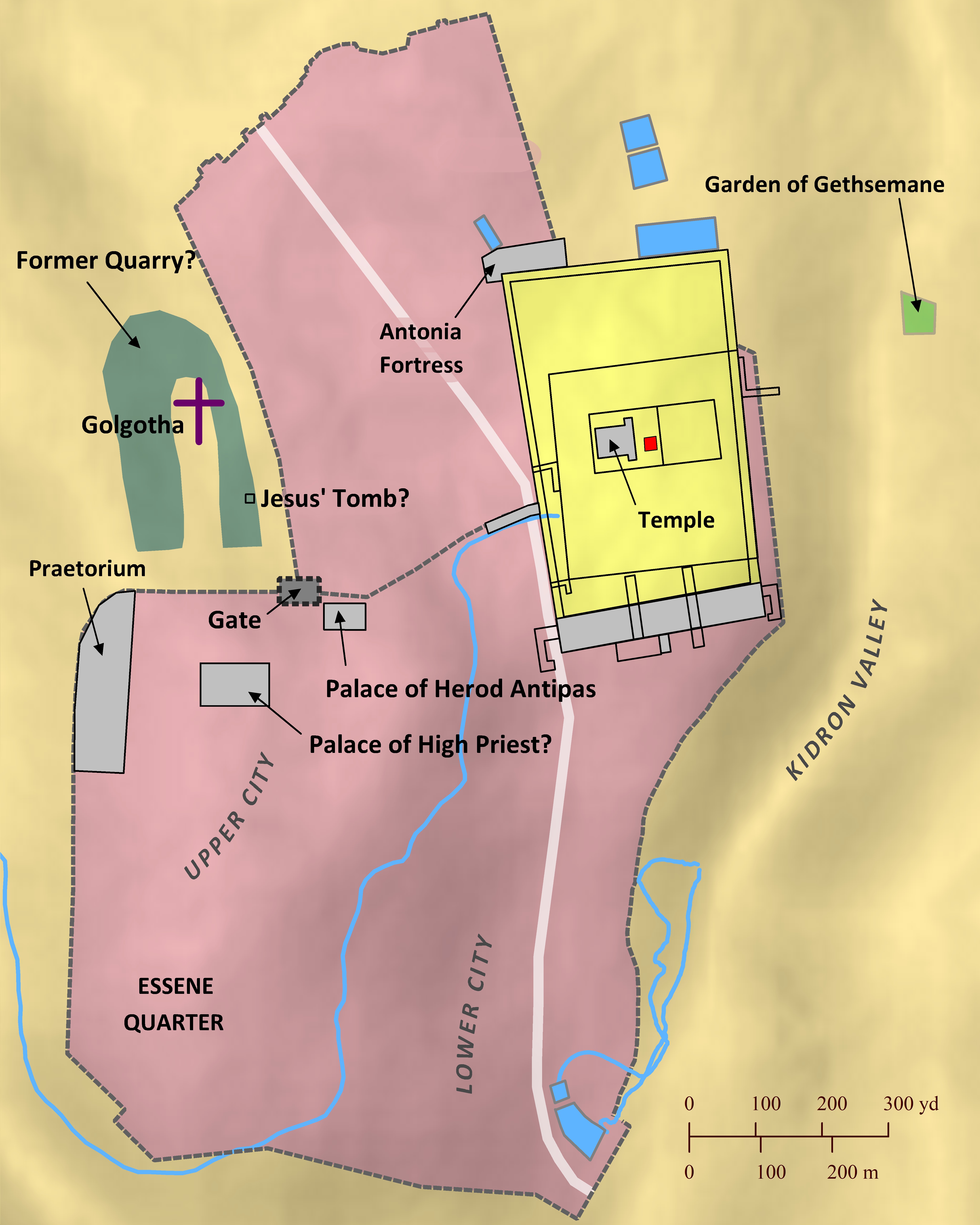
Matthew 26-27; Mark 14-15; Luke 22-23; John 13-19
On the Thursday before he was crucified, Jesus had arranged to share the Passover meal with his disciples in an upper room, traditionally thought to be located in the Essene Quarter of Jerusalem. After they finished the meal, they went to the Garden of Gethsemane, where Jesus often met with his disciples. There Judas Iscariot, one of Jesus’ own disciples, betrayed him to soldiers sent from the High Priest, and they took Jesus to the High Priest’s residence. In the morning the leading priests and teachers of the law put Jesus on trial and found him guilty of blasphemy. The council sent Jesus to stand trial for treason before the Roman governor Pontius Pilate, who resided at the Praetorium while in Jerusalem. The Praetorium was likely located at the former residence of Herod the Great, who had died over 30 years earlier. When Pilate learned that Jesus was from Galilee, he sent him to Herod Antipas, who had jurisdiction over Galilee. But when Jesus gave no answer to Herod’s many questions, Herod and his soldiers sent him back to Pilate, who conceded to the people’s demands that Jesus be crucified. Jesus was forced to carry his cross out of the city gate to Golgotha, meaning Skull Hill, referring to what may have been a small unquarried hill in the middle of an old quarry just outside the gate. After Jesus was unable to carry his cross any further, a man named Simon from Cyrene was forced to carry it for him. There at Golgotha they crucified Jesus. After Jesus died, his body was hurriedly taken down before nightfall and placed in a newly cut, rock tomb owned by Joseph of Arimathea, a member of the Jewish high council. This tomb was likely located at the perimeter of the old quarry.
Open Bible Data site copyright © 2023–2026 Freely-Given.org.
Python source code for creating these static pages is available on GitHub under an open licence.
For Bible data copyrights, see the details for each displayed Bible version.
The Open English Translation (OET) main site is at OpenEnglishTranslation.Bible or OET.Bible.