
OET OET-RV OET-LV GHT ULT UST BSB MSB BLB AICNT OEB WEBBE WMBB NET LSV FBV TCNT T4T LEB BBE Moff JPS Wymth ASV DRA YLT Drby RV SLT Wbstr KJB-1769 KJB-1611 Bshps Gnva Cvdl TNT Wycl SR-GNT UHB BrLXX BrTr Related Parallel Simple Interlinear Topics Reference Dictionary Search
ParallelVerse GEN EXO LEV NUM DEU JOB JOS JDG RUTH 1 SAM 2 SAM PSA AMOS HOS 1 KI 2 KI 1 CHR 2 CHR PROV ECC SNG JOEL MIC ISA ZEP HAB JER LAM YNA (JNA) NAH OBA DAN EZE EZRA EST NEH HAG ZEC MAL LAO GES LES ESG DNG 2 PS TOB JDT WIS SIR BAR LJE PAZ SUS BEL MAN 1 MAC 2 MAC 3 MAC 4 MAC YHN (JHN) MARK MAT LUKE ACTs YAC (JAM) GAL 1 TH 2 TH 1 COR 2 COR ROM COL PHM EPH PHP 1 TIM TIT 1 PET 2 PET 2 TIM HEB YUD (JUD) 1 YHN (1 JHN) 2 YHN (2 JHN) 3 YHN (3 JHN) REV
Ruth 4 V1 V3 V4 V5 V6 V7 V8 V9 V10 V11 V12 V13 V14 V15 V16 V17 V18 V19 V20 V21 V22
Note: This view shows ‘verses’ which are not necessarily natural language units and hence sometimes only part of a sentence will be visible—click on any Bible version abbreviation down the left-hand side to see the verse in more of its context. Normally the OET discourages the reading of individual ‘verses’, but this view is only designed as a tool for Bible-translators and others doing comparisons of different translations—the older translations are further down the page (so you can read up from the bottom to trace the English translation history). The OET segments on this page are still early looks into the drafted texts of the Open English Translation of the Bible—please double-check these texts in advance before using in public.
Text critical issues=none Clarity of original=clear Importance to us=normal Speaker(s)=Narrator (All still tentative.)
OET (OET-RV) Then Boaz called over ten of the older, well-respected men from the town and asked them to sit and witness their discussion, so they sat down with them.
OET-LV And_he/it_took ten men of_the_elders_of the_city and_he/it_said sit here and_they_sat_down.
UHB וַיִּקַּ֞ח עֲשָׂרָ֧ה אֲנָשִׁ֛ים מִזִּקְנֵ֥י הָעִ֖יר וַיֹּ֣אמֶר שְׁבוּ־פֹ֑ה וַיֵּשֵֽׁבוּ׃ ‡
(vayyiqqaḩ ˊₐsārāh ʼₐnāshim mizziqnēy hāˊir vayyoʼmer shəⱱū-foh vayyēshēⱱū.)
Key: khaki:verbs.
Note: Automatic aligning of the OET-RV to the LV is done by some temporary software, hence the OET-RV alignments are incomplete (and may occasionally be wrong).
BrLXX Καὶ ἔλαβε Βοὸζ δέκα ἄνδρας ἀπὸ τῶν πρεσβυτέρων τῆς πόλεως, καὶ εἶπε, καθίσατε ὧδε· καὶ ἐκάθισαν.
(Kai elabe Booz deka andras apo tōn presbuterōn taʸs poleōs, kai eipe, kathisate hōde; kai ekathisan.)
BrTr And Booz took ten men of the elders of the city, and said, Sit ye here; and they sat down.
ULT Then he took ten men from the elders of the city and said, “Sit down here.” So they sat down.
UST Boaz then gathered ten of the older, well-respected men from the town and said to them, “Please sit here so you can witness our business.” So they sat down.
BSB & MSB Then Boaz took ten of the elders of the city and said, “Sit here,” and they did so.
OEB Boaz also took ten of the town elders and said, ‘Sit down here.’ So they sat down.
WEBBE & WMBB Boaz took ten men of the elders of the city, and said, “Sit down here,” and they sat down.
NET Boaz chose ten of the village leaders and said, “Sit down here!” So they sat down.
LSV And he takes ten men from [the] elderly of the city, and says, “Sit down here”; and they sit down.
FBV Then Boaz selected ten of the town elders and asked them to sit there with them.
T4T Boaz then gathered ten of the elders of the town and asked them to sit down there also. After they sat down,
LEB And he took ten men from the elders of the city and said, “Sit here.” And they sat.
BBE Then he got ten of the responsible men of the town, and said, Be seated here. And they took their seats.
Moff No Moff RUT 4:2 book available
JPS And he took ten men of the elders of the city, and said: 'Sit ye down here.' And they sat down.
ASV And he took ten men of the elders of the city, and said, Sit ye down here. And they sat down.
DRA And Booz taking ten men of the ancients of the city, said to them: Sit ye down here.
YLT And he taketh ten men of the elders of the city, and saith, 'Sit down here;' and they sit down.
Drby And he took ten men of the elders of the city, and said, Sit down here. And they sat down.
RV And he took ten men of the elders of the city, and said, Sit ye down here. And they sat down.
(And he took ten men of the elders of the city, and said, Sit ye/you_all down here. And they sat down.)
SLT And he will take ten men from the old men of the city, and he will say, Sit ye down here. And they will sit down.
Wbstr And he took ten men of the elders of the city, and said, Sit ye down here. And they sat down.
KJB-1769 And he took ten men of the elders of the city, and said, Sit ye down here. And they sat down.
(And he took ten men of the elders of the city, and said, Sit ye/you_all down here. And they sat down.)
KJB-1611 And hee tooke ten men of the Elders of the citie, and said, Sit ye downe here. And they sate downe.
(Modernised spelling is same as from KJB-1769 above, apart from capitalisation)
Bshps And he toke ten men of the elders of the citie, and said: sit ye downe here. And they sat downe.
(Modernised spelling is same as from KJB-1769 above, apart from capitalisation and punctuation)
Gnva Then he tooke ten men of the Elders of the citie, and sayd, Sit ye downe here. And they sate downe.
(Then he took ten men of the Elders of the city, and said, Sit ye/you_all down here. And they sat down.)
Cvdl & he toke ten men of the Elders of ye cite, & sayde: Syt you downe here. And they sat the downe.
(and he took ten men of the Elders of ye/you_all city, and said: Sit you down here. And they sat the down.)
Wycl Forsothe Booz took ten `men of the eldere men of the citee, and seide to hem, Sitte ye here.
(For_certain/Truly Boaz took ten men of the elder men of the city, and said to them, Sit ye/you_all here.)
Luth Und er nahm zehn Männer von den Ältesten der Stadt und sprach: Setzet euch her! Und sie setzten sich.
(And he took ten men from the elders the/of_the city and spoke: Set(v) you her! And they/she/them put/set/sat itself/yourself/themselves.)
ClVg Tollens autem Booz decem viros de senioribus civitatis, dixit ad eos: Sedete hic.
(Taking_off however Booz ten men from/about seniors/elders of_the_city, he/she_said to them: Sit_down this/here.)
In this final chapter of the book, Ruth received the reward for her loyalty to Naomi.
Boaz is in focus in the first twelve verses. He met with the other close relative in the presence of many witnesses to discuss the entire situation. The other relative did not want to buy Elimelech’s property that Naomi was selling, if the arrangement also meant that he had to marry Ruth. So Boaz said that he would act as the redeemer himself.
In section 4:13–17, Boaz and Ruth were married, and the LORD soon gave them a son. The women in Bethlehem named the son Obed and rejoiced that Naomi now had a “son” to carry on her family line and care for her in her old age. So both Naomi and Ruth were going to be cared for, and the women went from “emptiness” to “fullness.”
Section 4:18–22 concludes the book with a genealogy that lists of the family line of Perez, who was a son of Judah and grandson of Jacob (who is also called Israel). The family line is listed from Perez through Obed to King David.
Here are some other examples of section headings for 4:1–12:
Boaz Redeems Ruth (ESV)
Boaz Settles the Matter (NET)
Structure:
Some commentaries divide this section into four scenes:NICOT, Sakenfield, Cornerstone, and Sakenfield. These divide the scenes in at least two different ways.
4:1–2 Introduction: Boaz Convenes a Legal Assembly
4:3–8 Boaz Obtains the Rights of Redemption
4:9–10 Boaz Formalizes the Agreement
4:11–12 Witnessing and Blessing
One commentary divides this section into three scenes.Block (pages 203–204).
4:1–2 setting the stage for the legal drama
4:3–8 report of the legal drama
4:9–12 significance of legal drama
You may divide the paragraphs in these scenes in whatever way best fits the structure of your language.
This paragraph describes how Boaz convened a legal assembly at the town gate prior to the actual legal proceedings.
Then Boaz took ten of the elders of the city
Boaz chose ten of the leading men of the town
Next/Then Boaz chose ten men from among the town’s leaders
Then: In Hebrew, this verse begins with the same Hebrew conjunction as in 4:1d. Here the BSB translates it as Then. In some languages, it may be helpful to use a conjunction that indicates the next action. For example:
Next
Boaz took ten of the elders of the city: The elders were the leading men of the town who discussed important things and made the decisions that governed the town. They were usually older men whom the people of the town recognized as its leaders. In this situation, the elders were called together to witness a legal process. See 4:9a–b.
took: In this verse, the Hebrew verb that the BSB translates as took means that Boaz “selected” the elders. He may have asked some men to stop as he saw them about to pass through the gate, or he may have sent someone to ask certain men that he knew to come to a meeting.
In Hebrew, it says “ten of the elders,” so apparently there were more than ten elders in the town.
Here are some other ways to translate this verse part:
Then Boaz chose ten men who were leaders of that city (GW)
Boaz gathered ten of the older leaders of the city (NCV)
and said, “Sit here,” and they did so.
and said to them, “Please sit here.” So they sat down.
and asked them to sit down with him. So they did as he asked.
and said, “Sit here,” and they did so: Translate this in a way that shows that Boaz politely asked the elders to sit down. For example:
and asked them to sit down there too (GNT)
Please sit down here
and: The Hebrew conjunction that the BSB translates as and introduces what happened as a result of what Boaz had said. You could translate it as “so.”
they did so: This refers to the request Boaz made that the elders sit down with him. Here are some other ways to translate these words:
So they also sat down. (GW)
When they were seated (GNT)
וַיִּקַּ֞ח עֲשָׂרָ֧ה אֲנָשִׁ֛ים
(Some words not found in UHB: and=he/it_took ten men of,the_elders_of the=city and=he/it_said sit here and,they_sat_down )
Alternate translation: [Then he chose ten men]
Ruth 1-4
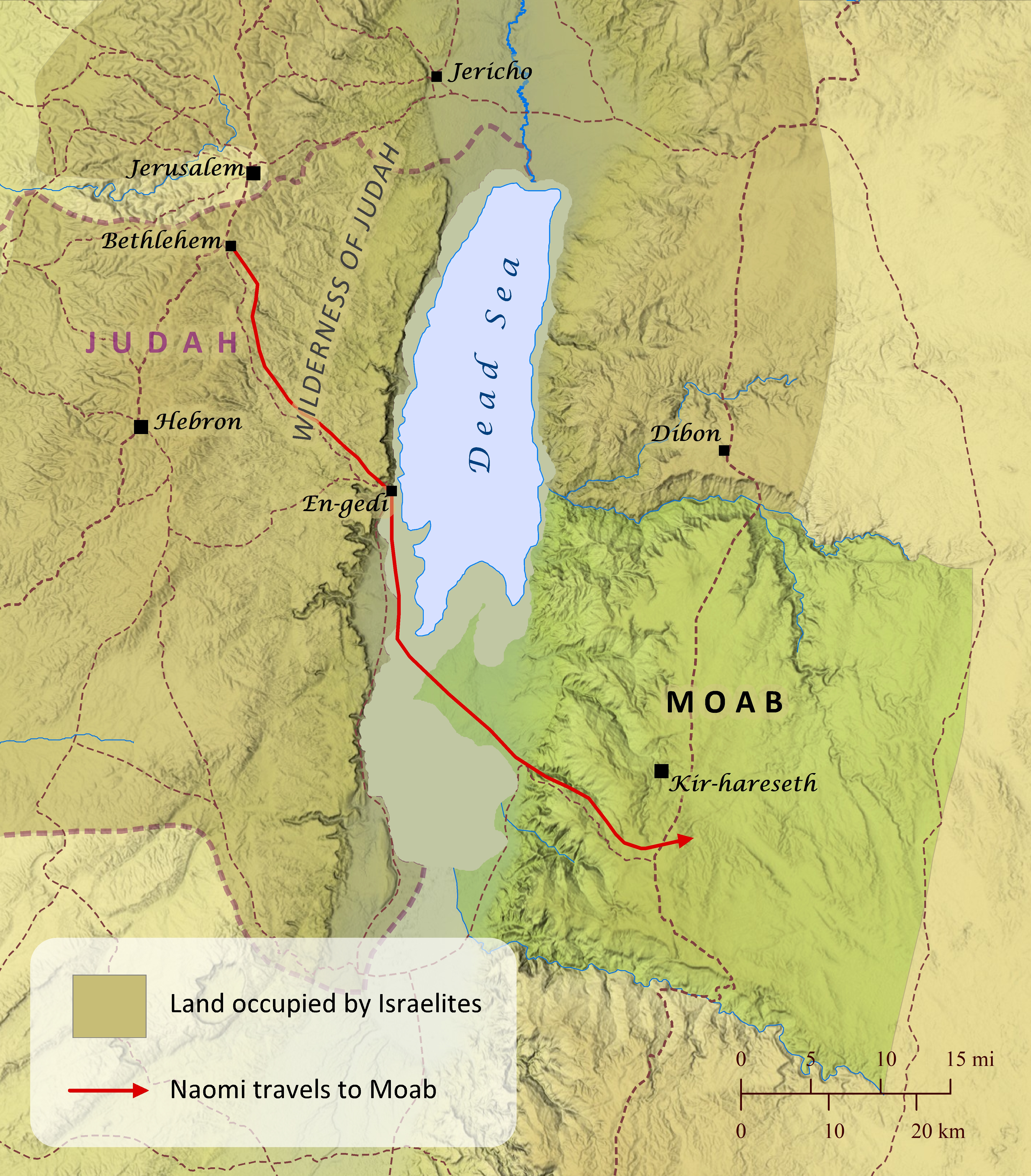
The story of Ruth is set in the time of the Judges, a few generations before the birth of King David. While much animosity often existed between Israel and Moab (Judges 3:12-30; 10:6-12:7; 2 Samuel 8:2; 10; 2 Kings 3:4-27; 2 Chronicles 20; see also Nations across the Jordan River map), other times the two nations appear to have enjoyed a somewhat congenial relationship, as is demonstrated by Naomi’s willingness to relocate to Moab to seek relief from a famine. Later Naomi’s sons also marry Moabite women, and Ruth’s devotion to Naomi and her God no doubt speaks highly of the character of many Moabites. Many years later Ruth’s great-grandson David placed his parents in the care of the king of Moab while he was on the run from King Saul (1 Samuel 22:3-4).
Open Bible Data site copyright © 2023–2026 Freely-Given.org.
Python source code for creating these static pages is available on GitHub under an open licence.
For Bible data copyrights, see the details for each displayed Bible version.
The Open English Translation (OET) main site is at OpenEnglishTranslation.Bible or OET.Bible.