OET OET-RV OET-LV GHT ULT UST BSB MSB BLB AICNT OEB WEBBE WMBB NET LSV FBV TCNT T4T LEB BBE Moff JPS Wymth ASV DRA YLT Drby RV SLT Wbstr KJB-1769 KJB-1611 Bshps Gnva Cvdl TNT Wycl SR-GNT UHB BrLXX BrTr Related Parallel Simple Interlinear Topics Reference Dictionary Search
ParallelVerse GEN EXO LEV NUM DEU JOB JOS JDG RUTH 1 SAM 2 SAM PSA AMOS HOS 1 KI 2 KI 1 CHR 2 CHR PROV ECC SNG JOEL MIC ISA ZEP HAB JER LAM YNA (JNA) NAH OBA DAN EZE EZRA EST NEH HAG ZEC MAL LAO GES LES ESG DNG 2 PS TOB JDT WIS SIR BAR LJE PAZ SUS BEL MAN 1 MAC 2 MAC 3 MAC 4 MAC YHN (JHN) MARK MAT LUKE ACTs YAC (JAM) GAL 1 TH 2 TH 1 COR 2 COR ROM COL PHM EPH PHP 1 TIM TIT 1 PET 2 PET 2 TIM HEB YUD (JUD) 1 YHN (1 JHN) 2 YHN (2 JHN) 3 YHN (3 JHN) REV
Ruth 4 V1 V2 V3 V4 V5 V6 V7 V8 V9 V11 V12 V13 V14 V15 V16 V17 V18 V19 V20 V21 V22
Note: This view shows ‘verses’ which are not necessarily natural language units and hence sometimes only part of a sentence will be visible—click on any Bible version abbreviation down the left-hand side to see the verse in more of its context. Normally the OET discourages the reading of individual ‘verses’, but this view is only designed as a tool for Bible-translators and others doing comparisons of different translations—the older translations are further down the page (so you can read up from the bottom to trace the English translation history). The OET segments on this page are still early looks into the drafted texts of the Open English Translation of the Bible—please double-check these texts in advance before using in public.
Text critical issues=none Clarity of original=clear Importance to us=normal Speaker(s)=Narrator (All still tentative.)
OET (OET-RV) I am also taking Ruth, Mahlon’s widow from Moab, to be my wife so that she can have a son. Everyone will consider that son to be Elimelek’s descendant and he will inherit the property and carry on Elimelek’s family name among his relatives and here in his hometown.[ref] You’ve seen and heard that today and can tell anyone who asks about it.”
OET-LV And_also DOM Rūt the_Mōʼāⱱite_woman the_wife_of Maḩlōn I_acquire to_me to/for_(a)_woman to_raise_up the_name_of the_dead_man over inheritance_of_his and_not the_name_of it_will_be_cut_off of_the_dead_man from_with brothers_of_his and_from_the_gate_of his_place_of_his are_witnesses you(pl) the_day.
UHB וְגַ֣ם אֶת־ר֣וּת הַמֹּאֲבִיָּה֩ אֵ֨שֶׁת מַחְל֜וֹן קָנִ֧יתִי לִ֣י לְאִשָּׁ֗ה לְהָקִ֤ים שֵׁם־הַמֵּת֙ עַל־נַ֣חֲלָת֔וֹ וְלֹא־יִכָּרֵ֧ת שֵׁם־הַמֵּ֛ת מֵעִ֥ם אֶחָ֖יו וּמִשַּׁ֣עַר מְקוֹמ֑וֹ עֵדִ֥ים אַתֶּ֖ם הַיּֽוֹם׃ ‡
(vəgam ʼet-rūt hammoʼₐⱱiyyāh ʼēshet maḩlōn qānitī liy ləʼishshāh ləhāqim shēm-hammēt ˊal-naḩₐlātō vəloʼ-yikkārēt shēm-hammēt mēˊim ʼeḩāyv ūmishshaˊar məqōmō ˊēdim ʼattem hayyōm.)
Key: khaki:verbs.
Note: Automatic aligning of the OET-RV to the LV is done by some temporary software, hence the OET-RV alignments are incomplete (and may occasionally be wrong).
BrLXX Καί γε Ῥοὺθ τὴν Μωαβίτιν τὴν γυναῖκα Μααλὼν κέκτημαι ἐμαυτῷ εἰς γυναῖκα, τοῦ ἀναστῆσαι τὸ ὄνομα τοῦ τεθνηκότος ἐπὶ τῆς κληρονομίας αὐτοῦ, καὶ οὐκ ἐξολοθρευθήσεται τὸ ὄνομα τοῦ τεθνηκότος ἐκ τῶν ἀδελφῶν αὐτοῦ, καὶ ἐκ τῆς φυλῆς λαοῦ αὐτοῦ· μάρτυρες ὑμεῖς σήμερον.
(Kai ge Ɽouth taʸn Mōabitin taʸn gunaika Maʼalōn kektaʸmai emautōi eis gunaika, tou anastaʸsai to onoma tou tethnaʸkotos epi taʸs klaʸronomias autou, kai ouk exolothreuthaʸsetai to onoma tou tethnaʸkotos ek tōn adelfōn autou, kai ek taʸs fulaʸs laou autou; martures humeis saʸmeron.)
BrTr Moreover I have bought for myself for a wife Ruth the Moabitess, the wife of Maalon, to raise up the name of the dead upon his inheritance; so the name of the dead shall not be destroyed from among his brethren, and from the tribe of his people: ye are this day witnesses.
ULT And also Ruth, the Moabite woman, the widow of Mahlon, I am acquiring as my wife, in order to raise up the name of the dead over his inheritance, so that the name of the dead will not be cut off from among his brothers and from the gate of his place. Today you are witnesses!”
UST I am also taking Ruth, Mahlon’s widow from Moab, to be my wife. This is in order that she may give birth to a son. Everyone will consider this son to be a descendant of Elimelek. This son will inherit the property and carry on Elimelek’s family name among his relatives and here in his hometown. Today you have seen and heard these things and can speak of them to anyone who asks about them.”
BSB & MSB Moreover, I have acquired Ruth the Moabitess, Mahlon’s widow, as my wife, to raise up the name of the deceased through his inheritance, so that his name will not disappear from among his brothers or from the gate of his home. You are witnesses today.”
OEB Moreover I have secured Ruth the Moabite, the wife of Mahlon, to be my wife, in order to perpetuate the name of the dead in connection with his inheritance, so that his name will not disappear from among his relatives and from the household where he lived. You are witnesses this day.’
WEBBE & WMBB Moreover, Ruth the Moabitess, the wife of Mahlon, I have purchased to be my wife, to raise up the name of the dead on his inheritance, that the name of the dead may not be cut off from amongst his brothers and from the gate of his place. You are witnesses today.”
NET I have also acquired Ruth the Moabite, the wife of Mahlon, as my wife to raise up a descendant who will inherit his property so the name of the deceased might not disappear from among his relatives and from his village. You are witnesses today.”
LSV and also Ruth the Moabitess, wife of Mahlon, I have bought to myself for a wife, to raise up the name of the dead over his inheritance; and the name of the dead is not cut off from among his brothers, and from the gate of his place; witnesses you [are] today.”
FBV I have also acquired Ruth the Moabite, Mahlon's widow, as my wife. By having children who may inherit his property his name will be kept alive in his family and in his home town. You are witnesses of this today.”
T4T I am also taking Ruth, the woman from Moab, Mahlon’s widow, to be my wife, in order that she may give birth to a son who will inherit the property of the dead man. In that way, Elimelech’s name will continue [LIT] among the members of his family and among all the people of this town. Today you all are witnesses of what I have done.”
LEB And also Ruth the Moabite, the wife of Mahlon, I have acquired as a wife, to raise up the name of the dead over his inheritance, so that the name of the dead may not be cut off from his relatives and from the gate of his birth place. You are witnesses today.”
BBE And, further, I have taken Ruth, the Moabitess, who was the wife of Mahlon, to be my wife, to keep the name of the dead man living in his heritage, so that his name may not be cut off from among his countrymen, and from the memory of his town: you are witnesses this day.
Moff No Moff RUT 4:10 book available
JPS Moreover Ruth the Moabitess, the wife of Mahlon, have I acquired to be my wife, to raise up the name of the dead upon his inheritance, that the name of the dead be not cut off from among his brethren, and from the gate of his place; ye are witnesses this day.'
ASV Moreover Ruth the Moabitess, the wife of Mahlon, have I purchased to be my wife, to raise up the name of the dead upon his inheritance, that the name of the dead be not cut off from among his brethren, and from the gate of his place: ye are witnesses this day.
DRA And have taken to wife Ruth the Moabitess, the wife of Mahalon, to raise up the name of the deceased in his inheritance lest his name be cut off, from among his family and his brethren and his people. You, I say, are witnesses of this thing.
YLT and also Ruth the Moabitess, wife of Mahlon, I have bought to myself for a wife, to raise up the name of the dead over his inheritance; and the name of the dead is not cut off from among his brethren, and from the gate of his place; witnesses ye [are] to-day.'
Drby moreover Ruth the Moabitess, the wife of Mahlon, have I purchased to be my wife, to raise up the name of the dead upon his inheritance, that the name of the dead be not cut off from among his brethren and from the gate of his place: ye are witnesses this day.
RV Moreover Ruth the Moabitess, the wife of Mahlon, have I purchased to be my wife, to raise up the name of the dead upon his inheritance, that the name of the dead be not cut off from among his brethren, and from the gate of his place: ye are witnesses this day.
(Moreover/What’s_more Ruth the Moabitess, the wife of Mahlon, have I purchased to be my wife, to raise up the name of the dead upon his inheritance, that the name of the dead be not cut off from among his brethren/brothers, and from the gate of his place: ye/you_all are witnesses this day.)
SLT And also Ruth the Moabitess, the wife of Mahlon, I bought to me for a wife, to raise up the name of the dead upon his inheritance; and the name of the dead shall not be cut off from his brethren and from the gate of his place: ye are witnesses this day.
Wbstr Moreover, Ruth the Moabitess, the wife of Mahlon, have I purchased to be my wife, to raise up the name of the dead upon his inheritance, that the name of the dead be not cut off from among his brethren, and from the gate of his place: ye are witnesses this day.
KJB-1769 Moreover Ruth the Moabitess, the wife of Mahlon, have I purchased to be my wife, to raise up the name of the dead upon his inheritance, that the name of the dead be not cut off from among his brethren, and from the gate of his place: ye are witnesses this day.
(Moreover/What’s_more Ruth the Moabitess, the wife of Mahlon, have I purchased to be my wife, to raise up the name of the dead upon his inheritance, that the name of the dead be not cut off from among his brethren/brothers, and from the gate of his place: ye/you_all are witnesses this day.)
KJB-1611 Moreouer, Ruth the Moabitesse, the wife of Mahlon, haue I purchased to be my wife, to raise vp the name of the dead vpon his inheritance, that the name of the dead be not cut off from among his brethren, and from the gate of his place: ye are witnesses this day.
(Moreover/What’s_more, Ruth the Moabitesse, the wife of Mahlon, have I purchased to be my wife, to raise up the name of the dead upon his inheritance, that the name of the dead be not cut off from among his brethren/brothers, and from the gate of his place: ye/you_all are witnesses this day.)
Bshps And moreouer, Ruth the Moabite the wyfe of Mahalo, haue I purchased to be my wyfe, to stirre vp the name of the dead vpon his inheritaunce, & that the name of the dead be not put out fro among his brethren, and from the gate of his place: ye are witnesses this day.
(And moreover/what’s_more, Ruth the Moabite the wife of Mahalo, have I purchased to be my wife, to stir up the name of the dead upon his inheritance, and that the name of the dead be not put out from among his brethren/brothers, and from the gate of his place: ye/you_all are witnesses this day.)
Gnva And moreouer, Ruth the Moabitesse the wife of Mahlon, haue I bought to be my wife, to stirre vp the name of the dead vpon his inheritance, and that the name of the dead be not put out from among his brethren, and from the gate of his place: ye are witnesses this day.
(And moreover/what’s_more, Ruth the Moabitesse the wife of Mahlon, have I bought to be my wife, to stir up the name of the dead upon his inheritance, and that the name of the dead be not put out from among his brethren/brothers, and from the gate of his place: ye/you_all are witnesses this day.)
Cvdl And Ruth the Moabitisse Mahelons wife, take I to wife, that I maye rayse vp a name vnto ye deed in his inheritaunce, and that his name be not roted out from amonge his brethren, and out of the gate of his place: Of this are ye witnesses.
(And Ruth the Moabitisse Mahelons wife, take I to wife, that I may raise up a name unto ye/you_all deed in his inheritance, and that his name be not rooted out from among his brethren/brothers, and out of the gate of his place: Of this are ye/you_all witnesses.)
Wycl and that Y haue take in to wedlok Ruth of Moab, the wijf of Maalon, that Y reise the name of the deed man in his erytage; lest his name be doon awey fro his meynee and britheren and puple. Ye, he seide, ben witnessis of this thing.
(and that I have take in to wedlock Ruth of Moab, the wife of Maalon, that I raise the name of the deed man in his heritage; lest his name be done away from his household/family and brethren/brothers and people. Ye, he said, been witnesses of this thing.)
Luth Dazu auch Ruth, die Moabitin, Mahlons Weib, nehme ich zum Weibe, daß ich dem Verstorbenen einen Namen erwecke auf sein Erbteil, und sein Name nicht ausgerottet werde unter seinen Brüdern und aus dem Tor seines Orts; Zeugen seid ihr des heute.
(In_addition also Ruth, the Moabitess, Mahlon’s woman, take I for_the woman, that I to_him Deceased_(one) a name(s) awaken on/in/to be inheritance, and be Name not eradicated become under his brothers and out_of to_him doorway his place/locations; witnesses(n) are you(pl)/their/her the today.)
ClVg et Ruth Moabitidem, uxorem Mahalon, in conjugium sumpserim, ut suscitem nomen defuncti in hæreditate sua, ne vocabulum ejus de familia sua ac fratribus et populo deleatur. Vos, inquam, hujus rei testes estis.
(and Ruth Moabite, wife Mahlon, in/into/on marriage I_may_have_taken, as I_may_awaken name deceased in/into/on inheritance his_own, not word his/her from/about familia his_own and brothers and to_the_people be_destroyed. You(pl), I_must_say, of_this of_the_thing witnesses you_are.)
In this final chapter of the book, Ruth received the reward for her loyalty to Naomi.
Boaz is in focus in the first twelve verses. He met with the other close relative in the presence of many witnesses to discuss the entire situation. The other relative did not want to buy Elimelech’s property that Naomi was selling, if the arrangement also meant that he had to marry Ruth. So Boaz said that he would act as the redeemer himself.
In section 4:13–17, Boaz and Ruth were married, and the LORD soon gave them a son. The women in Bethlehem named the son Obed and rejoiced that Naomi now had a “son” to carry on her family line and care for her in her old age. So both Naomi and Ruth were going to be cared for, and the women went from “emptiness” to “fullness.”
Section 4:18–22 concludes the book with a genealogy that lists of the family line of Perez, who was a son of Judah and grandson of Jacob (who is also called Israel). The family line is listed from Perez through Obed to King David.
Here are some other examples of section headings for 4:1–12:
Boaz Redeems Ruth (ESV)
Boaz Settles the Matter (NET)
Structure:
Some commentaries divide this section into four scenes:NICOT, Sakenfield, Cornerstone, and Sakenfield. These divide the scenes in at least two different ways.
4:1–2 Introduction: Boaz Convenes a Legal Assembly
4:3–8 Boaz Obtains the Rights of Redemption
4:9–10 Boaz Formalizes the Agreement
4:11–12 Witnessing and Blessing
One commentary divides this section into three scenes.Block (pages 203–204).
4:1–2 setting the stage for the legal drama
4:3–8 report of the legal drama
4:9–12 significance of legal drama
You may divide the paragraphs in these scenes in whatever way best fits the structure of your language.
This paragraph describes how Boaz formalized the agreement to acquire the land and also Ruth in front of the elders and the other witnesses.
The author probably discussed the land agreement first, because Boaz would not be able to marry Ruth unless he first acquired the land.Block (pages 221–223).
Moreover, I have acquired Ruth the Moabitess, Mahlon’s widow, as my wife,
Also, I am obtaining Ruth as my wife. She is the woman from Moab who is Mahlon’s widow.
And also regarding Ruth from Moab, who used to be Mahlon’s wife, I take her to be my own wife.
Moreover, I have acquired Ruth the Moabitess, Mahlon’s widow, as my wife: The Hebrew word that the BSB translates as acquired is the same word that is translated “buy” or “bought” in other parts of this chapter. It can also mean “have gotten” or “have obtained.”
Boaz was taking Ruth, Mahlon’s widow, as his wife. This was an important part of the responsibility of the “redeemer.” This is not the same as giving a payment to the parents of the bride, called a “bride-price,” which is practiced in many cultures. See how you translated “acquire” in 4:5b.
to raise up the name of the deceased through his inheritance,
I will marry her so that Mahlon’s name will be remembered with this property.
I will marry her to keep the property in the family of Mahlon.
In 4:10b and 4:10c, Boaz stated his reasons for marrying Ruth. Here he gave a positive reason. He said that if a son would be born to him and Ruth, that son would be the heir to the property of Mahlon and would carry on Mahlon’s family name.
to raise up: The Hebrew word that the BSB translates as to raise up here means “establish” or “cause to continue.” If an heir would be born, the property would continue to be known as the property of the family line of Elimelech and Mahlon.Chisholm (page 677).
the name of the deceased: This probably refers primarily to Mahlon. But Boaz was also talking about Elimelech who originally owned the property (see the GNT and NCV quoted in 4:9b). He did not distinguish between the name and property of the father Elimelek and the son Mahlon. But if you must be specific, it is recommended that you refer to Mahlon, as in 4:5c.Schipper (page 170), EBC (page 1342).
through his inheritance: The Hebrew word that the BSB translates as inheritance refers to the plot of land that Elimelech owned and that his sons would have inherited after he died.
Here are some other ways to translate this verse part:
This way she can have a son to carry on the family name of her dead husband and to inherit the family property here in his hometown. (NLT)
I am doing this so her dead husband’s property will stay in his name and his name will not be separated from his family and his hometown. (NCV)
so that his name will not disappear from among his brothers or from the gate of his home.
I will marry Ruth so that Mahlon’s name will not be forgotten among his family/descendants or disappear from the history of Bethlehem.
Then his family/descendants will continue to remember Mahlon and the town’s elders will repeat his name in the stories of his people.
Having given a positive reason in 4:10b for him to marry Ruth, Boaz here gave a negative reason. He said that if a son would be born to him and Ruth, people would not forget that Elimelech’s and Mahlon’s family/lineage continued to exist.
so that his name will not disappear: The Hebrew verb that the BSB translates as disappear is literally “be cut off.” If there was no heir and a different family bought Elimelech’s family land, then the name of Mahlon, and that of Elimelech and Chilion as well, would no longer be associated with this land. Their names would eventually be forgotten.
from among his brothers or from the gate of his home: Their names would be forgotten among his brothers in the family line and from the gate of his home in the town history. First, if there was no heir, there would be no descendants or relatives to talk about them. Secondly, if the property was not bought back and was used by some other family and their descendants, the names of Mahlon and Elimelech eventually would not be mentioned in relation to the property, even from the gate of his home.
his brothers: The Hebrew word that the BSB translates as his brothers means Mahlon’s relatives and descendants.
or from the gate of his home: This phrase is an idiom that refers to a family’s history in relation to their property, which is equivalent to town records. Here is another possible translation:
or from the town records
You are witnesses today.”
Today, you are witnesses.”
Today you have seen this and will be able to testify about it.”
You are witnesses today: This phrase was used to complete legal or commercial business. See the notes on 4:9b.
witnesses: The Hebrew word that the BSB translates as witnesses is emphasized by being placed first in the phrase in the Hebrew text.
Since 4:10 is very long, it may be better to break it into several shorter sentences. See the Display for examples.
Note 1 topic: figures-of-speech / explicit
וְגַ֣ם
and=also
This connecting phrase indicates that the people sitting at the gate are also witnesses to what follows. You could include this information if that would be helpful to your readers. Alternate translation: [You are also witnesses that]
לְהָקִ֤ים שֵׁם־הַמֵּת֙ עַל־נַ֣חֲלָת֔וֹ
to,raise_up (Some words not found in UHB: and=also DOM Rūt the_Moabite,[woman] wife_of Maḩlōn I_have_procured/acquired to=me to/for=(a)_woman to,raise_up name_of of,the_dead_[man] on/upon/above/on_account_of//he/it_went_in inheritance_of,his and=not cut_off name_of of,the_dead_[man] from,with brothers_of,his and,from,the_gate_of his_place_of,his witnesses you(pl) the=day )
See how you translated this phrase in [4:5](../04/05.md). Alternate translation: [so that I might give her a son who will inherit the dead man’s property]
Note 2 topic: figures-of-speech / nominaladj
הַמֵּת֙ & הַמֵּ֛ת
(Some words not found in UHB: and=also DOM Rūt the_Moabite,[woman] wife_of Maḩlōn I_have_procured/acquired to=me to/for=(a)_woman to,raise_up name_of of,the_dead_[man] on/upon/above/on_account_of//he/it_went_in inheritance_of,his and=not cut_off name_of of,the_dead_[man] from,with brothers_of,his and,from,the_gate_of his_place_of,his witnesses you(pl) the=day )
Boaz is using the adjective dead as a noun to mean the one who died. Your language may use adjectives in the same way. If not, you could translate this word with an equivalent phrase. See how you translated it in [4:5](../04/05.md). Alternate translation: [the man who died … the dead man]
Note 3 topic: figures-of-speech / metaphor
וְלֹא־יִכָּרֵ֧ת שֵׁם־הַמֵּ֛ת מֵעִ֥ם אֶחָ֖יו וּמִשַּׁ֣עַר מְקוֹמ֑וֹ
and=not (Some words not found in UHB: and=also DOM Rūt the_Moabite,[woman] wife_of Maḩlōn I_have_procured/acquired to=me to/for=(a)_woman to,raise_up name_of of,the_dead_[man] on/upon/above/on_account_of//he/it_went_in inheritance_of,his and=not cut_off name_of of,the_dead_[man] from,with brothers_of,his and,from,the_gate_of his_place_of,his witnesses you(pl) the=day )
Being forgotten is spoken of here as if one’s name were being cut off from a list of one’s people. Alternate translation: [so that he will not be forgotten by his brothers’ descendants and by the people of this town]
Note 4 topic: figures-of-speech / doublenegatives
וְלֹא־יִכָּרֵ֧ת שֵׁם־הַמֵּ֛ת מֵעִ֥ם אֶחָ֖יו וּמִשַּׁ֣עַר מְקוֹמ֑וֹ
and=not (Some words not found in UHB: and=also DOM Rūt the_Moabite,[woman] wife_of Maḩlōn I_have_procured/acquired to=me to/for=(a)_woman to,raise_up name_of of,the_dead_[man] on/upon/above/on_account_of//he/it_went_in inheritance_of,his and=not cut_off name_of of,the_dead_[man] from,with brothers_of,his and,from,the_gate_of his_place_of,his witnesses you(pl) the=day )
If it would be clearer in your language, you could use a positive expression to translate this double negative that consists of the negative particle not and the negative be cut off. Alternate translation: [so that the name of the dead man will be preserved among his brothers and at the gate of his place]
Note 5 topic: figures-of-speech / metonymy
וּמִשַּׁ֣עַר מְקוֹמ֑וֹ
(Some words not found in UHB: and=also DOM Rūt the_Moabite,[woman] wife_of Maḩlōn I_have_procured/acquired to=me to/for=(a)_woman to,raise_up name_of of,the_dead_[man] on/upon/above/on_account_of//he/it_went_in inheritance_of,his and=not cut_off name_of of,the_dead_[man] from,with brothers_of,his and,from,the_gate_of his_place_of,his witnesses you(pl) the=day )
Here, the gate refers to the location where the leaders gathered and made important legal decisions for his place, which refers to his town. This location represents the people there. If it would be helpful in your language, you could use an equivalent expression from your language or state the meaning plainly. Alternate translation: [and the important people of his town]
עֵדִ֥ים אַתֶּ֖ם הַיּֽוֹם
witnesses (Some words not found in UHB: and=also DOM Rūt the_Moabite,[woman] wife_of Maḩlōn I_have_procured/acquired to=me to/for=(a)_woman to,raise_up name_of of,the_dead_[man] on/upon/above/on_account_of//he/it_went_in inheritance_of,his and=not cut_off name_of of,the_dead_[man] from,with brothers_of,his and,from,the_gate_of his_place_of,his witnesses you(pl) the=day )
Alternate translation: [You have seen and heard these things today and can speak of them tomorrow]
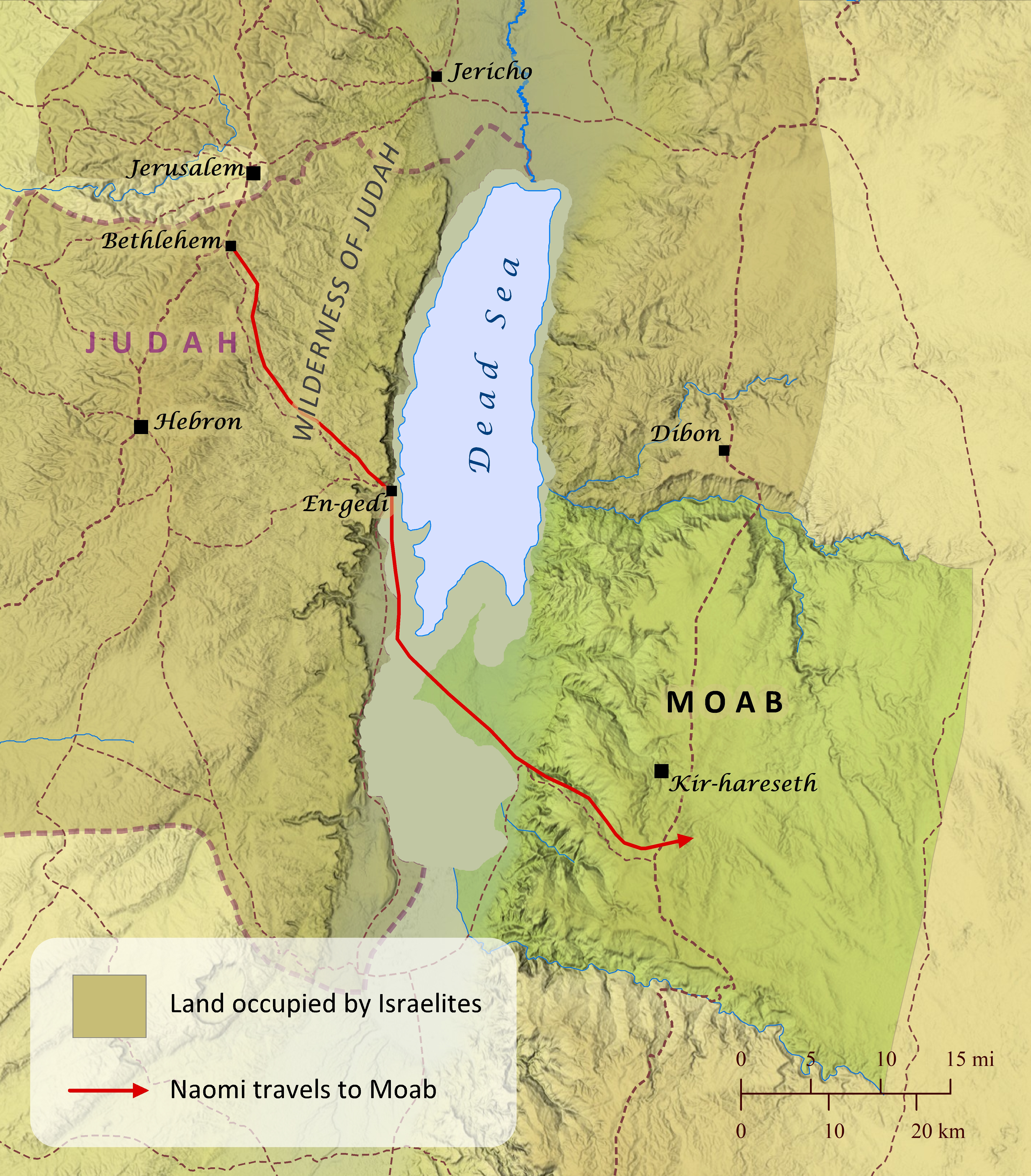
Ruth 1-4
The story of Ruth is set in the time of the Judges, a few generations before the birth of King David. While much animosity often existed between Israel and Moab (Judges 3:12-30; 10:6-12:7; 2 Samuel 8:2; 10; 2 Kings 3:4-27; 2 Chronicles 20; see also Nations across the Jordan River map), other times the two nations appear to have enjoyed a somewhat congenial relationship, as is demonstrated by Naomi’s willingness to relocate to Moab to seek relief from a famine. Later Naomi’s sons also marry Moabite women, and Ruth’s devotion to Naomi and her God no doubt speaks highly of the character of many Moabites. Many years later Ruth’s great-grandson David placed his parents in the care of the king of Moab while he was on the run from King Saul (1 Samuel 22:3-4).
Open Bible Data site copyright © 2023–2026 Freely-Given.org.
Python source code for creating these static pages is available on GitHub under an open licence.
For Bible data copyrights, see the details for each displayed Bible version.
The Open English Translation (OET) main site is at OpenEnglishTranslation.Bible or OET.Bible.