
OET OET-RV OET-LV GHT ULT UST BSB MSB BLB AICNT OEB WEBBE WMBB NET LSV FBV TCNT T4T LEB BBE Moff JPS Wymth ASV DRA YLT Drby RV SLT Wbstr KJB-1769 KJB-1611 Bshps Gnva Cvdl TNT Wycl SR-GNT UHB BrLXX BrTr Related Parallel Simple Interlinear Topics Reference Dictionary Search
ParallelVerse GEN EXO LEV NUM DEU JOB JOS JDG RUTH 1 SAM 2 SAM PSA AMOS HOS 1 KI 2 KI 1 CHR 2 CHR PROV ECC SNG JOEL MIC ISA ZEP HAB JER LAM YNA (JNA) NAH OBA DAN EZE EZRA EST NEH HAG ZEC MAL LAO GES LES ESG DNG 2 PS TOB JDT WIS SIR BAR LJE PAZ SUS BEL MAN 1 MAC 2 MAC 3 MAC 4 MAC YHN (JHN) MARK MAT LUKE ACTs YAC (JAM) GAL 1 TH 2 TH 1 COR 2 COR ROM COL PHM EPH PHP 1 TIM TIT 1 PET 2 PET 2 TIM HEB YUD (JUD) 1 YHN (1 JHN) 2 YHN (2 JHN) 3 YHN (3 JHN) REV
Ruth 4 V1 V2 V3 V4 V5 V6 V7 V9 V10 V11 V12 V13 V14 V15 V16 V17 V18 V19 V20 V21 V22
Note: This view shows ‘verses’ which are not necessarily natural language units and hence sometimes only part of a sentence will be visible—click on any Bible version abbreviation down the left-hand side to see the verse in more of its context. Normally the OET discourages the reading of individual ‘verses’, but this view is only designed as a tool for Bible-translators and others doing comparisons of different translations—the older translations are further down the page (so you can read up from the bottom to trace the English translation history). The OET segments on this page are still early looks into the drafted texts of the Open English Translation of the Bible—please double-check these texts in advance before using in public.
Text critical issues=small word differences Clarity of original=clear Importance to us=normal Speaker(s)=Narrator (All still tentative.)
OET (OET-RV) “You buy it yourself,” the relative said and he took off one of his sandals and gave it to Boaz.
OET-LV And_ the_kinsman-redeemer _he/it_said to_Boˊaz acquire_it to/for_you(fs) and_he_drew_off sandal_of_his.
UHB וַיֹּ֧אמֶר הַגֹּאֵ֛ל לְבֹ֖עַז קְנֵה־לָ֑ךְ וַיִּשְׁלֹ֖ף נַעֲלֽוֹ׃ ‡
(vayyoʼmer haggoʼēl ləⱱoˊaz qənēh-lāk vayyishlof naˊₐlō.)
Key: khaki:verbs.
Note: Automatic aligning of the OET-RV to the LV is done by some temporary software, hence the OET-RV alignments are incomplete (and may occasionally be wrong).
BrLXX Καὶ εἶπεν ὁ ἀγχιστεὺς τῷ Βοὸζ, κτῆσαι σεαυτῷ τὴν ἀγχιστείαν μου· καὶ ὑπελύσατο τὸ ὑπόδημα αὐτοῦ, καὶ ἔδωκεν αὐτῷ.
(Kai eipen ho agⱪisteus tōi Booz, ktaʸsai seautōi taʸn agⱪisteian mou; kai hupelusato to hupodaʸma autou, kai edōken autōi.)
BrTr And the kinsman said to Booz, Buy my right for thyself: and he took off his shoe and gave it to him.
ULT So the kinsman-redeemer said to Boaz, “Buy it for yourself,” and he took off his sandal.
UST So after the relative said to Boaz, “You buy the field yourself,” he took off one of his sandals and gave it to Boaz.
BSB & MSB So the kinsman-redeemer removed his sandal and said to Boaz, “Buy [it] for yourself.”
OEB So when the near relative said to Boaz, ‘Buy it for yourself,’ Boaz drew off the man’s sandal.
WEBBE & WMBB So the near kinsman said to Boaz, “Buy it for yourself,” then he took off his sandal.
NET So the guardian said to Boaz, “You may acquire it,” and he removed his sandal.
LSV And the redeemer says to Boaz, “Buy [it] for yourself,” and draws off his sandal.
FBV So the family redeemer took off his sandal and told Boaz, “You buy it.”
T4T So that close relative said to Boaz, “You buy the field yourself!” And he took off one of his sandals and gave it to Boaz.
LEB So the redeemer said to Boaz, “Acquire it for yourself,” and he removed his sandal.
BBE So the near relation said to Boaz, Take it for yourself. And he took off his shoe.
Moff No Moff RUT 4:8 book available
JPS So the near kinsman said unto Boaz: 'Buy it for thyself.' And he drew off his shoe.
ASV So the near kinsman said unto Boaz, Buy it for thyself. And he drew off his shoe.
DRA So Booz said to his kinsman: Put off thy shoe. And immediately he took it off from his foot.
YLT And the redeemer saith to Boaz, 'Buy [it] for thyself,' and draweth off his sandal.
Drby And he that had the right of redemption said to Boaz, Buy for thyself; and he drew off his sandal.
RV So the near kinsman said unto Boaz, Buy it for thyself. And he drew off his shoe.
(So the near kinsman/relative said unto Boaz, Buy it for thyself/yourself. And he drew off his shoe.)
SLT And the blood relative will say to Boaz, Buy for thee. And he will draw off his shoe.
Wbstr Therefore the kinsman said to Boaz, Buy it for thyself. So he drew off his shoe.
KJB-1769 Therefore the kinsman said unto Boaz, Buy it for thee. So he drew off his shoe.
(Therefore the kinsman/relative said unto Boaz, Buy it for thee/you. So he drew off his shoe.)
KJB-1611 Therfore the kinseman said vnto Boaz, Buy it for thee: so he drew off his shooe.
(Modernised spelling is same as from KJB-1769 above, apart from capitalisation and punctuation)
Bshps Therfore the kinsman sayde to Booz, Bye it thou: and so drue of his shoe.
(Therefore the kinsman/relative said to Boaz, Bye it thou: and so drew of his shoe.)
Gnva Therefore the kinsman sayd to Boas, Buy it for thee: and he drew off his shooe.
(Therefore the kinsman/relative said to Boas, Buy it for thee/you: and he drew off his shoe.)
Cvdl And the nye kynsman sayde vnto Boos: Bye thou it, & he put of his shue.
(And the nigh/near kinsman/relative said unto Boaz: Bye thou/you it, and he put of his shoe.)
Wycl Therfor Booz seide to his kynesman, Take the scho fro thee; `which scho he vnlaside anoon fro his foot.
(Therefore Boaz said to his kinsman/relative, Take the shoe from thee/you; which shoe he unlaced anon/immediately from his foot.)
Luth Und der Erbe sprach zu Boas: Kaufe du es; und zog seinen Schuh aus.
(And the/of_the heritage spoke to/for Boas: Buy you(sg) it; and pulled his shoe out.)
ClVg Dixit ergo propinquo suo Booz: Tolle calceamentum tuum. Quod statim solvit de pede suo.[fn]
(He/She_said therefore close_by his_own Booz: Remove shoe/sandal your(sg). That immediately pays from/about foot his_own.)
4.8 Solvere. Calceamentum velamen est mysteriorum. Lex vero de pede suo calceamentum solvit, et Christo dedit, quia sacramenta per magistros populi manifestare non potuit, sed Christo hoc faciendum reservavit. Joannes ergo non sibi, sed Christo calceamentum vindicavit, quia soli Christo sponsam competere intellexit; unde ait: Non sum dignus solvere corrigiam calceamenti ejus
4.8 To_solve. Shoe/sandal veil it_is mysteries. Law indeed/however from/about foot his_own shoe/sandal pays, and to_Christ/Messiah he_gave, because sacraments through to_the_teachers of_the_people to_make_visible not/no could, but to_Christ/Messiah this to_be_done reserved. Yohan therefore not/no to_himself, but to_Christ/Messiah shoe/sandal claimed, because alone to_Christ/Messiah bride to_be_suitable understood; from_where/who he_said: Not/No I_am worthy to_solve I_will_correct_you shoe his/her
In this final chapter of the book, Ruth received the reward for her loyalty to Naomi.
Boaz is in focus in the first twelve verses. He met with the other close relative in the presence of many witnesses to discuss the entire situation. The other relative did not want to buy Elimelech’s property that Naomi was selling, if the arrangement also meant that he had to marry Ruth. So Boaz said that he would act as the redeemer himself.
In section 4:13–17, Boaz and Ruth were married, and the LORD soon gave them a son. The women in Bethlehem named the son Obed and rejoiced that Naomi now had a “son” to carry on her family line and care for her in her old age. So both Naomi and Ruth were going to be cared for, and the women went from “emptiness” to “fullness.”
Section 4:18–22 concludes the book with a genealogy that lists of the family line of Perez, who was a son of Judah and grandson of Jacob (who is also called Israel). The family line is listed from Perez through Obed to King David.
Here are some other examples of section headings for 4:1–12:
Boaz Redeems Ruth (ESV)
Boaz Settles the Matter (NET)
Structure:
Some commentaries divide this section into four scenes:NICOT, Sakenfield, Cornerstone, and Sakenfield. These divide the scenes in at least two different ways.
4:1–2 Introduction: Boaz Convenes a Legal Assembly
4:3–8 Boaz Obtains the Rights of Redemption
4:9–10 Boaz Formalizes the Agreement
4:11–12 Witnessing and Blessing
One commentary divides this section into three scenes.Block (pages 203–204).
4:1–2 setting the stage for the legal drama
4:3–8 report of the legal drama
4:9–12 significance of legal drama
You may divide the paragraphs in these scenes in whatever way best fits the structure of your language.
This paragraph describes the sandal ceremony that finalized the redemption of property.
After the author explained the custom in 4:7, he continued the main story in 4:8.
So the kinsman-redeemer removed his sandal
Therefore, the closer relative pulled off his sandal
So the closer relative took off his own sandal
So: This word introduces the result of the custom. You can also translate it as “Then.”
the kinsman-redeemer removed his sandal: There is a textual difference here:
The Hebrew text ends with the word sandal: For example:
he took off his sandal (NRSV) (BSB, ESV, GW, KJV, NABRE, NASB, NCV, NET, NIV NJB, NJPS, NLT, NRSV)
The Greek translation (LXX/Septuagint) has the additional words “and gave it to Boaz.” For example:
he took off one of his sandals and handed it to Boaz (CEV)
he drew off his sandal and handed it over (REB) (CEV, GNT, REB)
The Notes will follow interpretation (1). The words “and handed it to Boaz" were not in the original text of Ruth but were added later. However, 4:7c specifies that one man handed the sandal to the other. So if it is clearer in your language to complete the action, you may follow one of the versions listed under interpretation (2).UBS (page 69).
and said to Boaz, “Buy it for yourself.”
and said to Boaz, “You should buy it for yourself.”
and told Boaz to buy it himself.
Here are some other ways to introduce this verse:
So when the man said to Boaz (GNT)
Then the man said…
and said to Boaz, “Buy it for yourself.”: The command Buy it for yourself has almost the same meaning as “Take my right of redemption” in 4:6c. But here the more general word Buy is used.
The Hebrew word that the BSB translates as Buy is a command. However, the other redeemer was giving Boaz permission to buy it rather than saying that he must buy it. So in many languages, it may be better to use a more polite expression. For example:
You may buy it yourself.
Note 1 topic: writing-newevent
וַיֹּ֧אמֶר הַגֹּאֵ֛ל לְבֹ֖עַז קְנֵה־לָ֑ךְ וַיִּשְׁלֹ֖ף נַעֲלֽוֹ
(Some words not found in UHB: and=he/it_said the,kinsman-redeemer to,Boaz buy to/for=you(fs) and,he_drew_off sandal_of,his )
The events of the story start again here after the background information of [verse 7](../04/07.md). Use your language’s way of starting to tell the events of the story again.
Note 2 topic: grammar-connect-logic-result
וַיֹּ֧אמֶר הַגֹּאֵ֛ל לְבֹ֖עַז קְנֵה־לָ֑ךְ וַיִּשְׁלֹ֖ף נַעֲלֽוֹ
(Some words not found in UHB: and=he/it_said the,kinsman-redeemer to,Boaz buy to/for=you(fs) and,he_drew_off sandal_of,his )
The word So at the beginning of this verse indicates that this event happened because of the custom described in the previous verse. If it would be clearer in your language, you could reverse the order of these phrases. Alternate translation: [So the kinsman-redeemer took off his sandal and said to Boaz, “Buy it for yourself”]
Note 3 topic: figures-of-speech / explicit
וַיִּשְׁלֹ֖ף נַעֲלֽוֹ
(Some words not found in UHB: and=he/it_said the,kinsman-redeemer to,Boaz buy to/for=you(fs) and,he_drew_off sandal_of,his )
The writer assumes that his readers will understand that the kinsman-redeemer gave the sandal to Boaz. You could include this information if that would be helpful to your readers. See the UST.
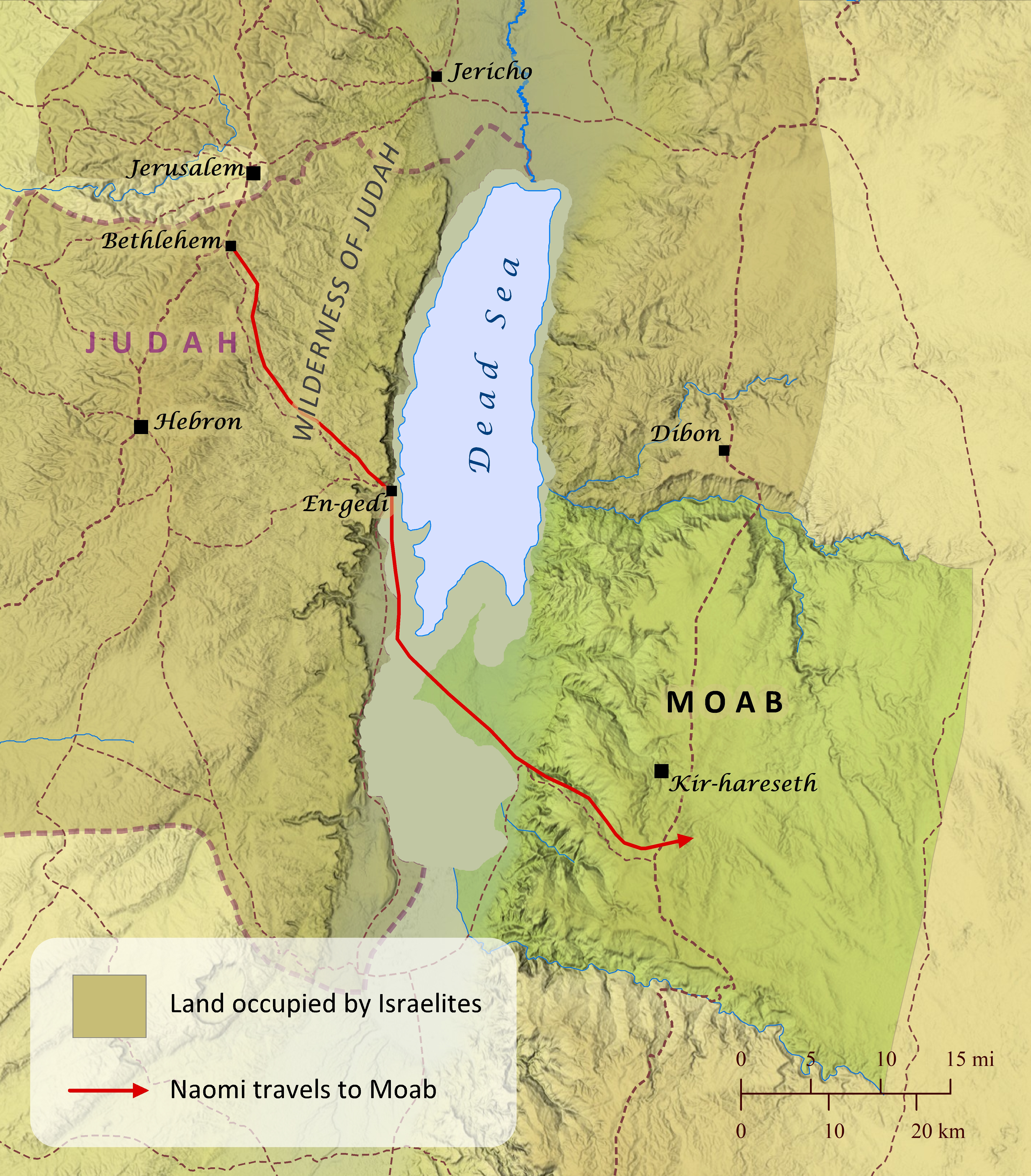
Ruth 1-4
The story of Ruth is set in the time of the Judges, a few generations before the birth of King David. While much animosity often existed between Israel and Moab (Judges 3:12-30; 10:6-12:7; 2 Samuel 8:2; 10; 2 Kings 3:4-27; 2 Chronicles 20; see also Nations across the Jordan River map), other times the two nations appear to have enjoyed a somewhat congenial relationship, as is demonstrated by Naomi’s willingness to relocate to Moab to seek relief from a famine. Later Naomi’s sons also marry Moabite women, and Ruth’s devotion to Naomi and her God no doubt speaks highly of the character of many Moabites. Many years later Ruth’s great-grandson David placed his parents in the care of the king of Moab while he was on the run from King Saul (1 Samuel 22:3-4).
Open Bible Data site copyright © 2023–2026 Freely-Given.org.
Python source code for creating these static pages is available on GitHub under an open licence.
For Bible data copyrights, see the details for each displayed Bible version.
The Open English Translation (OET) main site is at OpenEnglishTranslation.Bible or OET.Bible.