
OET OET-RV OET-LV GHT ULT UST BSB MSB BLB AICNT OEB WEBBE WMBB NET LSV FBV TCNT T4T LEB BBE Moff JPS Wymth ASV DRA YLT Drby RV SLT Wbstr KJB-1769 KJB-1611 Bshps Gnva Cvdl TNT Wycl SR-GNT UHB BrLXX BrTr Related Parallel Simple Interlinear Topics Reference Dictionary Search
ParallelVerse GEN EXO LEV NUM DEU JOB JOS JDG RUTH 1 SAM 2 SAM PSA AMOS HOS 1 KI 2 KI 1 CHR 2 CHR PROV ECC SNG JOEL MIC ISA ZEP HAB JER LAM YNA (JNA) NAH OBA DAN EZE EZRA EST NEH HAG ZEC MAL LAO GES LES ESG DNG 2 PS TOB JDT WIS SIR BAR LJE PAZ SUS BEL MAN 1 MAC 2 MAC 3 MAC 4 MAC YHN (JHN) MARK MAT LUKE ACTs YAC (JAM) GAL 1 TH 2 TH 1 COR 2 COR ROM COL PHM EPH PHP 1 TIM TIT 1 PET 2 PET 2 TIM HEB YUD (JUD) 1 YHN (1 JHN) 2 YHN (2 JHN) 3 YHN (3 JHN) REV
Ruth 2 V2 V3 V4 V5 V6 V7 V8 V9 V10 V11 V12 V13 V14 V15 V16 V17 V18 V19 V20 V21 V22 V23
Note: This view shows ‘verses’ which are not necessarily natural language units and hence sometimes only part of a sentence will be visible—click on any Bible version abbreviation down the left-hand side to see the verse in more of its context. Normally the OET discourages the reading of individual ‘verses’, but this view is only designed as a tool for Bible-translators and others doing comparisons of different translations—the older translations are further down the page (so you can read up from the bottom to trace the English translation history). The OET segments on this page are still early looks into the drafted texts of the Open English Translation of the Bible—please double-check these texts in advance before using in public.
Text critical issues=small word differences Clarity of original=clear Importance to us=normal Speaker(s)=Narrator (All still tentative.)
OET (OET-RV) Now there was a relative there of Naomi’s deceased husband. His name was Boaz and he was a very wealthy man from the same clan as Elimelek had been.
OET-LV And_belonged_to_Nāˊₒmī a_relative[fn] to/for_her/its_man/husband a_man mighty_of wealth from_the_clan_of ʼElīmelek and_his/its_name was_Boˊaz.
_C2.htm#C2V1">2:1 OSHB variant note: מידע: (x-qere) ’מוֹדַ֣ע’: lemma_4129 morph_HNcmsa id_08swV מוֹדַ֣ע
UHB וּֽלְנָעֳמִ֞י מוֹדַ֣ע [fn] לְאִישָׁ֗הּ אִ֚ישׁ גִּבּ֣וֹר חַ֔יִל מִמִּשְׁפַּ֖חַת אֱלִימֶ֑לֶךְ וּשְׁמ֖וֹ בֹּֽעַז׃ ‡
(ūlənāˊₒmiy mōdaˊ ləʼīshāh ʼiysh gibōr ḩayil mimmishpaḩat ʼₑlīmelek ūshəmō boˊaz.)
Key: .
Note: Automatic aligning of the OET-RV to the LV is done by some temporary software, hence the OET-RV alignments are incomplete (and may occasionally be wrong).
K מידע
BrLXX Καὶ τῇ Νωεμὶν ἀνὴρ γνώριμος τῷ ἀνδρὶ αὐτῆς, ὁ δὲ ἀνὴρ δυνατὸς ἰσχύϊ ἐκ τῆς συγγενείας Ἐλιμέλεχ, καὶ ὄνομα αὐτῷ Βοόζ.
(Kai taʸ Nōemin anaʸr gnōrimos tōi andri autaʸs, ho de anaʸr dunatos isⱪui ek taʸs sungeneias Elimeleⱪ, kai onoma autōi Boʼoz.)
BrTr And Noemin had a friend an acquaintance of her husband, and the man was a mighty man of the kindred of Elimelech, and his name was Booz.
ULT Now Naomi had a relative of her husband, a man of great worth from the clan of Elimelech. And his name, was Boaz.[fn]
a relative of her husband or perhaps an acquaintance of her husband (Hebrew Ketiv)
UST There was a man there who was a relative of Naomi’s dead husband, Elimelech. He was rich and important, and a member of the same clan to which Elimelech belonged. The man’s name was Boaz.
BSB & MSB Now Naomi had a relative on her husband’s side, a prominent man of noble character from the clan of Elimelech, whose name [was] Boaz.
OEB Now Naomi was related through her husband to a very wealthy man of the family of Elimelech named Boaz.
WEBBE & WMBB Naomi had a relative of her husband’s, a mighty man of wealth, of the family of Elimelech, and his name was Boaz.
NET Now Naomi had a relative on her husband’s side of the family named Boaz. He was a wealthy, prominent man from the clan of Elimelech.
LSV And Naomi has an acquaintance of her husband’s, a man mighty in wealth, of the family of Elimelech, and his name [is] Boaz.
FBV Now Naomi had a relative on her husband's side whose name was Boaz. He was a rich and influential man from the family of Elimelech.
T4T There was a man in Bethlehem who belonged to the clan of Naomi’s dead husband, Elimelech. He was rich and well-known/influential. His name was Boaz.
LEB ⌊Now⌋[fn] Naomi ⌊had a relative of her husband⌋,[fn] ⌊a prominent rich man⌋[fn] from the clan of Elimelech, whose name was Boaz.
2:1 Literally “and for”
2:1 Literally “was an acquaintance of a man of her husband”
2:1 Literally “a man mighty of wealth”
BBE And Naomi had a relation of her husband, a man of wealth, of the family of Elimelech; and his name was Boaz.
Moff No Moff RUT 2:1 book available
JPS And Naomi had a kinsman of her husband's, a mighty man of valour, of the family of Elimelech, and his name was Boaz.
ASV And Naomi had a kinsman of her husband’s, a mighty man of wealth, of the family of Elimelech, and his name was Boaz.
DRA Now her husband Elimelech had a kinsman, a powerful man, and very rich, whose name was Booz.
YLT And Naomi hath an acquaintance of her husband's, a man mighty in wealth, of the family of Elimelech, and his name [is] Boaz.
Drby And Naomi had a relation of her husband's, a mighty man of wealth, of the family of Elimelech, and his name was Boaz.
RV And Naomi had a kinsman of her husband’s, a mighty man of wealth, of the family of Elimelech; and his name was Boaz.
(And Naomi had a kinsman/relative of her husband’s, a mighty man of wealth, of the family of Elimelech; and his name was Boaz.)
SLT And to Naomi an acquaintance to her husband, a strong man of wealth, from the family of Elimelech; and his name Boaz.
Wbstr And Naomi had a kinsman of her husband's, a mighty man of wealth, of the family of Elimelech; and his name was Boaz.
KJB-1769 And Naomi had a kinsman of her husband’s, a mighty man of wealth, of the family of Elimelech; and his name was Boaz.[fn]
(And Naomi had a kinsman/relative of her husband’s, a mighty man of wealth, of the family of Elimelech; and his name was Boaz.)
2.1 Boaz: Gr. Booz
KJB-1611 ¶ And Naomi had a kinseman of her husbands, a mighty man of wealth, of the familie of Elimelech, and his name was Boaz.
(Modernised spelling is same as from KJB-1769 above, apart from punctuation)
Bshps And Naomies husbad had a kinsman, a ma of power and wealth which was of the kinred of Elimelech, named Booz.
(And Naomies husbad had a kinsman/relative, a man of power and wealth which was of the kindred of Elimelech, named Boaz.)
Gnva Then Naomis husband had a kinsman, one of great power of the familie of Elimelech, and his name was Boaz.
(Then Naomis husband had a kinsman/relative, one of great power of the family of Elimelech, and his name was Boaz.)
Cvdl There was a kinsman also of ye kynred of EliMelech Naemis husbande, whose name was Boos, which was an honest man.
(There was a kinsman/relative also of ye/you_all kindred of EliMelech Naomis husband, whose name was Boaz, which was an honest man.)
Wycl Forsothe a myyti man and a man `of grete richessis, `Booz bi name, `was kynysman of Elymelech.
(For_certain/Truly a mighty man and a man of great riches, Boaz by name, was kinsman/relative of Elymelech.)
Luth Es war auch ein Mann, der Naemi Mannes Freund, von dem Geschlecht Elimelechs, mit Namen Boas, der war ein weidlicher Mann.
(It what/which also a man, the/of_the Naomi man’s friend, from to_him descendant Elimelech’s, with name(s) Boas, the/of_the what/which a worthy man.)
ClVg Erat autem viro Elimelech consanguineus, homo potens, et magnarum opum, nomine Booz.
(It_was however to_the_man Elimelech kinsman, man powerful, and of_great_things of_helps, by_name Booz.)
This third section in the book of Ruth tells how Ruth met Boaz. Since Naomi and Ruth were poor at this time, Ruth asked Naomi for permission to glean in the grain fields in order to find them some food.
Ruth chose a field in which to glean. Although she did not know it, the man who owned that field, Boaz, was a relative of Elimelech. Boaz had heard about Ruth already, but he had not met her. He was sympathetic and kind to her that day, and told her to continue to work in his field during the rest of the harvest time.
That evening, Ruth returned home and told Naomi that the owner of the field where she had gleaned was called Boaz and that he had treated her well. Naomi was very pleased. She encouraged Ruth to continue to work there just as Boaz had invited her to do.
Here are some other examples of section headings:
Ruth Meets Boaz (ESV)
Ruth Works in the Field of Boaz (NET)
Now Naomi had a relative on her husband’s side,
¶ Now, there was a man living in Bethlehem who was related to Naomi’s husband.
¶ A certain man there was a relative/cousin of Naomi’s husband Elimelech, who had died.
Now Naomi had a relative on her husband’s side: This verse begins a new part of the story (2:1–23). It introduces an important character, Boaz, before he begins to speak or act in 2:4. This verse gives background information about Boaz. (See the Appendix, “Introduction to the Discourse Structure,” for more discussion about this.)
Introduce this verse in a way that is natural in your language to either begin a new part of the story or to indicate background information, or both. The BSB and many other English versions do this with the word Now. Used in this way, Now indicates a break in the sequence of actions from chapter 1. It is not a time word .
Naomi had a relative on her husband’s side: The phrase on her husband’s side means that Boaz and Naomi were related because of her marriage with Elimelech. The text does not exactly explain the relationship between Boaz and Elimelech, but it was a close one (see 2:20). Boaz may have been a cousin to Elimelech. He was not a “brother” in the sense of having the same father and mother. Probably Boaz was about the same age as Elimelech would have been if he were still alive. Use the correct kinship term in your language for such a relationship.
Here are some other ways to translate this:
who belonged to the family of her husband Elimelech (GNT)
There was a cousin to the former/deceased husband of Naomi
(combined/reordered)
Now Naomi was related to a rich and respected/influential person through her deceased/former husband, Elimelech. The relative’s name was Boaz.
a prominent man of noble character from the clan of Elimelech, whose name was Boaz.
His name was Boaz. He was a rich and important person from the same clan as Elimelech.
In fact, he was from the same extended family. He was a respected man of outstanding/high character, and his name was Boaz.
a prominent man of noble character from the clan of Elimelech, whose name was Boaz: The Hebrew phrase that the BSB translates as a prominent man of noble character has a several possible meanings. It is literally “a mighty man of strength/wealth/ability/character.” Most often in the Hebrew Scriptures, the phrase describes a mighty warrior. But in the context of Ruth, it describes Boaz as an important and influential man in Bethlehem due to his wealth and good character.
Here are some other ways to translate this:
a rich and important man (CEV)
a respected man of outstanding character
a wealthy, prominent man (NET)
from the clan of Elimelech: Boaz was from the same extended family as Elimelech. The clan of Elimelech does not identify Elimelech as the head of the clan. Rather, Boaz and Elimelech shared a common ancestor. The Hebrew word that the BSB translates as clan refers here to a unit smaller than a tribe (as in “tribe of Judah”) but larger than a immediate family of parents and children.Some commentators such as Bush (Word) and Campbell (Anchor Bible) suggest that the Hebrew word mišpāḥâ here refers to something larger than extended family. But the words clan and extended family are quite fluid and dependent on context to determine their relative size. A clan (or sub-clan) is a large extended family.
Here is another way to translate this:
from the same extended family as Elimelech
There is some repetition of information about Boaz. For example, saying that Boaz was a relative of Elimelech is similar to saying that he was from the same clan as Elimelech. In some languages, it may be more natural to combine and/or reorder some of this information. For example:
Now there was a man named Boaz who was from the same clan as Naomi’s husband. He/Boaz was wealthy and respected.
See 2:1a-b (combined/reordered) in the Display for another example.
Note 1 topic: writing-background
וּֽלְנָעֳמִ֞י מוֹדַ֣ע לְאִישָׁ֗הּ
and_[belonged],to,Naomi (Some words not found in UHB: and_[belonged],to,Naomi relative to/for=her/its=man/husband (a)_man mighty rich from,the_clan_of ʼElīmelek and=his/its=name Boˊaz )
Verse 1 gives background information about Boaz so that the reader will understand who he is. In your translation, present this information in a way that makes it clear that this is background information.
Note 2 topic: writing-participants
וּֽלְנָעֳמִ֞י מוֹדַ֣ע לְאִישָׁ֗הּ
and_[belonged],to,Naomi (Some words not found in UHB: and_[belonged],to,Naomi relative to/for=her/its=man/husband (a)_man mighty rich from,the_clan_of ʼElīmelek and=his/its=name Boˊaz )
This phrase begins the introduction of Boaz as a new participant in the story. If your language has its own way of introducing new participants, you could use it here in your translation.
Note 3 topic: figures-of-speech / idiom
אִ֚ישׁ גִּבּ֣וֹר חַ֔יִל
(a)_man (Some words not found in UHB: and_[belonged],to,Naomi relative to/for=her/its=man/husband (a)_man mighty rich from,the_clan_of ʼElīmelek and=his/its=name Boˊaz )
The expression a man of great worth describes Boaz as a person who was prosperous and well known in his community, with a good reputation. If it would be helpful in your language, you could use an equivalent idiom from your language or state this plainly. See the chapter introduction for more information. Alternate translation: [a prominent, wealthy man]
Note 4 topic: translate-kinship
מִמִּשְׁפַּ֖חַת אֱלִימֶ֑לֶךְ
(Some words not found in UHB: and_[belonged],to,Naomi relative to/for=her/its=man/husband (a)_man mighty rich from,the_clan_of ʼElīmelek and=his/its=name Boˊaz )
The use of the term clan here means that Boaz was related to Elimelek but did not have the same parents as Elimelek. The text is not saying that the clan was named after Elimelek or that Elimelek was the patriarch or leader of the clan, but only that Elimelek and Boaz belonged to the same clan.
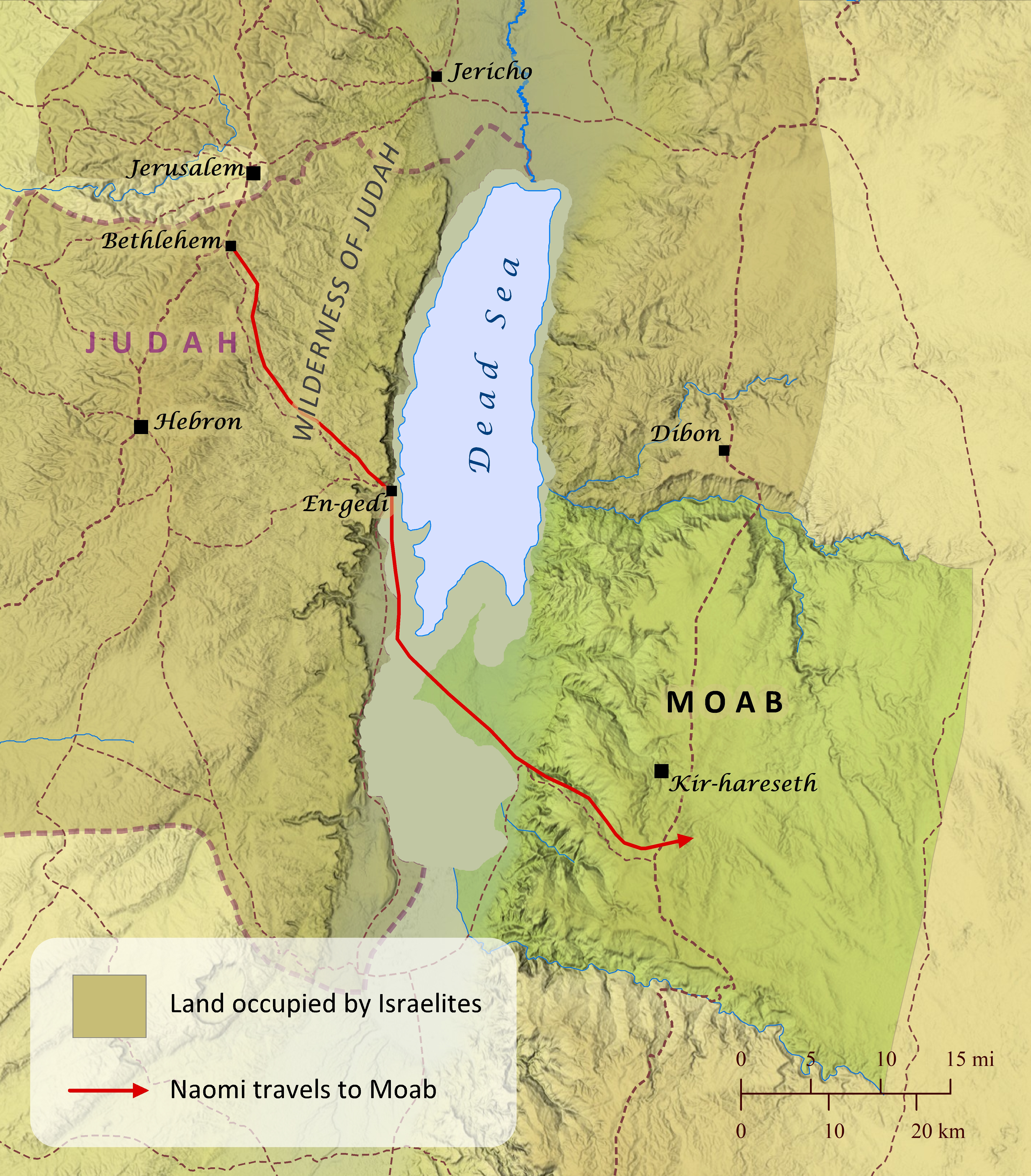
Ruth 1-4
The story of Ruth is set in the time of the Judges, a few generations before the birth of King David. While much animosity often existed between Israel and Moab (Judges 3:12-30; 10:6-12:7; 2 Samuel 8:2; 10; 2 Kings 3:4-27; 2 Chronicles 20; see also Nations across the Jordan River map), other times the two nations appear to have enjoyed a somewhat congenial relationship, as is demonstrated by Naomi’s willingness to relocate to Moab to seek relief from a famine. Later Naomi’s sons also marry Moabite women, and Ruth’s devotion to Naomi and her God no doubt speaks highly of the character of many Moabites. Many years later Ruth’s great-grandson David placed his parents in the care of the king of Moab while he was on the run from King Saul (1 Samuel 22:3-4).
Open Bible Data site copyright © 2023–2026 Freely-Given.org.
Python source code for creating these static pages is available on GitHub under an open licence.
For Bible data copyrights, see the details for each displayed Bible version.
The Open English Translation (OET) main site is at OpenEnglishTranslation.Bible or OET.Bible.