
OET OET-RV OET-LV GHT ULT UST BSB MSB BLB AICNT OEB WEBBE WMBB NET LSV FBV TCNT T4T LEB BBE Moff JPS Wymth ASV DRA YLT Drby RV SLT Wbstr KJB-1769 KJB-1611 Bshps Gnva Cvdl TNT Wycl SR-GNT UHB BrLXX BrTr Related Parallel Simple Interlinear Topics Reference Dictionary Search
ParallelVerse GEN EXO LEV NUM DEU JOB JOS JDG RUTH 1 SAM 2 SAM PSA AMOS HOS 1 KI 2 KI 1 CHR 2 CHR PROV ECC SNG JOEL MIC ISA ZEP HAB JER LAM YNA (JNA) NAH OBA DAN EZE EZRA EST NEH HAG ZEC MAL LAO GES LES ESG DNG 2 PS TOB JDT WIS SIR BAR LJE PAZ SUS BEL MAN 1 MAC 2 MAC 3 MAC 4 MAC YHN (JHN) MARK MAT LUKE ACTs YAC (JAM) GAL 1 TH 2 TH 1 COR 2 COR ROM COL PHM EPH PHP 1 TIM TIT 1 PET 2 PET 2 TIM HEB YUD (JUD) 1 YHN (1 JHN) 2 YHN (2 JHN) 3 YHN (3 JHN) REV
Ruth 2 V1 V2 V3 V4 V5 V6 V7 V8 V9 V10 V11 V13 V14 V15 V16 V17 V18 V19 V20 V21 V22 V23
Note: This view shows ‘verses’ which are not necessarily natural language units and hence sometimes only part of a sentence will be visible—click on any Bible version abbreviation down the left-hand side to see the verse in more of its context. Normally the OET discourages the reading of individual ‘verses’, but this view is only designed as a tool for Bible-translators and others doing comparisons of different translations—the older translations are further down the page (so you can read up from the bottom to trace the English translation history). The OET segments on this page are still early looks into the drafted texts of the Open English Translation of the Bible—please double-check these texts in advance before using in public.
Text critical issues=none Clarity of original=clear Importance to us=normal Speaker(s)=Narrator (All still tentative.)
OET (OET-RV) May Yahweh reward your hard work. Since you’ve come here for protection under Yisrael’s god Yahweh, may he reward you in full.”
OET-LV YHWH may_he_reward deed[s]_of_your and_may_it_be wage[s]_of_your complete from_with YHWH the_god_of Yisrāʼēl/(Israel) whom you_have_come to_take_refuge under wings_of_his.
UHB יְשַׁלֵּ֥ם יְהוָ֖ה פָּעֳלֵ֑ךְ וּתְהִ֨י מַשְׂכֻּרְתֵּ֜ךְ שְׁלֵמָ֗ה מֵעִ֤ם יְהוָה֙ אֱלֹהֵ֣י יִשְׂרָאֵ֔ל אֲשֶׁר־בָּ֖את לַחֲס֥וֹת תַּֽחַת־כְּנָפָֽיו׃ ‡
(yəshallēm yhwh pāˊₒlēk ūtəhiy maskurtēk shəlēmāh mēˊim yhwh ʼₑlohēy yisrāʼēl ʼₐsher-bāʼt laḩₐşōt taḩat-kənāfāyv.)
Key: khaki:verbs.
Note: Automatic aligning of the OET-RV to the LV is done by some temporary software, hence the OET-RV alignments are incomplete (and may occasionally be wrong).
BrLXX Ἀποτίσαι Κύριος τὴν ἐργασίαν σου· γένοιτο ὁ μισθός σου πλήρης παρὰ Κυρίου Θεοῦ Ἰσραὴλ, πρὸς ὃν ἦλθες πεποιθέναι ὑπὸ τὰς πτέρυγας αὐτοῦ.
(Apotisai Kurios taʸn ergasian sou; genoito ho misthos sou plaʸraʸs para Kuriou Theou Israaʸl, pros hon aʸlthes pepoithenai hupo tas pterugas autou.)
BrTr The Lord recompense thy work: may a full reward be given thee of the Lord God of Israel, to whom thou hast come to trust under his wings.
ULT May Yahweh reward your work, and may your full wages come from Yahweh, the God of Israel, under whose wings you have come for refuge.”
UST I pray that Yahweh will fully repay you for what you have done. Yes, may Yahweh, the God of Israel, the one whom you are trusting to protect you, reward you in full.”
BSB & MSB May the LORD repay your work, and may you receive a rich reward from the LORD, the God of Israel, under whose wings you have taken refuge.”
OEB May the Lord repay you for what you have done, and may you be fully rewarded by the God of Israel, under whose wings you have come to take refuge.’
CSB May the LORD reward you for what you have done, and may you receive a full reward from the LORD God of Israel, under whose wings you have come for refuge.”
NLT May the LORD, the God of Israel, under whose wings you have come to take refuge, reward you fully for what you have done.”
NIV May the LORD repay you for what you have done. May you be richly rewarded by the LORD, the God of Israel, under whose wings you have come to take refuge.”
CEV I pray that the LORD God of Israel will reward you for what you have done. And now that you have come to him for protection, I pray that he will bless you."
ESV The LORD repay you for what you have done, and a full reward be given you by the LORD, the God of Israel, under whose wings you have come to take refuge!”
NASB “May the LORD reward your work, and your wages be full from the LORD, the God of Israel, under whose wings you have come to seek refuge.”
LSB May Yahweh fully repay your work, and may your wages be full from Yahweh, the God of Israel, under whose wings you have come to seek refuge.”
WEBBE & WMBB May the LORD repay your work, and a full reward be given to you from the LORD, the God of Israel, under whose wings you have come to take refuge.”
MSG (11-12)Boaz answered her, “I’ve heard all about you—heard about the way you treated your mother-in-law after the death of her husband, and how you left your father and mother and the land of your birth and have come to live among a bunch of total strangers. God reward you well for what you’ve done—and with a generous bonus besides from God, to whom you’ve come seeking protection under his wings.”
NET May the Lord reward your efforts! May your acts of kindness be repaid fully by the Lord God of Israel, from whom you have sought protection!”
LSV YHWH repays your work, and your reward is complete from YHWH, God of Israel, under whose wings you have come to take refuge.”
FBV May the Lord fully reward you for all you've done—the Lord, the God of Israel, to whom you've come for protection.”[fn]
2:12 Literally, “under whose wings you have sought refuge.”
T4T I hope/desire that Yahweh will repay you for what you have done. You have put yourself in the care of Yahweh, like a little bird puts itself under its mother’s wings [MET]. I desire that he will reward you very greatly.”
LEB May Yahweh reward your work and may a full reward be given to you from Yahweh, the God of Israel, under whose wings you came to take refuge.”
NRSV May the LORD reward you for your deeds, and may you have a full reward from the LORD, the God of Israel, under whose wings you have come for refuge!”
NKJV The LORD repay your work, and a full reward be given you by the LORD God of Israel, under whose wings you have come for refuge.”
NAB May the LORD reward what you have done! May you receive a full reward from the LORD, the God of Israel, under whose wings you have come for refuge.”
BBE The Lord give you a reward for what you have done, and may a full reward be given to you by the Lord, the God of Israel, under whose wings you have come to take cover.
Moff No Moff RUT 2:12 book available
JPS The LORD recompense thy work, and be thy reward complete from the LORD, the God of Israel, under whose wings thou art come to take refuge.'
ASV Jehovah recompense thy work, and a full reward be given thee of Jehovah, the God of Israel, under whose wings thou art come to take refuge.
DRA The Lord render unto thee for thy work, and mayest thou receive a full reward of the Lord the God of Israel, to whom thou art come, and under whose wings thou art fled.
YLT Jehovah doth recompense thy work, and thy reward is complete from Jehovah, God of Israel, under whose wings thou hast come to take refuge.'
Drby Jehovah recompense thy work, and let thy reward be full from Jehovah the [fn]God of Israel, under whose wings thou art come to take refuge.
2.12 Elohim
RV The LORD recompense thy work, and a full reward be given thee of the LORD, the God of Israel, under whose wings thou art come to take refuge.
(The LORD recompense thy/your work, and a full reward be given thee/you of the LORD, the God of Israel, under whose wings thou/you art come to take refuge.)
SLT Jehovah will recompense thy work, and thy reward shall be complete from Jehovah God of Israel, because thou camest to trust under his wings.
Wbstr The LORD recompense thy work, and a full reward be given thee of the LORD God of Israel, under whose wings thou hast come to trust.
KJB-1769 The LORD recompense thy work, and a full reward be given thee of the LORD God of Israel, under whose wings thou art come to trust.
(The LORD recompense thy/your work, and a full reward be given thee/you of the LORD God of Israel, under whose wings thou/you art come to trust.)
KJB-1611 The LORD recompense thy worke, and a full reward be giuen thee of the LORD God of Israel, vnder whose wings thou art come to trust.
(Modernised spelling is same as from KJB-1769 above)
Bshps The Lord quyte thy worke, and a full reward be geuen thee of the Lord God of Israel, vnder whose winges thou art come to trust.
(The Lord reward thy/your work, and a full reward be given thee/you of the Lord God of Israel, under whose wings thou/you art come to trust.)
Gnva The Lord recompense thy worke, and a ful reward be giuen thee of the Lord God of Israel, vnder whose wings thou art come to trust.
(The Lord recompense thy/your work, and a full reward be given thee/you of the Lord God of Israel, under whose wings thou/you art come to trust.)
Cvdl The LORDE recompence the thy doinge, and thy rewarde be parfecte wt the LORDE God of Israel, vnto whom thou art come to put thy trust vnder his wynges.
(The LORD recompense the thy/your doing, and thy/your reward be perfect with the LORD God of Israel, unto whom thou/you art come to put thy/your trust under his wings.)
Wycl The Lord yelde to thee for thi werk, and resseyue thou ful mede of the Lord God of Israel, to whom thou camest, and vndir whose wengis thou fleddist.
(The Lord yield to thee/you for thy/your work, and receive thou/you full reward/merit of the Lord God of Israel, to whom thou/you camest, and under whose wings thou/you fled.)
Luth Der HErr vergelte dir deine Tat; und müsse dein Lohn vollkommen sein bei dem HErr’s, dem GOtt Israels, zu welchem du kommen bist, daß du unter seinen Flügeln Zuversicht hättest.
(The LORD retaliate you/to_you(sg) your Tat; and must your(s) wage/salary completely/perfectly be at/in to_him LORD’s, to_him God Israel’s, to/for which_one you(sg) coming are, that you(sg) under his wings confidence would_have.)
ClVg Reddat tibi Dominus pro opere tuo, et plenam mercedem recipias a Domino Deo Israël, ad quem venisti, et sub cujus confugisti alas.
(Give_back to_you Master for by_work your, and full a_reward you_may_receive from Master to_God Israel, to which you_came, and under whose you_fled alas.)
This third section in the book of Ruth tells how Ruth met Boaz. Since Naomi and Ruth were poor at this time, Ruth asked Naomi for permission to glean in the grain fields in order to find them some food.
Ruth chose a field in which to glean. Although she did not know it, the man who owned that field, Boaz, was a relative of Elimelech. Boaz had heard about Ruth already, but he had not met her. He was sympathetic and kind to her that day, and told her to continue to work in his field during the rest of the harvest time.
That evening, Ruth returned home and told Naomi that the owner of the field where she had gleaned was called Boaz and that he had treated her well. Naomi was very pleased. She encouraged Ruth to continue to work there just as Boaz had invited her to do.
Here are some other examples of section headings:
Ruth Meets Boaz (ESV)
Ruth Works in the Field of Boaz (NET)
In this paragraph, Boaz told Ruth that she should stay and glean in his field along with his other women workers. He told her that he had instructed the young men not to bother her. He also said that she should feel free to drink from the water jars that the young men had filled. Ruth asked Boaz why he was being so kind to her. He replied that he had heard about everything she had done for her mother-in-law. He had also heard about her decision to leave her homeland and come to live with people she did not previously know.
May the LORD repay your work,
May Yahweh reward you(sing) for what you have done for her/Naomi.
I pray that Yahweh will repay/bless you for the kind things you have done for your mother-in-law.
May the LORD repay your work: This is a blessing. Boaz was saying that he hoped and prayed that God would do good to Ruth. Here are some other ways to translate this:
May the Lord reward you for your deeds! (NRSV)
I ask the LORD to reward you for what you have done.
repay: The Hebrew word that the BSB translates as repay refers here to doing good to someone as a reward for a good action that that person has done.
Here are some other ways to translate this:
reward you
do good to you
your work: Boaz was referring to the work, or actions, he had spoken of in 2:11b-c. These were good things, kind actions. In some languages, it may be necessary to make this explicit. For example:
for being good to your mother-in-law
for your kind deeds/actions
and may you receive a rich reward from the LORD, the God of Israel,
May Yahweh, the God of Israel, give you(sing) a rich/great reward.
I pray that Yahweh, the God whom we(excl) Israelites worship, will be very kind to you.
may you receive a rich reward from the LORD, the God of Israel: The Hebrew is more literally “May your wages be complete from Yahweh, the God of Israel.” This repeats the meaning of 2:12a but with greater emphasis.
Here are some other ways to translate this:
and a full reward be given you by the Lord, the God of Israel (RSV)
May you receive a rich reward from the Lord God of Israel (GW)
the LORD, the God of Israel: The Hebrew word that the BSB translates as the LORD is Yahweh, and the Hebrew word that the BSB translates as God is ʾelohim, the normal term for God. This sort of double expression is common in the Old Testament. How you translate it will depend on the term that you have chosen for Yahweh. For example:
the Lord God of Israel (CEV)
Yahweh, the God whom the people of Israel serve/worship
under whose wings you have taken refuge.”
He is the one to whom you have come to find safety like a baby bird under its mother’s wings.”
For he is the God whom you are trusting to protect you.”
under whose wings you have taken refuge: This is a metaphor. The picture is of a young bird seeking protection under the wings of its mother. Boaz meant that Ruth was relying on the LORD to protect her and care for her, just as a mother bird protects and cares for her young ones.
There are several ways to translate this figure of speech:
Keep the metaphor. For example:
under whose wings you have come for refuge!” (NRSV)
Use a simile. For example:
to whom you have come for protection like a baby bird hiding under its mother’s wings.”
Explain the meaning of the metaphor. For example:
to whom you have come to find protection/safety.”
from whom you have sought protection!” (NET)
Use another simile or metaphor from your language that means the same thing. Avoid referring to anything that Boaz could not have known or talked about.
taken refuge: The Hebrew word that the BSB translates as taken refuge means “to go for protection” or “to seek a safe place.” This implies that Ruth was trusting the God of Israel to protect her.
The Notes have used closed quote marks above to indicate that Boaz’ words to Ruth end with this verse part. Verse 2:13a continues this paragraph with Ruth’s response. In some languages, it may be easier for readers to identify a new speaker if there is a new paragraph.
Note 1 topic: figures-of-speech / explicit
פָּעֳלֵ֑ךְ
(Some words not found in UHB: reward YHWH deed[s]_of,your and,may_it_be wage[s]_of,your full from,with YHWH god_of Yisrael which/who come to,take_refuge under wings_of,his )
The implication is that her work was the good things she had done, everything Boaz had just described. You could include this information if that would be helpful to your readers. Alternate translation: [your good deeds.]
Note 2 topic: figures-of-speech / parallelism
וּתְהִ֨י מַשְׂכֻּרְתֵּ֜ךְ שְׁלֵמָ֗ה מֵעִ֤ם יְהוָה֙
and,may_it_be (Some words not found in UHB: reward YHWH deed[s]_of,your and,may_it_be wage[s]_of,your full from,with YHWH god_of Yisrael which/who come to,take_refuge under wings_of,his )
This clause and the previous clause mean basically the same thing. The second clause emphasizes the meaning of the first by repeating the same idea with different words. If it would be helpful to your readers, you could connect the clauses in a way that shows that the second clause is repeating the first one, not saying something additional. Alternate translation: [that is, may you receive everything that you deserve from Yahweh]
Note 3 topic: figures-of-speech / metaphor
אֲשֶׁר־בָּ֖את לַחֲס֥וֹת תַּֽחַת־כְּנָפָֽיו
(Some words not found in UHB: reward YHWH deed[s]_of,your and,may_it_be wage[s]_of,your full from,with YHWH god_of Yisrael which/who come to,take_refuge under wings_of,his )
Here, under whose wings is a metaphor that uses the picture of a mother bird gathering her chicks under her wings to protect them as a way to describe God’s protection for those who trust in him. Alternate translation: [in whose safe care you have placed yourself]
Ruth 1-4
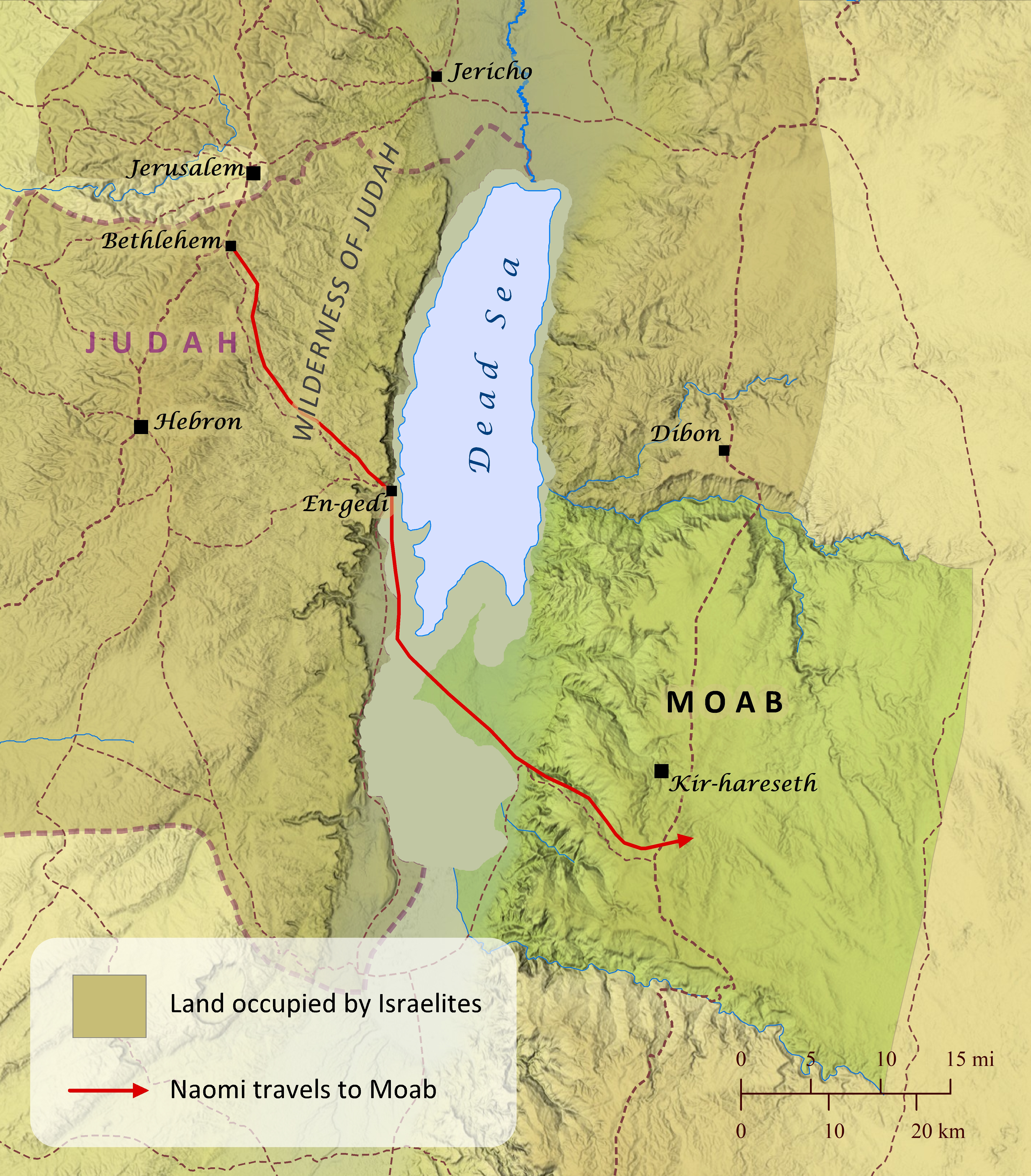
The story of Ruth is set in the time of the Judges, a few generations before the birth of King David. While much animosity often existed between Israel and Moab (Judges 3:12-30; 10:6-12:7; 2 Samuel 8:2; 10; 2 Kings 3:4-27; 2 Chronicles 20; see also Nations across the Jordan River map), other times the two nations appear to have enjoyed a somewhat congenial relationship, as is demonstrated by Naomi’s willingness to relocate to Moab to seek relief from a famine. Later Naomi’s sons also marry Moabite women, and Ruth’s devotion to Naomi and her God no doubt speaks highly of the character of many Moabites. Many years later Ruth’s great-grandson David placed his parents in the care of the king of Moab while he was on the run from King Saul (1 Samuel 22:3-4).
Open Bible Data site copyright © 2023–2026 Freely-Given.org.
Python source code for creating these static pages is available on GitHub under an open licence.
For Bible data copyrights, see the details for each displayed Bible version.
The Open English Translation (OET) main site is at OpenEnglishTranslation.Bible or OET.Bible.