
OET OET-RV OET-LV GHT ULT UST BSB MSB BLB AICNT OEB WEBBE WMBB NET LSV FBV TCNT T4T LEB BBE Moff JPS Wymth ASV DRA YLT Drby RV SLT Wbstr KJB-1769 KJB-1611 Bshps Gnva Cvdl TNT Wycl SR-GNT UHB BrLXX BrTr Related Parallel Simple Interlinear Topics Reference Dictionary Search
ParallelVerse GEN EXO LEV NUM DEU JOB JOS JDG RUTH 1 SAM 2 SAM PSA AMOS HOS 1 KI 2 KI 1 CHR 2 CHR PROV ECC SNG JOEL MIC ISA ZEP HAB JER LAM YNA (JNA) NAH OBA DAN EZE EZRA EST NEH HAG ZEC MAL LAO GES LES ESG DNG 2 PS TOB JDT WIS SIR BAR LJE PAZ SUS BEL MAN 1 MAC 2 MAC 3 MAC 4 MAC YHN (JHN) MARK MAT LUKE ACTs YAC (JAM) GAL 1 TH 2 TH 1 COR 2 COR ROM COL PHM EPH PHP 1 TIM TIT 1 PET 2 PET 2 TIM HEB YUD (JUD) 1 YHN (1 JHN) 2 YHN (2 JHN) 3 YHN (3 JHN) REV
Ruth 2 V1 V2 V3 V4 V5 V6 V7 V9 V10 V11 V12 V13 V14 V15 V16 V17 V18 V19 V20 V21 V22 V23
Note: This view shows ‘verses’ which are not necessarily natural language units and hence sometimes only part of a sentence will be visible—click on any Bible version abbreviation down the left-hand side to see the verse in more of its context. Normally the OET discourages the reading of individual ‘verses’, but this view is only designed as a tool for Bible-translators and others doing comparisons of different translations—the older translations are further down the page (so you can read up from the bottom to trace the English translation history). The OET segments on this page are still early looks into the drafted texts of the Open English Translation of the Bible—please double-check these texts in advance before using in public.
Text critical issues=none Clarity of original=clear Importance to us=normal Speaker(s)=Narrator (All still tentative.)
OET (OET-RV) So Boaz approached Ruth, “Young woman,” he said, “listen here. Don’t leave this place or go to any other field to pick up grain, but just stay close by these young female workers of mine.
OET-LV And_ Boˊaz _he/it_said to Rūt am_not have_you_heard my_daughter_of_my do_not go to_glean in_a_field another and_also not you_must_pass_on from_this_field and_thus you_will_stay with servants_of_my_female.
UHB וַיֹּאמֶר֩ בֹּ֨עַז אֶל־ר֜וּת הֲל֧וֹא שָׁמַ֣עַתְּ בִּתִּ֗י אַל־תֵּלְכִי֙ לִלְקֹט֙ בְּשָׂדֶ֣ה אַחֵ֔ר וְגַ֛ם לֹ֥א תַעֲבוּרִ֖י מִזֶּ֑ה וְכֹ֥ה תִדְבָּקִ֖ין עִם־נַעֲרֹתָֽי׃ ‡
(vayyoʼmer boˊaz ʼel-rūt hₐlōʼ shāmaˊattə bittiy ʼal-tēləkī liləqoţ bəsādeh ʼaḩēr vəgam loʼ taˊₐⱱūriy mizzeh vəkoh tidbāqiyn ˊim-naˊₐrotāy.)
Key: khaki:verbs.
Note: Automatic aligning of the OET-RV to the LV is done by some temporary software, hence the OET-RV alignments are incomplete (and may occasionally be wrong).
BrLXX Καὶ εἶπε Βοὸζ πρὸς Ῥοὺθ, οὐκ ἤκουσας θύγατερ; μὴ πορευθῇς ἐν ἀγρῷ συλλέξαι ἑτέρῳ· καὶ σὺ οὐ πορεύσῃ ἐντεῦθεν, ὧδε κολλήθητι μετὰ τῶν κορασίων μου.
(Kai eipe Booz pros Ɽouth, ouk aʸkousas thugater; maʸ poreuthaʸs en agrōi sullexai heterōi; kai su ou poreusaʸ enteuthen, hōde kollaʸthaʸti meta tōn korasiōn mou.)
BrTr And Booz said to Ruth, Hast thou not heard, my daughter? go not to glean in another field; and depart not thou hence, join thyself here with my damsels.
ULT Then Boaz said to Ruth, “Will you not listen, my daughter? Do not go to glean in another field, and do not even go away from here, but thusly stick closely to my young female workers.
UST Then Boaz walked over to where Ruth was and said to Ruth, “Young lady, please listen to me. You do not need to go to any other field or anywhere else to gather grain. You should stay right here with my servant girls.
BSB & MSB Then Boaz said to Ruth, “Listen, my daughter. Do not go and glean in another field, and do not go away from this [place], but stay here close to my servant girls.
OEB Then Boaz said to Ruth, ‘Listen, my daughter. Do not go to glean in another field nor leave this place, but stay here with my girls.
WEBBE & WMBB Then Boaz said to Ruth, “Listen, my daughter. Don’t go to glean in another field, and don’t go from here, but stay here close to my maidens.
NET So Boaz said to Ruth, “Listen carefully, my dear! Do not leave to gather grain in another field. You need not go beyond the limits of this field. You may go along beside my female workers.
LSV And Boaz says to Ruth, “Have you not heard, my daughter? Do not go to glean in another field, and also, do not pass over from here, and thus you cleave to my young women:
FBV Boaz went and spoke to Ruth. “Listen to me, my daughter,” he told her. “Don't leave to go and pick up grain in someone else's field. Stay close to my women.
T4T So Boaz went over to Ruth and said to her, “Young lady, listen to me. Don’t go and pick up grain in another field. Do not go away from here. Stay here with my servant girls.
LEB And Boaz said to Ruth, “⌊Listen carefully⌋,[fn] my daughter, go no longer to glean in another field. Moreover, do not leave from this one, but ⌊stay close⌋[fn] with my young women.
BBE Then said Boaz to Ruth, Give ear to me, my daughter: do not go to take up the grain in another field, or go away from here, but keep here by my young women:
Moff No Moff RUT 2:8 book available
JPS Then said Boaz unto Ruth: 'Hearest thou not, my daughter? Go not to glean in another field, neither pass from hence, but abide here fast by my maidens.
ASV Then said Boaz unto Ruth, Hearest thou not, my daughter? Go not to glean in another field, neither pass from hence, but abide here fast by my maidens.
DRA And Booz said to Ruth: Hear me, daughter, do not go to glean in any other field, and do not depart from this place: but keep with my maids,
YLT And Boaz saith unto Ruth, 'Hast thou not heard, my daughter? go not to glean in another field, and also, pass not over from this, and thus thou dost cleave to my young women:
Drby And Boaz said to Ruth, Hearest thou not, my daughter? Go not to glean in another field, neither go from here, but keep here with my maidens.
RV Then said Boaz unto Ruth, Hearest thou not, my daughter? Go not to glean in another field, neither pass from hence, but abide here fast by my maidens.
(Then said Boaz unto Ruth, Hearest thou/you not, my daughter? Go not to glean in another field, neither pass from hence, but abide here fast by my maidens.)
SLT And Boaz will say to Ruth, Heardest thou not, my daughter? Thou shalt not go to gather in another field, and also thou shalt not pass away from this; and here thou shalt adhere with my maidens:
Wbstr Then said Boaz to Ruth, Hearest thou not, my daughter? Go not to glean in another field, neither go from hence, but abide here fast by my maidens:
KJB-1769 Then said Boaz unto Ruth, Hearest thou not, my daughter? Go not to glean in another field, neither go from hence, but abide here fast by my maidens:
(Then said Boaz unto Ruth, Hearest thou/you not, my daughter? Go not to glean in another field, neither go from hence, but abide here fast by my maidens:)
KJB-1611 Then said Boaz vnto Ruth, Hearest thou not, my daughter? Goe not to gleane in another field, neither goe from hence, but abide here fast by my maidens.
(Then said Boaz unto Ruth, Hearest thou/you not, my daughter? Go not to gleane in another field, neither go from hence, but abide here fast by my maidens.)
Bshps Then sayd Booz vnto Ruth: Hearest thou my daughter? Go to no other fielde to gather, neither go from hence, but abyde here by my maydens.
(Then said Boaz unto Ruth: Hearest thou/you my daughter? Go to no other field to gather, neither go from hence, but abide here by my maidens.)
Gnva Then said Boaz vnto Ruth, Hearest thou, my daughter? goe to none other fielde to gather, neither goe from hence: but abide here by my maydens.
(Then said Boaz unto Ruth, Hearest thou/you, my daughter? go to none other field to gather, neither go from hence: but abide here by my maidens.)
Cvdl Then sayde Boos vnto Ruth: Hearest thou my doughter? Thou shalt not come vpon another mans londe to gather, and go not awaye from hence, but tary with my dasels,
(Then said Boaz unto Ruth: Hearest thou/you my daughter? Thou/You shalt/shall not come upon another mans land to gather, and go not away from hence, but tarry/wait with my dasels,)
Wycl And Booz seide to Ruth, Douytir, here thou; go thou not in to anothir feelde to gadere, nether go awei fro this place, but be thou ioyned to my dameselis,
(And Boaz said to Ruth, Daughter, here thou; go thou/you not in to another field to gather, neither go away from this place, but be thou/you joined to my girls,)
Luth Da sprach Boas zu Ruth: Hörest du es, meine Tochter? Du sollst nicht gehen auf einen andern Acker aufzulesen; und gehe auch nicht von hinnen, sondern halte dich zu meinen Dirnen;
(So spoke Boas to/for Ruth: Hear/listen you(sg) it, my daughter? You(sg) should not go on/in/to a other field to_pick_up; and go also not from inside, rather hold/stop you/yourself to/for my maidens;)
ClVg Et ait Booz ad Ruth: Audi, filia, ne vadas in alterum agrum ad colligendum, nec recedas ab hoc loco: sed jungere puellis meis,[fn]
(And he_said Booz to Ruth: Listen, daughter, not go in/into/on the_other field to to_be_collected, but_not you_may_retreat away this instead: but to_join girls mine,)
2.8 Ne vadas. Quasi dicat: Ne recedas a statu fidei, ne sequaris errores hæreticorum vel schismaticorum: sed magis jungere animabus sanctis, ut metas Scripturas sanctas, meditando, et opere implendo; et haustum divinæ sapientiæ de libris duorum Testamentorum unde pueri, id est, sancti bibunt, et ipsa bibas.
2.8 Don’t go. As_if let_him_say: Don’t you_may_retreat from state of_faith, not you_may_follow errors of_heretics or of_schismatics: but more to_join souls to_the_saints, as you_may_reap Scriptures holy(pl), to_be_meditated, and by_work to_be_filled; and drawn_up divine of_wisdom from/about books of_two Of_testaments from_where/who children, that it_is, holy they_drink, and herself drink.
This third section in the book of Ruth tells how Ruth met Boaz. Since Naomi and Ruth were poor at this time, Ruth asked Naomi for permission to glean in the grain fields in order to find them some food.
Ruth chose a field in which to glean. Although she did not know it, the man who owned that field, Boaz, was a relative of Elimelech. Boaz had heard about Ruth already, but he had not met her. He was sympathetic and kind to her that day, and told her to continue to work in his field during the rest of the harvest time.
That evening, Ruth returned home and told Naomi that the owner of the field where she had gleaned was called Boaz and that he had treated her well. Naomi was very pleased. She encouraged Ruth to continue to work there just as Boaz had invited her to do.
Here are some other examples of section headings:
Ruth Meets Boaz (ESV)
Ruth Works in the Field of Boaz (NET)
In this paragraph, Boaz told Ruth that she should stay and glean in his field along with his other women workers. He told her that he had instructed the young men not to bother her. He also said that she should feel free to drink from the water jars that the young men had filled. Ruth asked Boaz why he was being so kind to her. He replied that he had heard about everything she had done for her mother-in-law. He had also heard about her decision to leave her homeland and come to live with people she did not previously know.
Then Boaz said to Ruth, “Listen, my daughter.
¶ So Boaz said to Ruth, “I consider you to be like my own daughter, so pay attention to me.
¶ Then Boaz went to Ruth and said, “Dear young lady, be sure to do what I will tell you.
Then Boaz said to Ruth: After hearing from his foreman who Ruth was and understanding her situation, he responded in 2:8–9 with kind instructions to Ruth.
Here are some other ways to translate this clause:
So Boaz said to Ruth (NIV)
Boaz went over and said to Ruth (NLT)
Listen: Boaz spoke to Ruth gently but forcefully. He wanted her to be sure to follow his instructions in 2:8–9, which were for her own good.
Here are some other ways to translate this:
Listen carefully, my dear! (NLT)
Let me give you some advice. (GNT)
my daughter: Boaz was older than Ruth and had greater social status than her, but he spoke to her in a gentle way and addressed her as a father to a daughter. You should use a term that shows respect and kindness from a man, older and more important, to a younger woman.
One way to use the word daughter and avoid the literal meaning is to use a simile. For example:
You are like a daughter to me
Although daughter may be appropriate in some languages, a different term such as “little sister” may be better in others.
In some languages, it may not be appropriate to use a kinship term at all because Boaz was only related to her by marriage. If it is not appropriate for you to use a kinship term, here are some other ways to translate this:
You are a woman whom I respect.
Dear young lady,
Do not go and glean in another field, and do not go away from this place,
Do not go/leave to gather grain in any other field. You must not leave this field.
Stay and pick up grain/barley only in my fields. Be sure not to go into someone else’s fields.
Do not go and glean in another field, and do not go away from this place: Boaz told Ruth to stay in his fields. He did not want her to glean in any fields that belonged to other people. Notice that these two clauses have essentially the same meaning. This is good Hebrew style. The repetition adds emphasis to Boaz’s instruction that Ruth should glean only in his fields.
The verb form used in the second clause strengthens the meaning of the first. It may imply that Ruth should be sure not to cross boundary markers to go into someone else’s field.Bush (Word) in particular argues for this sense. He appeals to the Hebrew conjunction gam ‘also’ which suggests the second command adds somehow to the first. He takes the view (together with other commentators) that Boaz “is granting her more than the ordinary rights of gleanage” by allowing her to glean so close to his women workers. This explains the stronger negative verb form used to say that Ruth must be careful not to go beyond the boundary markers. Bush further comments, “Boaz’s admonition is necessary since fields in the ancient Near East were separated by no clearly visible boundaries.” One more point in support of this view is the verb ‘avar which often includes the sense of passing or crossing boundaries.
Here are some other ways to translate these clauses:
Do not leave to gather grain in another field. You need not go beyond the limits of this field. (NET)
Don’t gather grain anywhere except in this field. (GNT)
Don’t go in any other field to gather grain, and don’t even leave this one. (GW)
but stay here close to my servant girls.
Keep close to my young female workers.
Continue to closely follow the women who work in my field.
but stay here close to my servant girls: The Hebrew word that the BSB translates as stay here close to could also be translated as “keep close.” Boaz wanted Ruth to stay near his other female workers. This had two advantages for her. First, being close to the women who work for him would be a safe place for her. Second, it was probably an advantage and special privilege for Ruth to glean so close to the harvest workers. Gathering grain among those who were bundling and tying the stalks meant that she would gather more than a usual gleaner.
my servant girls: The Hebrew word that the BSB translates as my servant girls is literally “my young women.” These were probably hired workers, mostly young adults. Normally, the men would cut the grain and place it in piles on the ground. Women workers would then gather it into bundles, tie them, and take them to the threshing floor.
Here are some other ways to translate this verse part:
stay close to my servant-girls (REB)
Stay right behind the young women working in my field. (NLT)
continue following closely behind my women workers (NCV)
Note 1 topic: figures-of-speech / rquestion
הֲל֧וֹא שָׁמַ֣עַתְּ בִּתִּ֗י
am=not (Some words not found in UHB: and=he/it_said Boˊaz to/towards Rūt am=not listen my_daughter_of,my not go to,glean in,a_field next/another and=also not leave from,this_[field] and,thus you,will_stay with servants_of,my_female )
Boaz is using the question form to draw Ruth’s attention to what he will say to her. If you would not use the question form for this purpose in your language, you could translate this as a statement or an exclamation. Alternate translation: [Listen to me, my daughter!] or [Note well what I am telling you, my daughter!]
Note 2 topic: figures-of-speech / idiom
בִּתִּ֗י
(Some words not found in UHB: and=he/it_said Boˊaz to/towards Rūt am=not listen my_daughter_of,my not go to,glean in,a_field next/another and=also not leave from,this_[field] and,thus you,will_stay with servants_of,my_female )
Boaz’s use of the term, my daughter was a kind way to address a younger woman. Ruth was not the actual daughter of Boaz, but he was treating her kindly and respectfully. Use the term that communicates kindness and respect from a man to a younger woman in your language.
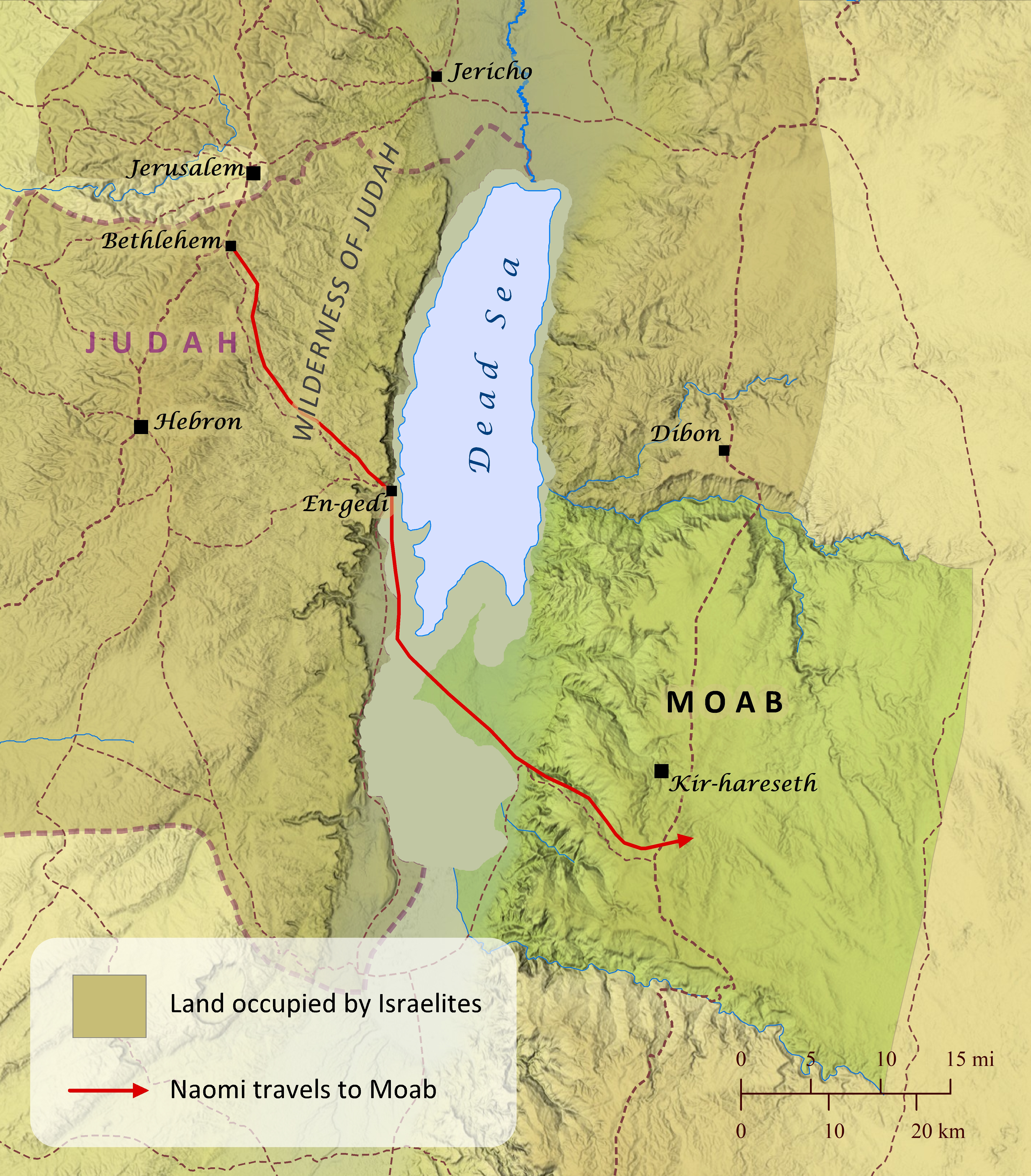
Ruth 1-4
The story of Ruth is set in the time of the Judges, a few generations before the birth of King David. While much animosity often existed between Israel and Moab (Judges 3:12-30; 10:6-12:7; 2 Samuel 8:2; 10; 2 Kings 3:4-27; 2 Chronicles 20; see also Nations across the Jordan River map), other times the two nations appear to have enjoyed a somewhat congenial relationship, as is demonstrated by Naomi’s willingness to relocate to Moab to seek relief from a famine. Later Naomi’s sons also marry Moabite women, and Ruth’s devotion to Naomi and her God no doubt speaks highly of the character of many Moabites. Many years later Ruth’s great-grandson David placed his parents in the care of the king of Moab while he was on the run from King Saul (1 Samuel 22:3-4).
Open Bible Data site copyright © 2023–2026 Freely-Given.org.
Python source code for creating these static pages is available on GitHub under an open licence.
For Bible data copyrights, see the details for each displayed Bible version.
The Open English Translation (OET) main site is at OpenEnglishTranslation.Bible or OET.Bible.