
OET OET-RV OET-LV GHT ULT UST BSB MSB BLB AICNT OEB WEBBE WMBB NET LSV FBV TCNT T4T LEB BBE Moff JPS Wymth ASV DRA YLT Drby RV SLT Wbstr KJB-1769 KJB-1611 Bshps Gnva Cvdl TNT Wycl SR-GNT UHB BrLXX BrTr Related Parallel Simple Interlinear Topics Reference Dictionary Search
ParallelVerse GEN EXO LEV NUM DEU JOB JOS JDG RUTH 1 SAM 2 SAM PSA AMOS HOS 1 KI 2 KI 1 CHR 2 CHR PROV ECC SNG JOEL MIC ISA ZEP HAB JER LAM YNA (JNA) NAH OBA DAN EZE EZRA EST NEH HAG ZEC MAL LAO GES LES ESG DNG 2 PS TOB JDT WIS SIR BAR LJE PAZ SUS BEL MAN 1 MAC 2 MAC 3 MAC 4 MAC YHN (JHN) MARK MAT LUKE ACTs YAC (JAM) GAL 1 TH 2 TH 1 COR 2 COR ROM COL PHM EPH PHP 1 TIM TIT 1 PET 2 PET 2 TIM HEB YUD (JUD) 1 YHN (1 JHN) 2 YHN (2 JHN) 3 YHN (3 JHN) REV
Ruth 2 V1 V2 V3 V4 V5 V6 V8 V9 V10 V11 V12 V13 V14 V15 V16 V17 V18 V19 V20 V21 V22 V23
Note: This view shows ‘verses’ which are not necessarily natural language units and hence sometimes only part of a sentence will be visible—click on any Bible version abbreviation down the left-hand side to see the verse in more of its context. Normally the OET discourages the reading of individual ‘verses’, but this view is only designed as a tool for Bible-translators and others doing comparisons of different translations—the older translations are further down the page (so you can read up from the bottom to trace the English translation history). The OET segments on this page are still early looks into the drafted texts of the Open English Translation of the Bible—please double-check these texts in advance before using in public.
Text critical issues=small word differences Clarity of original=clear Importance to us=normal Speaker(s)=Narrator (All still tentative.)
OET (OET-RV) She asked me for permission to follow the harvesters and pick up any heads of grain that drop, and she’s been doing it since early morning until just recently she’s taking a break now in the shelter.
OET-LV And_she/it_said let_me_glean please and_I_will_gather among_sheaves behind the_harvesters and_she_came and_she_has_stayed from_then this_morning and_unto now this sitting_her the_house little.
UHB וַתֹּ֗אמֶר אֲלַקֳטָה־נָּא֙ וְאָסַפְתִּ֣י בָֽעֳמָרִ֔ים אַחֲרֵ֖י הַקּוֹצְרִ֑ים וַתָּב֣וֹא וַֽתַּעֲמ֗וֹד מֵאָ֤ז הַבֹּ֨קֶר֙ וְעַד־עַ֔תָּה זֶ֛ה שִׁבְתָּ֥הּ הַבַּ֖יִת מְעָֽט׃ ‡
(vattoʼmer ʼₐlaqₒţāh-nāʼ vəʼāşaftiy ⱱāˊₒmārim ʼaḩₐrēy haqqōʦərim vattāⱱōʼ vattaˊₐmōd mēʼāz haboqer vəˊad-ˊattāh zeh shiⱱtāh habayit məˊāţ.)
Key: khaki:verbs.
Note: Automatic aligning of the OET-RV to the LV is done by some temporary software, hence the OET-RV alignments are incomplete (and may occasionally be wrong).
BrLXX Καὶ εἶπε, συλλέξω δὴ καὶ συνάξω ἐν τοῖς δράγμασιν ὄπισθεν τῶν θεριζόντων· καὶ ἦλθε καὶ ἔστη ἀπὸ πρωΐθεν καὶ ἕως ἑσπέρας, οὐ κατέπαυσεν ἐν τῷ ἀγρῷ μικρόν.
(Kai eipe, sullexō daʸ kai sunaxō en tois dragmasin opisthen tōn therizontōn; kai aʸlthe kai estaʸ apo prōithen kai heōs hesperas, ou katepausen en tōi agrōi mikron.)
BrTr And she said, I pray you, let me glean and gather among the sheaves after the reapers: and she came and stood from morning till evening, and rested not even a little in the field.
ULT And she said, ‘Please let me glean and gather among the bundles of grain after the reapers.’ And she came and has continued from then, in the morning, until now. This is her resting in the house a little.”[fn]
This is her … a little meaning of Hebrew uncertain
UST The woman said to me, ‘Please let me pick up the grain that the men who are harvesting leave behind.’ I allowed her to do so. She has worked since early this morning until recently, when she rested for a short time under the shelter.”
BSB & MSB She has said, ‘Please let me glean and gather among the sheaves after the harvesters.’ So she came out and has continued from morning until now, except that she rested a short time in the shelter.”
OEB She asked to be allowed to glean and gather sheaves after the reapers. So she came and has continued to work until now and she has not rested a moment in the field.’
WEBBE & WMBB She said, ‘Please let me glean and gather after the reapers amongst the sheaves.’ So she came, and has continued even from the morning until now, except that she rested a little in the house.”
NET She asked, ‘May I follow the harvesters and gather grain among the bundles?’ Since she arrived she has been working hard from this morning until now – except for sitting in the resting hut a short time.”
LSV and she says, Please let me glean and I have gathered among the sheaves after the reapers; and she comes and remains since the morning and until now; she sat in the house a little [while].”
FBV “She asked me, ‘Please may I have permission to pick up grain behind the reapers.’[fn] So she came, and she's been working here from morning until now, except for a brief rest in the shelter.”
2:7 The Hebrew adds “among the sheaves,” but this is probably transposed from verse 15. She was given this unusual permission by Boaz only later.
T4T She said to me, ‘Please let me walk behind the men who are harvesting the grain and pick up some of the grain they leave behind.’ I gave her permission, and she went into the field, and she has been working from this morning until now. The only time she did not work was when she rested for a short time in the shelter.”
LEB And she said, ‘Please let me glean and let me gather among the sheaves behind the reapers.’ So she came and remained from the morning up to now. ⌊She is sitting for a little while in the house⌋.”[fn]
2:7 Literally “this one she is sitting a little in the house”
BBE And she said to me, Let me come into the grain-field and take up the grain after the cutters. So she came, and has been here from morning till now, without resting even for a minute.
Moff No Moff RUT 2:7 book available
JPS and she said: Let me glean, I pray you, and gather after the reapers among the sheaves; so she came, and hath continued even from the morning until now, save that she tarried a little in the house.'
ASV and she said, Let me glean, I pray you, and gather after the reapers among the sheaves. So she came, and hath continued even from the morning until now, save that she tarried a little in the house.
DRA And she desired leave to glean the ears of corn that remain, following the steps of the reapers: and she hath been in the field from morning till now, and hath not gone home for one moment.
YLT and she saith, Let me glean, I pray thee — and I have gathered among the sheaves after the reapers; and she cometh and remaineth since the morning and till now; she sat in the house a little.
Drby and she said, I pray you, let me glean and gather among the sheaves after the reapers. And she came, and has continued from the morning until now: her sitting in the house has been little as yet.
RV And she said, Let me glean, I pray you, and gather after the reapers among the sheaves: so she came, and hath continued even from the morning until now, save that she tarried a little in the house.
(And she said, Let me glean, I pray you, and gather after the reapers among the sheaves: so she came, and hath/has continued even from the morning until now, save that she tarried/waited a little in the house.)
SLT And she will say, I will gather now; and I collected among the sheaves after the reapers: and she will stand from that time of the morning, and even to this time of her sitting in the house a little.
Wbstr And she said, I pray you, let me glean and gather after the reapers among the sheaves: so she came, and hath continued even from the morning until now, that she tarried a little in the house.
KJB-1769 And she said, I pray you, let me glean and gather after the reapers among the sheaves: so she came, and hath continued even from the morning until now, that she tarried a little in the house.
(And she said, I pray you, let me glean and gather after the reapers among the sheaves: so she came, and hath/has continued even from the morning until now, that she tarried/waited a little in the house.)
KJB-1611 And she said, I pray you, let mee gleane and gather after the reapers amongst the sheaues: so shee came, and hath continued euen from the morning vntill now, that she taried a little in the house.
(Modernised spelling is same as from KJB-1769 above)
Bshps And she sayde vnto vs, I pray you let me gleane and gather after the reapers, amongst the sheaues: and so she came, and hath continued euen from the morning vnto nowe, saue that she taried a litle in the house.
(And she said unto us, I pray you let me glean and gather after the reapers, among the sheaves: and so she came, and hath/has continued even from the morning unto now, save that she tarried/waited a little in the house.)
Gnva And shee saide vnto vs, I pray you, let mee gleane and gather after the reapers among the sheaues: so shee came, and hath continued from that time in the morning vnto now, saue that she taried a litle in the house.
(And she said unto us, I pray you, let me glean and gather after the reapers among the sheaves: so she came, and hath/has continued from that time in the morning unto now, save that she tarried/waited a little in the house.)
Cvdl And she sayde: Let me plucke vp and gather (I praie the) betwene the sheues after the reapers: and thus is she come, and hath stonde here euer sence the mornynge, and within a litle whyle she wolde haue bene gone home agayne.
(And she said: Let me pluck up and gather (I pray the) between the sheaves after the reapers: and thus is she come, and hath/has stand here ever since the morning, and within a little while she would have been gone home again.)
Wycl that sche schulde gedere eeris of corn leeuynge bihynde, and sue the `steppis of reperis; and fro the morewtid til now sche stondith in the feeld, and sotheli nethir at a moment sche turnede ayen hoom.
(that she should gather ears of corn leaving behind, and sue the steps of reapers; and from the morning till now she standeth/stands in the field, and truly neither at a moment she turned again home.)
Luth Denn sie sprach: Lieber, laß mich auflesen und sammeln unter den Garben, den Schnittern nach; und ist also kommen und da gestanden von Morgen an bis her und bleibt wenig daheim.
(Because they/she/them spoke: love(n)r, let me pick_up and collect under the sheaves, the reapers after; and is also coming and there confessed from morning at/to until her and remains/stays few home.)
ClVg et rogavit ut spicas colligeret remanentes, sequens messorum vestigia: et de mane usque nunc stat in agro, et ne ad momentum quidem domum reversa est.[fn]
(and asked as ears_of_corn would_collect remaining, following reaped footsteps: and from/about in_the_morning until now stands in/into/on field, and not to momentum indeed house/home returned it_is.)
2.7 Et rogavit. Quia sancta Ecclesia perseverat in agro divinæ lectionis post messores et prædicatores, mysteria Scripturarum colligens, ut in sinu mentis suæ testimonia et exempla virtutum recordat. Vel ager ille est cœlestis studii disciplina messis intelligentia spiritualis; messores, prædicatores; spicæ remanentes, sententiæ Scripturarum, quæ multum per mysterium occultatæ, quasi pleniores remanent ad exercitium meditantis. Plebs ergo gentilis ecclesiasticam disciplinam ardenter appetit, ut ad meditationem divinæ legis et sanctorum societatem admittatur, et sanctorum documentis vel exemplis reficiatur.
2.7 And asked. Because holy Assembly/Church perseveres in/into/on field divine reading after reapers and preachers, mysteries Scriptures collecting, as in/into/on pocket of_the_mind his/her_own(pl) evidence and examples virtues recordat. Or field/farm he/that_one it_is heavenly study discipline harvest/crop intelligence spiritual; reapers, preachers; ear_of_grain remaining, sentences Scriptures, which a_lot through mystery hidden, as_if fuller remain to exercise meditating. Plebs therefore Gentile ecclesiastic discipline fervently desires, as to meditation divine law and holy_place society may_be_admitted, and holy_place lessons or examples may_be_repaired.
This third section in the book of Ruth tells how Ruth met Boaz. Since Naomi and Ruth were poor at this time, Ruth asked Naomi for permission to glean in the grain fields in order to find them some food.
Ruth chose a field in which to glean. Although she did not know it, the man who owned that field, Boaz, was a relative of Elimelech. Boaz had heard about Ruth already, but he had not met her. He was sympathetic and kind to her that day, and told her to continue to work in his field during the rest of the harvest time.
That evening, Ruth returned home and told Naomi that the owner of the field where she had gleaned was called Boaz and that he had treated her well. Naomi was very pleased. She encouraged Ruth to continue to work there just as Boaz had invited her to do.
Here are some other examples of section headings:
Ruth Meets Boaz (ESV)
Ruth Works in the Field of Boaz (NET)
She has said, ‘Please let me glean and gather among the sheaves after the harvesters.’
She asked me, ‘May I please pick up grain here and gather it into bundles behind/after the harvesters?’
She politely asked me if she could follow the other workers and gather the grain that they had left.
She has said, ‘Please let me glean and gather among the sheaves after the harvesters.’: The foreman was reporting Ruth’s words. So Ruth’s words were reported as direct speech embedded in the speech of the foreman. Translate this in whatever way is natural in your language, using either direct or indirect speech.
Here are some ways to do this using indirect speech:
She asked if she might glean…. (REB)
She asked me to let her follow the workers and gather grain. (GNT)
Please let me glean and gather among the sheaves after the harvesters: There is a textual issue in this verse part:
The Masoretic Text includes the words which the BSB translates as among the sheaves. Ruth either asked to gather among the sheaves or “into sheaves.” (See the note just below addressing the interpretation issue.) For example:
She asked, ‘May I follow the harvesters and gather grain among the bundles?’ (NET) (BSB, ESV, GW, KJV, NABRE, NASB, NET, NIV, NJB, NRSV, REB)
The words among the sheaves are omitted.Support for this text is found in the Syriac and Vulgate translations. Ruth only asked to follow after or behind the harvesters and gather grain. For example:
‘Please let me follow the workers cutting grain and gather what they leave behind.’ (NCV) (CEV, GNT, NCV, NLT)
It is recommended that you follow interpretation (1) along with most versions. This interpretation also has strong textual support.The LXX also includes the words in question (καὶ συνάξω ἐν τοῖς δράγμασιν). HOTTP supports the MT reading with a B-rating. The inclusion of these words, and particularly if they are interpreted to mean “among the sheaves/bundles,” creates the difficulty of Ruth asking for special privilege in her gleaning. So, many scholars support the text that includes them as the more difficult reading. UBS recommends textual reading (2), but they seem to exaggerate the difficulty of the MT reading and the textual support for omitting the words “among the sheaves” (only the Syriac and Vulgate).
Normally in Jewish practice, gleaners were not permitted to begin to glean in a field until the harvesters had finished their work and removed their bundles of grain from the field. As a result, the Hebrew words that the BSB translates as among the sheaves have different emphases. Ruth may have wanted to gather grain into “sheaves/bundles” after the harvesters had finished their work. She may also have wanted to gather grain at the same time as the other women harvesters.Bush (Word), in particular, makes a detailed and cogent case for “after the harvesters.” About Ruth he says: “Ruth was a stranger and a foreigner. It would be almost unthinkable for her to have requested the right to glean ‘among the sheaves,’ a right of gleanage that far exceeded anything accorded by custom to native Bethlehemites. It could have caused her only the ill will and enmity of all the other women whom circumstances (cf. Deut 24:19) had also driven to the exigencies of the poverty stricken.” Commentators who support versions like the NIV reinterpret the character of Ruth based on the assumption that she asks for special privilege in gleaning. They describe her as “courageous” and “brash” (Hubbard) or “resolute” and “stubborn” (Block).
Here are some other ways to translate this verse part:
‘I would like to gather the gleanings into sheaves after the harvesters.’ (NABRE)
She asked me this morning if she could gather grain behind the harvesters. (NLT)
She said, ‘Please let me gather grain. I will only gather among the bundles behind the reapers.’ (GW)
Translate in a way that shows that Ruth was being polite and humble. She was also determined to provide for the needs of Naomi and herself.
You may want to include a footnote to explain that Ruth asked for a special privilege in gleaning that went beyond what was customary. Here is a suggested footnote:
While it is not stated specifically in the Old Testament, scholars believe that the custom was that gleaners could only glean in a field after the harvesters had completed their work and removed their bundles of grain. Ruth requested the special privilege to glean close to his woman workers at the same time as they were bundling the harvest.
sheaves: The Hebrew word that the BSB translates as sheaves means stalks of grain that have been gathered into a “bundle.” A bundle was often the amount formed by filling the arms with stalks of grain. A sheaf is a bundle that has been tied or bound. Sheaves were left in the fields until they were gathered up and taken to the threshing floor.
So she came out and has continued from morning until now,
Since she arrived this morning, she has remained in the field working all the time.
I permitted her to work/glean, and she started to glean. She has continued from early morning until now.
So she came out and has continued: The Hebrew word that the BSB translates as has continued has a range of meaning including “stand, continue, remain.” In this context, it probably means that she “remained.” Many versions are ambiguous about where Ruth remained. The context seems to indicate that Ruth continued to work in the field after the foreman had given her permission to do so.
Some versions make explicit what Ruth did in the field. For example:
She asked if she could pick up grain left by the harvest workers (CEV)
She asked me to let her follow the workers and gather grain. (GNT)
from morning until now: This is literally “from then, the morning, and until now.” “From then” probably refers to the time when the foreman had talked to Ruth. He was saying that Ruth had stayed in their field and worked steadily at gleaning. For example:
She has been hard at work ever since (NLT)
now: The workers had probably come early in the morning. It was later when Boaz came to see how they were doing. It may have been mid-morning, since the mealtime at midday mentioned in 2:14a seems to have been a little later.
except that she rested a short time in the shelter.”
She has only rested for a short time in the shelter.”
However, she did stop for a few moments to sit in the shade of the hut.”
There are two textual issues in this part of the verse.
except that she rested a short time: One textual issue has to do with the Hebrew phrase that the BSB translates as except that she rested a short time:
The Hebrew Masoretic text says that Ruth rested in the shelter for a short time (literally “a little”). That is, she worked for most of the morning but took a brief rest. For example:
except for a few minutes’ rest (NLT)
She has stopped only a few moments to rest (NCV) (BSB, ESV, GNT, GW, KJV, NABRE, NASB, NCV, NET, NIV, NJB, NJPS, NLT, REB)
The LXX (Septuagint) indicates that Ruth did not rest at all. For example:
without resting even for a moment (NRSV) (CEV, NRSV)
It is recommended that you follow option (1).
in the shelter: The other textual issue has to do with the Hebrew word that the BSB translates as in the shelter:
The Masoretic text includes the word that the BSB translates as in the shelter. For example:
except for a short rest in the shelter (NIV) (BSB, NIV, GNT, REB, NET, GW, NLT, NCV, KJV, NASB, NJPS)
The Septuagint (LXX) does not include a word meaning “house” or shelter. For example:
with hardly a rest (NJB) (CEV, ESV, NABRE, NJB, NRSV)
It is recommended that you follow option (1).
shelter: The Hebrew word that the BSB translates as shelter (literally “house”) was probably a temporary building that provided shade for the harvest workers when they rested. Perhaps it was built with poles and had a roof made from leafy branches or straw. People in many cultures build some similar type of temporary shelter when their garden or field is not near their homes. If your language has a name for such a shelter, use it here.NET note.
Note 1 topic: figures-of-speech / quotesinquotes
וַתֹּ֗אמֶר אֲלַקֳטָה־נָּא֙ וְאָסַפְתִּ֣י בָֽעֳמָרִ֔ים אַחֲרֵ֖י הַקּוֹצְרִ֑ים
(Some words not found in UHB: and=she/it_said glean please and,I_will_gather among,sheaves after the,harvesters and,she_came and,she_has_stayed from,then this,morning and=unto now this sitting,her the,house short )
If your language would not use a direct quotation inside of a direct quotation, you could translate this second direct quotation as an indirect quotation. Alternate translation: [She asked me if she could glean and gather among the bundles of grain after the reapers]
Note 2 topic: figures-of-speech / hendiadys
אֲלַקֳטָה־נָּא֙ וְאָסַפְתִּ֣י
glean (Some words not found in UHB: and=she/it_said glean please and,I_will_gather among,sheaves after the,harvesters and,she_came and,she_has_stayed from,then this,morning and=unto now this sitting,her the,house short )
The two words glean and gather express a single idea. If it would be more natural in your language, you could express this idea in a different way. Alternate translation: [Please let me glean by gathering]
Note 3 topic: translate-unknown
הַבַּ֖יִת
(Some words not found in UHB: and=she/it_said glean please and,I_will_gather among,sheaves after the,harvesters and,she_came and,she_has_stayed from,then this,morning and=unto now this sitting,her the,house short )
Here, the house was a temporary shelter or garden hut in the field that provided shade from the sun where the workers could rest. Alternate translation: [in the hut] or [in the shed]
Ruth 1-4
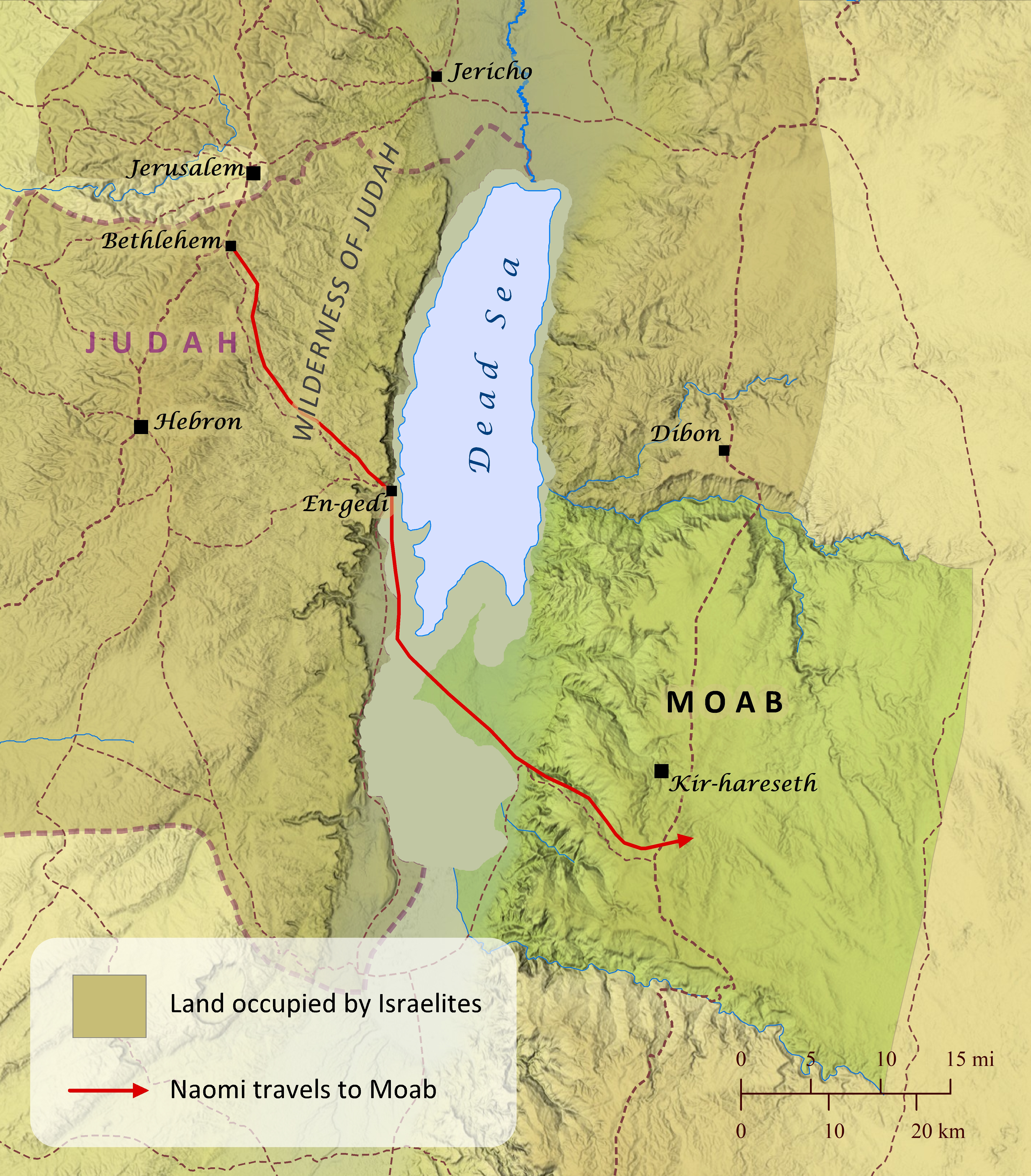
The story of Ruth is set in the time of the Judges, a few generations before the birth of King David. While much animosity often existed between Israel and Moab (Judges 3:12-30; 10:6-12:7; 2 Samuel 8:2; 10; 2 Kings 3:4-27; 2 Chronicles 20; see also Nations across the Jordan River map), other times the two nations appear to have enjoyed a somewhat congenial relationship, as is demonstrated by Naomi’s willingness to relocate to Moab to seek relief from a famine. Later Naomi’s sons also marry Moabite women, and Ruth’s devotion to Naomi and her God no doubt speaks highly of the character of many Moabites. Many years later Ruth’s great-grandson David placed his parents in the care of the king of Moab while he was on the run from King Saul (1 Samuel 22:3-4).
Open Bible Data site copyright © 2023–2026 Freely-Given.org.
Python source code for creating these static pages is available on GitHub under an open licence.
For Bible data copyrights, see the details for each displayed Bible version.
The Open English Translation (OET) main site is at OpenEnglishTranslation.Bible or OET.Bible.