¶ Now as for me, I was the king’s cupbearer.

OET OET-RV OET-LV GHT ULT UST BSB MSB BLB AICNT OEB WEBBE WMBB NET LSV FBV TCNT T4T LEB BBE Moff JPS Wymth ASV DRA YLT Drby RV SLT Wbstr KJB-1769 KJB-1611 Bshps Gnva Cvdl TNT Wycl SR-GNT UHB BrLXX BrTr Related Parallel Simple Interlinear Topics Reference Dictionary Search
ParallelVerse GEN EXO LEV NUM DEU JOB JOS JDG RUTH 1 SAM 2 SAM PSA AMOS HOS 1 KI 2 KI 1 CHR 2 CHR PROV ECC SNG JOEL MIC ISA ZEP HAB JER LAM YNA (JNA) NAH OBA DAN EZE EZRA EST NEH HAG ZEC MAL LAO GES LES ESG DNG 2 PS TOB JDT WIS SIR BAR LJE PAZ SUS BEL MAN 1 MAC 2 MAC 3 MAC 4 MAC YHN (JHN) MARK MAT LUKE ACTs YAC (JAM) GAL 1 TH 2 TH 1 COR 2 COR ROM COL PHM EPH PHP 1 TIM TIT 1 PET 2 PET 2 TIM HEB YUD (JUD) 1 YHN (1 JHN) 2 YHN (2 JHN) 3 YHN (3 JHN) REV
Neh Intro C2 C3 C4 C5 C6 C7 C8 C9 C10 C11 C12 C13
Neh 1 V1 V2 V3 V4 V5 V6 V7 V8 V9 V10
Note: This view shows ‘verses’ which are not necessarily natural language units and hence sometimes only part of a sentence will be visible—click on any Bible version abbreviation down the left-hand side to see the verse in more of its context. Normally the OET discourages the reading of individual ‘verses’, but this view is only designed as a tool for Bible-translators and others doing comparisons of different translations—the older translations are further down the page (so you can read up from the bottom to trace the English translation history). The OET segments on this page are still early looks into the drafted texts of the Open English Translation of the Bible—please double-check these texts in advance before using in public.
Text critical issues=none Clarity of original=clear Importance to us=normal Speaker(s)=Narrator (All still tentative.)
OET (OET-RV) Oh, my master, please listen carefully to your servant’s prayer, and to the prayer of your other servants who delight to honour your name. Please cause your servant to succeed today, and give me favour in the king’s eyes.”
¶ Now as for me, I was the king’s cupbearer.
OET-LV Please my_master let_it_be please ear_of_your attentive to the_prayer_of your_servant_of_your and_near/to the_prayer_of your_servants (the)_delighting to_fear DOM your(ms)_name and_grant_success please to_servant_of_your the_day and_give_him (to)_compassion(s) to_(the)_face_of/in_front_of/before the_man the_this and_I I_was cup_bearer of_king.
UHB אָנָּ֣א אֲדֹנָ֗י תְּהִ֣י נָ֣א אָזְנְךָֽ־קַ֠שֶּׁבֶת אֶל־תְּפִלַּ֨ת עַבְדְּךָ֜ וְאֶל־תְּפִלַּ֣ת עֲבָדֶ֗יךָ הַֽחֲפֵצִים֙ לְיִרְאָ֣ה אֶת־שְׁמֶ֔ךָ וְהַצְלִֽיחָה־נָּ֤א לְעַבְדְּךָ֙ הַיּ֔וֹם וּתְנֵ֣הוּ לְרַחֲמִ֔ים לִפְנֵ֖י הָאִ֣ישׁ הַזֶּ֑ה וַאֲנִ֛י הָיִ֥יתִי מַשְׁקֶ֖ה לַמֶּֽלֶךְ׃פ ‡
(ʼānnāʼ ʼₐdonāy təhiy nāʼ ʼāzənəkā-qashsheⱱet ʼel-təfillat ˊaⱱdəkā vəʼel-təfillat ˊₐⱱādeykā haḩₐfēʦīm ləyirʼāh ʼet-shəmekā vəhaʦliyḩāh-nāʼ ləˊaⱱdəkā hayyōm ūtənēhū ləraḩₐmim lifənēy hāʼiysh hazzeh vaʼₐniy hāyitī mashqeh lammelek.◊)
Key: khaki:verbs.
Note: Automatic aligning of the OET-RV to the LV is done by some temporary software, hence the OET-RV alignments are incomplete (and may occasionally be wrong).
BrLXX (EZR 11:11) Μὴ δὴ Κύριε, ἀλλὰ ἔστω τὸ οὖς σου προσέχον εἰς τὴν προσευχὴν τοῦ δούλου σου, καὶ εἰς τὴν προσευχὴν παίδων σου τῶν θελόντων φοβεῖσθαι τὸ ὄνομά σου· καὶ εὐόδωσον δὴ τῷ παιδί σου σήμερον, καὶ δὸς αὐτὸν εἰς οἰκτιρμοὺς ἐνώπιον τοῦ ἀνδρὸς τούτου· καὶ ἐγὼ ἤμην οἰνοχόος τῷ βασιλεῖ.
(Maʸ daʸ Kurie, alla estō to ous sou proseⱪon eis taʸn proseuⱪaʸn tou doulou sou, kai eis taʸn proseuⱪaʸn paidōn sou tōn thelontōn fobeisthai to onoma sou; kai euodōson daʸ tōi paidi sou saʸmeron, kai dos auton eis oiktirmous enōpion tou andros toutou; kai egō aʸmaʸn oinoⱪoos tōi basilei.)
BrTr Turn not away, I pray thee, O Lord, but let thine ear be attentive to the prayer of thy servant, and to the prayer of thy servants, who desire to fear thy name: and prosper, I pray thee, thy servant this day, and cause him to find mercy in the sight of this man. Now I was the king's cup-bearer.
ULT Ah! My Lord, please let your ear be attentive to the prayer of your servant and to the prayer of your servants, the ones who delight to fear your name. And please cause your servant to succeed today, and give him mercies before the face of this man.” Now as for me, I was a cupbearer for the king.
UST O my Lord, please pay careful attention to my prayer and to the prayers of my fellow Israelites. We are eager to honor you. Please grant that the king will agree to the request that I hope to make soon.” At that time, I was an important official who served the wine at the king’s table.
BSB & MSB O Lord, may Your ear be attentive to [my] prayer and to the prayers of Your servants[fn] who delight to revere Your name. Give Your servant success this day, I pray, and grant him mercy in the sight of this man.”
§ ( At that time I was the cupbearer to the king.)
1:11 Literally to the prayer of Your servant and to the prayer of Your servants
OEB No OEB NEH 1:11 book available
WEBBE Lord,[fn] I beg you, let your ear be attentive now to the prayer of your servant, and to the prayer of your servants who delight to fear your name; and please prosper your servant today, and grant him mercy in the sight of this man.”
¶ Now I was cup bearer to the king.
1:11 The word translated “Lord” is “Adonai.”
WMBB Lord,[fn] I beg you, let your ear be attentive now to the prayer of your servant, and to the prayer of your servants who delight to fear your name; and please prosper your servant today, and grant him mercy in the sight of this man.”
¶ Now I was cup bearer to the king.
1:11 The word translated “Lord” (mixed case) is “Adonai.”
NET Please, O Lord, listen attentively to the prayer of your servant and to the prayer of your servants who take pleasure in showing respect to your name. Grant your servant success today and show compassion to me in the presence of this man.”
¶ Now I was cupbearer for the king.
LSV Ah, now, O Lord, please let Your ear be attentive to the prayer of Your servant, and to the prayer of Your servants, those delighting to fear Your Name; and please give prosperity to Your servant today, and give him for mercies before this man”; and I have been butler to the king.
FBV Lord, please respond to my prayer and to the prayers of those who love to worship you. Please let me be successful today and make the king sympathetic to me.’ ” I was the king's cupbearer.
T4T Yahweh, please hear this prayer of mine, and the prayers of all your people who are delighted to revere you [MTY]. Today I will go to the king, to request that he do me a great favor. Please motivate him to act kindly toward me, in order that I will be successful in obtaining what I want.”
¶ At that time, I was the one whose work was to taste all the food and drink before it was served to the king, to be sure that no one had put poison in it.
LEB O Lord, please let your ear be attentive to the prayer of your servant and to the prayer of your servants who delight to revere in your name. Please, let your servant be successful this day and give him compassion before this man.”
¶ I was cupbearer for the king.
BBE O Lord, let your ear take note of the prayer of your servant, and of the prayers of your servants, who take delight in worshipping your name: give help, O Lord, to your servant this day, and let him have mercy in the eyes of this man. (Now I was the king's wine-servant.)
Moff Ah, Lord, may thine ear now n be attentive to the prayer of thy servant and to the prayer of thy servants who delight to reverence thy Name. Ah, let thy servant have success at this time, let him find favour in the sight of this man!” (for I was a cupbearer to the king).
JPS O Lord, I beseech Thee, let now Thine ear be attentive to the prayer of Thy servant, and to the prayer of Thy servants, who delight to fear Thy name; and prosper, I pray Thee, Thy servant this day, and grant him mercy in the sight of this man.' Now I was cupbearer to the king.
ASV O Lord, I beseech thee, let now thine ear be attentive to the prayer of thy servant, and to the prayer of thy servants, who delight to fear thy name; and prosper, I pray thee, thy servant this day, and grant him mercy in the sight of this man.
¶ Now I was cupbearer to the king.
DRA I beseech thee, O Lord, let thy ear be attentive to the prayer of thy servant, and to the prayer of thy servants who desire to fear thy name: and direct thy servant this day, and give him mercy before this man. For I was the king’s cupbearer.
YLT 'I beseech Thee, O Lord, let, I pray Thee, Thine ear be attentive unto the prayer of Thy servant, and unto the prayer of Thy servants, those delighting to fear Thy Name; and give prosperity, I pray Thee, to Thy servant to-day, and give him for mercies before this man;' and I have been butler to the king.
Drby O Lord, I beseech thee, let now thine ear be attentive to the prayer of thy servant, and to the prayer of thy servants who delight to fear thy name; and prosper, I pray thee, thy servant this day, and grant him mercy in the sight of this man. Now I was the king's cupbearer.
RV O Lord, I beseech thee, let now thine ear be attentive to the prayer of thy servant, and to the prayer of thy servants, who delight to fear thy name: and prosper, I pray thee, thy servant this day, and grant him mercy in the sight of this man. (Now I was cupbearer to the king.)
(Oh Lord, I beseech/implore thee/you, let now thine/your ear be attentive to the prayer of thy/your servant, and to the prayer of thy/your servants, who delight to fear thy/your name: and prosper, I pray thee/you, thy/your servant this day, and grant him mercy in the sight of this man. (Now I was cup-bearer to the king.))
SLT Now, O Lord, now will thine ear be attending to the prayer of thy servant, and to the prayer of thy servants, desiring to fear thy name? and prosper now to thy servant this day: and wilt thou give him for compassion before this man? And I was giving drink to the king.
Wbstr O LORD, I beseech thee, let now thy ear be attentive to the prayer of thy servant, and to the prayer of thy servants, who desire to fear thy name: and prosper, I pray thee, thy servant this day, and grant him mercy in the sight of this man. For I was the king's cup-bearer.
KJB-1769 O Lord, I beseech thee, let now thine ear be attentive to the prayer of thy servant, and to the prayer of thy servants, who desire to fear thy name: and prosper, I pray thee, thy servant this day, and grant him mercy in the sight of this man. For I was the king’s cupbearer.
(Oh Lord, I beseech/implore thee/you, let now thine/your ear be attentive to the prayer of thy/your servant, and to the prayer of thy/your servants, who desire to fear thy/your name: and prosper, I pray thee/you, thy/your servant this day, and grant him mercy in the sight of this man. For I was the king’s cup-bearer.)
KJB-1611 O LORD, I beseech thee, let now thine eare be attentiue to the prayer of thy seruant, and to the prayer of thy seruants, who desire to feare thy name: and prosper, I pray thee, thy seruant this day, and grant him mercie in the sight of this man. For I was the kings cup-bearer.
(Oh LORD, I beseech/implore thee/you, let now thine/your ear be attentive to the prayer of thy/your servant, and to the prayer of thy/your servants, who desire to fear thy/your name: and prosper, I pray thee/you, thy/your servant this day, and grant him mercy in the sight of this man. For I was the kings cup-bearer.)
Bshps O Lorde I besech thee, let thyne eare hearken to the prayer of thy seruaunt, and to the prayer of thy seruauntes, whose desire is to feare thy name: and let thy seruaunt prosper this day, and graunt him mercie in the sight of this man. For I was the kinges butler.
(Oh Lord I beseech/implore thee/you, let thine/your ear hearken to the prayer of thy/your servant, and to the prayer of thy/your servants, whose desire is to fear thy/your name: and let thy/your servant prosper this day, and grant him mercy in the sight of this man. For I was the kings butler.)
Gnva O Lord, I beseech thee, let thine eare now hearken to the prayer of thy seruant, and to the prayer of thy seruants, who desire to feare thy Name, and I pray thee, cause thy seruant to prosper this day, and giue him fauour in the presence of this man: for I was the Kings butler.
(Oh Lord, I beseech/implore thee/you, let thine/your ear now hearken to the prayer of thy/your servant, and to the prayer of thy/your servants, who desire to fear thy/your Name, and I pray thee/you, cause thy/your servant to prosper this day, and give him favour in the presence of this man: for I was the Kings butler.)
Cvdl O LORDE, let thine eares marke the prayer of thy seruaunt, & the prayer of thy seruauntes, whose desyre is to feare thy name, & let thy seruaunt prospere this daye, & graunte him mercy in the sight of this man: for I was the kynges butlar.
(Oh LORD, let thine/your ears mark the prayer of thy/your servant, and the prayer of thy/your servants, whose desire is to fear thy/your name, and let thy/your servant prosper this day, and grant him mercy in the sight of this man: for I was the kings butler.)
Wycl Lord, Y biseche, `thin eere be ententif to the preier of thi seruaunt, and to the preier of thi seruauntis, that wolen drede thi name; and dresse thi seruaunt to dai, and yiue thou merci to him bifor this man. For Y was the boteler of the kyng.
(Lord, I beseech/implore, thin ear be attentive to the prayer of thy/your servant, and to the prayer of thy/your servants, that woollen dread thy/your name; and dress thy/your servant today, and give thou/you mercy to him before this man. For I was the butler of the king.)
Luth Ach, HErr, laß deine Ohren aufmerken auf das Gebet deines Knechts und auf das Gebet deiner Knechte, die da begehren, deinen Namen zu fürchten; und. laß deinem Knechte heute gelingen und gib ihm Barmherzigkeit vor diesem Manne! Denn ich war des Königs Schenke.
(Oh_dear, LORD, let your ears pay_attention on/in/to the prayer your(s) servant/farmhands and on/in/to the prayer your(s) servant(s), the there desire, your(s) name(s) to/for fear(v); and. let your servant(s) today succeed and give him compassion before/in_front_of this_one man! Because I what/which the kings Give.)
ClVg Obsecro, Domine, sit auris tua attendens ad orationem servi tui, et ad orationem servorum tuorum, qui volunt timere nomen tuum: et dirige servum tuum hodie, et da ei misericordiam ante virum hunc. Ego enim eram pincerna regis.
(Please, Master, be ear your attending to speech slaves yours(sg), and to speech of_servants yours, who/which they_want to_be_afraid name your(sg): and direct a_servant your(sg) today/at_this_time, and give to_him mercy before husband this_one. I because I_was cupbearer king.)
Note 1 topic: figures-of-speech / exclamations
אָנָּ֣א
(Some words not found in UHB: o my=master be now ear_of,your attentive to/towards prayer_of your_servant_of,your and=near/to prayer_of your=servants (the),delighting to,fear DOM your(ms)=name and,grant,success please to,servant_of,your the=day and,give,him (to),compassion(s) to=(the)_face_of/in_front_of/before the=man the=this and,I was cupbearer of,king )
As in [1:5](../01/05.md), Nehemiah uses this word to call on God with strong feeling. Alternate translation: [O]
אֲדֹנָ֗י תְּהִ֣י נָ֣א אָזְנְךָֽ־קַ֠שֶּׁבֶת אֶל־תְּפִלַּ֨ת עַבְדְּךָ֜
my=master (Some words not found in UHB: o my=master be now ear_of,your attentive to/towards prayer_of your_servant_of,your and=near/to prayer_of your=servants (the),delighting to,fear DOM your(ms)=name and,grant,success please to,servant_of,your the=day and,give,him (to),compassion(s) to=(the)_face_of/in_front_of/before the=man the=this and,I was cupbearer of,king )
Nehemiah calls himself a servant and he calls God his Lord because this is how a person in his culture would address a superior in order to show humility and respect. See how you translated this in [1:6](../01/06.md).
Note 2 topic: translate-names
אֲדֹנָ֗י
my=master
This term in Hebrew can be understood as either a noun with a pronoun suffix (“my Lord”) or as a simple title (“Lord”).
Note 3 topic: figures-of-speech / metonymy
תְּהִ֣י נָ֣א אָזְנְךָֽ־קַ֠שֶּׁבֶת
(Some words not found in UHB: o my=master be now ear_of,your attentive to/towards prayer_of your_servant_of,your and=near/to prayer_of your=servants (the),delighting to,fear DOM your(ms)=name and,grant,success please to,servant_of,your the=day and,give,him (to),compassion(s) to=(the)_face_of/in_front_of/before the=man the=this and,I was cupbearer of,king )
As in [1:6](../01/06.md), this phrase refers to the action of listening. Alternate translation: [please pay careful attention.]
Note 4 topic: figures-of-speech / 123person
תְּפִלַּ֨ת עַבְדְּךָ֜
(Some words not found in UHB: o my=master be now ear_of,your attentive to/towards prayer_of your_servant_of,your and=near/to prayer_of your=servants (the),delighting to,fear DOM your(ms)=name and,grant,success please to,servant_of,your the=day and,give,him (to),compassion(s) to=(the)_face_of/in_front_of/before the=man the=this and,I was cupbearer of,king )
Alternate translation: [to my prayer]
תְּפִלַּ֣ת עֲבָדֶ֗יךָ
(Some words not found in UHB: o my=master be now ear_of,your attentive to/towards prayer_of your_servant_of,your and=near/to prayer_of your=servants (the),delighting to,fear DOM your(ms)=name and,grant,success please to,servant_of,your the=day and,give,him (to),compassion(s) to=(the)_face_of/in_front_of/before the=man the=this and,I was cupbearer of,king )
Here, servants refers to the rest of the Israelite people who were also praying for Yahweh to act on behalf of his people and on behalf of Jerusalem. Alternate translation: [and to the prayers of my fellow Israelites]
Note 5 topic: figures-of-speech / metonymy
הַֽחֲפֵצִים֙ לְיִרְאָ֣ה אֶת־שְׁמֶ֔ךָ
(the),delighting to,fear DOM (Some words not found in UHB: o my=master be now ear_of,your attentive to/towards prayer_of your_servant_of,your and=near/to prayer_of your=servants (the),delighting to,fear DOM your(ms)=name and,grant,success please to,servant_of,your the=day and,give,him (to),compassion(s) to=(the)_face_of/in_front_of/before the=man the=this and,I was cupbearer of,king )
Here, name represents Yahweh himself. Alternate translation: [who are glad to honor you] or [who are eager to uphold your reputation]
Note 6 topic: figures-of-speech / idiom
הַֽחֲפֵצִים֙
(the),delighting
To delight in doing something means to be glad to do it and to want to do it.
לְיִרְאָ֣ה
to,fear
As in [1:5](../01/05.md), fear means to show respect and reverence.
Note 7 topic: figures-of-speech / 123person
וְהַצְלִֽיחָה־נָּ֤א לְעַבְדְּךָ֙ הַיּ֔וֹם וּתְנֵ֣הוּ לְרַחֲמִ֔ים
and,grant,success (Some words not found in UHB: o my=master be now ear_of,your attentive to/towards prayer_of your_servant_of,your and=near/to prayer_of your=servants (the),delighting to,fear DOM your(ms)=name and,grant,success please to,servant_of,your the=day and,give,him (to),compassion(s) to=(the)_face_of/in_front_of/before the=man the=this and,I was cupbearer of,king )
Once again Nehemiah calls himself a servant to show respect to a superior. He then refers to himself in the third person (“give him”) to express humility before God. Alternate translation: [make me successful today and let the king be merciful to me]
Note 8 topic: figures-of-speech / parallelism
וְהַצְלִֽיחָה־נָּ֤א לְעַבְדְּךָ֙ הַיּ֔וֹם וּתְנֵ֣הוּ לְרַחֲמִ֔ים
and,grant,success (Some words not found in UHB: o my=master be now ear_of,your attentive to/towards prayer_of your_servant_of,your and=near/to prayer_of your=servants (the),delighting to,fear DOM your(ms)=name and,grant,success please to,servant_of,your the=day and,give,him (to),compassion(s) to=(the)_face_of/in_front_of/before the=man the=this and,I was cupbearer of,king )
These two statements mean similar things. Nehemiah says the same thing twice, in slightly different ways, to emphasize how important it is for him to have God’s help. You do not need to repeat both phrases in your translation if that would be confusing for your readers. Alternate translation: [grant that the king will have mercy on me]
Note 9 topic: figures-of-speech / idiom
הַיּ֔וֹם
the=day
This does not necessarily mean on this same day. Rather, Nehemiah is praying that God will give him the opportunity to speak with the king soon about helping the Jews in Jerusalem. Alternate translation: [soon]
Note 10 topic: figures-of-speech / 123person
וּתְנֵ֣הוּ לְרַחֲמִ֔ים
and,give,him (to),compassion(s)
Here, him refers to Nehemiah, who refers to himself in the third person to express his humility before God.
Note 11 topic: figures-of-speech / metaphor
לִפְנֵ֖י הָאִ֣ישׁ הַזֶּ֑ה
to=(the)_face_of/in_front_of/before the=man (Some words not found in UHB: o my=master be now ear_of,your attentive to/towards prayer_of your_servant_of,your and=near/to prayer_of your=servants (the),delighting to,fear DOM your(ms)=name and,grant,success please to,servant_of,your the=day and,give,him (to),compassion(s) to=(the)_face_of/in_front_of/before the=man the=this and,I was cupbearer of,king )
Here, face is a figurative way of referring to the action of seeing, and seeing is a figurative way of describing knowledge, perception, notice, attention, or judgment. In this context, Nehemiah is asking God to cause the king to make a favorable decision in response to a request he plans to make. Alternate translation: [Please grant that the king will agree to the request that I am going to make.]
Note 12 topic: figures-of-speech / explicit
הָאִ֣ישׁ הַזֶּ֑ה
the=man (Some words not found in UHB: o my=master be now ear_of,your attentive to/towards prayer_of your_servant_of,your and=near/to prayer_of your=servants (the),delighting to,fear DOM your(ms)=name and,grant,success please to,servant_of,your the=day and,give,him (to),compassion(s) to=(the)_face_of/in_front_of/before the=man the=this and,I was cupbearer of,king )
As we will discover in the next chapter, this man refers to Artaxerxes, the king of Persia. If it would be helpful to your readers, you could say this explicitly. Alternate translation: [the king]
Note 13 topic: writing-background
וַאֲנִ֛י הָיִ֥יתִי מַשְׁקֶ֖ה לַמֶּֽלֶךְ
and,I was (Some words not found in UHB: o my=master be now ear_of,your attentive to/towards prayer_of your_servant_of,your and=near/to prayer_of your=servants (the),delighting to,fear DOM your(ms)=name and,grant,success please to,servant_of,your the=day and,give,him (to),compassion(s) to=(the)_face_of/in_front_of/before the=man the=this and,I was cupbearer of,king )
This is background information about Nehemiah’s role in the king’s court. Your language may have a special way to mark background information. As a “cupbearer,” it was Nehemiah’s duty to serve the wine at the king’s table, but he was much more than a waiter or butler. When the king gave him this assignment, this showed that he trusted Nehemiah completely to protect him from being poisoned. Nehemiah’s work also allowed him to see the king frequently and get to know him. So this was an important office. Alternate translation: [At that time, I was an important official who served the wine at the king’s table.]
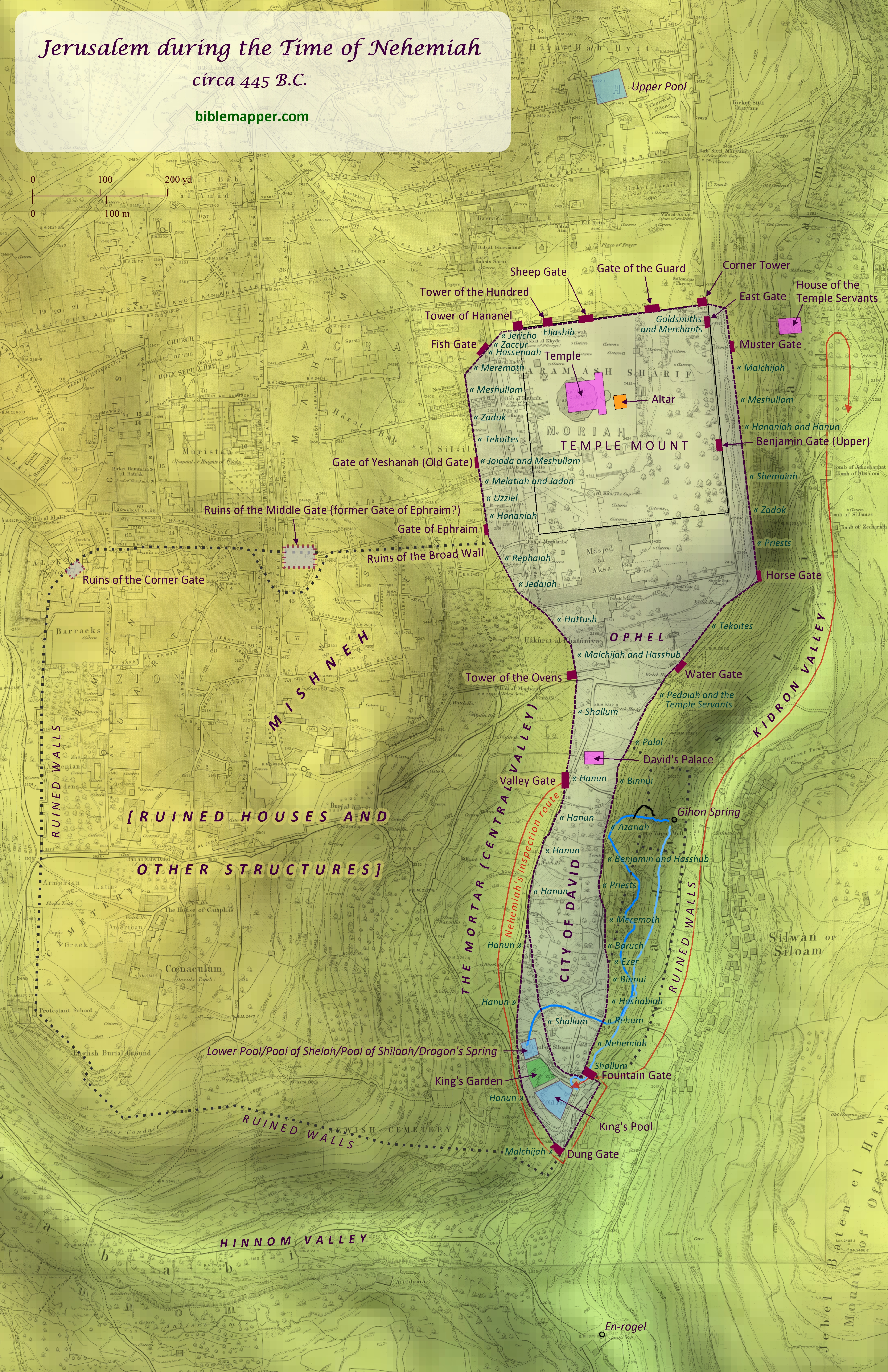
Author’s Note: This map draws heavily upon the careful work of Dr. Leen Ritmeyer (www.ritmeyer.com) regarding the probable location of gates, walls, and other features, though I have deviated at points from his data, based on my own research and conclusions.
A wealth of archaeological evidence supports the existence and location of many of the structures shown on this map, and great care has been taken to correlate them as faithfully as possible with the data provided in the book of Nehemiah and other biblical texts. Nevertheless, the specific identification of virtually all of these items is open to great debate. For this reason, no attempt has been made on this map to indicate any degree of uncertainty for the identifications that have been included, since the vast majority of these would be marked as uncertain anyway.
The shaded relief has been overlaid with the Ordnance Survey of Jerusalem (1865), by Charles Wilson.
The book of Nehemiah is one of the last books of the Old Testament written, and it recounts the efforts of Nehemiah to rebuild the walls of Jerusalem long after they had been destroyed by the Babylonians (2 Kings 24-25; 2 Chronicles 36:17-21; Jeremiah 39:1-10; see “Nebuchadnezzar’s Final Campaign against Judah” map). Nehemiah had been a trusted official in the Persian royal court who acquired a special commission to return to his ancestral land of Judea for the rebuilding effort (Nehemiah 1-2; see “Jews Return from Exile” map). After arriving in Jerusalem, he quickly surveyed the condition of the walls and then organized the people of Judea into work teams (Nehemiah 2-3). These teams each worked on a designated portion of the walls, and the entire project was completed in 52 days (Nehemiah 6:15). The builders came from Jerusalem and from towns throughout the greater province of Judea, and most of these towns are included in the map of “Judea under Persian Rule”.
It is far beyond the scope of this article to present all the textual and archaeological evidence that forms the basis for the identifications made on this map, but two specific portions of this map seem to warrant explanation:
One Gate of Ephraim or Two?
The Gate of Ephraim is mentioned in Nehemiah 8:16 and 12:39, and it is noted as lying along the path of the walls that Nehemiah rebuilt. This has indirectly led to some confusion, however, regarding the location of another gate called the Gate of Ephraim in 2 Kings 14:13 and 2 Chronicles 25:23, which both note that King Jehoash of Israel broke down the wall of Jerusalem from the Gate of Ephraim to the Corner Gate, a distance of 400 cubits. This confusion stems from equating the Gate of Ephraim mentioned in 2 Kings and 2 Chronicles with the Gate of Ephraim mentioned in Nehemiah. Assuming the biblical text to be reliable, this assumption would require that the Corner Gate, which is mentioned also in 2 Chronicles 26:9; Jeremiah 31:38; and Zechariah 14:10, would have been located somewhere along the wall about 600 feet (183 meters) from the Gate of Ephraim. Placing it directly west of the Gate of Ephraim of Nehemiah would place it very close to the Middle Gate, perhaps suggesting that the Middle Gate was in fact the Corner Gate. But Jeremiah’s mention of both the Middle Gate (39:3) and the Corner Gate (Jeremiah 31:38) in the same book makes this equation unlikely. Placing the Corner Gate directly north of the Gate of Ephraim near the northwestern corner of the Temple Mount seems plausible at first glance, but this location is very hard to reconcile with both Jeremiah 31:38 and Zechariah 14:10. Jeremiah 31:38 traces a line from the Tower of Hananel to the Corner Gate, but this would make little sense if the Corner Gate were located in very close proximity to the Tower of Hananel. Similarly, Zechariah 14:10 appears to be using the Corner Gate as a marker for the far western extreme of Jerusalem, but a location at the northwest corner of the Temple Mount hardly seems like the intended location.
A more likely solution can be found by regarding the Gate of Ephraim of 2 Kings 14 and 2 Chronicles 25 as different than the Gate of Ephraim of Nehemiah, though perhaps the Gate of Ephraim had been renamed after the exile to hearken back to the old Gate of Ephraim, which had been destroyed. If this is true, the earlier Gate of Ephraim may actually have been the same as the Middle Gate of Jeremiah 39:3 (Jeremiah never mentions the Gate of Ephraim), or perhaps it was a gate near where the Middle Gate was built later. This location, then, would place the Corner Gate at the far western corner of the larger wall around greater Jerusalem, as shown on this map. The distance between these two gates is about 600 feet (183 meters), and the appropriately named Corner Gate would be a fitting candidate to mark the far western extreme of the city.
It should also be noted that this solution, however, requires that the first Gate of Ephraim existed prior to Hezekiah’s building activity. This stands in contrast to the common assertion that the wall encompassing greater Jerusalem (which Josephus calls the First Wall) was built by Hezekiah in response to the dramatic increase in residents that relocated to Jerusalem due to the fall of the northern kingdom of Israel. But the only mention in the Bible of Hezekiah building a new wall is 2 Chronicles 32:5, which notes that he built a wall “outside” the wall that was broken down (2 Chronicles 32:5). This is most likely referencing a wall in the Kidron Valley that has since been found by archaeology, and perhaps a second wall around the Temple Mount. So it would seem that elsewhere Hezekiah merely repaired or replaced portions of a wall that already existed but was in disrepair. This synchronizes well with Isaiah 22:11, where Isaiah rebukes a leader (perhaps Hezekiah) for breaking down houses “to fortify the wall” (not build a new one).
Wall Enclosing the King’s Pool
Another common assumption that is difficult to correlate with Nehemiah is the placement of the King’s Pool and the Lower Pool outside the main wall of the City of David. (The King’s Pool was likely the same as the Old Pool mentioned in Isaiah 22:11. The Lower Pool appears to be alternately called elsewhere the [Pool of] Shiloah/Siloam [Isaiah 8:6] and the Pool of Shelah [Nehemiah 3:15], which is fed by the Dragon’s Spring [Nehemiah 2:13].) Two different passages in Nehemiah (Nehemiah 3:13; 12:31) clearly trace a path along a wall from the Valley Gate (likely midway up the western wall of the City of David) directly to the Dung Gate, with no mention of any other gates or distinct changes in direction. Likewise, both Nehemiah 3:15 and 12:37 note that the Fountain Gate (likely located immediately northeast of the King’s Pool on this map) was reached after passing by the Dung Gate. This author has become convinced that this requires that the Dung Gate lay along a portion of the wall that must have extended directly from the area of the Valley Gate. Further details are given in Nehemiah 3:13, which notes that Hanun and the inhabitants of Zanoah repaired 1000 cubits (1500 feet; 457 meters) of the wall from the Valley Gate to the Dung Gate. If the Valley Gate and the Dung Gate were indeed located at the two places shown on this map, and a wall between them followed the path shown here, the distance between them along the wall would have measured about 1548 feet (472 meters), or 1032 cubits–extremely close to the 1000-cubit distance given in Nehemiah 3:13. The existence of this wall is also supported by Isaiah 22:11-12, which notes that a reservoir for the waters of the Old Pool (likely the same as the King’s Pool on this map) had been built “between the two walls.” This could be understood to refer to Josephus’s First Wall and the wall immediately north of the King’s Pool, but this author suspects instead that it is referring to the wall that must have already existed immediately south of the Lower Pool and the King’s Pool on this map.
Open Bible Data site copyright © 2023–2026 Freely-Given.org.
Python source code for creating these static pages is available on GitHub under an open licence.
For Bible data copyrights, see the details for each displayed Bible version.
The Open English Translation (OET) main site is at OpenEnglishTranslation.Bible or OET.Bible.