
OET OET-RV OET-LV GHT ULT UST BSB MSB BLB AICNT OEB WEBBE WMBB NET LSV FBV TCNT T4T LEB BBE Moff JPS Wymth ASV DRA YLT Drby RV SLT Wbstr KJB-1769 KJB-1611 Bshps Gnva Cvdl TNT Wycl SR-GNT UHB BrLXX BrTr Related Parallel Simple Interlinear Topics Reference Dictionary Search
OET By Document By Section By Chapter Details
OET INT FRT GEN EXO LEV NUM DEU JOB JOS JDG RUTH 1 SAM 2 SAM PSA AMOS HOS 1 KI 2 KI 1 CHR 2 CHR PROV ECC SNG JOEL MIC ISA ZEP HAB JER LAM YNA NAH OBA DAN EZE EZRA EST NEH HAG ZEC MAL GES LES ESG DNG 2 PS TOB JDT WIS SIR BAR MAN 1 MAC 2 MAC 3 MAC 4 MAC YHN MARK MAT LUKE ACTs YAC GAL 1 TH 2 TH 1 COR 2 COR ROM COL PHM EPH PHP 1 TIM TIT 1 PET 2 PET 2 TIM HEB YUD 1 YHN 2 YHN 3 YHN REV
ISA Intro C1 C2 C3 C4 C5 C6 C7 C8 C9 C10 C11 C12 C13 C14 C15 C16 C17 C18 C19 C20 C21 C22 C23 C24 C25 C26 C27 C28 C29 C30 C31 C32 C33 C34 C35 C36 C38 C39 C40 C41 C42 C43 C44 C45 C46 C47 C48 C49 C50 C51 C52 C53 C54 C55 C56 C57 C58 C59 C60 C61 C62 C63 C64 C65 C66
This is still an early look into the drafted text of the Open English Translation of the Bible. Please double-check the text in advance before using in public.
37 When King Hizkiyah heard the report, he torn his clothes too, and covered himself with sackcloth and went into Yahweh’s residence. 2 Then he sent Elyakim (the palace supervisor) and Shevna (the administrator) and the elders of the priests to go to Yeshayah (Isaiah), the son of Amots (Amos) the prophet, 3 and they told him, “King Hizkiyah says that today is a day of distress and rebuke and disgrace, like when children go to their mother who’s about to deliver her baby but she doesn’t have the strength to give birth. 4 Perhaps your god Yahweh heard the messages from the negotiator who was sent by his master, the Assyrian king, to defy the living god. Perhaps Yahweh will rebuke him for the words that Yahweh heard. So send up a prayer for the remnant of us here.”
5 When King Hizkiyah’s servants got to Yeshayah, 6 he told them to tell their master, “Yahweh says not to be afraid because of the words that you heard when the Assyrian king’s servants insulted me. 7 Listen, I’ll put a spirit in him and he’ll hear a report that he needs to return to his own country, and then I’ll cause him to be assassinated at home.”
8 Then the Assyrian negotiator returned to find the Assyrian king because he’d heard that he had left Lakish, and he found him fighting against Livnah. 9 Then the king heard that Ethiopia’s King Tirhakah was marching out to attack him, so he sent messengers back to Hizkiyah with instructions, 10 “Tell Yehudah’s King Hizkiyah: don’t let your god that you trust in, deceive you by telling you that Yerushalem won’t be conquered by the Assyrian king. 11 Listen, you’ve heard how that the Assyrian kings have destroyed all the other regions. Don’t think that you’ll be saved. 12 Did the gods of those other nations save them—places like Gozan and Haran and Retsef, and the people of Eden who lived in Telassar? 13 What happened to the kings of Hamat, Arpad, La’ir, Sefarvayim, Hena, and Ivvah?”
37:14 Hizkiyah’s Prayer
14 Hizkiyah accepted the letter brought by the messengers and read it. Then he went into Yahweh’s residence and spread it out in front of Yahweh 15 and prayed to Yahweh, saying, 16 “Commander-in-chief Yahweh, Yisrael’s god, who’s enthroned above the winged creatures. You alone are God over all of earth’s kingdoms—you made the heavens and the earth. 17 Yahweh, please pay attention and listen. Open your eyes, Yahweh, and look, and listen to everything that Sennacherib has said to defy the living god. 18 Yahweh, it’s true that the Assyrian kings have destroyed all those nations and their regions, 19 and his men threw their gods into the fire, because they weren’t gods at all—they’re just crafted from wood and stone, so they destroyed them. 20 But now, Yahweh our god, save us from his power so that all of the world’s kingdoms will know that you alone are Yahweh who is God.
37:20 OSHB note: BHS has been faithful to the Leningrad Codex where there might be a question of the validity of the form and we keep the same form as BHS.
21 Then Amots’ son Yeshayah sent this message to King Hizkiyah: “Yisrael’s god Yahweh says that because you prayed to me about the Assyrian King Sennacherib, 22 then this is what Yahweh pronounces about him:
Tsiyyon’s (Zion’s) virgin daughter despises you—she scorns you.
Yerushalem’s daughter shakes her head at you.
23 Who is it that you’ve defied and insulted?
Who did you raise your voice against
and arrogantly challenged?
24 You’ve defied my master by sending your servants,
and you’ve said that you’ve gone to the tops of the mountains with your chariots—
up to the remotest parts of Lebanon to cut down its tallest cedars and best pines.
You’ve said that you’ll enter the highest parts of its forest plantation.
25 It’s me who has dug and drunk water,
and dried up all of Egypt’s canals with the soles of my feet.
26 “Haven’t you heard that I determined it from long ago.
≈ I planned it since ancient times and now I’m making it happen,
→ and you’re about to make fortified cities into desolate heaps of ruins.
27 Their powerless inhabitants are dismayed and ashamed.
They come and go like the vegetation in the countryside,
and like how a grass roof doesn’t stay green for long
and like a field as the grain crop grows.
28 “I know when you sit down and when you go in or out,
and I know your raging against me.
29 Because of that raging against me,
≈ and your arrogance that’s reached my ears,
and I’ll send you home on the same road that you came here on.”
30 So this will be the sign for you Hizkiyah:
This year you’ll eat wild crops,
and next year you’ll eat the self-seeded growth.
But in the third year you must sow and harvest,
and plant vineyards and eat their fruit.
31 The people of Yehudah who’ve remained here
will send their roots down and their fruit will grow up,
32 because a remnant will come out of Yerushalem,
≈ and survivors from Mt. Tsiyyon (Zion).
Commander-in-chief Yahweh will accomplish this through his zeal.
33 Therefore Yahweh says this about the Assyrian king:
He won’t come into this city and he won’t shoot an error here.
≈ He won’t bring a shield near it, and he won’t build ramps up against it.
34 He’ll return by the road that he came on, and he won’t enter this city.
That is Yahweh’s declaration 35 and I’ll protect this city and rescue it for my own sake and for the sake of my servant David.
36 Then Yahweh’s messenger went out and killed 185,000 Assyrian soldiers—when the others got up early the next morning, wow, there were corpses all around! 37 Then the Assyrian King Sennacherib left and headed back there, and he settled down in Nineveh. 38 One day he was worshipping in the temple of his god Nisrok, and his sons Adrammelek and Sharetser ran a sword through him before escaping to the Ararat region, and his son Esar-Haddon replaced him as king.

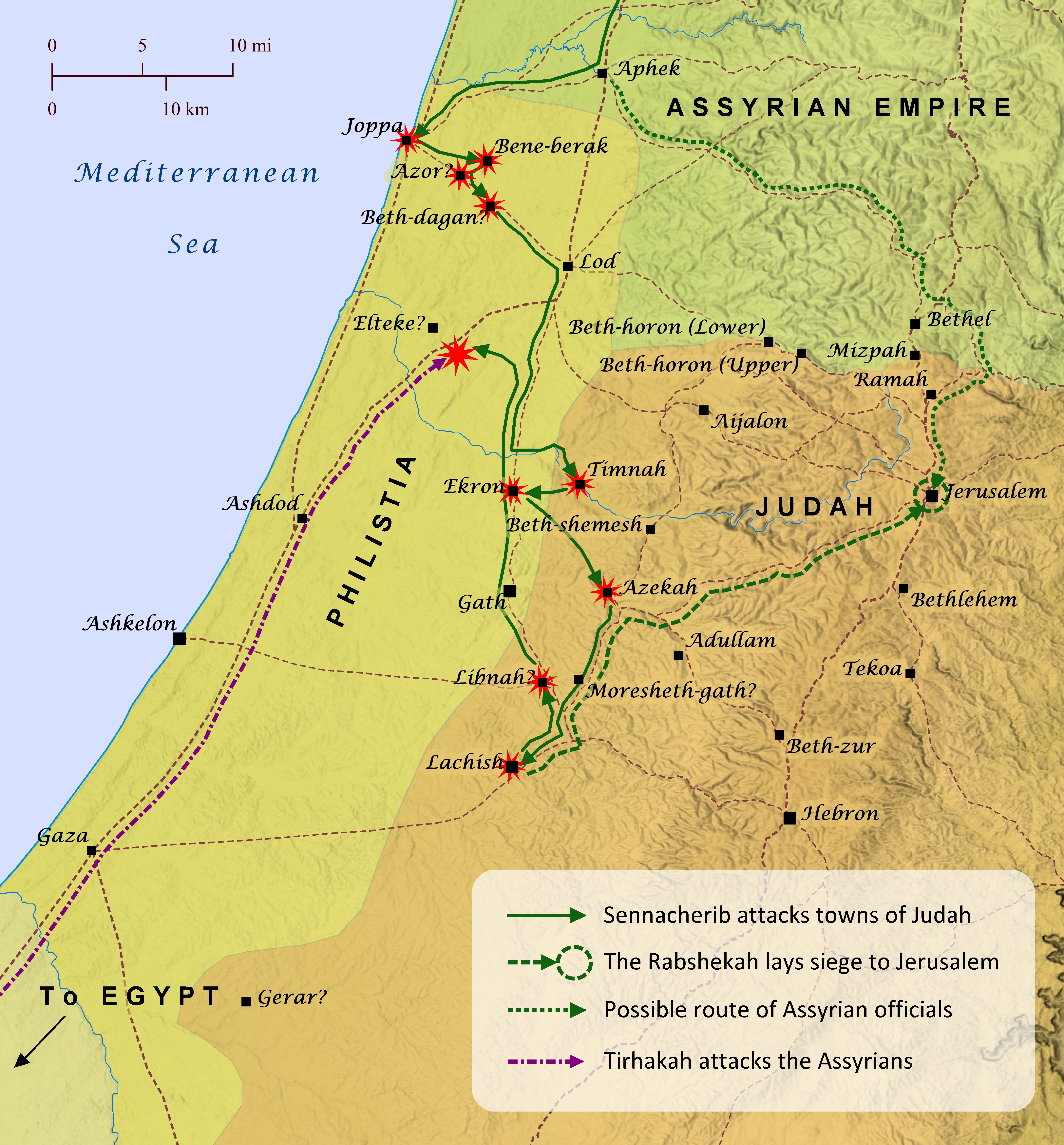
Isaiah 36-37; 2 Kings 18-19; 2 Chronicles 32
The harrowing experience of the attack on Judah by King Sennacherib of Assyria during Hezekiah’s reign is recorded by three different writers of Scripture and even by Sennacherib himself. Many scholars also suspect that this event formed the basis for Herodotus’s story regarding an army of mice eating the bow strings of the Assyrian army during their campaign against the Egyptians (Histories, 2.141). The origins of this event stretch back into the reign of Hezekiah’s father Ahaz, who enticed the Assyrians to attack Israel and Aram in exchange for making Judah a vassal of Assyria (2 Kings 16-17; 2 Chronicles 28; Isaiah 7-8; also see “The Final Days of the Northern Kingdom of Israel” map). Judah continued to be a vassal of Assyria through the early part of Hezekiah’s reign, but Hezekiah also quietly made extensive preparations to throw off the yoke of Assyria one day (2 Kings 18:1-12; 1 Chronicles 4:39-43; 2 Chronicles 29-31; also see “Hezekiah Strengthens Judah” map). Hezekiah also appears to have been hoping for support from Babylon and Egypt regarding his efforts to revolt against Assyria’s rule, but the prophet Isaiah warned Judah against placing their hopes in these foreign powers (Isaiah 30:1-5; 31:1-3; 39:1-8; 40:10-15; 2 Kings 20:12-19). After a few years spent quashing rebellion among the Babylonians, the Kassites, and the Medes in the east, Sennacherib turned his sights westward and began a campaign to subdue the various vassal nations that were refusing to submit to Assyria’s rule any longer. He first reconquered the Phoenician cities of Sidon and Tyre and then moved south to Philistia. He subdued Joppa, Beth-dagon, Bene-berak, and Azor and then moved to capture the cities of the Shephelah, which guarded the entrances to the valleys leading into the central hill country of Judah. While Sennacherib was attacking Lachish he sent his officers to demand Hezekiah’s surrender. This may be the Assyrian advance upon Jerusalem from the north described in Isaiah 10:28-32, but this is not certain (see “Assyria Advances on Jerusalem” map). Hezekiah sent officers back to Sennacherib with gold and silver taken from Temple and the royal treasury, but he would not surrender. The officers then traveled to Libnah to meet with Sennacherib, for he gone to fight there by that time. In the meantime King Tirhakah of Cush, who was ruling over Egypt at this time, came to attack Sennacherib, so Sennacherib sent his officials back to Hezekiah with a message that Jerusalem would be taken if he resisted. Hezekiah laid the letter from the officials before the Lord and prayed, and the Lord sent word through the prophet Isaiah that Jerusalem would not be taken. Then that very night the angel of the Lord killed 185,000 Assyrian soldiers (probably those with Sennacherib fighting the Egyptians), and Sennacherib went back to Assyria. There while he was worshiping in the temple of Nisroch, Sennacherib’s sons killed him and fled to Ararat (see “Ararat” map).
ISA Intro C1 C2 C3 C4 C5 C6 C7 C8 C9 C10 C11 C12 C13 C14 C15 C16 C17 C18 C19 C20 C21 C22 C23 C24 C25 C26 C27 C28 C29 C30 C31 C32 C33 C34 C35 C36 C38 C39 C40 C41 C42 C43 C44 C45 C46 C47 C48 C49 C50 C51 C52 C53 C54 C55 C56 C57 C58 C59 C60 C61 C62 C63 C64 C65 C66