
OET OET-RV OET-LV GHT ULT UST BSB MSB BLB AICNT OEB WEBBE WMBB NET LSV FBV TCNT T4T LEB BBE Moff JPS Wymth ASV DRA YLT Drby RV SLT Wbstr KJB-1769 KJB-1611 Bshps Gnva Cvdl TNT Wycl SR-GNT UHB BrLXX BrTr Related Parallel Simple Interlinear Topics Reference Dictionary Search
ParallelVerse GEN EXO LEV NUM DEU JOB JOS JDG RUTH 1 SAM 2 SAM PSA AMOS HOS 1 KI 2 KI 1 CHR 2 CHR PROV ECC SNG JOEL MIC ISA ZEP HAB JER LAM YNA (JNA) NAH OBA DAN EZE EZRA EST NEH HAG ZEC MAL LAO GES LES ESG DNG 2 PS TOB JDT ESA WIS SIR BAR LJE PAZ SUS BEL MAN 1 MAC 2 MAC 3 MAC 4 MAC YHN (JHN) MARK MAT LUKE ACTs YAC (JAM) GAL 1 TH 2 TH 1 COR 2 COR ROM COL PHM EPH PHP 1 TIM TIT 1 PET 2 PET 2 TIM HEB YUD (JUD) 1 YHN (1 JHN) 2 YHN (2 JHN) 3 YHN (3 JHN) REV
Isa Intro C1 C2 C3 C4 C5 C6 C7 C8 C9 C10 C11 C12 C13 C14 C15 C16 C17 C18 C19 C20 C21 C22 C23 C24 C25 C26 C27 C28 C29 C30 C31 C32 C33 C34 C35 C36 C38 C39 C40 C41 C42 C43 C44 C45 C46 C47 C48 C49 C50 C51 C52 C53 C54 C55 C56 C57 C58 C59 C60 C61 C62 C63 C64 C65 C66
Isa 37 V1 V2 V3 V4 V5 V6 V7 V8 V9 V10 V11 V12 V13 V15 V16 V17 V18 V19 V20 V21 V22 V23 V24 V25 V26 V27 V28 V29 V30 V31 V32 V33 V34 V35 V36 V37 V38
Note: This view shows ‘verses’ which are not necessarily natural language units and hence sometimes only part of a sentence will be visible—click on any Bible version abbreviation down the left-hand side to see the verse in more of its context. Normally the OET discourages the reading of individual ‘verses’, but this view is only designed as a tool for Bible-translators and others doing comparisons of different translations—the older translations are further down the page (so you can read up from the bottom to trace the English translation history). The OET segments on this page are still early looks into the drafted texts of the Open English Translation of the Bible—please double-check these texts in advance before using in public.
Text critical issues=small word differences Clarity of original=clear Importance to us=normal Speaker(s)=Narrator (All still tentative.)
OET (OET-RV) Hizkiyah accepted the letter brought by the messengers and read it. Then he went into Yahweh’s residence and spread it out in front of Yahweh
OET-LV And_ Ḩizqiyyāh _he/it_took DOM the_letters from_the_hand_of the_messengers and_he_read_it and_he/it_ascended the_house_of YHWH and_he_spread_it_out Ḩizqiyyāh to_(the)_face_of/in_front_of/before YHWH.
UHB וַיִּקַּ֨ח חִזְקִיָּ֧הוּ אֶת־הַסְּפָרִ֛ים מִיַּ֥ד הַמַּלְאָכִ֖ים וַיִּקְרָאֵ֑הוּ וַיַּ֨עַל֙ בֵּ֣ית יְהוָ֔ה וַיִּפְרְשֵׂ֥הוּ חִזְקִיָּ֖הוּ לִפְנֵ֥י יְהוָֽה׃ ‡
(vayyiqqaḩ ḩizqiyyāhū ʼet-haşşəfārim miyyad hammalʼākim vayyiqrāʼēhū vayyaˊal bēyt yhwh vayyifrəsēhū ḩizqiyyāhū lifənēy yhwh.)
Key: khaki:verbs.
Note: Automatic aligning of the OET-RV to the LV is done by some temporary software, hence the OET-RV alignments are incomplete (and may occasionally be wrong).
BrLXX Καὶ ἔλαβεν Ἐζεκίας τὸ βιβλίον παρὰ τῶν ἀγγέλων, καὶ ἀνέγνω αὐτὸ, καὶ ἀνέβη εἰς οἶκον Κυρίου, καὶ ἤνοιξεν αὐτὸ ἐναντίον Κυρίου.
(Kai elaben Ezekias to biblion para tōn angelōn, kai anegnō auto, kai anebaʸ eis oikon Kuriou, kai aʸnoixen auto enantion Kuriou.)
BrTr And Ezekias received the letter from the messengers, and read it, and went up to the house of the Lord, and opened it before the Lord.
ULT And Hezekiah took the writings from the hand of the messengers, and he read it. And he went up, to the house of Yahweh, and Hezekiah spread it out to the face of Yahweh.
UST The messengers gave Hezekiah a letter from the Assyrian king that said the same thing they had told him. Hezekiah read the letter. Then he went to the courtyard of Yahweh’s temple. The Assyrian king had written the letter on a scroll, and Hezekiah unrolled the scroll so that the writing would be visible as he prayed to Yahweh.
BSB & MSB So Hezekiah received the letter from the messengers, read it, and went up to the house of the LORD and spread it out before the LORD.
OEB No OEB ISA book available
WEBBE & WMBB Hezekiah received the letter from the hand of the messengers and read it. Then Hezekiah went up to the LORD’s house, and spread it before the LORD.
NET Hezekiah took the letter from the messengers and read it. Then Hezekiah went up to the Lord’s temple and spread it out before the Lord.
LSV And Hezekiah takes the letters out of the hand of the messengers, and reads them, and Hezekiah goes up to the house of YHWH, and Hezekiah spreads it before YHWH.
FBV Hezekiah received the letter from the messengers and read it. Then he went up to the Lord's Temple and opened it out before the Lord.
T4T Hezekiah received the letter that the messengers gave him, and he read it. Then he went up to the temple and spread out the letter in front of Yahweh.
LEB ¶ And Hezekiah took the letter from the hand of the messengers, and he read[fn] it. Then[fn] he went up to the temple[fn] of Yahweh, and Hezekiah spread it out before the ⌊presence⌋[fn] of Yahweh.
BBE And Hezekiah took the letter from the hands of those who had come with it; and after reading it, Hezekiah went up to the house of the Lord, opening the letter there before the Lord,
Moff No Moff ISA book available
JPS And Hezekiah received the letter from the hand of the messengers, and read it; and Hezekiah went up unto the house of the LORD, and spread it before the LORD.
ASV And Hezekiah received the letter from the hand of the messengers, and read it; and Hezekiah went up unto the house of Jehovah, and spread it before Jehovah.
DRA And Ezechias took the letter from the hand of the messengers, and read it, and went up to the house of the Lord, and Ezechias spread it before the Lord.
YLT And Hezekiah taketh the letters out of the hand of the messengers, and readeth them, and Hezekiah goeth up to the house of Jehovah, and Hezekiah spreadeth it before Jehovah.
Drby And Hezekiah received the letter from the hand of the messengers, and read it; and Hezekiah went up into the house of Jehovah, and spread it before Jehovah.
RV And Hezekiah received the letter from the hand of the messengers, and read it: and Hezekiah went up unto the house of the LORD, and spread it before the LORD.
SLT And Hezekiah will take the letter from the hand of the messengers and read it: and he will go up to the house of Jehovah, and Hezekiah will spread it before Jehovah.
Wbstr And Hezekiah received the letter from the hand of the messengers, and read it: and Hezekiah went up to the house of the LORD, and spread it before the LORD.
KJB-1769 ¶ And Hezekiah received the letter from the hand of the messengers, and read it: and Hezekiah went up unto the house of the LORD, and spread it before the LORD.
KJB-1611 ¶ And Hezekiah receiued the letter from the hand of the messengers, and read it, and Hezekiah went vp vnto the house of the LORD, and spread it before the LORD.
(Modernised spelling is same as from KJB-1769 above, apart from punctuation)
Bshps Nowe when Hezekia had receaued the letter of the messengers, and read it, he went vp into the house of the Lorde, and opened the letter before the Lorde,
(Now when Hezekia had received the letter of the messengers, and read it, he went up into the house of the Lord, and opened the letter before the Lord,)
Gnva So Hezekiah receiued the letter of the hand of the messengers and read it, and he went vp into the House of the Lord, and Hezekiah spread it before the Lord.
(So Hezekiah received the letter of the hand of the messengers and read it, and he went up into the House of the Lord, and Hezekiah spread it before the Lord.)
Cvdl Now when Ezechias had receaued ye lettre of the messaungers, & red it, he went vp in to the house of the LORDE, & opened the lettre before ye LORDE.
(Now when Ezechias had received ye/you_all lettre of the messengers, and red it, he went up in to the house of the LORD, and opened the lettre before ye/you_all LORD.)
Wycl And Ezechie took the bookis fro the hond of messangeris, and redde tho; and he stiede in to the hous of the Lord, and spredde abrood tho bifore the Lord;
(And Ezechie took the books from the hand of messengers, and red them; and he stayed in to the house of the Lord, and spread abroad those before the Lord;)
Luth Und da Hiskia den Brief von den Boten empfangen und gelesen hatte, ging er hinauf in das Haus des HErr’s und breitete ihn aus vor dem HErr’s.
(And there Hiskia the Brief from the messenger received and read had, went he up in the house the LORD’s and spread him/it out_of before/in_front_of to_him LORD’s.)
ClVg Et tulit Ezechias libros de manu nuntiorum, et legit eos, et ascendit in domum Domini, et expandit eos Ezechias coram Domino:
(And took Ezechias books from/about by_hand news, and legit them, and went_up in/into/on house/home Master, and spreads them Ezechias before Master:)
Note 1 topic: translate-plural
וַיִּקַּ֨ח חִזְקִיָּ֧הוּ אֶת־הַסְּפָרִ֛ים מִיַּ֥ד הַמַּלְאָכִ֖ים וַיִּקְרָאֵ֑הוּ
(Some words not found in UHB: and=he/it_took Ḩizqiyyāh DOM the,letters from,the_hand_of of,the_messengers and,he,read_it and=he/it_ascended house_of YHWH and,he,spread_it_out Ḩizqiyyāh to=(the)_face_of/in_front_of/before YHWH )
While the term writings is plural, the author’s use of the singular pronoun it in the next clause and the next sentence shows that Hezekiah received one letter from the king of Assyria. (His messengers apparently read the contents of this letter out loud to Hezekiah and then gave him the written copy of the message for confirmation.) So in this context, the term writings has the sense of “the things that the king had written.” You could indicate that explicitly in your translation if that would be helpful to your readers. You could also use singular forms instead of plural ones. Alternate translation: [Then the messengers handed Hezekiah a written copy of what they had said, and he read the things that the king had written] or [Then Hezekiah took the letter from the hand of the messengers, and he read it]
Note 2 topic: figures-of-speech / explicitinfo
וַיַּ֨עַל֙
(Some words not found in UHB: and=he/it_took Ḩizqiyyāh DOM the,letters from,the_hand_of of,the_messengers and,he,read_it and=he/it_ascended house_of YHWH and,he,spread_it_out Ḩizqiyyāh to=(the)_face_of/in_front_of/before YHWH )
In keeping with what is usual for his language and culture, Isaiah is marking travel for change in elevation, up. If this expression contains extra information that would not be natural to express in your language, you could shorten it. Alternate translation: [And he went]
Note 3 topic: translate-symaction
וַיִּפְרְשֵׂ֥הוּ חִזְקִיָּ֖הוּ לִפְנֵ֥י יְהוָֽה
(Some words not found in UHB: and=he/it_took Ḩizqiyyāh DOM the,letters from,the_hand_of of,the_messengers and,he,read_it and=he/it_ascended house_of YHWH and,he,spread_it_out Ḩizqiyyāh to=(the)_face_of/in_front_of/before YHWH )
When Hezekiah spread the letter out (unrolled the scroll on which it was written) so that the contents were visible to Yahweh, this was a symbolic action by which he was asking for help by calling Yahweh’s attention to what Sennacherib had written, specifically the claim that Yahweh was no different from the gods of other nations. (Hezekiah did not believe that Yahweh would not know what was in the letter if he did not unroll the scroll. Also, Sennacherib’s messengers had stated the contents out loud before giving him this written version.) If it would be helpful to your readers, you could explain the significance of this action in the text of your translation or in a footnote. Alternate translation: [and Hezekiah spread it out before Yahweh as an appeal for help]
Note 4 topic: figures-of-speech / metonymy
לִפְנֵ֥י יְהוָֽה
to=(the)_face_of/in_front_of/before YHWH
Here, to the face of represents being in front of Yahweh. If it would be helpful in your language, you could use an equivalent expression or plain language. Alternate translation: [in front of Yahweh] or [where Yahweh could see it]
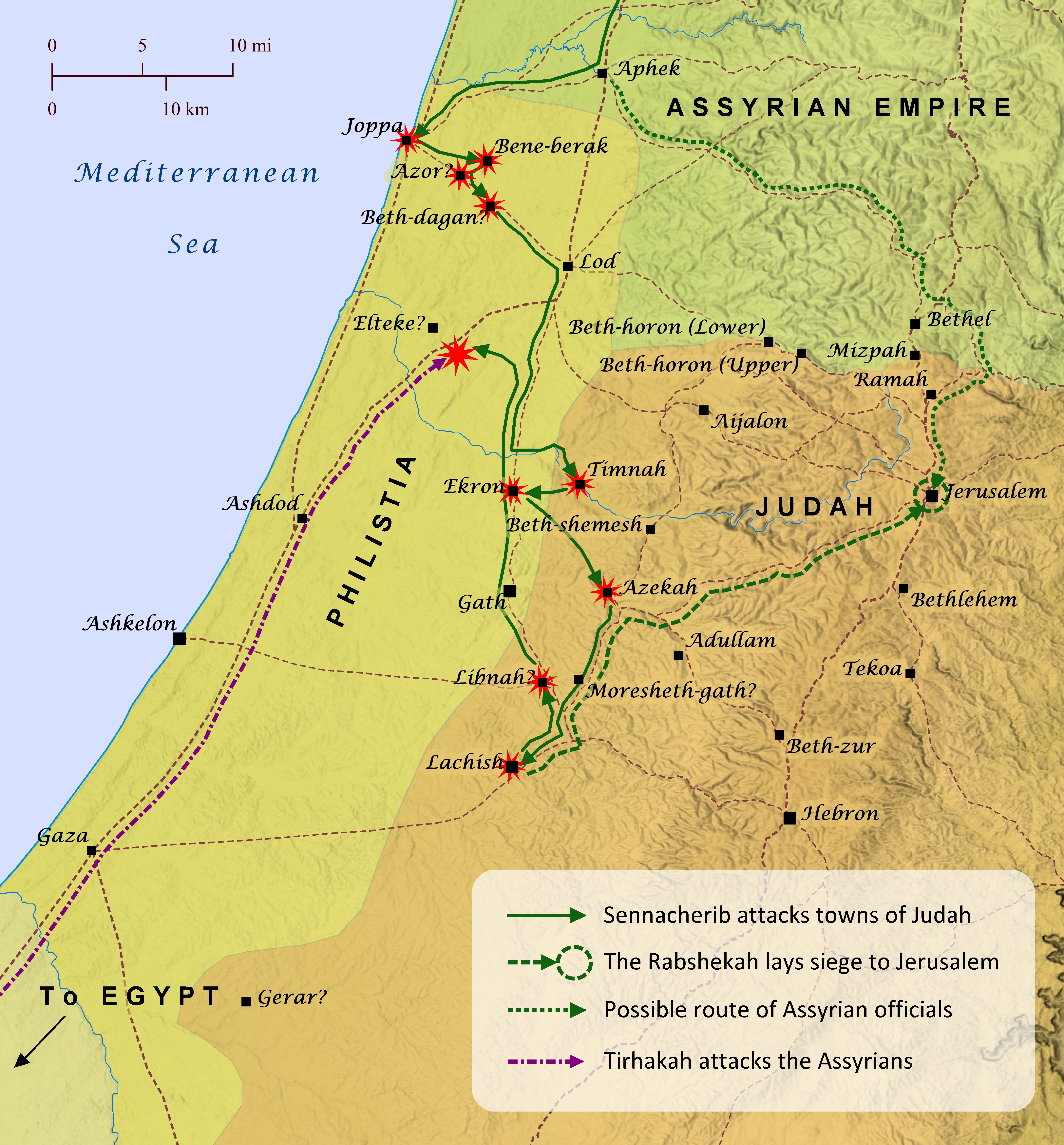
Isaiah 36-37; 2 Kings 18-19; 2 Chronicles 32
The harrowing experience of the attack on Judah by King Sennacherib of Assyria during Hezekiah’s reign is recorded by three different writers of Scripture and even by Sennacherib himself. Many scholars also suspect that this event formed the basis for Herodotus’s story regarding an army of mice eating the bow strings of the Assyrian army during their campaign against the Egyptians (Histories, 2.141). The origins of this event stretch back into the reign of Hezekiah’s father Ahaz, who enticed the Assyrians to attack Israel and Aram in exchange for making Judah a vassal of Assyria (2 Kings 16-17; 2 Chronicles 28; Isaiah 7-8; also see “The Final Days of the Northern Kingdom of Israel” map). Judah continued to be a vassal of Assyria through the early part of Hezekiah’s reign, but Hezekiah also quietly made extensive preparations to throw off the yoke of Assyria one day (2 Kings 18:1-12; 1 Chronicles 4:39-43; 2 Chronicles 29-31; also see “Hezekiah Strengthens Judah” map). Hezekiah also appears to have been hoping for support from Babylon and Egypt regarding his efforts to revolt against Assyria’s rule, but the prophet Isaiah warned Judah against placing their hopes in these foreign powers (Isaiah 30:1-5; 31:1-3; 39:1-8; 40:10-15; 2 Kings 20:12-19). After a few years spent quashing rebellion among the Babylonians, the Kassites, and the Medes in the east, Sennacherib turned his sights westward and began a campaign to subdue the various vassal nations that were refusing to submit to Assyria’s rule any longer. He first reconquered the Phoenician cities of Sidon and Tyre and then moved south to Philistia. He subdued Joppa, Beth-dagon, Bene-berak, and Azor and then moved to capture the cities of the Shephelah, which guarded the entrances to the valleys leading into the central hill country of Judah. While Sennacherib was attacking Lachish he sent his officers to demand Hezekiah’s surrender. This may be the Assyrian advance upon Jerusalem from the north described in Isaiah 10:28-32, but this is not certain (see “Assyria Advances on Jerusalem” map). Hezekiah sent officers back to Sennacherib with gold and silver taken from Temple and the royal treasury, but he would not surrender. The officers then traveled to Libnah to meet with Sennacherib, for he gone to fight there by that time. In the meantime King Tirhakah of Cush, who was ruling over Egypt at this time, came to attack Sennacherib, so Sennacherib sent his officials back to Hezekiah with a message that Jerusalem would be taken if he resisted. Hezekiah laid the letter from the officials before the Lord and prayed, and the Lord sent word through the prophet Isaiah that Jerusalem would not be taken. Then that very night the angel of the Lord killed 185,000 Assyrian soldiers (probably those with Sennacherib fighting the Egyptians), and Sennacherib went back to Assyria. There while he was worshiping in the temple of Nisroch, Sennacherib’s sons killed him and fled to Ararat (see “Ararat” map).
Open Bible Data site copyright © 2023–2026 Freely-Given.org.
Python source code for creating these static pages is available on GitHub under an open licence.
For Bible data copyrights, see the details for each displayed Bible version.
The Open English Translation (OET) main site is at OpenEnglishTranslation.Bible or OET.Bible.