
OET OET-RV OET-LV GHT ULT UST BSB MSB BLB AICNT OEB WEBBE WMBB NET LSV FBV TCNT T4T LEB BBE Moff JPS Wymth ASV DRA YLT Drby RV SLT Wbstr KJB-1769 KJB-1611 Bshps Gnva Cvdl TNT Wycl SR-GNT UHB BrLXX BrTr Related Parallel Simple Interlinear Topics Reference Dictionary Search
ParallelVerse GEN EXO LEV NUM DEU JOB JOS JDG RUTH 1 SAM 2 SAM PSA AMOS HOS 1 KI 2 KI 1 CHR 2 CHR PROV ECC SNG JOEL MIC ISA ZEP HAB JER LAM YNA (JNA) NAH OBA DAN EZE EZRA EST NEH HAG ZEC MAL LAO GES LES ESG DNG 2 PS TOB JDT WIS SIR BAR LJE PAZ SUS BEL MAN 1 MAC 2 MAC 3 MAC 4 MAC YHN (JHN) MARK MAT LUKE ACTs YAC (JAM) GAL 1 TH 2 TH 1 COR 2 COR ROM COL PHM EPH PHP 1 TIM TIT 1 PET 2 PET 2 TIM HEB YUD (JUD) 1 YHN (1 JHN) 2 YHN (2 JHN) 3 YHN (3 JHN) REV
Ruth 3 V1 V2 V3 V4 V5 V6 V7 V9 V10 V11 V12 V13 V14 V15 V16 V17 V18
Note: This view shows ‘verses’ which are not necessarily natural language units and hence sometimes only part of a sentence will be visible—click on any Bible version abbreviation down the left-hand side to see the verse in more of its context. Normally the OET discourages the reading of individual ‘verses’, but this view is only designed as a tool for Bible-translators and others doing comparisons of different translations—the older translations are further down the page (so you can read up from the bottom to trace the English translation history). The OET segments on this page are still early looks into the drafted texts of the Open English Translation of the Bible—please double-check these texts in advance before using in public.
Text critical issues=none Clarity of original=clear Importance to us=normal Speaker(s)=Narrator (All still tentative.)
OET (OET-RV) But Boaz was startled in the middle of the night, and when he turned over he was stunned to find a woman lying at his feet.
OET-LV And_he/it_was in_the_middle_of the_night and_he_trembled the_man and_he_twisted and_BEHOLD/LO/SEE a_woman was_lying_down feet_of_his.
UHB וַיְהִי֙ בַּחֲצִ֣י הַלַּ֔יְלָה וַיֶּחֱרַ֥ד הָאִ֖ישׁ וַיִּלָּפֵ֑ת וְהִנֵּ֣ה אִשָּׁ֔ה שֹׁכֶ֖בֶת מַרְגְּלֹתָֽיו׃ ‡
(vayəhī baḩₐʦiy hallaylāh vayyeḩₑrad hāʼiysh vayyillāfēt vəhinnēh ʼishshāh shokeⱱet margəlotāyv.)
Key: khaki:verbs.
Note: Automatic aligning of the OET-RV to the LV is done by some temporary software, hence the OET-RV alignments are incomplete (and may occasionally be wrong).
BrLXX Ἐγένετο δὲ ἐν τῷ μεσονυκτίῳ, καὶ ἐξέστη ὁ ἀνὴρ, καὶ ἐταράχθη, καὶ ἰδοὺ γυνὴ κοιμᾶται πρὸς ποδῶν αὐτοῦ.
(Egeneto de en tōi mesonuktiōi, kai exestaʸ ho anaʸr, kai etaraⱪthaʸ, kai idou gunaʸ koimatai pros podōn autou.)
BrTr And it came to pass at midnight that the man was amazed, and troubled, and behold, a woman lay at his feet.
ULT Then it happened in the middle of the night that the man was startled and turned over. And behold, a woman was lying at his feet!
UST In the middle of the night, he woke up suddenly. He sat up and was amazed to find a woman lying at his feet!
BSB & MSB At midnight, Boaz was startled, turned over, and there lying at his feet was a woman!
OEB At midnight the man was startled and turned over, and there was a woman lying at his feet!
WEBBE & WMBB At midnight, the man was startled and turned himself; and behold, a woman lay at his feet.
NET In the middle of the night he was startled and turned over. Now he saw a woman lying beside him!
LSV And it comes to pass, at the middle of the night, that the man trembles, and turns himself, and behold, a woman is lying at his feet.
FBV Around midnight Boaz suddenly woke up. Bending forward he was surprised to see a woman lying at his feet.
T4T In the middle of the night, he suddenly awoke. He sat up and saw that a woman was lying at his feet.
LEB And it happened in the middle of the night the man was startled and he reached out and behold, a woman was lying at his feet.
BBE Now in the middle of the night, the man awaking from his sleep in fear, and lifting himself up, saw a woman stretched at his feet.
Moff No Moff RUT 3:8 book available
JPS And it came to pass at midnight, that the man was startled, and turned himself; and, behold, a woman lay at his feet.
ASV And it came to pass at midnight, that the man was afraid, and turned himself; and, behold, a woman lay at his feet.
DRA And behold, when it was now midnight the man was afraid, and troubled: and he saw a woman lying at his feet,
YLT And it cometh to pass, at the middle of the night, that the man trembleth, and turneth himself, and lo, a woman is lying at his feet.
Drby And it came to pass at midnight, that the man was startled, and turned himself; and behold, a woman lay at his feet.
RV And it came to pass at midnight, that the man was afraid, and turned himself: and, behold, a woman lay at his feet.
SLT And it will be in the middle of the night, and the man will be terrified: and he will turn and behold a woman lying from his feet.
Wbstr And it came to pass at midnight, that the man was afraid, and turned himself: and behold, a woman lay at his feet.
KJB-1769 ¶ And it came to pass at midnight, that the man was afraid, and turned himself: and, behold, a woman lay at his feet.[fn]
3.8 turned: or, took hold on
KJB-1611 ¶ And it came to passe at midnight, that the man was afraid, and [fn]turned himselfe: and behold, a woman lay at his feete.
(Modernised spelling is same as from KJB-1769 above, apart from punctuation and footnotes)
3:8 Or, tooke holde on.
Bshps And at midnight, the man was afraide, and caught holde: and beholde, a woman lay at his feete.
(And at midnight, the man was afraid, and caught hold: and behold, a woman lay at his feet.)
Gnva And at midnight the man was afraide and caught holde: and loe, a woman lay at his feete.
(And at midnight the man was afraid and caught hold: and lo, a woman lay at his feet.)
Cvdl Now wha it was midnight, the man was afrayed, and groped aboute him, and beholde, a woman laye at his fete.
(Now when it was midnight, the man was afraid, and groped about him, and behold, a woman lay at his feet.)
Wycl And lo! now at mydnyyt `the man dredde, and was troblid; and he siy a womman lyggynge at hise feet;
(And lo! now at midnight the man dreaded, and was troubled; and he saw a woman lying at his feet;)
Luth Da es nun Mitternacht ward, erschrak der Mann und erschütterte; und siehe, ein Weib lag zu seinen Füßen.
(So it now midnight was, frightened the/of_the man and shook; and see/look, a woman lag to/for his feet.)
ClVg Et ecce, nocte jam media expavit homo, et conturbatus est: viditque mulierem jacentem ad pedes suos,
(And ecce, at_night already middle was_frightened man, and troubled it_is: and_he_saw woman lying_down to feet his_own,)
Life for widows in ancient Israel was difficult, especially for those who had no grown sons, because women depended on men to protect and provide for them. This fourth section tells how Naomi wanted to find a new husband for Ruth so that she could have a better living situation. So, she instructed Ruth to go and meet Boaz secretly at night. Ruth followed Naomi’s plan and asked him to take her into his care as his wife. She told him that this was his duty as a relative of her dead husband.
Boaz was happy to do this, but there was a problem. There was another relative who was more closely related to Naomi and Ruth than he was. If that man did not want to marry Ruth, Boaz promised that he would marry her. When Ruth returned home and told Naomi what had happened, Naomi assured her that Boaz would work hard to take care of the situation that very day.
Here are some other examples of a heading for this section:
Naomi’s Plan for Ruth’s Marriage (GW)
Ruth and Boaz at the Threshing Floor (NIV)
Ruth asked Boaz to marry her
At midnight, Boaz was startled, turned over,
During the night he woke up suddenly, turned over, (GNT)
At about midnight, he suddenly woke up shivering.
In Hebrew, this sentence begins with a word that means “And it happened” or “And it was.” The conversation between Ruth and Boaz that begins in the next verse (3:9–15) is the main event or climax of this part of the book of Ruth. This word introduces the dramatic event that leads up to this climax.For an explanation of the use of this Hebrew word (wayəhî) to introduce an event that leads to the climax of a story, see Van der Merwe (page 332, section 44.5.1.i.b).
Here are some ways to begin this sentence:
Suddenly (LB)
Just then
Now it happened…that (NKJV)
The BSB and most English versions do not translate this word here. But you should consider how your language naturally leads up to the main event or climax of a story.
At midnight: This phrase refers to an approximate time around midnight. The Hebrew language and culture did not divide the night hours into exact units.
Here are some other ways to translate this phrase:
Around midnight (NLT)
In the middle of the night (NIV)
During the night (GNT)
Boaz was startled: The Hebrew phrase that the BSB translates as Boaz was startled is literally “the man trembled.” The verb that means “tremble” usually refers to shaking from fear. The text does not say what made Boaz “tremble,” but the most likely reason was the cold air on his feet. And this is exactly what Naomi had planned.
Here are some other ways to translate this clause:
he woke up suddenly (GNT)
the man was shivering (GW)
the man was startled (ESV)
Boaz suddenly woke up (NLT96)
If the options in your language for translating “trembled” force you to be specific about why Boaz trembled, it should be from the cold rather than from fear.
Boaz: As in 3:3c, you may translate this phrase literally as “the man,” use the pronoun “he,” or refer to Boaz by name.
turned over: The word which the BSB translates as turned over is rare in the OT, so scholars are not sure what it means. There are four ways to interpret this word:
It means he turned or rolled over. For example:
and turned over (ESV)
and he rolled over (NCV) (BSB, ESV, GNT, GW, KJV, NCV, NET, NIV, NLT, NRSV, REB)
It means he groped around (for his covers). For example:
groped about (NABRE)
reached out (NABRE)Interpretation (2) is also supported by LEB and Block (page 179).
It means he looked all around. For example:
looked about him (NJB) (NJB)
It means he sat up or bent forward. For example:
bent forward (NASB) (NASB)
It is recommended that you follow interpretation (1) along with most versions.
and there lying at his feet was a woman!
and discovered a woman lying at his feet. (NIV)
and was surprised to find a woman lying at his feet. (GNT)
and there lying at his feet was a woman!: The author of Ruth used dramatic language in this clause to help the reader to experience how surprising it was for Boaz to find a woman lying at his feet. In Hebrew, this clause begins with a phrase that means “and behold.” The BSB does not use words to translate this phrase, but the exclamation mark (!) at the end of the sentence helps to match this dramatic and lively Hebrew expression.
Here are some other ways to translate this clause:
and Look! A woman lying at his feet!AYB7 (page 147).
and was shocked to see a woman lying at his feet (CEV)
He was surprised to find a woman lying at his feet! (NLT)
he discovered there was a woman lying at his feet (VOICE)
he saw a woman who was lying there at his feet (EASY)
Translate this clause in a way that will help your readers to understand how very surprised Boaz must have felt by what he found.
Note 1 topic: writing-background
וַיְהִי֙ בַּחֲצִ֣י הַלַּ֔יְלָה
and=he/it_was (Some words not found in UHB: and=he/it_was in,the_middle_of the=night and,he_trembled the=man and,he_twisted and=see/lo/see! woman/wife lying feet_of,his )
This clause gives information about when the next event in the story happened. Use a natural way in your language to give background information. Alternate translation: [Hours later, in the middle of the night,]
Note 2 topic: figures-of-speech / activepassive
וַיֶּחֱרַ֥ד הָאִ֖ישׁ
(Some words not found in UHB: and=he/it_was in,the_middle_of the=night and,he_trembled the=man and,he_twisted and=see/lo/see! woman/wife lying feet_of,his )
If your language does not use this passive form, you could express the idea in active form or in another way that is natural in your language. It is not clear what startled Boaz. Perhaps he suddenly felt the cold air on his feet or legs. Alternate translation: [the man startled]
Note 3 topic: figures-of-speech / exclamations
וְהִנֵּ֣ה
(Some words not found in UHB: and=he/it_was in,the_middle_of the=night and,he_trembled the=man and,he_twisted and=see/lo/see! woman/wife lying feet_of,his )
Here the word behold shows that what follows was very surprising to Boaz. Use your language’s way of expressing surprise. Alternate translation: [And much to his surprise]
Ruth 1-4
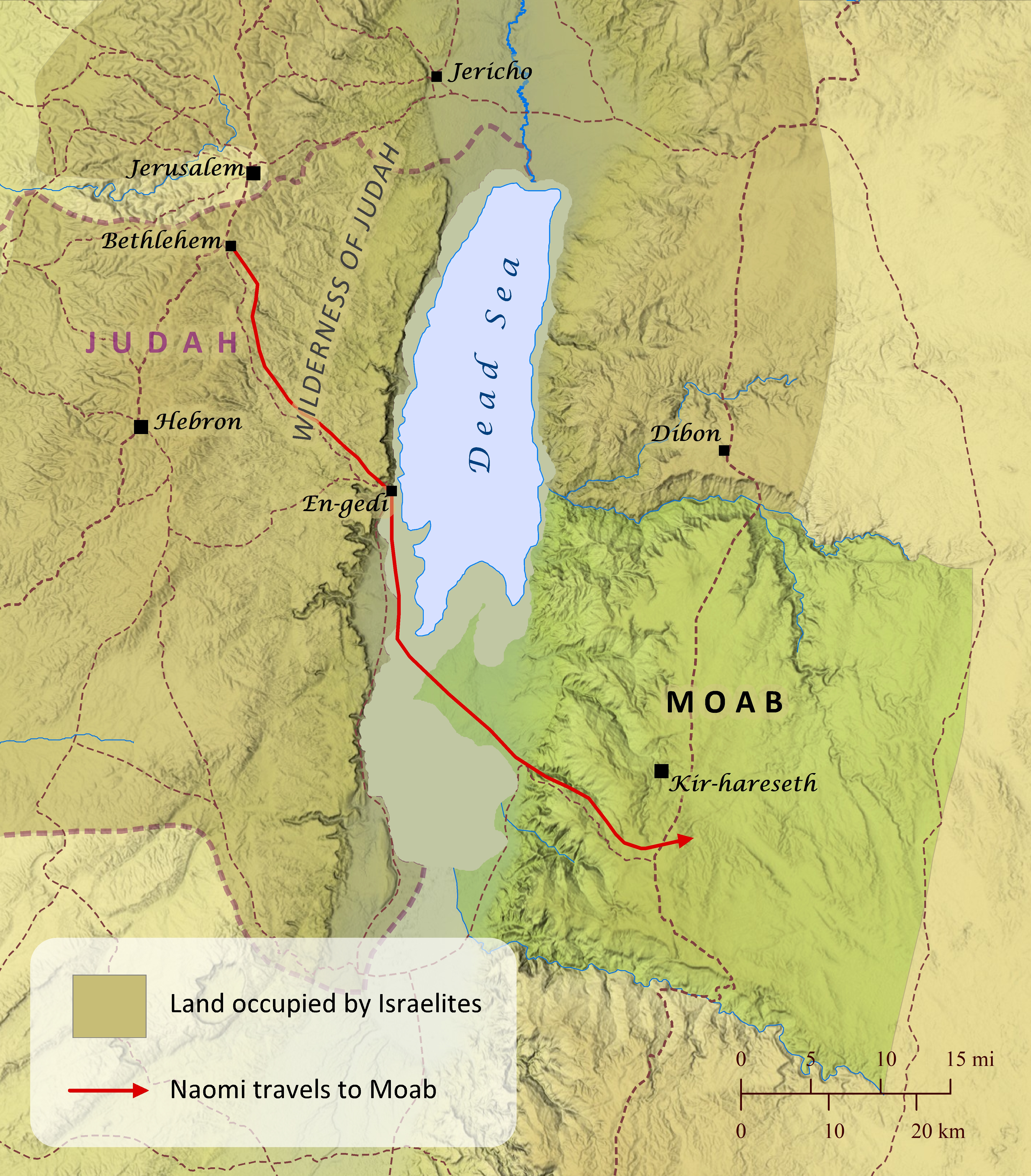
The story of Ruth is set in the time of the Judges, a few generations before the birth of King David. While much animosity often existed between Israel and Moab (Judges 3:12-30; 10:6-12:7; 2 Samuel 8:2; 10; 2 Kings 3:4-27; 2 Chronicles 20; see also Nations across the Jordan River map), other times the two nations appear to have enjoyed a somewhat congenial relationship, as is demonstrated by Naomi’s willingness to relocate to Moab to seek relief from a famine. Later Naomi’s sons also marry Moabite women, and Ruth’s devotion to Naomi and her God no doubt speaks highly of the character of many Moabites. Many years later Ruth’s great-grandson David placed his parents in the care of the king of Moab while he was on the run from King Saul (1 Samuel 22:3-4).
Open Bible Data site copyright © 2023–2026 Freely-Given.org.
Python source code for creating these static pages is available on GitHub under an open licence.
For Bible data copyrights, see the details for each displayed Bible version.
The Open English Translation (OET) main site is at OpenEnglishTranslation.Bible or OET.Bible.