Open Bible Data Home About News OET Key
OET OET-RV OET-LV ULT UST BSB MSB BLB AICNT OEB WEBBE WMBB NET LSV FBV TCNT T4T LEB BBE Moff JPS Wymth ASV DRA YLT Drby RV SLT Wbstr KJB-1769 KJB-1611 Bshps Gnva Cvdl TNT Wycl SR-GNT UHB BrLXX BrTr Related Topics Parallel Interlinear Reference Dictionary Search
ParallelVerse GEN EXO LEV NUM DEU JOB JOS JDG RUTH 1 SAM 2 SAM PSA AMOS HOS 1 KI 2 KI 1 CHR 2 CHR PROV ECC SNG JOEL MIC ISA ZEP HAB JER LAM YNA (JNA) NAH OBA DAN EZE EZRA EST NEH HAG ZEC MAL LAO GES LES ESG DNG 2 PS TOB JDT WIS SIR BAR LJE PAZ SUS BEL MAN 1 MAC 2 MAC 3 MAC 4 MAC YHN (JHN) MARK MAT LUKE ACTs YAC (JAM) GAL 1 TH 2 TH 1 COR 2 COR ROM COL PHM EPH PHP 1 TIM TIT 1 PET 2 PET 2 TIM HEB YUD (JUD) 1 YHN (1 JHN) 2 YHN (2 JHN) 3 YHN (3 JHN) REV
Ruth 4 V1 V2 V3 V4 V5 V6 V7 V8 V9 V10 V12 V13 V14 V15 V16 V17 V18 V19 V20 V21 V22
Note: This view shows ‘verses’ which are not natural language units and hence sometimes only part of a sentence will be visible—click on any Bible version abbreviation down the left-hand side to see the verse in more of its context. Normally the OET discourages the reading of individual ‘verses’, but this view is only designed as a tool for doing comparisons of different translations—the older translations are further down the page (so you can read up from the bottom to trace the English translation history). The OET segments on this page are still very early looks into the unfinished texts of the Open English Translation of the Bible—please double-check these texts in advance before using in public.
Text critical issues=small word differences Clarity of original=clear Importance to us=normal (All still tentative.)
OET (OET-RV) All the respected men, and the others who were sitting at the town gate, agreed, and they said, “Yes, we are your. We pray that Yahweh will allow this woman who will be coming into your home, to be like Rachel and Leah, the two who gave birth to our ancestors and started our people, Yisrael.[ref] May you become great in the clan of Efratah and famous here in Beyt-Lehem!
OET-LV And_ all_of _they_said the_people which was_at_gate and_the_elders we_are_witnesses YHWH may_he_make DOM the_woman who_is_about_to_come into house_of_your like_Rāḩēl and_like_Lēʼāh who they_built the_two_of_of_them DOM the_house_of Yisrāʼēl/(Israel) and_make wealth in_ʼEfrātāh and_proclaim a_name in_house_of leḩem.

UHB וַיֹּ֨אמְר֜וּ כָּל־הָעָ֧ם אֲשֶׁר־בַּשַּׁ֛עַר וְהַזְּקֵנִ֖ים עֵדִ֑ים יִתֵּן֩ יְהוָ֨ה אֶֽת־הָאִשָּׁ֜ה הַבָּאָ֣ה אֶל־בֵּיתֶ֗ךָ כְּרָחֵ֤ל ׀ וּכְלֵאָה֙ אֲשֶׁ֨ר בָּנ֤וּ שְׁתֵּיהֶם֙ אֶת־בֵּ֣ית יִשְׂרָאֵ֔ל וַעֲשֵׂה־חַ֣יִל בְּאֶפְרָ֔תָה וּקְרָא־שֵׁ֖ם בְּבֵ֥ית לָֽחֶם׃ ‡
(vayyoʼmərū kāl-hāˊām ʼₐsher-bashshaˊar vəhazzəqēnim ˊēdim yittēn yhwh ʼet-hāʼishshāh habāʼāh ʼel-bēytekā kərāḩēl ūkəlēʼāh ʼₐsher bānū shəttēyhem ʼet-bēyt yisrāʼēl vaˊₐsēh-ḩayil bəʼefrātāh ūqərāʼ-shēm bəⱱēyt lāḩem.)
Key: khaki:verbs, green:YHWH.
Note: Automatic aligning of the OET-RV to the LV is done by some temporary software, hence the OET-RV alignments are incomplete (and may occasionally be wrong).
BrLXX Καὶ εἴποσαν πᾶς ὁ λαὸς οἱ ἐν τῇ πύλῃ, μάρτυρες· καὶ οἱ πρεσβύτεροι εἴποσαν, δῴη Κύριος τὴν γυναῖκά σου, τὴν εἰσπορευομένην εἰς τὸν οἶκόν σου, ὡς Ῥαχὴλ καὶ ὡς Λίαν, αἳ ᾠκοδόμησαν ἀμφότεραι τὸν οἶκον τοῦ Ἰσραὴλ, καὶ ἐποίησαν δύναμιν ἐν Ἐφραθᾷ, καὶ ἔσται ὄνομα ἐν Βηθλεέμ.
(Kai eiposan pas ho laos hoi en taʸ pulaʸ, martures; kai hoi presbuteroi eiposan, dōaʸ Kurios taʸn gunaika sou, taʸn eisporeuomenaʸn eis ton oikon sou, hōs Ɽaⱪaʸl kai hōs Lian, hai ōkodomaʸsan amfoterai ton oikon tou Israaʸl, kai epoiaʸsan dunamin en Efratha, kai estai onoma en Baʸthleʼem. )
BrTr And all the people who were in the gate said, We are witnesses: and the elders said, The Lord make thy wife who goes into thy house, as Rachel and as Lia, who both together built the house of Israel, and wrought mightily in Ephratha, and there shall be a name to thee in Bethleem.
ULT And all the people who were in the gate and the elders said, “We are witnesses! May Yahweh make this woman who is coming into your house like Rachel and Leah, the two who built up the house of Israel. Prosper in Ephrathah and be renowned in Bethlehem!
UST All the respected men, and the others who were sitting at the town gate, agreed, and they said, “Yes, we have seen and heard. We pray that Yahweh will allow this woman, who will be coming into your home, to be like Rachel and Leah, the two who bore our ancestors and started our people, Israel. May you become great in the clan of Ephrathah and famous here in Bethlehem!
BSB “We are witnesses,” said the elders and all the people at the gate. “May the LORD make the woman entering your home like Rachel and Leah, who together built up the house of Israel. May you be prosperous in Ephrathah and famous in Bethlehem.
MSB (Same as BSB above)
OEB Then all the people who were at the gate and the elders said, ‘We are witnesses. May the Lord make the woman who is coming into your house like Rachel and Leah, who together built the house of Israel. May you do well in Ephrata, and become famous in Bethlehem.
WEBBE All the people who were in the gate, and the elders, said, “We are witnesses. May the LORD make the woman who has come into your house like Rachel and like Leah, which both built the house of Israel; and treat you worthily in Ephrathah, and be famous in Bethlehem.
WMBB (Same as above)
NET All the people who were at the gate and the elders replied, “We are witnesses. May the Lord make the woman who is entering your home like Rachel and Leah, both of whom built up the house of Israel! May you prosper in Ephrathah and become famous in Bethlehem.
LSV And all the people who [are] in the gate say—also the elderly, “Witnesses! YHWH makes the woman who is coming to your house as Rachel and as Leah, both of whom built the house of Israel; and you do virtuously in Ephrathah, and proclaim the name in Beth-Lehem;
FBV The elders and all the people present at the town gate said, “Yes, we are witnesses. May the Lord make the woman who is coming to your house like Rachel and Leah who between them gave birth to the people of Israel. May you become prosperous in Ephrathah, and famous in Bethlehem.
T4T All the elders and the others who were sitting at the town gate agreed, and one of them said, “Yes, we are witnesses. We hope/desire that Yahweh will enable this woman, who will be coming into your home, to give birth to many children, as Rachel and Leah did. They are the women from whom all us people [MTY] of Israel are descended. We hope that you will become rich in the clan of Ephratah, and become famous [MTY] here in Bethlehem.
LEB And all of the people who were at the gate and the elders said, “We are witnesses. May Yahweh make the woman coming into your house as Rachel and as Leah, who ⌊together⌋[fn] built the house of Israel. May you have strength in Ephrathah and bestow a name in Bethlehem.
4:11 Literally “the two of them”
BBE And all the people who were in the public place, and the responsible men, said, We are witnesses. May the Lord make this woman, who is about to come into your house, like Rachel and Leah, which two were the builders of the house of Israel: and may you have wealth in Ephrathah, and be great in Beth-lehem;
Moff No Moff RUTH book available
JPS And all the people that were in the gate, and the elders, said: 'We are witnesses. The LORD make the woman that is come into thy house like Rachel and like Leah, which two did build the house of Israel; and do thou worthily in Ephrath, and be famous in Beth-lehem;
ASV And all the people that were in the gate, and the elders, said, We are witnesses. Jehovah make the woman that is come into thy house like Rachel and like Leah, which two did build the house of Israel: and do thou worthily in Ephrathah, and be famous in Beth-lehem:
DRA Then all the people that were in the gate, and the ancients answered: We are witnesses: The Lord make this woman who cometh into thy house, like Rachel, and Lia, who built up the house of Israel: that she may be an example of virtue in Ephrata, and may have a famous name in Bethlehem:
YLT And all the people who [are] in the gate say — also the elders — 'Witnesses! Jehovah make the woman who is coming in unto thy house as Rachel and as Leah, both of whom built the house of Israel; and do thou virtuously in Ephrathah, and proclaim the Name in Beth-Lehem;
Drby And all the people that were in the gate and the elders said, [We are] witnesses. Jehovah make the woman that cometh into thy house like Rachel and like Leah, which two did build the house of Israel; and acquire power in Ephratah, and make thyself a name in Bethlehem;
RV And all the people that were in the gate, and the elders, said, We are witnesses. The LORD make the woman that is come into thine house like Rachel and like Leah, which two did build the house of Israel: and do thou worthily in Ephrathah, and be famous in Beth-lehem:
(And all the people that were in the gate, and the elders, said, We are witnesses. The LORD make the woman that is come into thine/your house like Rachel and like Leah, which two did build the house of Israel: and do thou/you worthily in Ephrathah, and be famous in Beth-lehem: )
SLT And all the people which are in the gate will say, and the old men, Witnesses. Jehovah will give the woman coming into thy house as Rachel and as Leah, which they two built up the house of Israel: and make thou power in Ephratah, and call a name in the house of bread.
Wbstr And all the people that were in the gate, and the elders said, We are witnesses. The LORD make the woman that hath come into thy house like Rachel and like Leah, which two did build the house of Israel: and do thou worthily in Ephratah, and be famous in Beth-lehem:
KJB-1769 And all the people that were in the gate, and the elders, said, We are witnesses. The LORD make the woman that is come into thine house like Rachel and like Leah, which two did build the house of Israel: and do thou worthily in Ephratah, and be famous in Beth-lehem:[fn][fn]
(And all the people that were in the gate, and the elders, said, We are witnesses. The LORD make the woman that is come into thine/your house like Rachel and like Leah, which two did build the house of Israel: and do thou/you worthily in Ephratah, and be famous in Beth-lehem: )
KJB-1611 And all the people that were in the gate, and the Elders said, Wee are witnesses: The LORD make the woman that is come into thine house, like Rachel and like Leah, which two did build the house of Israel: and [fn]do thou worthily in Ephratah, and [fn]bee famous in Bethlehem.
(Modernised spelling is same as from KJB-1769 above, apart from marking of added words (and possibly capitalisation and punctuation and footnotes))
Bshps And all the people that were in the gate, and the elders, sayde, We are witnesses: The Lord make the woma that is come into thyne house, lyke Rahel and Lea, whiche twayne dyd buylde the house of Israel: & that thou mayest do worthyly in Ephrata, and be famous in Bethlehem.
(And all the people that were in the gate, and the elders, said, We are witnesses: The Lord make the woma that is come into thine/your house, like Rahel and Lea, which twayne did build the house of Israel: and that thou/you mayest/may do worthyly in Ephrata, and be famous in Bethlehem.)
Gnva And all the people that were in the gate, and the Elders sayd, We are witnesses: the Lord make the wife that commeth into thine house, like Rahel and like Leah, which twaine did build the house of Israel: and that thou mayest doe worthily in Ephrathah, and be famous in Beth-lehem,
(And all the people that were in the gate, and the Elders said, We are witnesses: the Lord make the wife that cometh/comes into thine/your house, like Rahel and like Leah, which twain/two_or_both did build the house of Israel: and that thou/you mayest/may do worthily in Ephrathah, and be famous in Beth-lehem, )
Cvdl And all the people that was in the gate with the Elders, saide: We are witnesses. The LORDE make the woman that commeth in to thy house, as Rachel and Lea ( which both haue buylded vp the house of Israel) that she maye be an ensample of vertue in Ephrata, and haue an honorable name in Bethleem.
(And all the people that was in the gate with the Elders, said: We are witnesses. The LORD make the woman that cometh/comes in to thy/your house, as Rachel and Lea ( which both have built up the house of Israel) that she may be an ensample/example of virtue in Ephrata, and have an honourable name in Beth-lehem.)
Wycl Al the puple, that was in the yate, answeride, and the grettere men in birthe answeriden, We ben witnessis; the Lord make this womman, that entrith in to thin hows, as Rachel and Lia, that bildiden the hows of Israel, that sche be ensaumple of vertu in Effrata, and haue a solempne name in Bethleem;
(All the people, that was in the gate, answered, and the greater men in birth answered, We been witnesses; the Lord make this woman, that entereth/enters in to thin house, as Rachel and Lia, that built the house of Israel, that she be ensample/example of virtue in Effrata, and have a solemn name in Beth-lehem;)
Luth Und alles Volk, das im Tor war, samt den Ältesten sprachen: Wir sind Zeugen. Der HErr mache das Weib, das in dein Haus kommt, wie Rahel und Lea, die beide das Haus Israel gebauet haben; und wachse sehr in Ephratha und werde gepreiset zu Bethlehem!
(And all/everything people, the in_the doorway was, together_with the elders said: We are witnesses(n). The LORD make the woman, the in your(s) house comes, as/like Rahel and Lea, the both the house Israel built have; and grow very in Ephratha and become priced to/for Bethlehem!)
ClVg Respondit omnis populus, qui erat in porta, et majores natu: Nos testes sumus: faciat Dominus hanc mulierem, quæ ingreditur domum tuam, sicut Rachel et Liam, quæ ædificaverunt domum Israël: ut sit exemplum virtutis in Ephratha, et habeat celebre nomen in Bethlehem:[fn]
(Respondit everyone the_people, who/which was in/into/on gate/door, and elders natu: We testes we_are: let_him_do Master this woman, which enters house/home your(sg), like Rachel and Liam, which they_built house/home Israel: as be exemplum of_virtue in/into/on Ephratha, and have celebre name in/into/on Bethlehem: )
4.11 Et majores. ISID. Decem majorum natu benedictio ostendit in nomine Jesu omnes gentes esse benedicendas. Iota enim apud Græcos decem significat, quæ in nomine Jesu prima littera est. Faciat Dominus hanc. Imprecatur prospera Ecclesiæ gentium, ut gratiam fecunditatis, quam habuerunt Isrælitarum primi parentes, percipiat. Rachel. Spe internæ contemplationis habens internam intelligentiam veritatis. Unde, Rachel bona facie, et pulchra specie, quam amat omnis pie studiosus, et propter hanc servit Laban, qui interpretatur dealbatio, quam comparat gratiæ Dei qui dicit: Quod si fuerunt peccata vestra sicut Phœnicium, tanquam nix dealbabuntur Isa. 1.. Liam. Actio hujus vitæ in qua vivimus laboriosa est ex fide, et incerta, quo exitu perveniat ad utilitatem eorum quibus consulere volumus. Ipsa est Lia prior uxor Jacob, quæ infirmis oculis fuisse memoratur.
4.11 And elders. ISID. Ten major/greaterum born blessing he_showed in/into/on by_name Yesu everyone people/nations to_be benedicendas. Iota because at Greeks ten means, which in/into/on by_name Yesu the_first letter it_is. Faciat Master this. Imprecatur prosperous Assemblies/Churches nations, as grace fecunditatis, how they_had Israelitarum first parents, percipiat. Rachel. Spe internæ contemplation having internam intelligence to_the_truths. Unde, Rachel good(s) face, and beautiful in_appearance, how loves everyone pie studiosus, and because this serves Laban, who/which interprets bleaching, how compares thanks of_God who/which he_says: That when/but_if they_were sins your like Phœnicium, as_if nix dealbabuntur Isa. 1.. Liam. Actio of_this of_life in/into/on which we_live workiosa it_is from with_faith, and incerta, where exit arrive to benefit their to_whom consulere we_want. Itself it_is Lia prior wife Yacob, which infirmis eyes to_have_been memoratur.
4:11 Rachel and Leah, Jacob’s two wives, were the mothers of Israel.
• Ephrathah: See study note on 1:2.
In this final chapter of the book, Ruth received the reward for her loyalty to Naomi.
Boaz is in focus in the first twelve verses. He met with the other close relative in the presence of many witnesses to discuss the entire situation. The other relative did not want to buy Elimelech’s property that Naomi was selling, if the arrangement also meant that he had to marry Ruth. So Boaz said that he would act as the redeemer himself.
In section 4:13–17, Boaz and Ruth were married, and the LORD soon gave them a son. The women in Bethlehem named the son Obed and rejoiced that Naomi now had a “son” to carry on her family line and care for her in her old age. So both Naomi and Ruth were going to be cared for, and the women went from “emptiness” to “fullness.”
Section 4:18–22 concludes the book with a genealogy that lists of the family line of Perez, who was a son of Judah and grandson of Jacob (who is also called Israel). The family line is listed from Perez through Obed to King David.
Here are some other examples of section headings for 4:1–12:
Boaz Redeems Ruth (ESV)
Boaz Settles the Matter (NET)
Structure:
Some commentaries divide this section into four scenes:NICOT, Sakenfield, Cornerstone, and Sakenfield. These divide the scenes in at least two different ways.
4:1–2 Introduction: Boaz Convenes a Legal Assembly
4:3–8 Boaz Obtains the Rights of Redemption
4:9–10 Boaz Formalizes the Agreement
4:11–12 Witnessing and Blessing
One commentary divides this section into three scenes.Block (pages 203–204).
4:1–2 setting the stage for the legal drama
4:3–8 report of the legal drama
4:9–12 significance of legal drama
You may divide the paragraphs in these scenes in whatever way best fits the structure of your language.
This paragraph describes the blessing that was pronounced on Boaz, including wealth and a good reputation. It also describes the blessing that was given to Ruth that she would bear many children.
“We are witnesses,”
¶ “Yes, we are witnesses!”
¶ “We have seen this and we will testify to it.”
“We are witnesses,”: The repetition of “We/You are witnesses in 4:9b, 4:10d, and 4:11a highlights the role of the witnesses.Block (pages 221–223).
said the elders and all the people at the gate.
said the town leaders and all the people who were listening/observing in the gate area.
said the leading men of the town and the other people near the gate/meeting area.
said the elders and all the people at the gate: These people were the leading men of the town and the other people there at the town meeting place. See how you translated these two terms in 4:9a.
“May the LORD make the woman entering your home like Rachel and Leah,
May Yahweh cause this woman you are bringing into your home as your wife to bear children, just as he did for Rachel and Leah,
We pray that Yahweh will bless the woman who is becoming your wife. We pray that he will help her to have many children and descendants, as Rachel and Leah did.
May the LORD make the woman entering your home: This is a short prayer or blessing.
the woman: This refers to Ruth. You may refer to her by name if calling her the woman would be impolite or derogatory in your language.
Here are some other ways to translate this verse part:
May the Lord make your wife (GNT)
May the LORD cause your wife Ruth
entering your home: Here the people are speaking to Boaz. The pronoun translated “you” and your in 4:11c, 4:12a, and 4:12b are masculine singular in the Hebrew text.
Ruth was entering Boaz’s home, or into his “family” or “household,” as his wife. In some languages, it may be helpful to include this implied information. For example:
whom you are bringing into your home as your wife
like Rachel and Leah: These were the two wives of Jacob, a grandson of Abraham. If your readers do not know these names, you may want to give this information in a footnote. For example:
The people prayed that the LORD would bless Ruth by giving her children, who would themselves have many descendants. This is what the LORD had done for Rachel and Leah in Genesis chapters 29–30.
who together built up the house of Israel.
who together made the people of Israel strong and numerous.
The two of them had many children and descendants, who became the nation of Israel.
who together built up the house of Israel: The many sons of Rachel and Leah were the founders of the nation of Israel. Rachel and Leah and their two servant girls gave birth to twelve sons. The twelve sons each became the head of a tribe within the descendants of Israel.
Although Zilpah and Bilhah, the women servants of Rachel and Leah, gave birth to four of the sons, all the sons were officially considered to be the children of Rachel and Leah.
built up: This means that they made Israel strong and numerous by having many descendants.
the house of Israel: Jacob was also known as Israel. There are two ways to interpret it here:
It refers to the nation or people of Israel who had descended from Jacob. For example:
from whom all the nation of Israel descended (NLT)
both of whom built our family of Israel (GW) (GW, NCV, NJB, NJPS, NLT)
It refers to the children and descendants of Jacob himself. For example:
like Rachel and Leah, who bore many children to Jacob (GNT) (CEV, GNT)
The versions that translate the Hebrew literally as “the house/family of Israel” are ambiguous.
(BSB, ESV, KJV, NABRE, NASB, NET, NIV, NRSV, REB).
Only one commentary clearly supports interpretation (2). You may follow any of the interpretations in your language.
house: The Hebrew word that the BSB translates as house here refers a person’s descendants.
May you be prosperous in Ephrathah and famous in Bethlehem.
May you(sing) greatly prosper in Ephrathah. May you(sing) be well known in Bethlehem.
We pray that Yahweh will make you(sing) wealthy and famous in our town Ephrathah, that is, Bethlehem.
May you be prosperous in Ephrathah and famous in Bethlehem: Before the Notes discuss the interpretation of the blessings given here, it will be helpful to notice that this verse part has two parallel lines:
May you be prosperous in Ephrathah
and be famous in Bethlehem
in Ephrathah…in Bethlehem: Ephrathah is probably the name of a clan that lived in Bethlehem. This clan name was an old name for Bethlehem. Here it is a synonym for Bethlehem. In your translation, you may need to indicate that Bethlehem and Ephrathah are the same place.
There are four ways to interpret the Hebrew idiom that the BSB translates as “May you be prosperous”:
It refers to an increase in money and possessions. For example:
May you become rich… (GNT) (BSB, CEV, GNT, NABRE, NASB, NET, NJPS, NLT, RSV)
It refers to an increase in reputation and status. For example:
May you become powerful… (NCV) (NCV, NIV, NJB, NLT96)
It refers to good character. For example:
So show your strength of character… (GW) (ESV, GW, KJV, REB)
It refers to an increase in children. For example:
May you produce children (NRSV) (NRSV)Sakenfield (pages 76–78) says that the NRSV translation is overly influenced by the many references to bearing children, and that the phrase here has a much broader meaning. Cornerstone (page 575) supports this interpretation as “an affirmation of the stated intent of the new couple’s union,” which is fulfilled in the next verse.
It is recommended that you follow interpretation (1). The people prayed that as a result of his marriage, Boaz would prosper and grow rich. However, interpretation (2) is supported by the parallelism.UBS (pages 71–73), KD (page 359). EBC (page 1342) says that the union of Boaz and Ruth eventually gain fame for Bethlehem through the future King David and the Messiah. Interpretation (3) is supported by the Hebrew usage elsewhere.Schipper (pages 170–171) mentions “mighty man of worth” (2:1) and “woman of worth” (3:1).
and famous in Bethlehem: The Hebrew idiom that the BSB translates as famous is literally “call a name.” The people wanted Boaz to get a well-known name, or gain a good reputation, as a result of the many children and descendants they hoped he would have.
Note 1 topic: figures-of-speech / explicit
הָעָ֧ם אֲשֶׁר־בַּשַּׁ֛עַר
the,people which/who [was]_at,gate
The implication is that the people who were in the gate are the same people who heard and observed the meeting between Boaz and the man who had been first as kinsman-redeemer. You could include this information if that would be helpful to your readers. Alternate translation: [the people who had observed Boaz’s meeting with the first kinsman-redeemer]
Note 2 topic: figures-of-speech / metonymy
הַבָּאָ֣ה אֶל־בֵּיתֶ֗ךָ
[who,is]_about_to_come to/towards house_of,your
This has both a literal and a figurative meaning. As Ruth marries Boaz, she will move into his physical house. “House” can be a metonym that represents “family,” so this also refers to becoming part of Boaz’s family by being his wife. Alternate translation: [who is becoming part of your family]
Note 3 topic: translate-blessing
יִתֵּן֩ יְהוָ֨ה אֶֽת־הָאִשָּׁ֜ה הַבָּאָ֣ה אֶל־בֵּיתֶ֗ךָ כְּרָחֵ֤ל ׀ וּכְלֵאָה֙ אֲשֶׁ֨ר בָּנ֤וּ שְׁתֵּיהֶם֙ אֶת־בֵּ֣ית יִשְׂרָאֵ֔ל
he/it_gave YHWH DOM the=woman [who,is]_about_to_come to/towards house_of,your like,Rachel and,like,Leah which/who they_had_built the_two_of,of_them DOM house_of Yisrael
Here, the people are asking God to bless Ruth. Their blessing continues for Ruth and Boaz through verse 12. You could express this as either a blessing or a prayer, in whichever way is more natural in your language. Alternate translation: [We ask Yahweh to make this woman who is coming into your house like Rachel and Leah, the two who built up the house of Israel]
Note 4 topic: figures-of-speech / explicit
כְּרָחֵ֤ל ׀ וּכְלֵאָה֙ אֲשֶׁ֨ר בָּנ֤וּ שְׁתֵּיהֶם֙ אֶת־בֵּ֣ית יִשְׂרָאֵ֔ל
like,Rachel and,like,Leah which/who they_had_built the_two_of,of_them DOM house_of Yisrael
Rachel and Leah are the names of two women, the two wives of Jacob, whose name was changed to Israel. They are considered to be the female ancestors of the people of Israel. They had many children, so implied in this blessing is the request that God give Ruth many children. You could include this information if that would be helpful to your readers. Alternate translation: [like Rachel and Leah, who bore many children who then became the nation of Israel]
Note 5 topic: figures-of-speech / metaphor
בָּנ֤וּ & אֶת־בֵּ֣ית יִשְׂרָאֵ֔ל
they_had_built & DOM house_of Yisrael
Here the people are speaking of the nation of Israel as if it were a house. If it would be helpful in your language, you could state the meaning plainly. Alternate translation: [bore many children who then became the nation of Israel]
Note 6 topic: figures-of-speech / parallelism
וַעֲשֵׂה־חַ֣יִל בְּאֶפְרָ֔תָה וּקְרָא־שֵׁ֖ם בְּבֵ֥ית לָֽחֶם
and,make powerful in,Ephrathah and,proclaim name_of in=house_of -leḩem
These two phrases mean basically the same thing. The second emphasizes the meaning of the first by repeating the same idea with different words. The area around the town of Bethlehem was known as Ephrathah, and that became another name for the town. Presumably, this name came from the Israelite clan that settled in and around the city of Bethlehem. If it would be helpful to your readers, you could connect the phrases with a word other than and in order to show that the second phrase is repeating the first one, not saying something additional. Alternate translation: [May you prosper among your clan of Ephrathah, yes, may you be important in Bethlehem]
Note 7 topic: figures-of-speech / imperative
וַעֲשֵׂה־חַ֣יִל בְּאֶפְרָ֔תָה וּקְרָא־שֵׁ֖ם בְּבֵ֥ית לָֽחֶם
and,make powerful in,Ephrathah and,proclaim name_of in=house_of -leḩem
The verbs here are command forms, but they communicate the good desire of the people rather than commands. They serve to continue the blessing while shifting it from Ruth to Boaz. Use the style of blessing that is appropriate in your language. Alternate translation: [And you, Boaz, may you prosper among your clan of Ephrathah, yes, may you be important in Bethlehem]
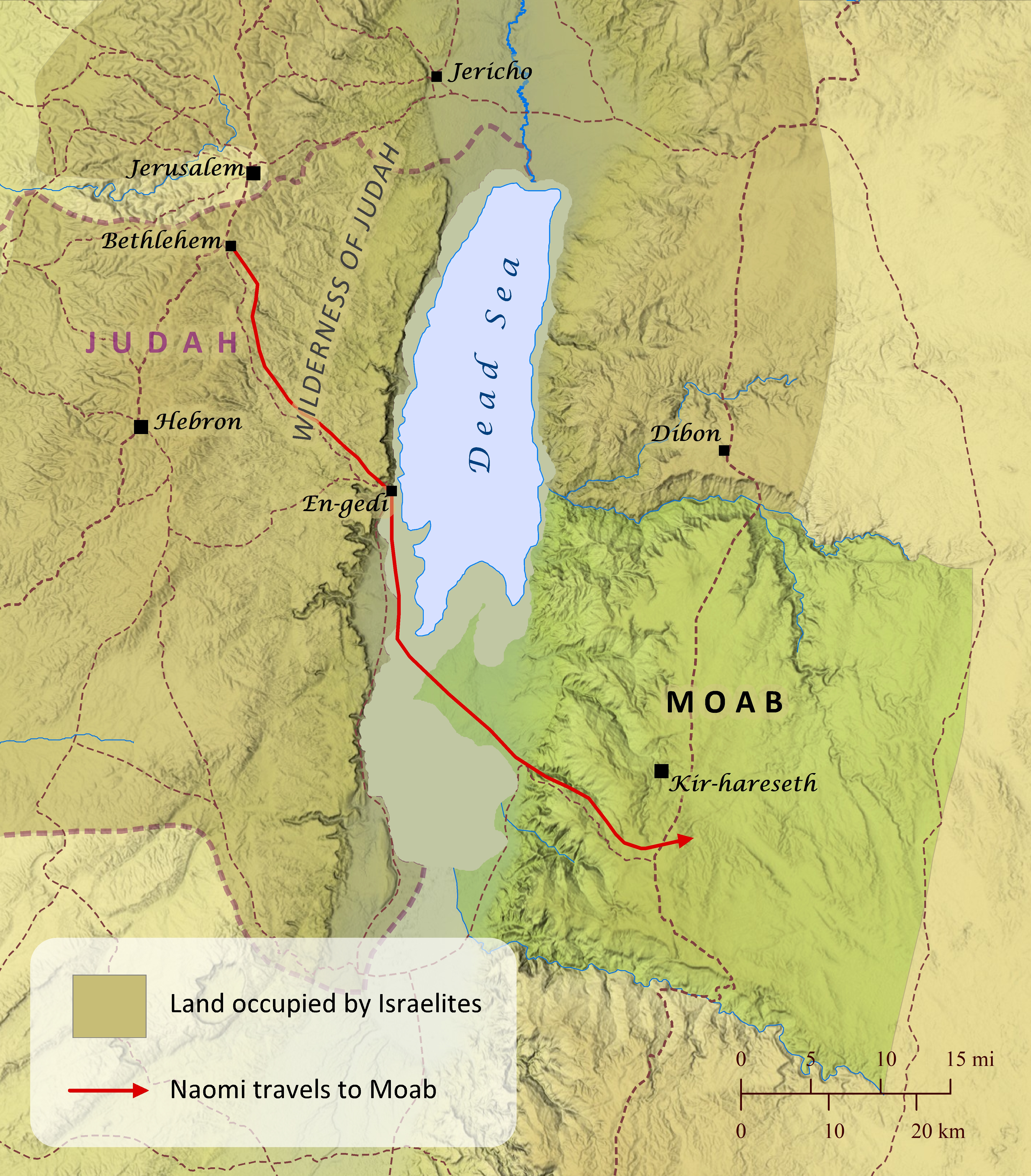
Ruth 1-4
The story of Ruth is set in the time of the Judges, a few generations before the birth of King David. While much animosity often existed between Israel and Moab (Judges 3:12-30; 10:6-12:7; 2 Samuel 8:2; 10; 2 Kings 3:4-27; 2 Chronicles 20; see also Nations across the Jordan River map), other times the two nations appear to have enjoyed a somewhat congenial relationship, as is demonstrated by Naomi’s willingness to relocate to Moab to seek relief from a famine. Later Naomi’s sons also marry Moabite women, and Ruth’s devotion to Naomi and her God no doubt speaks highly of the character of many Moabites. Many years later Ruth’s great-grandson David placed his parents in the care of the king of Moab while he was on the run from King Saul (1 Samuel 22:3-4).
Open Bible Data site copyright © 2023–2026 Freely-Given.org.
Python source code for creating these static pages is available on GitHub under an open licence.
For Bible data copyrights, see the details for each displayed Bible version.
The Open English Translation (OET) main site is at OpenEnglishTranslation.Bible or OET.Bible.