
OET OET-RV OET-LV GHT ULT UST BSB MSB BLB AICNT OEB WEBBE WMBB NET LSV FBV TCNT T4T LEB BBE Moff JPS Wymth ASV DRA YLT Drby RV SLT Wbstr KJB-1769 KJB-1611 Bshps Gnva Cvdl TNT Wycl SR-GNT UHB BrLXX BrTr Related Parallel Simple Interlinear Topics Reference Dictionary Search
ParallelVerse GEN EXO LEV NUM DEU JOB JOS JDG RUTH 1 SAM 2 SAM PSA AMOS HOS 1 KI 2 KI 1 CHR 2 CHR PROV ECC SNG JOEL MIC ISA ZEP HAB JER LAM YNA (JNA) NAH OBA DAN EZE EZRA EST NEH HAG ZEC MAL LAO GES LES ESG DNG 2 PS TOB JDT WIS SIR BAR LJE PAZ SUS BEL MAN 1 MAC 2 MAC 3 MAC 4 MAC YHN (JHN) MARK MAT LUKE ACTs YAC (JAM) GAL 1 TH 2 TH 1 COR 2 COR ROM COL PHM EPH PHP 1 TIM TIT 1 PET 2 PET 2 TIM HEB YUD (JUD) 1 YHN (1 JHN) 2 YHN (2 JHN) 3 YHN (3 JHN) REV
Neh Intro C1 C3 C4 C5 C6 C7 C8 C9 C10 C11 C12 C13
Neh 2 V1 V2 V3 V4 V5 V6 V7 V9 V10 V11 V12 V13 V14 V15 V16 V17 V18 V19 V20
Note: This view shows ‘verses’ which are not necessarily natural language units and hence sometimes only part of a sentence will be visible—click on any Bible version abbreviation down the left-hand side to see the verse in more of its context. Normally the OET discourages the reading of individual ‘verses’, but this view is only designed as a tool for Bible-translators and others doing comparisons of different translations—the older translations are further down the page (so you can read up from the bottom to trace the English translation history). The OET segments on this page are still early looks into the drafted texts of the Open English Translation of the Bible—please double-check these texts in advance before using in public.
Text critical issues=small word differences Clarity of original=clear Importance to us=normal Speaker(s)=Narrator (All still tentative.)
OET (OET-RV) Also a letter to Asaf, the keeper of the king’s forest, so he’ll give me timber for the beams of the gates of the fortress near the temple, and for the city wall, and for the house that I’ll live in.” Then the king granted those requests, thanks to God’s help on what I was doing.
OET-LV And_a_letter to ʼĀşāf the_one_who_kept_of the_forest which to/for_the_king that he_will_give to_me wood(s) to_make_beams_for DOM the_gates_of the_citadel which belongs_to_house and_for_the_wall_of the_city and_for_house which I_will_go to_him/it and_he_gave_them to_me the_king according_to_the_hand_of my_god_of_my (the)_good on_me.
UHB וְאִגֶּ֡רֶת אֶל־אָסָף֩ שֹׁמֵ֨ר הַפַּרְדֵּ֜ס אֲשֶׁ֣ר לַמֶּ֗לֶךְ אֲשֶׁ֣ר יִתֶּן־לִ֣י עֵצִ֡ים לְ֠קָרוֹת אֶת־שַׁעֲרֵ֨י הַבִּירָ֤ה אֲשֶׁר־לַבַּ֨יִת֙ וּלְחוֹמַ֣ת הָעִ֔יר וְלַבַּ֖יִת אֲשֶׁר־אָב֣וֹא אֵלָ֑יו וַיִּתֶּן־לִ֣י הַמֶּ֔לֶךְ כְּיַד־אֱלֹהַ֖י הַטּוֹבָ֥ה עָלָֽי׃ ‡
(vəʼiggeret ʼel-ʼāşāf shomēr hapardēş ʼₐsher lammelek ʼₐsher yitten-liy ˊēʦim ləqārōt ʼet-shaˊₐrēy habīrāh ʼₐsher-labayit ūləḩōmat hāˊir vəlabayit ʼₐsher-ʼāⱱōʼ ʼēlāyv vayyitten-liy hammelek kəyad-ʼₑlohay haţţōⱱāh ˊālāy.)
Key: khaki:verbs.
Note: Automatic aligning of the OET-RV to the LV is done by some temporary software, hence the OET-RV alignments are incomplete (and may occasionally be wrong).
BrLXX (EZR 12:8) καὶ ἐπιστολὴν ἐπὶ Ἀσὰφ φύλακα τοῦ παραδείσου ὅς ἐστι τῷ βασιλεῖ, ὥστε δοῦναί μοι ξύλα στεγάσαι τὰς πύλας, καὶ εἰς τὸ τεῖχος τῆς πόλεως, καὶ εἰς οἶκον ὃν εἰσελεύσομαι εἰς αὐτόν· καὶ ἔδωκέ μοι ὁ βασιλεὺς ὡς χεὶρ Θεοῦ ἡ ἀγαθή.
(kai epistolaʸn epi Asaf fulaka tou paradeisou hos esti tōi basilei, hōste dounai moi xula stegasai tas pulas, kai eis to teiⱪos taʸs poleōs, kai eis oikon hon eiseleusomai eis auton; kai edōke moi ho basileus hōs ⱪeir Theou haʸ agathaʸ.)
BrTr and a letter to Asaph the keeper of the garden which belongs to the king, that he may give me timber to cover the gates, and for the wall of the city, and for the house into which I shall enter. And the king gave to me, according as the good hand of God was upon me.
ULT and a letter to Asaph, the keeper of the forest that belongs to the king, that he will give to me timbers to lay the beams of the gates of the citadel, which is for the house, and for the wall of the city, and for the house into which I will enter.”
¶ And the king gave to me, according to the good hand of my God upon me.
UST Please also write a letter for me to Asaph, the man who takes care of your royal forest in that area. Please tell him to give me timber to make the beams to support the gates of the fortress that is near the temple. Please also tell him to give me timber for the city wall and for the house that I will live in.”
¶ God was with me and helping me, and so the king agreed to all of my requests.
BSB & MSB And may I have a letter to Asaph, keeper of the king’s forest, so that he will give me timber to make beams for the gates of the citadel to the temple, for the city wall, and for the house I will occupy.”
§ And because the gracious hand of my God was upon me, the king granted my requests.
OEB No OEB NEH 2:8 book available
WEBBE & WMBB and a letter to Asaph the keeper of the king’s forest, that he may give me timber to make beams for the gates of the citadel by the temple, for the wall of the city, and for the house that I will occupy.”
¶ The king granted my requests, because of the good hand of my God on me.
NET and a letter for Asaph the keeper of the king’s nature preserve, so that he will give me timber for beams for the gates of the fortress adjacent to the temple and for the city wall and for the house to which I go.” So the king granted me these requests, for the good hand of my God was on me.
LSV and a letter to Asaph, keeper of the paradise that the king has, that he give to me trees for beams [for] the gates of the palace that the house has, and for the wall of the city, and for the house into which I enter”; and the king gives to me, according to the good hand of my God on me.
FBV May I also have a letter for Asaph, warden of the king's forest, so he can give me timber to make beams for the gates of Temple fortress, for the city walls, and for the house I will live in.” Because my gracious God was upon me, the king gave me what I asked.
T4T Also, please write a letter to Asaph, the man who takes care of your forest in that area, telling him to give me timber to make the beams to support the gates of the fortress that is near the temple, and timber for making the walls of the city, and for building the house in which I will live.” The king did what I requested him to do, because my God was graciously/kindly ◄helping/acting for► me.
LEB Also, a letter to Asaph, keeper of the king’s land reserve, that he should give me timber for laying the beams for the gates of the citadel of the house and for the walls of the city, and for the house which I will enter.” And the king gave permission to me, according to the good hand of God on me.
BBE And a letter to Asaph, the keeper of the king's park, so that he may give me wood to make boards for the doors of the tower of the house, and for the wall of the town, and for the house which is to be mine. And the king gave me this, for the hand of my God was on me.
Moff and a letter for Asaph the keeper of the king’s park, ordering him to give me timber to make beams for the gates of the castle belonging to the temple and for the wall of the city and for the house in which I shall reside.” This the king granted me, thanks to the kind favour of my God.
JPS and a letter unto Asaph the keeper of the king's park, that he may give me timber to make beams for the gates of the castle which appertaineth to the house, and for the wall of the city, and for the house that I shall enter into.' And the king granted me, according to the good hand of my God upon me.
ASV and a letter unto Asaph the keeper of the king’s forest, that he may give me timber to make beams for the gates of the castle which appertaineth to the house, and for the wall of the city, and for the house that I shall enter into. And the king granted me, according to the good hand of my God upon me.
DRA And a letter to Asaph the keeper of the king’s forest, to give me timber that I may cover the gates of the tower of the house, and the walls of the city, and the house that I shall enter into. And the king gave me according to the good hand of my God with me.
YLT and a letter unto Asaph, keeper of the paradise that the king hath, that he give to me trees for beams [for] the gates of the palace that the house hath, and for the wall of the city, and for the house into which I enter;' and the king giveth to me, according to the good hand of my God upon me.
Drby and a letter to Asaph the keeper of the king's forest, that he may give me timber to make beams for the gates of the palace which [appertains] to the house, and for the wall of the city, and for the house that I shall enter into. And the king granted me, according to the good hand of my [fn]God upon me.
2.8 Elohim
RV and a letter unto Asaph the keeper of the king’s forest, that he may give me timber to make beams for the gates of the castle which appertaineth to the house, and for the wall of the city, and for the house that I shall enter into. And the king granted me, according to the good hand of my God upon me.
(and a letter unto Asaph the keeper of the king’s forest, that he may give me timber to make beams for the gates of the castle which appertaineth/appertains/relates_to to the house, and for the wall of the city, and for the house that I shall enter into. And the king granted me, according to the good hand of my God upon me.)
SLT And a letter to Asaph watching the pleasure-grounds to the king, who shall give to me woods to frame the gates of the fortress that is to the house, and for the walls of the city, and for the house which I shall come into it And the king will give to me according to the good hand of my God upon me.
Wbstr And a letter to Asaph the keeper of the king's forest, that he may give me timber to make beams for the gates of the palace which appertained to the house, and for the wall of the city, and for the house that I shall enter. And the king granted me, according to the good hand of my God upon me.
KJB-1769 And a letter unto Asaph the keeper of the king’s forest, that he may give me timber to make beams for the gates of the palace which appertained to the house, and for the wall of the city, and for the house that I shall enter into. And the king granted me, according to the good hand of my God upon me.
KJB-1611 And a letter vnto Asaph the keeper of the kings forrest, that he may giue me timber to make beames for the gates of the palace which appertained to the house, and for the wall of the Citie, and for the house that I shall enter into: And the king granted me, according to the good hand of my God vpon me.
(Modernised spelling is same as from KJB-1769 above, apart from capitalisation and punctuation)
Bshps And letters vnto Asaph the lorde of the kinges wood, that he may geue me timber to make beames for the gates of the palace which is harde by the house, and for the walles of the citie, and for the house that I shall enter into. And the king gaue me according to the hande of my God which was good vpon me.
(And letters unto Asaph the lord of the kings wood, that he may give me timber to make beams for the gates of the palace which is hard by the house, and for the walls of the city, and for the house that I shall enter into. And the king gave me according to the hand of my God which was good upon me.)
Gnva And letters vnto Asaph the keeper of the Kings parke, that hee may giue me timber to buylde the gates of the palace (which apperteined to the house) and for the walles of the citie, and for the house that I shall enter into. And the King gaue me according to the good hand of my God vpon me.
(And letters unto Asaph the keeper of the Kings park, that he may give me timber to build the gates of the palace (which appertained to the house) and for the walls of the city, and for the house that I shall enter into. And the King gave me according to the good hand of my God upon me.)
Cvdl & letters vnto Assaph the lorde of the kynges wod, yt he maye geue me wodd for balkes to the gates of the palace, which are harde on the house & harde on the walles of the cite, & for the house that I shal entre in to. And ye kynge gaue me acordinge to the good hande of God vpo me.
(and letters unto Assaph the lord of the kings wood, it he may give me wood for balks to the gates of the palace, which are hard on the house and hard on the walls of the city, and for the house that I shall enter in to. And ye/you_all king gave me according to the good hand of God upon me.)
Wycl `and a pistle to Asaph, kepere of the kyngis forest, that he yyue trees to me, that Y may hile the yatis of the tour of the hows, and of the wal of the citee, and the hows, into which Y schal entre. And `the kyng yaf to me, bi the good hond of my God with me.
(and a epistle to Asaph, keeper of the kings forest, that he give trees to me, that I may cover the gates of the tour of the house, and of the wall of the city, and the house, into which I shall enter. And the king gave to me, by the good hand of my God with me.)
Luth und Briefe an Assaph, den Holzfürsten des Königs, daß er mir Holz gebe zu Balken der Pforten am Palast, die im Hause und an der Stadtmauer sind, und zum Hause, da ich einziehen soll. Und der König gab mir nach der guten Hand meines Gottes über mir.
(and letters at/to Asaph, the woodland_rulers the kings, that he to_me wood give to/for beam/plank the/of_the gates in/at/on_the palace, the in_the house(n) and at/to the/of_the city_wall are, and for_the house(n), there I move_in should. And the/of_the king gave to_me after the/of_the good hand my God’s above to_me.)
ClVg et epistolam ad Asaph custodem saltus regis, ut det mihi ligna, ut tegere possim portas turris domus, et muros civitatis, et domum quam ingressus fuero. Et dedit mihi rex juxta manum Dei mei bonam mecum.
(and letter to Asaph the_keeper forest king, as give to_me wood, as to_cover I_can doors tower home, and the_walls of_the_city, and house/home how entering I_will_be. And he_gave to_me king next_to hand of_God my/mine good with_me.)
וְאִגֶּ֡רֶת אֶל־אָסָף֩
(Some words not found in UHB: and,a_letter to/towards ʼĀşāf he/it_was_watching the,forest which/who to/for=the_king which/who give to=me timber to,make_beams_for DOM gates_of of,the_citadel which/who [belongs]_to,house and,for,the_wall_of the=city and,for,house which/who occupy to=him/it and,he_gave_[them] to=me the=king according,to_the_hand_of my_God_of,my (the),good on,me )
Nehemiah is continuing his requests to the king. If it would be helpful in your language, you could say that explicitly. Alternate translation: [Please also write a letter to Asaph for me]
Note 1 topic: translate-names
אָסָף֩
ʼĀşāf
This is the name of a man.
שֹׁמֵ֨ר
(Some words not found in UHB: and,a_letter to/towards ʼĀşāf he/it_was_watching the,forest which/who to/for=the_king which/who give to=me timber to,make_beams_for DOM gates_of of,the_citadel which/who [belongs]_to,house and,for,the_wall_of the=city and,for,house which/who occupy to=him/it and,he_gave_[them] to=me the=king according,to_the_hand_of my_God_of,my (the),good on,me )
Alternate translation: [the man who takes care of]
Note 2 topic: figures-of-speech / explicit
הַפַּרְדֵּ֜ס אֲשֶׁ֣ר לַמֶּ֗לֶךְ
(Some words not found in UHB: and,a_letter to/towards ʼĀşāf he/it_was_watching the,forest which/who to/for=the_king which/who give to=me timber to,make_beams_for DOM gates_of of,the_citadel which/who [belongs]_to,house and,for,the_wall_of the=city and,for,house which/who occupy to=him/it and,he_gave_[them] to=me the=king according,to_the_hand_of my_God_of,my (the),good on,me )
The implication is that this forest was near where Nehemiah was going to need the wood. If it would be helpful in your language, you could say that explicitly. Alternate translation: [your royal forest in that area]
Note 3 topic: figures-of-speech / 123person
הַפַּרְדֵּ֜ס אֲשֶׁ֣ר לַמֶּ֗לֶךְ
(Some words not found in UHB: and,a_letter to/towards ʼĀşāf he/it_was_watching the,forest which/who to/for=the_king which/who give to=me timber to,make_beams_for DOM gates_of of,the_citadel which/who [belongs]_to,house and,for,the_wall_of the=city and,for,house which/who occupy to=him/it and,he_gave_[them] to=me the=king according,to_the_hand_of my_God_of,my (the),good on,me )
Nehemiah addresses the king in the third person as a sign of respect. Alternate translation: [your royal forest]
אֲשֶׁ֣ר יִתֶּן־לִ֣י עֵצִ֡ים
(Some words not found in UHB: and,a_letter to/towards ʼĀşāf he/it_was_watching the,forest which/who to/for=the_king which/who give to=me timber to,make_beams_for DOM gates_of of,the_citadel which/who [belongs]_to,house and,for,the_wall_of the=city and,for,house which/who occupy to=him/it and,he_gave_[them] to=me the=king according,to_the_hand_of my_God_of,my (the),good on,me )
Alternate translation: [Please tell him to give me timber]
Note 4 topic: figures-of-speech / metonymy
הַבִּירָ֤ה אֲשֶׁר־לַבַּ֨יִת֙
(Some words not found in UHB: and,a_letter to/towards ʼĀşāf he/it_was_watching the,forest which/who to/for=the_king which/who give to=me timber to,make_beams_for DOM gates_of of,the_citadel which/who [belongs]_to,house and,for,the_wall_of the=city and,for,house which/who occupy to=him/it and,he_gave_[them] to=me the=king according,to_the_hand_of my_God_of,my (the),good on,me )
As in [1:1](../01/01.md), citadel refers to a fortress or stronghold. “House” here describes the temple as the “house” where God lives. Alternate translation: [the fortress that is near the temple]
וְלַבַּ֖יִת אֲשֶׁר־אָב֣וֹא אֵלָ֑יו
(Some words not found in UHB: and,a_letter to/towards ʼĀşāf he/it_was_watching the,forest which/who to/for=the_king which/who give to=me timber to,make_beams_for DOM gates_of of,the_citadel which/who [belongs]_to,house and,for,the_wall_of the=city and,for,house which/who occupy to=him/it and,he_gave_[them] to=me the=king according,to_the_hand_of my_God_of,my (the),good on,me )
Alternate translation: [and for the house that I will live in]
וַיִּתֶּן־לִ֣י הַמֶּ֔לֶךְ
(Some words not found in UHB: and,a_letter to/towards ʼĀşāf he/it_was_watching the,forest which/who to/for=the_king which/who give to=me timber to,make_beams_for DOM gates_of of,the_citadel which/who [belongs]_to,house and,for,the_wall_of the=city and,for,house which/who occupy to=him/it and,he_gave_[them] to=me the=king according,to_the_hand_of my_God_of,my (the),good on,me )
Alternate translation: [The king agreed to all of my requests]
Note 5 topic: figures-of-speech / metaphor
כְּיַד־אֱלֹהַ֖י הַטּוֹבָ֥ה עָלָֽי
(Some words not found in UHB: and,a_letter to/towards ʼĀşāf he/it_was_watching the,forest which/who to/for=the_king which/who give to=me timber to,make_beams_for DOM gates_of of,the_citadel which/who [belongs]_to,house and,for,the_wall_of the=city and,for,house which/who occupy to=him/it and,he_gave_[them] to=me the=king according,to_the_hand_of my_God_of,my (the),good on,me )
Here, hand represents strength, power, control, or action. In this context, the expression means that God acted toward Nehemiah in a positive and favorable manner. Alternate translation: [because God’s favor was upon me]
Note 6 topic: grammar-connect-logic-result
כְּיַד־אֱלֹהַ֖י הַטּוֹבָ֥ה עָלָֽי
(Some words not found in UHB: and,a_letter to/towards ʼĀşāf he/it_was_watching the,forest which/who to/for=the_king which/who give to=me timber to,make_beams_for DOM gates_of of,the_citadel which/who [belongs]_to,house and,for,the_wall_of the=city and,for,house which/who occupy to=him/it and,he_gave_[them] to=me the=king according,to_the_hand_of my_God_of,my (the),good on,me )
If it would be helpful in your language, you could give this explanation (the reason) before the result that it accounts for, using a connecting word like “so.” Alternate translation: [God’s favor was upon me, and so the king agreed to all of my requests]
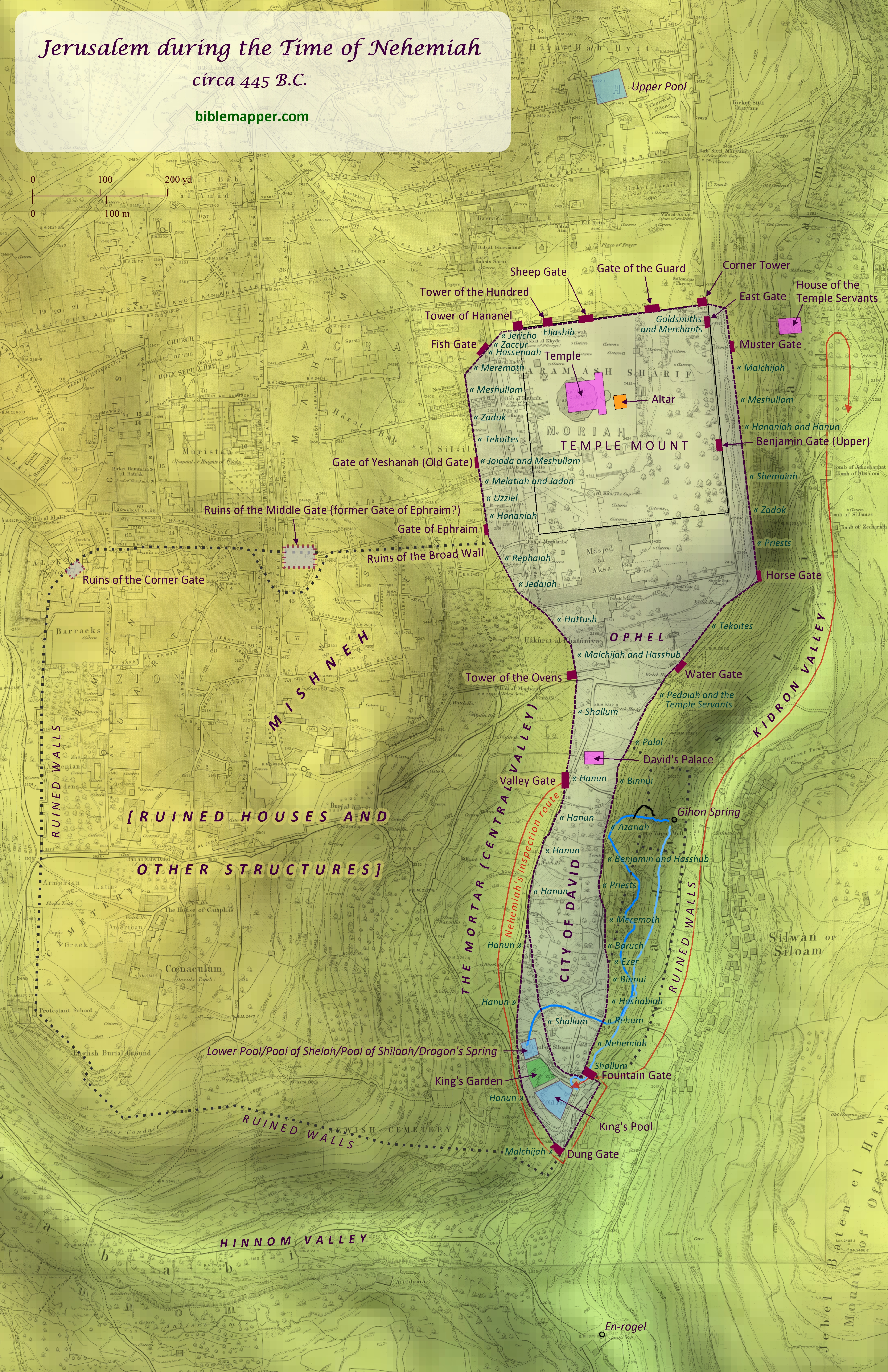
Author’s Note: This map draws heavily upon the careful work of Dr. Leen Ritmeyer (www.ritmeyer.com) regarding the probable location of gates, walls, and other features, though I have deviated at points from his data, based on my own research and conclusions.
A wealth of archaeological evidence supports the existence and location of many of the structures shown on this map, and great care has been taken to correlate them as faithfully as possible with the data provided in the book of Nehemiah and other biblical texts. Nevertheless, the specific identification of virtually all of these items is open to great debate. For this reason, no attempt has been made on this map to indicate any degree of uncertainty for the identifications that have been included, since the vast majority of these would be marked as uncertain anyway.
The shaded relief has been overlaid with the Ordnance Survey of Jerusalem (1865), by Charles Wilson.
The book of Nehemiah is one of the last books of the Old Testament written, and it recounts the efforts of Nehemiah to rebuild the walls of Jerusalem long after they had been destroyed by the Babylonians (2 Kings 24-25; 2 Chronicles 36:17-21; Jeremiah 39:1-10; see “Nebuchadnezzar’s Final Campaign against Judah” map). Nehemiah had been a trusted official in the Persian royal court who acquired a special commission to return to his ancestral land of Judea for the rebuilding effort (Nehemiah 1-2; see “Jews Return from Exile” map). After arriving in Jerusalem, he quickly surveyed the condition of the walls and then organized the people of Judea into work teams (Nehemiah 2-3). These teams each worked on a designated portion of the walls, and the entire project was completed in 52 days (Nehemiah 6:15). The builders came from Jerusalem and from towns throughout the greater province of Judea, and most of these towns are included in the map of “Judea under Persian Rule”.
It is far beyond the scope of this article to present all the textual and archaeological evidence that forms the basis for the identifications made on this map, but two specific portions of this map seem to warrant explanation:
One Gate of Ephraim or Two?
The Gate of Ephraim is mentioned in Nehemiah 8:16 and 12:39, and it is noted as lying along the path of the walls that Nehemiah rebuilt. This has indirectly led to some confusion, however, regarding the location of another gate called the Gate of Ephraim in 2 Kings 14:13 and 2 Chronicles 25:23, which both note that King Jehoash of Israel broke down the wall of Jerusalem from the Gate of Ephraim to the Corner Gate, a distance of 400 cubits. This confusion stems from equating the Gate of Ephraim mentioned in 2 Kings and 2 Chronicles with the Gate of Ephraim mentioned in Nehemiah. Assuming the biblical text to be reliable, this assumption would require that the Corner Gate, which is mentioned also in 2 Chronicles 26:9; Jeremiah 31:38; and Zechariah 14:10, would have been located somewhere along the wall about 600 feet (183 meters) from the Gate of Ephraim. Placing it directly west of the Gate of Ephraim of Nehemiah would place it very close to the Middle Gate, perhaps suggesting that the Middle Gate was in fact the Corner Gate. But Jeremiah’s mention of both the Middle Gate (39:3) and the Corner Gate (Jeremiah 31:38) in the same book makes this equation unlikely. Placing the Corner Gate directly north of the Gate of Ephraim near the northwestern corner of the Temple Mount seems plausible at first glance, but this location is very hard to reconcile with both Jeremiah 31:38 and Zechariah 14:10. Jeremiah 31:38 traces a line from the Tower of Hananel to the Corner Gate, but this would make little sense if the Corner Gate were located in very close proximity to the Tower of Hananel. Similarly, Zechariah 14:10 appears to be using the Corner Gate as a marker for the far western extreme of Jerusalem, but a location at the northwest corner of the Temple Mount hardly seems like the intended location.
A more likely solution can be found by regarding the Gate of Ephraim of 2 Kings 14 and 2 Chronicles 25 as different than the Gate of Ephraim of Nehemiah, though perhaps the Gate of Ephraim had been renamed after the exile to hearken back to the old Gate of Ephraim, which had been destroyed. If this is true, the earlier Gate of Ephraim may actually have been the same as the Middle Gate of Jeremiah 39:3 (Jeremiah never mentions the Gate of Ephraim), or perhaps it was a gate near where the Middle Gate was built later. This location, then, would place the Corner Gate at the far western corner of the larger wall around greater Jerusalem, as shown on this map. The distance between these two gates is about 600 feet (183 meters), and the appropriately named Corner Gate would be a fitting candidate to mark the far western extreme of the city.
It should also be noted that this solution, however, requires that the first Gate of Ephraim existed prior to Hezekiah’s building activity. This stands in contrast to the common assertion that the wall encompassing greater Jerusalem (which Josephus calls the First Wall) was built by Hezekiah in response to the dramatic increase in residents that relocated to Jerusalem due to the fall of the northern kingdom of Israel. But the only mention in the Bible of Hezekiah building a new wall is 2 Chronicles 32:5, which notes that he built a wall “outside” the wall that was broken down (2 Chronicles 32:5). This is most likely referencing a wall in the Kidron Valley that has since been found by archaeology, and perhaps a second wall around the Temple Mount. So it would seem that elsewhere Hezekiah merely repaired or replaced portions of a wall that already existed but was in disrepair. This synchronizes well with Isaiah 22:11, where Isaiah rebukes a leader (perhaps Hezekiah) for breaking down houses “to fortify the wall” (not build a new one).
Wall Enclosing the King’s Pool
Another common assumption that is difficult to correlate with Nehemiah is the placement of the King’s Pool and the Lower Pool outside the main wall of the City of David. (The King’s Pool was likely the same as the Old Pool mentioned in Isaiah 22:11. The Lower Pool appears to be alternately called elsewhere the [Pool of] Shiloah/Siloam [Isaiah 8:6] and the Pool of Shelah [Nehemiah 3:15], which is fed by the Dragon’s Spring [Nehemiah 2:13].) Two different passages in Nehemiah (Nehemiah 3:13; 12:31) clearly trace a path along a wall from the Valley Gate (likely midway up the western wall of the City of David) directly to the Dung Gate, with no mention of any other gates or distinct changes in direction. Likewise, both Nehemiah 3:15 and 12:37 note that the Fountain Gate (likely located immediately northeast of the King’s Pool on this map) was reached after passing by the Dung Gate. This author has become convinced that this requires that the Dung Gate lay along a portion of the wall that must have extended directly from the area of the Valley Gate. Further details are given in Nehemiah 3:13, which notes that Hanun and the inhabitants of Zanoah repaired 1000 cubits (1500 feet; 457 meters) of the wall from the Valley Gate to the Dung Gate. If the Valley Gate and the Dung Gate were indeed located at the two places shown on this map, and a wall between them followed the path shown here, the distance between them along the wall would have measured about 1548 feet (472 meters), or 1032 cubits–extremely close to the 1000-cubit distance given in Nehemiah 3:13. The existence of this wall is also supported by Isaiah 22:11-12, which notes that a reservoir for the waters of the Old Pool (likely the same as the King’s Pool on this map) had been built “between the two walls.” This could be understood to refer to Josephus’s First Wall and the wall immediately north of the King’s Pool, but this author suspects instead that it is referring to the wall that must have already existed immediately south of the Lower Pool and the King’s Pool on this map.
Open Bible Data site copyright © 2023–2026 Freely-Given.org.
Python source code for creating these static pages is available on GitHub under an open licence.
For Bible data copyrights, see the details for each displayed Bible version.
The Open English Translation (OET) main site is at OpenEnglishTranslation.Bible or OET.Bible.