
ParallelVerse GEN EXO LEV NUM DEUT JOB YEHO (JOS) HERO (JDG) RUTH 1 SAM 2 SAM PSA AMOS HOS 1 KI 2 KI 1 CHR 2 CHR PROV ECC SNG YOEL (JOEL) MIC ISA ZEP HAB YIR (JER) LAM YNA (JNA) NAH OBAD DAN EZEK EZRA EST NEH HAG ZEC MAL 2 PS WIS TOB MAN BAR L JER G DAN SUS PR AZ BEL G ESD L ESD ESG JDT 3 MAC SIR 1 MAC 2 MAC 4 MAC YHN (JHN) MARK MAT LUKE ACTs YAC (JAM) GAL 1 TH 2 TH 1 COR 2 COR ROM COL LAOD PHM EPH PHP 1 TIM TIT 1 PET 2 PET 2 TIM HEB YUD (JUD) 1 YHN (1 JHN) 2 YHN (2 JHN) 3 YHN (3 JHN) REV
ParallelVerse Neh Intro C1 C3 C4 C5 C6 C7 C8 C9 C10 C11 C12 C13
Neh 2 V0 V1 V2 V3 V4 V5 V6 V7 V8 V9 V10 V11 V13 V14 V15 V16 V17 V18 V19 V20
Note: This view shows ‘verses’ which are not necessarily natural language units and hence sometimes only part of a sentence will be visible—click on any Bible version abbreviation down the left-hand side to see the verse in more of its context. Normally the OET discourages the reading of individual ‘verses’, but this view is only designed as a tool for Bible-translators and others doing comparisons of different translations—the older translations are further down the page (so you can read up from the bottom to trace the English translation history). The OET segments on this page are still early looks into the drafted texts of the Open English Translation of the Bible—please double-check these texts in advance before using in public.
Text critical issues=none Clarity of original=clear Importance to us=normal Speaker(s)=Narrator (All still tentative.)
OET (OET-RV) One night, I got up and took a few men with me, without having told anyone what I felt that my god had been telling me to do for Yerushalem. We only had the one horse that I was riding,
OET-LV And_I_arose night I and_men a_few with_me and_not I_had_told to/for_ʼĀdām/humankind what god_of_was_my putting into heart_of_my for_doing for_Yərūshālaim/(Jerusalem) and_an_animal there_was_not with_me if/because (if) the_cattle/livestock which I was_riding on_it.
UHB וָאָק֣וּם ׀ לַ֗יְלָה אֲנִי֮ וַאֲנָשִׁ֣ים ׀ מְעַט֮ עִמִּי֒ וְלֹא־הִגַּ֣דְתִּי לְאָדָ֔ם מָ֗ה אֱלֹהַי֙ נֹתֵ֣ן אֶל־לִבִּ֔י לַעֲשׂ֖וֹת לִירוּשָׁלִָ֑ם וּבְהֵמָה֙ אֵ֣ין עִמִּ֔י כִּ֚י אִם־הַבְּהֵמָ֔ה אֲשֶׁ֥ר אֲנִ֖י רֹכֵ֥ב בָּֽהּ׃ ‡
(vāʼāqūm laylāh ʼₐnī vaʼₐnāshim məˊaţ ˊimmiy vəloʼ-higgadtī ləʼādām māh ʼₑlohay notēn ʼel-libiy laˊₐsōt liyrūshālāim ūⱱəhēmāh ʼēyn ˊimmiy kiy ʼim-habəhēmāh ʼₐsher ʼₐniy rokēⱱ bāh.)
Key: khaki:verbs.
Note: Automatic aligning of the OET-RV to the LV is done by some temporary software, hence the OET-RV alignments are incomplete (and may occasionally be wrong).
People tagged in the matching LV passage: God
Places tagged in the matching LV passage: Jerusalem
Dictionary: Jerusalem
BrLXX (EZR 12:12) Καὶ ἀνέστην νυκτὸς ἐγὼ καὶ ἄνδρες ὀλίγοι μετʼ ἐμοῦ, καὶ οὐκ ἀπήγγειλα ἀνθρώπῳ τί ὁ Θεὸς δίδωσιν εἰς καρδίαν μου τοῦ ποιῆσαι μετὰ τοῦ Ἰσραὴλ, καὶ κτῆνος οὐκ ἔστι μετʼ ἐμοῦ, εἰ μὴ τὸ κτῆνος ᾧ ἐγὼ ἐπιβαίνω ἐπʼ αὐτῷ.
(Kai anestaʸn nuktos egō kai andres oligoi metʼ emou, kai ouk apaʸngeila anthrōpōi ti ho Theos didōsin eis kardian mou tou poiaʸsai meta tou Israaʸl, kai ktaʸnos ouk esti metʼ emou, ei maʸ to ktaʸnos hō egō epibainō epʼ autōi.)
BrTr And I rose up by night, I and a few men with me; and I told no man what God put into my heart to do with Israel; and there was no beast with me, except the beast which I rode upon.
ULT And I arose in the night, myself and a few men with me, and I did not tell anyone what my God had been giving to my heart to do for Jerusalem. Now there was no animal with me except the animal upon which I was riding.
UST I did not say publicly what God was leading me to do for Jerusalem. Instead, I got up secretly in the night to inspect the city walls. I brought only a few other men with me. So that we could work quietly, the only animal I brought with me was the one that I was riding.
BSB I set out at night with a few men. I did not tell anyone what my God had laid on my heart to do for Jerusalem. The only animal with me was the one on which I was riding
OEB No OEB NEH 2:12 book available
WEBBE I arose in the night, I and a few men with me. I didn’t tell anyone what my God put into my heart to do for Jerusalem. There wasn’t any animal with me except the animal that I rode on.
NET I got up during the night, along with a few men who were with me. But I did not tell anyone what my God was putting on my heart to do for Jerusalem. There were no animals with me, except for the one I was riding.
LSV and I rise by night, I and a few men with me, and have not declared to a man what my God is giving to my heart to do for Jerusalem, and there is no beast with me except the beast on which I am riding.
FBV Then I got up during the night and went out with just a few men. I didn't explain to anyone what my God had put in my head to do for Jerusalem. I only took one horse to ride.[fn]
2:12 In other words he was keeping his mission as quiet as possible and minimizing any noise from his group.
T4T 11-12 When I arrived in Jerusalem, I did not tell anyone what thoughts God had given to me about what I should do there. Three days after I arrived in Jerusalem, I went out of the city in the evening, taking a few other men with me. I was riding a donkey; we had no other animals with us.
LEB I got up during the night, I and a few men with me. I did not tell anybody what my God put in my heart to do for Jerusalem. No animal was with me except the animal that I was riding on.
BBE And in the night I got up, taking with me a small band of men; I said nothing to any man of what God had put into my heart to do for Jerusalem: and I had no beast with me but the one on which I was seated.
Moff I got up during the night, I and one or two men with me; I did not tell anyone what my God was putting into my mind to do for Jerusalem, and there was no beast in my company except the beast I rode upon myself,
JPS And I arose in the night, I and some few men with me; neither told I any man what my God put into my heart to do for Jerusalem; neither was there any beast with me, save the beast that I rode upon.
ASV And I arose in the night, I and some few men with me; neither told I any man what my God put into my heart to do for Jerusalem; neither was there any beast with me, save the beast that I rode upon.
DRA And I arose in the night, I and some few men with me, and I told not any man what God had put in my heart to do in Jerusalem, and there was no beast with me, but the beast that I rode upon.
YLT and I rise by night, I and a few men with me, and have not declared to a man what my God is giving unto my heart to do for Jerusalem, and there is no beast with me except the beast on which I am riding.
Drby And I arose in the night, I and some few men with me — but I told no man what my [fn]God had put in my heart to do for Jerusalem — and there was no beast with me, except the beast that I rode upon.
2.12 Elohim
RV And I arose in the night, I and some few men with me; neither told I any man what my God put into my heart to do for Jerusalem: neither was there any beast with me, save the beast that I rode upon.
(And I arose in the night, I and some few men with me; neither told I any man what my God put into my heart to do for Yerusalem: neither was there any beast with me, save the beast that I rode upon.)
SLT And I shall rise in the night, I and a few men with me; and I announced not to man what my God gave into my heart to do at Jerusalem: and no beast with me but the beast that I rode upon it.
Wbstr And I arose in the night, I and some few men with me; neither told I any man what my God had put in my heart to do at Jerusalem: neither was there any beast with me, save the beast that I rode upon.
KJB-1769 ¶ And I arose in the night, I and some few men with me; neither told I any man what my God had put in my heart to do at Jerusalem: neither was there any beast with me, save the beast that I rode upon.
(¶ And I arose in the night, I and some few men with me; neither told I any man what my God had put in my heart to do at Yerusalem: neither was there any beast with me, save the beast that I rode upon.)
KJB-1611 ¶ And I arose in the night, I, and some few men with mee, neither tolde I any man what God had put in my heart to doe at Ierusalem: neither was there any beast with mee, saue the beast that I rode vpon.
(¶ And I arose in the night, I, and some few men with me, neither told I any man what God had put in my heart to do at Yerusalem: neither was there any beast with me, save the beast that I rode upon.)
Bshps And I gat me vp in the night season, and a fewe men with me, neither tolde I any man what God had geuen me in my heart to do at Hierusalem: and there was not one beast with me, saue it that I rode vpon.
(And I gat me up in the night season, and a few men with me, neither told I any man what God had given me in my heart to do at Yerusalem: and there was not one beast with me, save it that I rode upon.)
Gnva And I rose in the night, I, and a fewe men with me: for I told no man, what God had put in mine heart to do at Ierusalem, and there was not a beast with me, saue the beast whereon I rode.
(And I rose in the night, I, and a few men with me: for I told no man, what God had put in mine heart to do at Yerusalem, and there was not a beast with me, save the beast whereon I rode.)
Cvdl I gat me vp in ye night season, & a fewe men with me: for I tolde no man what God had geue me in my hert to do at Ierusalem: & there was not one beest wt me, saue it yt I rode vpon.
(I gat me up in ye/you_all night season, and a few men with me: for I told no man what God had give me in my heart to do at Yerusalem: and there was not one beast/animal with me, save it it I rode upon.)
Wycl And Y roos bi nyyt, Y and a fewe men with me, and Y schewide not to ony man, what thing God hadde youe in myn herte, that Y wolde do in Jerusalem; and no werk beest was with me, no but the beeste, `on which Y sat.
(And I rose by night, I and a few men with me, and I showed not to any man, what thing God had given in mine heart, that I would do in Yerusalem; and no work beast/animal was with me, no but the beast/animal, on which I sat.)
Luth machte ich mich des Nachts auf und wenig Männer mit mir; denn ich sagte keinem Menschen, was mir mein GOtt eingegeben hatte, zu tun an Jerusalem; und war kein Tier mit mir, ohne da ich auf ritt.
(made/did I me the night on/in/to and few men with to_me; because/than I said none people, what/which to_me my God entered had, to/for do/put at/to Jerusalem; and what/which no/not animal with to_me, without there I on/in/to ride.)
ClVg Et surrexi nocte ego, et viri pauci mecum, et non indicavi cuiquam quid Deus dedisset in corde meo ut facerem in Jerusalem: et jumentum non erat mecum, nisi animal cui sedebam.
(And I_rose at_night I, and men a_few with_me, and not/no I_indicated to_anyone what God would_have_given in/into/on heart mine as I_would_do in/into/on Yerusalem: and animal/pack-mule not/no was with_me, except animal to_whom I_was_sitting.)
Note 1 topic: figures-of-speech / explicit
וָאָק֣וּם ׀ לַ֗יְלָה
and,I_arose night
The implication is that Nehemiah went out to inspect the city walls, as described in 1:13–15. The implication is also that he did this at night so that no one would know he was doing it. If it would be helpful in your language, you could say this explicitly. Alternate translation: [I got up secretly in the night to inspect the city walls.]
Note 2 topic: figures-of-speech / gendernotations
אֲנִי֮ וַאֲנָשִׁ֣ים ׀ מְעַט֮ עִמִּי֒
I (Some words not found in UHB: and,I_arose night I and,men a_few with,me and=not tell to/for=ʼĀdām/humankind what God_of,[was]_my put to/towards heart_of,my for=doing for,Jerusalem and,an_animal not with,me that/for/because/then/when if the=cattle/livestock which/who I riding on,it )
The word men here could conceivably include both men and women. However, for a nighttime mission through the ruins of the city walls, it’s likely that Nehemiah brought along only other men. So in this context you could use a word that indicates that. Alternate translation: [I brought only a few other men with me.]
Note 3 topic: figures-of-speech / hyperbole
וְלֹא־הִגַּ֣דְתִּי לְאָדָ֔ם מָ֗ה אֱלֹהַי֙ נֹתֵ֣ן אֶל־לִבִּ֔י לַעֲשׂ֖וֹת לִירוּשָׁלִָ֑ם
and=not (Some words not found in UHB: and,I_arose night I and,men a_few with,me and=not tell to/for=ʼĀdām/humankind what God_of,[was]_my put to/towards heart_of,my for=doing for,Jerusalem and,an_animal not with,me that/for/because/then/when if the=cattle/livestock which/who I riding on,it )
Probably Nehemiah told at least some people, since he brought a few men with him when he went out to inspect the walls. So “not … anyone” might be an exaggeration that emphasizes the secrecy Nehemiah maintained. Alternate translation: [I did not say publicly what God had led me to do for Jerusalem.]
Note 4 topic: grammar-connect-logic-result
וְלֹא־הִגַּ֣דְתִּי לְאָדָ֔ם מָ֗ה אֱלֹהַי֙ נֹתֵ֣ן אֶל־לִבִּ֔י לַעֲשׂ֖וֹת לִירוּשָׁלִָ֑ם
and=not (Some words not found in UHB: and,I_arose night I and,men a_few with,me and=not tell to/for=ʼĀdām/humankind what God_of,[was]_my put to/towards heart_of,my for=doing for,Jerusalem and,an_animal not with,me that/for/because/then/when if the=cattle/livestock which/who I riding on,it )
If it would be helpful in your language, you could give this explanation before describing Nehemiah’s nighttime mission, because it is the reason that explains the result of him maintaining so much secrecy.
Note 5 topic: figures-of-speech / metaphor
מָ֗ה אֱלֹהַי֙ נֹתֵ֣ן אֶל־לִבִּ֔י לַעֲשׂ֖וֹת
what God_of,[was]_my put to/towards (Some words not found in UHB: and,I_arose night I and,men a_few with,me and=not tell to/for=ʼĀdām/humankind what God_of,[was]_my put to/towards heart_of,my for=doing for,Jerusalem and,an_animal not with,me that/for/because/then/when if the=cattle/livestock which/who I riding on,it )
Here, Nehemiah’s heart represents his thoughts and will. Alternate translation: [what God had inspired me to do] or [what God had led me to do]
Note 6 topic: figures-of-speech / explicit
וּבְהֵמָה֙ אֵ֣ין עִמִּ֔י
and,an_animal not (Some words not found in UHB: and,I_arose night I and,men a_few with,me and=not tell to/for=ʼĀdām/humankind what God_of,[was]_my put to/towards heart_of,my for=doing for,Jerusalem and,an_animal not with,me that/for/because/then/when if the=cattle/livestock which/who I riding on,it )
The implication is that this was another measure to maintain secrecy. If it would be helpful in your language, you could say this explicitly. Alternate translation: [To keep things quiet, there were no other animals with me]
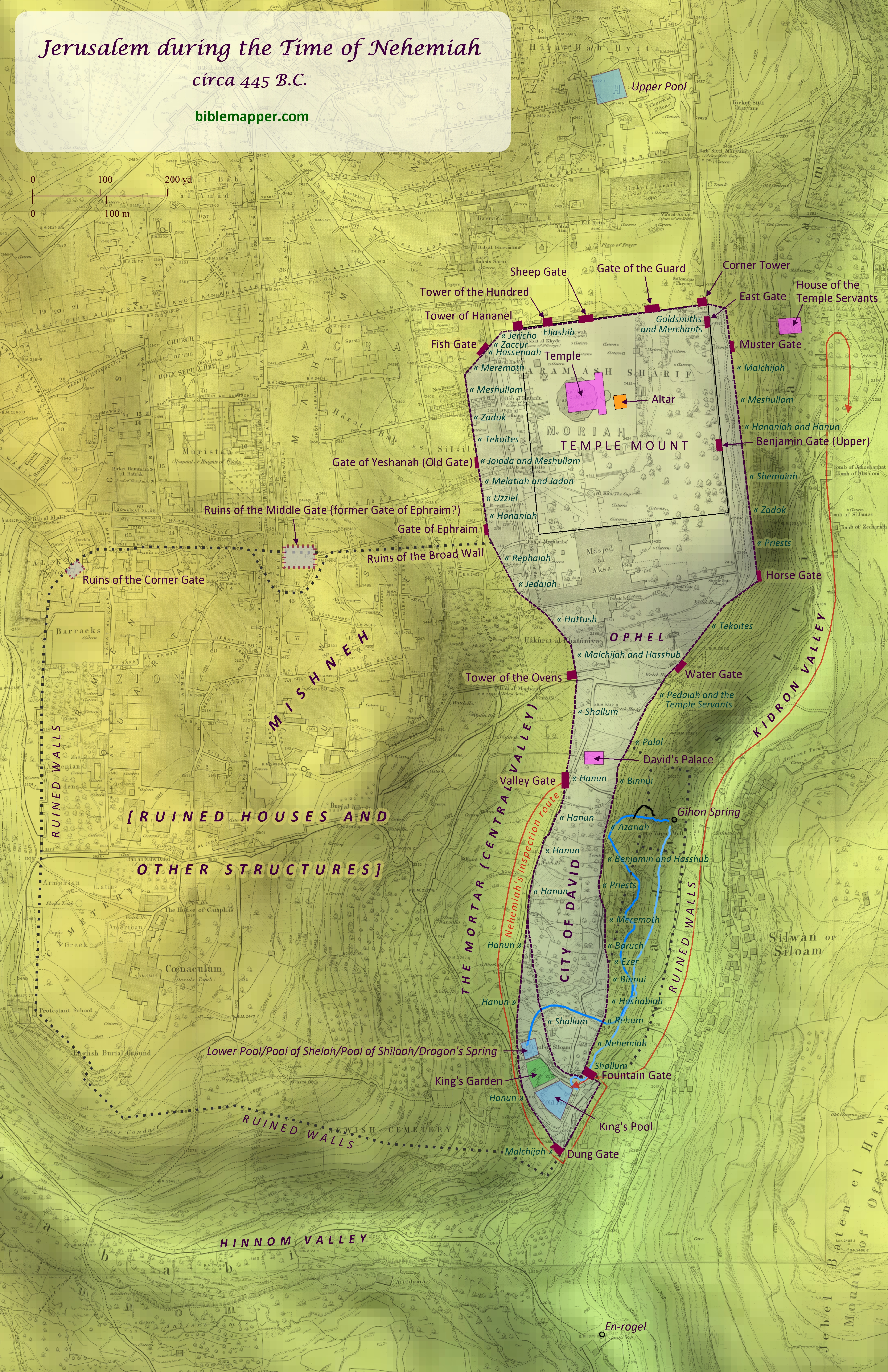
Author’s Note: This map draws heavily upon the careful work of Dr. Leen Ritmeyer (www.ritmeyer.com) regarding the probable location of gates, walls, and other features, though I have deviated at points from his data, based on my own research and conclusions.
A wealth of archaeological evidence supports the existence and location of many of the structures shown on this map, and great care has been taken to correlate them as faithfully as possible with the data provided in the book of Nehemiah and other biblical texts. Nevertheless, the specific identification of virtually all of these items is open to great debate. For this reason, no attempt has been made on this map to indicate any degree of uncertainty for the identifications that have been included, since the vast majority of these would be marked as uncertain anyway.
The shaded relief has been overlaid with the Ordnance Survey of Jerusalem (1865), by Charles Wilson.
The book of Nehemiah is one of the last books of the Old Testament written, and it recounts the efforts of Nehemiah to rebuild the walls of Jerusalem long after they had been destroyed by the Babylonians (2 Kings 24-25; 2 Chronicles 36:17-21; Jeremiah 39:1-10; see “Nebuchadnezzar’s Final Campaign against Judah” map). Nehemiah had been a trusted official in the Persian royal court who acquired a special commission to return to his ancestral land of Judea for the rebuilding effort (Nehemiah 1-2; see “Jews Return from Exile” map). After arriving in Jerusalem, he quickly surveyed the condition of the walls and then organized the people of Judea into work teams (Nehemiah 2-3). These teams each worked on a designated portion of the walls, and the entire project was completed in 52 days (Nehemiah 6:15). The builders came from Jerusalem and from towns throughout the greater province of Judea, and most of these towns are included in the map of “Judea under Persian Rule”.
It is far beyond the scope of this article to present all the textual and archaeological evidence that forms the basis for the identifications made on this map, but two specific portions of this map seem to warrant explanation:
One Gate of Ephraim or Two?
The Gate of Ephraim is mentioned in Nehemiah 8:16 and 12:39, and it is noted as lying along the path of the walls that Nehemiah rebuilt. This has indirectly led to some confusion, however, regarding the location of another gate called the Gate of Ephraim in 2 Kings 14:13 and 2 Chronicles 25:23, which both note that King Jehoash of Israel broke down the wall of Jerusalem from the Gate of Ephraim to the Corner Gate, a distance of 400 cubits. This confusion stems from equating the Gate of Ephraim mentioned in 2 Kings and 2 Chronicles with the Gate of Ephraim mentioned in Nehemiah. Assuming the biblical text to be reliable, this assumption would require that the Corner Gate, which is mentioned also in 2 Chronicles 26:9; Jeremiah 31:38; and Zechariah 14:10, would have been located somewhere along the wall about 600 feet (183 meters) from the Gate of Ephraim. Placing it directly west of the Gate of Ephraim of Nehemiah would place it very close to the Middle Gate, perhaps suggesting that the Middle Gate was in fact the Corner Gate. But Jeremiah’s mention of both the Middle Gate (39:3) and the Corner Gate (Jeremiah 31:38) in the same book makes this equation unlikely. Placing the Corner Gate directly north of the Gate of Ephraim near the northwestern corner of the Temple Mount seems plausible at first glance, but this location is very hard to reconcile with both Jeremiah 31:38 and Zechariah 14:10. Jeremiah 31:38 traces a line from the Tower of Hananel to the Corner Gate, but this would make little sense if the Corner Gate were located in very close proximity to the Tower of Hananel. Similarly, Zechariah 14:10 appears to be using the Corner Gate as a marker for the far western extreme of Jerusalem, but a location at the northwest corner of the Temple Mount hardly seems like the intended location.
A more likely solution can be found by regarding the Gate of Ephraim of 2 Kings 14 and 2 Chronicles 25 as different than the Gate of Ephraim of Nehemiah, though perhaps the Gate of Ephraim had been renamed after the exile to hearken back to the old Gate of Ephraim, which had been destroyed. If this is true, the earlier Gate of Ephraim may actually have been the same as the Middle Gate of Jeremiah 39:3 (Jeremiah never mentions the Gate of Ephraim), or perhaps it was a gate near where the Middle Gate was built later. This location, then, would place the Corner Gate at the far western corner of the larger wall around greater Jerusalem, as shown on this map. The distance between these two gates is about 600 feet (183 meters), and the appropriately named Corner Gate would be a fitting candidate to mark the far western extreme of the city.
It should also be noted that this solution, however, requires that the first Gate of Ephraim existed prior to Hezekiah’s building activity. This stands in contrast to the common assertion that the wall encompassing greater Jerusalem (which Josephus calls the First Wall) was built by Hezekiah in response to the dramatic increase in residents that relocated to Jerusalem due to the fall of the northern kingdom of Israel. But the only mention in the Bible of Hezekiah building a new wall is 2 Chronicles 32:5, which notes that he built a wall “outside” the wall that was broken down (2 Chronicles 32:5). This is most likely referencing a wall in the Kidron Valley that has since been found by archaeology, and perhaps a second wall around the Temple Mount. So it would seem that elsewhere Hezekiah merely repaired or replaced portions of a wall that already existed but was in disrepair. This synchronizes well with Isaiah 22:11, where Isaiah rebukes a leader (perhaps Hezekiah) for breaking down houses “to fortify the wall” (not build a new one).
Wall Enclosing the King’s Pool
Another common assumption that is difficult to correlate with Nehemiah is the placement of the King’s Pool and the Lower Pool outside the main wall of the City of David. (The King’s Pool was likely the same as the Old Pool mentioned in Isaiah 22:11. The Lower Pool appears to be alternately called elsewhere the [Pool of] Shiloah/Siloam [Isaiah 8:6] and the Pool of Shelah [Nehemiah 3:15], which is fed by the Dragon’s Spring [Nehemiah 2:13].) Two different passages in Nehemiah (Nehemiah 3:13; 12:31) clearly trace a path along a wall from the Valley Gate (likely midway up the western wall of the City of David) directly to the Dung Gate, with no mention of any other gates or distinct changes in direction. Likewise, both Nehemiah 3:15 and 12:37 note that the Fountain Gate (likely located immediately northeast of the King’s Pool on this map) was reached after passing by the Dung Gate. This author has become convinced that this requires that the Dung Gate lay along a portion of the wall that must have extended directly from the area of the Valley Gate. Further details are given in Nehemiah 3:13, which notes that Hanun and the inhabitants of Zanoah repaired 1000 cubits (1500 feet; 457 meters) of the wall from the Valley Gate to the Dung Gate. If the Valley Gate and the Dung Gate were indeed located at the two places shown on this map, and a wall between them followed the path shown here, the distance between them along the wall would have measured about 1548 feet (472 meters), or 1032 cubits–extremely close to the 1000-cubit distance given in Nehemiah 3:13. The existence of this wall is also supported by Isaiah 22:11-12, which notes that a reservoir for the waters of the Old Pool (likely the same as the King’s Pool on this map) had been built “between the two walls.” This could be understood to refer to Josephus’s First Wall and the wall immediately north of the King’s Pool, but this author suspects instead that it is referring to the wall that must have already existed immediately south of the Lower Pool and the King’s Pool on this map.
Open Bible Data site copyright © 2023–2026 Freely-Given.org.
Python source code for creating these static pages is available on GitHub under an open licence.
For Bible data copyrights, see the details for each displayed Bible version.
The Open English Translation (OET) main site is at OpenEnglishTranslation.Bible or OET.Bible.