
OET OET-RV OET-LV GHT ULT UST BSB MSB BLB AICNT OEB WEBBE WMBB NET LSV FBV TCNT T4T LEB BBE Moff JPS Wymth ASV DRA YLT Drby RV SLT Wbstr KJB-1769 KJB-1611 Bshps Gnva Cvdl TNT Wycl SR-GNT UHB BrLXX BrTr Related Parallel Simple Interlinear Topics Reference Dictionary Search
ParallelVerse GEN EXO LEV NUM DEU JOB JOS JDG RUTH 1 SAM 2 SAM PSA AMOS HOS 1 KI 2 KI 1 CHR 2 CHR PROV ECC SNG JOEL MIC ISA ZEP HAB JER LAM YNA (JNA) NAH OBA DAN EZE EZRA EST NEH HAG ZEC MAL LAO GES LES ESG DNG 2 PS TOB JDT ESA WIS SIR BAR LJE PAZ SUS BEL MAN 1 MAC 2 MAC 3 MAC 4 MAC YHN (JHN) MARK MAT LUKE ACTs YAC (JAM) GAL 1 TH 2 TH 1 COR 2 COR ROM COL PHM EPH PHP 1 TIM TIT 1 PET 2 PET 2 TIM HEB YUD (JUD) 1 YHN (1 JHN) 2 YHN (2 JHN) 3 YHN (3 JHN) REV
Jos Intro C1 C2 C3 C4 C5 C6 C7 C8 C9 C10 C11 C12 C13 C14 C16 C17 C18 C19 C20 C21 C22 C23 C24
Jos 15 V1 V4 V7 V10 V13 V16 V19 V22 V25 V28 V31 V34 V37 V40 V43 V46 V49 V52 V55 V58 V61
Note: This view shows ‘verses’ which are not necessarily natural language units and hence sometimes only part of a sentence will be visible—click on any Bible version abbreviation down the left-hand side to see the verse in more of its context. Normally the OET discourages the reading of individual ‘verses’, but this view is only designed as a tool for Bible-translators and others doing comparisons of different translations—the older translations are further down the page (so you can read up from the bottom to trace the English translation history). The OET segments on this page are still early looks into the drafted texts of the Open English Translation of the Bible—please double-check these texts in advance before using in public.
Text critical issues=none Clarity of original=clear Importance to us=normal Speaker(s)=Narrator (All still tentative.)
OET (OET-RV) Caleb captured the land from Anak’s three sons—Sheshai, Ahiman, and Talmai,
OET-LV And_he_dispossessed from_there Kālēⱱ DOM three the_sons_of (the)_ˊĀnāq DOM Shēshay and_DOM ʼAḩīman and_DOM Talmay those_born_of (the)_ˊĀnāq.
UHB וַיֹּ֤רֶשׁ מִשָּׁם֙ כָּלֵ֔ב אֶת־שְׁלוֹשָׁ֖ה בְּנֵ֣י הָעֲנָ֑ק אֶת־שֵׁשַׁ֤י וְאֶת־אֲחִימַן֙ וְאֶת־תַּלְמַ֔י יְלִידֵ֖י הָעֲנָֽק׃ ‡
(vayyoresh mishshām kālēⱱ ʼet-shəlōshāh bənēy hāˊₐnāq ʼet-shēshay vəʼet-ʼₐḩīman vəʼet-talmay yəlīdēy hāˊₐnāq.)
Key: khaki:verbs.
Note: Automatic aligning of the OET-RV to the LV is done by some temporary software, hence the OET-RV alignments are incomplete (and may occasionally be wrong).
BrLXX Καὶ ἐξωλόθρευσεν ἐκεῖθεν Χάλεβ υἱὸς Ἰεφονὴ τοὺς τρεῖς υἱοὺς Ἐνὰκ, τὸν Σουσὶ καὶ Θολαμὶ καὶ τὸν Ἀχιμᾶ.
(Kai exōlothreusen ekeithen Ⱪaleb huios Iefonaʸ tous treis huious Enak, ton Sousi kai Tholami kai ton Aⱪima.)
BrTr And Chaleb the son of Jephone destroyed thence the three sons of Enac, Susi, and Tholami, and Achima.
ULT And Caleb dispossessed from there the three sons of Anak, Sheshai and Ahiman and Talmai, the children of Anak.
UST Caleb forced the three clans of the Anak people group to leave Hebron. Those were the Sheshai, Ahiman, and Talmai clans.
BSB & MSB And Caleb drove out from there the three sons of Anak—the descendants of Sheshai, Ahiman, and Talmai, the children of Anak.
OEB Caleb drove out the three groups of of Anakites, the Sheshai, Ahiman, and Talmai, who were the descendants of Anak.
WEBBE & WMBB Caleb drove out the three sons of Anak: Sheshai, and Ahiman, and Talmai, the children of Anak.
NET Caleb drove out from there three Anakites – Sheshai, Ahiman, and Talmai, descendants of Anak.
LSV And Caleb is dispossessing there the three sons of Anak: Sheshai, and Ahiman, and Talmai, children of Anak,
FBV Caleb drove out three family groups—Sheshai, Ahiman, and Talmai, descendants of Anak.[fn]
15:14 See Numbers 13:22. Since these names are mentioned more than forty years previously, it seems these are names for the larger family groups.
T4T Caleb forced the three clans of the Anak people-group to leave Hebron. Those were the Sheshai, Ahiman, and Talmai clans.
LEB Caleb drove out from there three of Anak’s sons, Sheshai, Ahiman, and Talmai, the descendants[fn] of Anak.
15:14 Or “children”
BBE And the three sons of Anak, Sheshai and Ahiman and Talmai, the children of Anak, were forced out from there by Caleb.
Moff Caleb drove out the three giant sons of Anak, Sheshai, Ahiman, and Talmai.
JPS And Caleb drove out thence the three sons of Anak, Sheshai, and Ahiman, and Talmai, the children of Anak.
ASV And Caleb drove out thence the three sons of Anak: Sheshai, and Ahiman, and Talmai, the children of Anak.
DRA And Caleb destroyed out of it the three sons of Ehac, Sesai and Ahiman. and Tholmai of the race of Enac.
YLT And Caleb is dispossessing thence the three sons of Anak, Sheshai, and Ahiman, and Talmai, children of Anak,
Drby And thence Caleb dispossessed the three sons of Anak, Sheshai and Ahiman and Talmai, who were born of Anak.
RV And Caleb drove out thence the three sons of Anak, Sheshai, and Ahiman, and Talmai, the children of Anak.
SLT And Caleb drove from thence the three sons of Anak, Sheshai, and Ahiman and Talmai, children of Anak.
Wbstr And Caleb drove thence the three sons of Anak, Sheshai, and Ahiman, and Talmai, the children of Anak.
KJB-1769 And Caleb drove thence the three sons of Anak, Sheshai, and Ahiman, and Talmai, the children of Anak.
KJB-1611 And Caleb droue thence the three sonnes of Anak, Sheshai, and Ahiman, and Talmai, the children of Anak.
(Modernised spelling is same as from KJB-1769 above)
Bshps And Caleb droue thence the three sonnes of Enac, Sesai, and Ahiman, and Thalmai, which were the sonnes of Enac.
(And Caleb drove thence the three sons of Enac, Sesai, and Ahiman, and Thalmai, which were the sons of Enac.)
Gnva And Caleb droue thence three sonnes of Anak, Sheshai, and Ahiman, and Talmai, the sonnes of Anak.
(And Caleb drove thence three sons of Anak, Sheshai, and Ahiman, and Talmai, the sons of Anak.)
Cvdl And Caleb droue from thence the thre sonnes of Enak, Sesai, Ahiman, and Thalmas begotten of Enak.
(And Caleb drove from thence the three sons of Enak, Sesai, Ahiman, and Thalmas begotten of Enak.)
Wycl And Caleph dide awei fro it thre sones of Enach, Sisai, and Achyman, and Tholmai, of the generacioun of Enach.
(And Caleph did away from it three sons of Enach, Sisai, and Achyman, and Tholmai, of the generation of Enach.)
Luth Und Kaleb vertrieb von dannen die drei Söhne Enaks: Sesai, Ahiman und Thalmai, geboren von Enak.
(And Kaleb distribution from then the three sons Enaks: Sesai, Ahiman and Thalmai, born from Enak.)
ClVg Delevitque ex ea Caleb tres filios Enac, Sesai et Ahiman et Tholmai de stirpe Enac.
(Delevitque from them Caleb three children Enac, Sesai and Ahiman and Tholmai from/about stock Enac.)
This section describes the boundaries of the tribe of Judah and lists the towns that are within those boundaries.
Here are some other possible section headings:
The boundaries of Judah
The land of the tribe of Judah
This paragraph tells about Caleb and his daughter Acsah (also spelled Aksah or Achsah in other English versions). The story of Caleb starts in Numbers 13. In Joshua 14:6–15 Caleb received land from Joshua. In this paragraph Caleb gave Acsah a gift of land when she married Othni-el.
And Caleb drove out from there the three sons of Anak—
Caleb forced the three clans of Anak people to leave there.
Caleb attacked the three clans of Anak who lived in Hebron and made them leave.
And Caleb drove out from there the three sons of Anak: The clause Caleb drove out from there indicates that Caleb attacked the three sons of Anak and made them leave Hebron.
the three sons of Anak: The Hebrew word that the BSB translates as sons can refer to a group of descendants. In this verse it is likely that the three sons of Anak refers to three tribes of the descendants of Anak.
Here are some other ways to translate this part of the verse:
Caleb forced three tribes of Anak people to leave there
Caleb attacked the three tribes of Anak people who lived in Hebron and made them leave
the descendants of Sheshai, Ahiman, and Talmai, the children of Anak.
Those were the clans of Sheshai, Ahiman, and Talmai, descended from Anak.
They were the descendants of Sheshai, Ahiman, and Talmai. Anak was their ancestor.
the descendants of Sheshai, Ahiman, and Talmai, the children of Anak: The names Sheshai, Ahiman, and Talmai refer to three tribes. Anak was their forefather. These tribes are also mentioned in Numbers 13:22 and Judges 1:10.
Here are some other ways to translate this part of the verse:
Those were the tribes of Sheshai, Ahiman and Talmai, all descended from Anak
These were the descendants of Sheshai, Ahiman and Talmai, who were descended from Anak
Note 1 topic: figures-of-speech / metaphor
אֶת־שְׁלוֹשָׁ֖ה בְּנֵ֣י הָעֲנָ֑ק אֶת־שֵׁשַׁ֤י וְאֶת־אֲחִימַן֙ וְאֶת־תַּלְמַ֔י יְלִידֵ֖י הָעֲנָֽק
DOM DOM (Some words not found in UHB: and,he_dispossessed from=there Kālēⱱ/(Caleb) DOM three sons_of of_(the),Anak DOM Shēshay and=DOM ʼAḩīman and=DOM Talmay descendants_of of_(the),Anak )
The author is using the term sons to refer to the three clans that were descended from a man named Anak. He is using the term children to mean “descendants.” Alternate translation: [the three Anakite clans of Sheshai, Ahiman, and Talmai, who were all descendants of Anak]
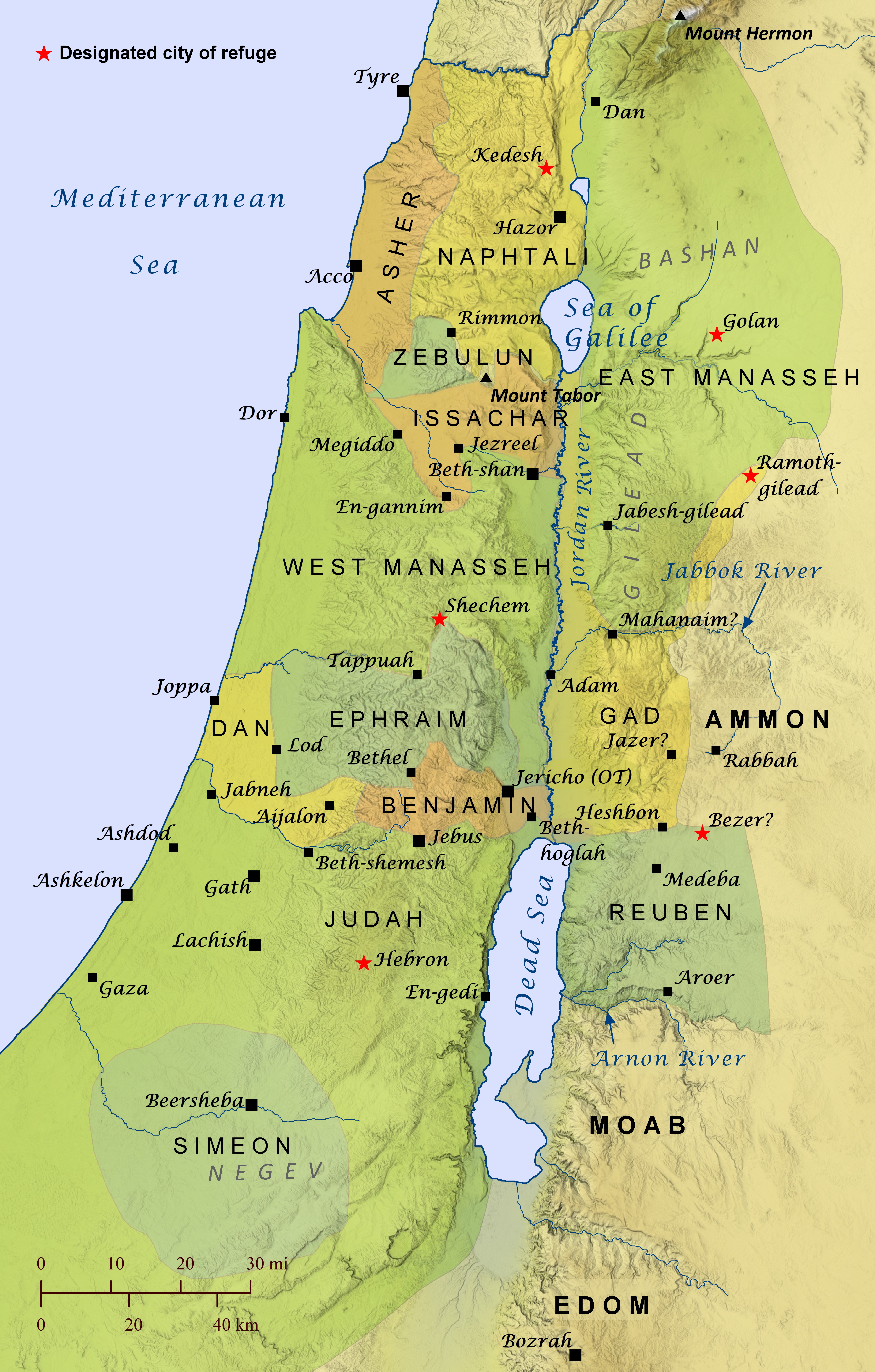
After the Israelites had conquered portions of the Promised Land and Joshua had grown old, the Lord directed him to divide the rest of the land among the tribes of Israel as their inheritance (Joshua 13-20). The eastern tribes had already been allotted their land under Moses’ leadership (Numbers 32), but they continued to help the other tribes drive out the Canaanites from land west of the Jordan River. The Lord also instructed the Israelites to designate several cities of refuge, where someone could flee for protection from an avenger if they accidentally killed someone (Numbers 35; Joshua 20).
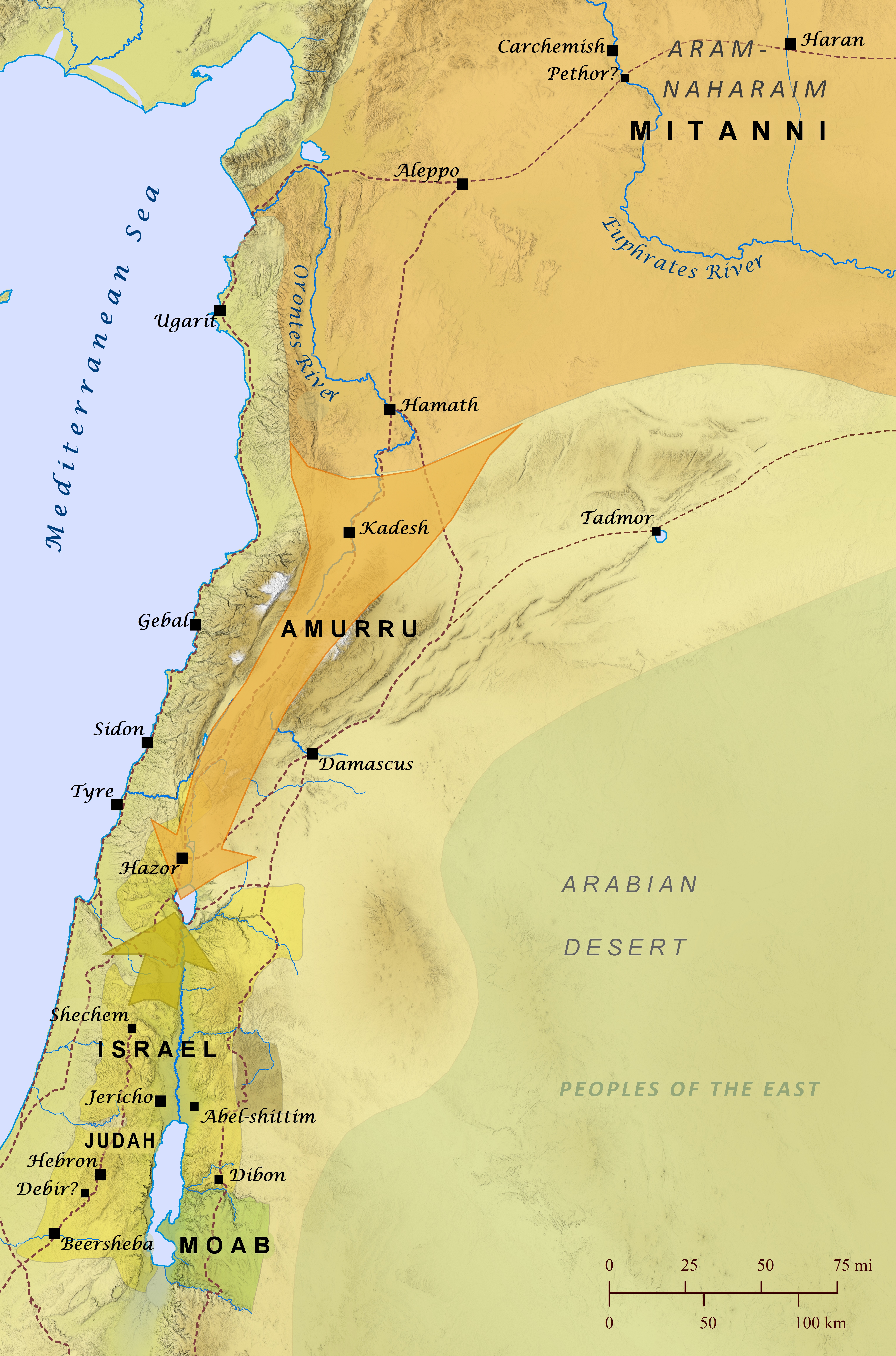
Joshua 15:13-19; Judges 1:11-15; 3:8-11
Though Scripture affords Othniel son of Kenaz a mere six verses to detail his accomplishments, the significance of what he accomplished should not be underestimated. Othniel is first mentioned during the initial conquest of the land, and it is noted that he was the son of Kenaz, the younger brother of Joshua. As the Israelites were seeking to capture Kiriath-sepher (later renamed Debir), Caleb offered the reward of his daughter Achsah (Othniel’s cousin) as a wife for whoever could take the town. Othniel took the town and received Achsah as his wife, and Caleb also granted him the nearby springs. After this, the writer of Judges recounts how the Israelites lived among the pagan inhabitants of the land, intermarried with them, and worshiped their gods. Therefore the Lord became angry with them, and he allowed them to be dominated by King Cushan-rishathaim of Aram-naharaim, who ruled over most of northwest Mesopotamia. This was the same land where Abraham lived before journeying on to Canaan (Genesis 11:27-31; also see “The World of the Patriarchs” map), the homeland of Isaac’s wife Rebekah (Genesis 24:10), the land to which Jacob fled to escape the wrath of his twin brother Esau (Genesis 28; also see “Jacob Goes to Paddan-Aram” map), and the homeland of Balaam son of Beor (Numbers 22:4-5; also see “Balaam Blesses Israel” map). As the first judge of Israel, Othniel led Israel from about 1374-1334 B.C., so it is likely that the kingdom of Cushan-rishathaim was the Mitanni kingdom, which ruled Aram-naharaim from about 1600-1260 B.C. If this is true, it is likely that Cushan-rishathaim was Eriba-Adad I, who ruled Mitanni from about 1390–1366 B.C. The name Cushan-rishathaim, meaning “Cush of the two wickednesses,” may have been an intentional corruption in Hebrew of an otherwise unknown name of Eriba-Adad I. By Othniel’s time, the Mitanni kingdom was beginning a period of decline, so their oppression of the newly established Israelite tribes may have been an attempt to reestablish their dominance throughout the region. Scripture succinctly notes that “the spirit of the Lord came upon [Othniel],” and he waged war against Cushan-rishathaim and defeated him, and the land of Israel had rest for forty years (Judges 3:10-11). Othniel’s bravery during this early period of Israel’s settlement in Canaan ultimately led the nation to victory and survival during a very vulnerable period of their history. And although the Mitanni kingdom continued to rule Aram-naharaim for another century, Othniel’s actions undoubtedly contributed to its continued decline and eventual collapse.
Open Bible Data site copyright © 2023–2026 Freely-Given.org.
Python source code for creating these static pages is available on GitHub under an open licence.
For Bible data copyrights, see the details for each displayed Bible version.
The Open English Translation (OET) main site is at OpenEnglishTranslation.Bible or OET.Bible.