
OET OET-RV OET-LV GHT ULT UST BSB MSB BLB AICNT OEB WEBBE WMBB NET LSV FBV TCNT T4T LEB BBE Moff JPS Wymth ASV DRA YLT Drby RV SLT Wbstr KJB-1769 KJB-1611 Bshps Gnva Cvdl TNT Wycl SR-GNT UHB BrLXX BrTr Related Parallel Simple Interlinear Topics Reference Dictionary Search
ParallelVerse GEN EXO LEV NUM DEU JOB JOS JDG RUTH 1 SAM 2 SAM PSA AMOS HOS 1 KI 2 KI 1 CHR 2 CHR PROV ECC SNG JOEL MIC ISA ZEP HAB JER LAM YNA (JNA) NAH OBA DAN EZE EZRA EST NEH HAG ZEC MAL LAO GES LES ESG DNG 2 PS TOB JDT WIS SIR BAR LJE PAZ SUS BEL MAN 1 MAC 2 MAC 3 MAC 4 MAC YHN (JHN) MARK MAT LUKE ACTs YAC (JAM) GAL 1 TH 2 TH 1 COR 2 COR ROM COL PHM EPH PHP 1 TIM TIT 1 PET 2 PET 2 TIM HEB YUD (JUD) 1 YHN (1 JHN) 2 YHN (2 JHN) 3 YHN (3 JHN) REV
Jos Intro C1 C2 C3 C4 C5 C6 C7 C8 C9 C10 C11 C12 C13 C14 C16 C17 C18 C19 C20 C21 C22 C23 C24
Jos 15 V1 V4 V7 V13 V16 V19 V22 V25 V28 V31 V34 V37 V40 V43 V46 V49 V52 V55 V58 V61
Note: This view shows ‘verses’ which are not necessarily natural language units and hence sometimes only part of a sentence will be visible—click on any Bible version abbreviation down the left-hand side to see the verse in more of its context. Normally the OET discourages the reading of individual ‘verses’, but this view is only designed as a tool for Bible-translators and others doing comparisons of different translations—the older translations are further down the page (so you can read up from the bottom to trace the English translation history). The OET segments on this page are still early looks into the drafted texts of the Open English Translation of the Bible—please double-check these texts in advance before using in public.
Text critical issues=none Clarity of original=clear Importance to us=normal Speaker(s)=Narrator (All still tentative.)
OET (OET-RV) Then the border went around from Ba’alah to the west to Mt. Seir, and passed over to the shoulder of Mt. Yearim from the north (also called Kesalon), and went down to Beyt-Shemesh, and passed over to Timnah.
OET-LV And_ the_border _it_turns from_Baˊₐlāh westward_to to the_mountain_of Sēˊīr and_it_passes_on to the_slope_of the_mountain_of Yəˊārīm from_northward_northward that is_Kəşālōn and_it_goes_down Bēyt Shemesh and_it_passes_on Timnāh.
UHB וְנָסַב֩ הַגְּב֨וּל מִבַּעֲלָ֥ה יָ֨מָּה֙ אֶל־הַ֣ר שֵׂעִ֔יר וְעָבַ֕ר אֶל־כֶּ֧תֶף הַר־יְעָרִ֛ים מִצָּפ֖וֹנָה הִ֣יא כְסָל֑וֹן וְיָרַ֥ד בֵּֽית־שֶׁ֖מֶשׁ וְעָבַ֥ר תִּמְנָֽה׃ ‡
(vənāşaⱱ haggəⱱūl mibaˊₐlāh yāmmāh ʼel-har sēˊir vəˊāⱱar ʼel-ketef har-yəˊārim miʦʦāfōnāh hiyʼ kəşālōn vəyārad bēyt-shemesh vəˊāⱱar timnāh.)
Key: khaki:verbs.
Note: Automatic aligning of the OET-RV to the LV is done by some temporary software, hence the OET-RV alignments are incomplete (and may occasionally be wrong).
BrLXX Καὶ περιελεύσεται ὅριον ἀπὸ Βαὰλ ἐπὶ θάλασσαν, καὶ παρελεύσεται εἰς ὄρος Ἀσσὰρ ἐπὶ νώτου πόλιν Ἰαρὶν ἀπὸ Βοῤῥᾶ· αὕτη ἐστὶ Χασλών· καὶ καταβήσεται ἐπὶ πόλιν ἡλίου, καὶ παρελεύσεται ἐπὶ Λίβα·
(Kai perieleusetai horion apo Baʼal epi thalassan, kai pareleusetai eis oros Assar epi nōtou polin Yarin apo Boɽɽa; hautaʸ esti Ⱪaslōn; kai katabaʸsetai epi polin haʸliou, kai pareleusetai epi Liba;)
BrTr And the border will go round from Baal to the sea, and will go on to the mount of Assar behind the city of Jarin northwards; this is Chaslon: and it will come down to the city of the Sun, and will go on to the south.
ULT And the border curved around from Baalah seaward to Mount Seir and passed over to the shoulder of Mount Jearim from the north (it is Chesalon). Then it went down to Beth Shemesh and passed over to Timnah.
UST Then the border continued west past Baalah to Mount Seir. Then it went southwest along the north side of Mount Jearim. (People also call that Mount Chesalon.) The border then went down to Beth Shemesh, and from there it passed by Timnah.
BSB & MSB The border curled westward from Baalah to Mount Seir, ran along the northern slope of Mount Jearim (that is, Chesalon), went down to Beth-shemesh, and crossed to Timnah.
OEB and west of Baalah round to Mount Seir, going on to the north of the ridge of Mount Jeadrim (that is, Chesalon), down to Beth-shemesh, and on to Timnah.
WEBBE & WMBB and the border turned about from Baalah westward to Mount Seir, and passed along to the side of Mount Jearim (also called Chesalon) on the north, and went down to Beth Shemesh, and passed along by Timnah;
NET It then turned from Baalah westward to Mount Seir, crossed to the slope of Mount Jearim on the north (that is Kesalon), descended to Beth Shemesh, and crossed to Timnah.
LSV and the border has gone around from Ba‘alah westward, to Mount Seir, and passed over to the side of Mount Jearim (it [is] Chesalon), on the north, and gone down [to] Beth-Shemesh, and passed over to Timnah;
FBV Then the boundary moved around to the west of Baalah to Mount Seir and passed along the northern slope of Mount Jearim to the town of Kesalon, down to Beth Shemesh and on to Timnah.
T4T Then the border extended further west to Seir Mountain. Then it continued southwest along the north side of Jearim Mountain, which is also named Kesalon, to Beth-Shemesh city. From there it extended northwest past Timnah city,
LEB and the border goes around from Baalah to the west, to Mount Seir, and passes on to the slope of Mount Jearim from the north (that is, Kesalon), and goes down to Beth Shemesh, and passes along by Timnah.
BBE Then turning west, the line goes from Baalah to Mount Seir, and on to the side of Mount Jearim (which is Chesalon) on the north, then down to Beth-shemesh, and on past Timnah:
Moff it also extended to Baalah (that is, Kiriath-jearim) and west of Baalah round to mount Seir, going on to the north of the ridge of mount Jeadrim (that is, Kesalon), down to Beth-shemesh, and on to Timnah;
JPS And the border turned about from Baalah westward unto mount Seir, and passed along unto the side of mount Jearim on the north — the same is Chesalon — and went down to Beth-shemesh, and passed along by Timnah.
ASV and the border turned about from Baalah westward unto mount Seir, and passed along unto the side of mount Jearim on the north (the same is Chesalon), and went down to Beth-shemesh, and passed along by Timnah;
DRA And it compasseth from Baala westward unto mount Seir: and passeth by the side of mount Jarim to the north into Cheslon: and goeth down into Bethsames, and passeth into Thamna.
YLT and the border hath gone round from Baalah westward, unto mount Seir, and passed over unto the side of mount Jearim (it [is] Chesalon), on the north, and gone down [to] Beth-Shemesh, and passed over to Timnah;
Drby and the border turned from Baalah westwards toward mount Seir, and passed toward the side of Har-jearim, that is, Chesalon, northwards, and went down to Beth-shemesh, and passed Timnah.
RV and the border turned about from Baalah westward unto mount Seir, and passed along unto the side of mount Jearim on the north (the same is Chesalon), and went down to Beth-shemesh, and passed along by Timnah:
SLT And the bound encompassed from Baalah to the sea to mount Seir, and passed over to the shoulder of Jearim from the north (this is Chesalon) and it went down to the House of the Sun, and passed over to Timnah:
Wbstr And the border compassed from Baalah westward to mount Seir, and passed along to the side of mount Jearim (which is Chesalon) on the north side, and went down to Beth-shemesh, and passed on to Timnah:
KJB-1769 And the border compassed from Baalah westward unto mount Seir, and passed along unto the side of mount Jearim, which is Chesalon, on the north side, and went down to Beth-shemesh, and passed on to Timnah:
(And the border compassed/surrounded from Baalah westward unto mount Seir, and passed along unto the side of mount Jearim, which is Chesalon, on the north side, and went down to Beth-shemesh, and passed on to Timnah:)
KJB-1611 And the border compassed from Baalah Westward vnto mount Seir, and passed along vnto the side of mount Iearim, (which is Chesalon) on the North side, and went downe to Bethshemesh, and passed on to Timnah.
(Modernised spelling is same as from KJB-1769 above, apart from capitalisation and punctuation)
Bshps And then it compasseth from Baala westward vnto mount Seir, and then goeth along vnto the side of mount Iarim, which is Chesalon on the northside, and commeth downe to Bethsames, and goeth to Thimnah.
(And then it compasseth/compasses/surrounds from Baala westward unto mount Seir, and then goeth/goes along unto the side of mount Yarim, which is Chesalon on the north_side, and cometh/comes down to Bethsames, and goeth/goes to Thimnah.)
Gnva Then this border compasseth from Baalah Westward vnto mount Seir, and goeth along vnto the side of mount Iearim, which is Chesalon on the Northside: so it commeth downe to Bethshemesh, and goeth to Timnah.
(Then this border compasseth/compasses/surrounds from Baalah Westward unto mount Seir, and goeth/goes along unto the side of mount Yearim, which is Chesalon on the North_side: so it cometh/comes down to Bethshemesh, and goeth/goes to Timnah.)
Cvdl and fetcheth a copasse aboute from Baala westwarde vnto mount Seir, and goeth by the north syde of the mount Iarim, that is Chessalon: and cometh downe to Bethsemes, and goeth thorow Thimna,
(and fetcheth a compass/all_around about from Baala westward unto mount Seir, and goeth/goes by the north side of the mount Yarim, that is Chessalon: and cometh/comes down to Bethsemes, and goeth/goes through Thimna,)
Wycl and it cumpassith fro Baala ayens the west, `til to the hil of Seir, and it passith bi the side of the hil Jarym to the north in Selbon, and goith doun in to Bethsamys; and it passith in to Thanna,
(and it surrounds from Baala against the west, till to the hill of Seir, and it passeth/passes by the side of the hill Yarym to the north in Selbon, and goeth/goes down in to Bethsamys; and it passeth/passes in to Thanna,)
Luth und lenket sich herum von Baala gegen Abend zum Gebirge Seir und gehet an der Seite her des Gebirges Jearim von mitternachtwärts, das ist Chessalon, und kommt herab gen Beth-Semes und gehet durch Thimna;
(and steers(v) itself/yourself/themselves around/about from Baalah to/against evening/night for_the mountains Seir and goes at/to the/of_the side(n) her the mountains Jearim from midnight, the is Chesalon, and comes down to/toward Beth-shemesh and goes through Timnah;)
ClVg Et circuit de Baala contra occidentem, usque ad montem Seir: transitque juxta latus montis Jarim ad aquilonem in Cheslon: et descendit in Bethsames, transitque in Thamna.
(And circuit from/about Baalah on_the_contrary west, until to mountain Seir: and_goes_over next_to side mountain Yearim to the_north in/into/on Chesalon: and came_down in/into/on Beth-shemesh, and_goes_over in/into/on Timnah.)
This section describes the boundaries of the tribe of Judah and lists the towns that are within those boundaries.
Here are some other possible section headings:
The boundaries of Judah
The land of the tribe of Judah
The north boundary of Judah started from the north end of the Dead Sea and went west from there to the Mediterranean Sea. This boundary did not go in a straight line. It swung south to avoid Jerusalem, which was part of the territory of Benjamin.
The border curled westward from Baalah to Mount Seir,
The border then curves to the west of Baalah on to Mount Seir.
The border goes in a curve west from Baalah Town and arrives at Mount Seir.
The border curled westward from Baalah to Mount Seir: The clause curled westward from Baalah to Mount Seir indicates that the border line was not straight. It went on a curve as it went westward to Mount Seir.
Mount Seir: The location of this mountain is uncertain. It may be a mountain ridge west of Kiriath-jearim and north of Chesalon, about eleven miles west of Jerusalem.15:10 Rasmussen, p. 250.
Here are some other ways to translate this part of the verse:
The border then curved to the west of the town of Baalah to Mount Seir
The border went in a curve west from Baalah to Seir Mountain
ran along the northern slope of Mount Jearim (that is, Chesalon),
It descends on to the northern side of Mount Jearim (also called Chesalon).
Then the border goes down along the northern ridge of Mount Jearim (which is also called Mount Chesalon).
ran along the northern slope of Mount Jearim (that is, Chesalon): The phrase the northern slope of Mount Jearim refers to the northern ridge of Mount Jearim.
Mount Jearim (that is, Chesalon): Mount Jearim was one of the low hills west of Jerusalem.
There is an interpretation issue here. There are two ways to understand the relationship between Chesalon and Mount Jearim.
Chesalon is another name for Mount Jearim. For example, the ESV says:
Mount Jearim (that is Chesalon) (BSB, ESV, RSV, NET, NIV, GW, NJPS, GNT, KJV)
Chesalon is the name of a town. For example:
the town of Kesalon on the northern slope of Mount Jearim (NLT) (NLT, CEV)
It is recommended that you follow interpretation (1). This is followed by most English versions.15:10 In modern times there is a town in this area called Kesla. Thus, it is possible that there was an ancient town called Chesalon. See Woudstra, p. 255–256.
Chesalon: Here are some ways that the English versions spell this word:
Chesalon (BSB, ESV, RSV, GW, GNT, CEV, NABRE, NJPS, KJV)
Kesalon (NIV, NET, NLT)
Here are some other ways to translate this part of the verse:
The border continued to the northern side of Mount Jearim (also called Mount Chesalon)
Then the border went down along the northern ridge of Mount Jearim (which is also called Mount Chesalon)
went down to Beth-shemesh, and crossed to Timnah.
It continues going down southwest to Beth-shemesh and then northwest to Timnah.
The border descends to Beth-shemesh Town and goes to Timnah Town.
went down to Beth-shemesh, and crossed to Timnah: Here are some other ways to translate this part of the verse:
The border descended to the town of Beth-shemesh and went on to the town of Timnah
It continued going down southwest to Beth-shemesh and then northwest to Timnah
crossed to Timnah: There is an interpretation issue here:
The border goes to the town of Timnah. For example:
and on to Timnah (GW) (BSB, GW, NIV, NET, NABRE, NJPS, CEV, NLT, KJV)
The border passes by the town of Timnah. For example:
passes along by Timnah (ESV) (ESV, RSV, GNT)
It is recommended that you follow option (1). This is the option taken by most English versions. However, the Hebrew grammar can be understood either way, and probably both are true.
Note 1 topic: figures-of-speech / personification
אֶל־כֶּ֧תֶף הַר־יְעָרִ֛ים
to/towards to/towards (Some words not found in UHB: and,it_turns the,border from,Baalah westward,to to/towards mount_of Sēˊīr and,it_passes_on to/towards slope_of mount_of Yəˊārīm/(Jearim) from,northward,northward she/it Kəşālōn/(Chesalon) and,it_goes_down house_of -shemesh and,it_passes_on Timnāh )
See how you translated the same expression in [Joshua 15:8](../15/08.md). Alternate translation: [to the north slope of Mount Jearim]
Note 2 topic: writing-background
הַר־יְעָרִ֛ים & הִ֣יא כְסָל֑וֹן
mount_of Yəˊārīm/(Jearim) & she/it Kəşālōn/(Chesalon)
The author is providing background information to help readers understand that Mount Jearim was also known as Chesalon. In your translation, present this information in a way that would be natural in your own language and culture.
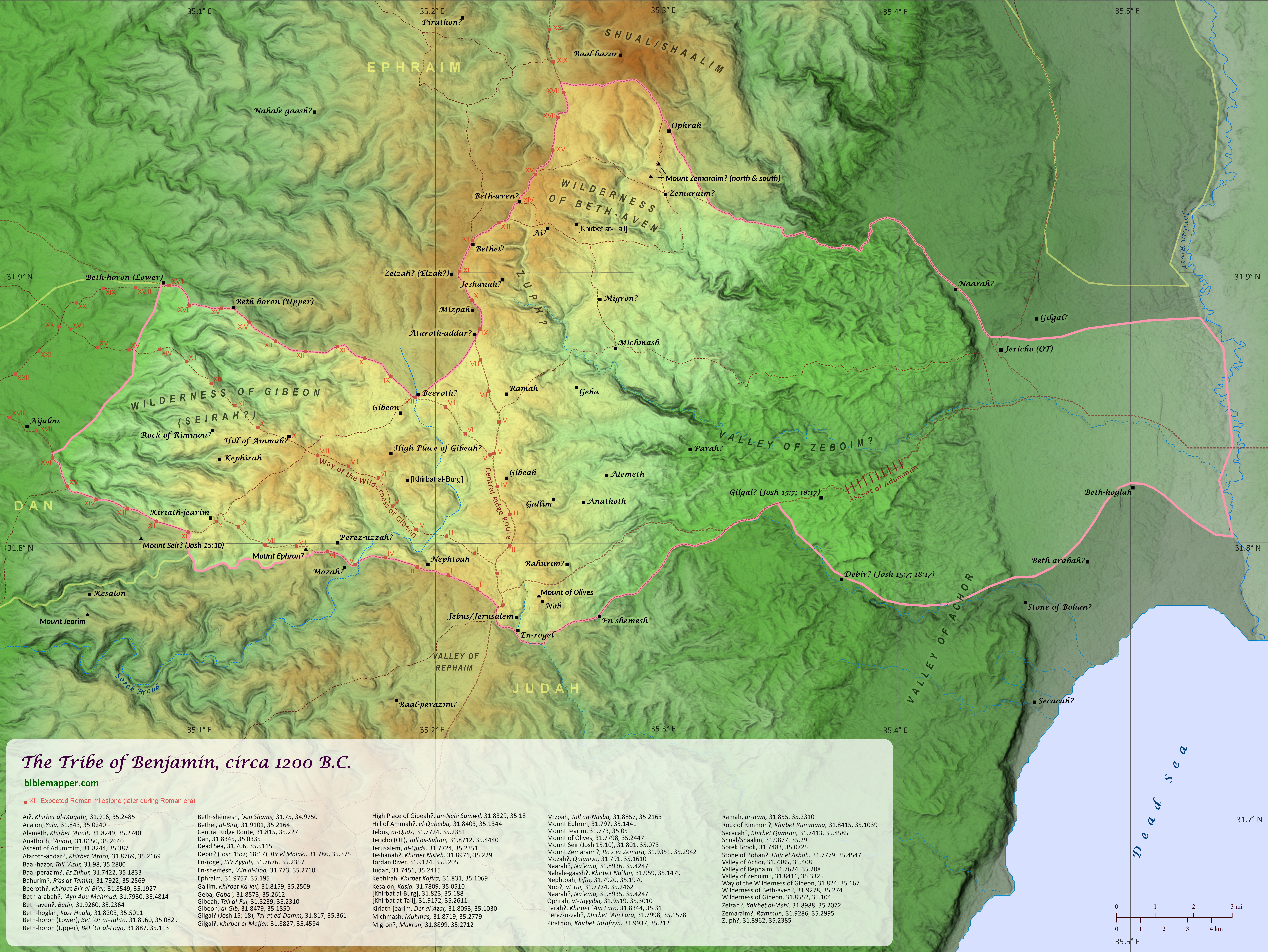
The descendants of Jacob’s son Benjamin occupied one of the smallest of the Israelite tribal allotments–measuring a mere 27 miles (43 km) wide by 14 miles (23 km) high–yet the significance of all the biblical events that took place within it is immense. Benjamin was the location of the Israelites’ very first battles to conquer to the Promised Land, beginning with Jericho and moving on to Ai (see “The Israelites Conquer Ai” map). After this, four Gibeonite towns–all located in western Benjaminite territory–deceived the Israelites into forming an alliance with them (see “The Conquest of Canaan: The Southern Campaign” map) in order to avoid being wiped out by them. Two judges (Ehud and Deborah; see “Ehud Rescues Israel” and “Deborah and Barak Defeat Sisera” maps) hailed from Benjamin as did the prophet Samuel (see “The Tribe of Benjamin” map). After the Ark of the Covenant was captured near Aphek and Shiloh was overrun by the Philistines, it appears that the altar was moved to the High Place of Gibeah by the time of Solomon (see “The Ark of the Covenant in the Promised Land” map). In the closing years of the judges, a tragic incident at Gibeah led to a war between Benjamin and the rest of the Israelites tribes (see “Israel Battles Benjamin” map). Saul, the first king of Israel, also hailed from Benjamin (see “Saul Searches for His Father’s Donkeys” map). While King David’s capital was at Hebron, a detachment of his forces attacked those of Saul’s son Ish-bosheth at Gibeon, leading them to flee to the Hill of Ammah (likely the same as Emmaus; see “The Battle at the Pool of Gibeon” map). David later established Jerusalem, technically located within Benjamin’s territory, as his new capital over all Israel (2 Samuel 5:6-9). The borders of Benjamin’s tribal allotment and the adjacent borders of its neighboring tribes are meticulously defined in Joshua 15:1-16:3 and Joshua 18:11-28, demonstrating the biblical writers’ acute awareness of Benjamin’s territory. Several stretches of these borders appear to follow established roads that existed during the settlement era.
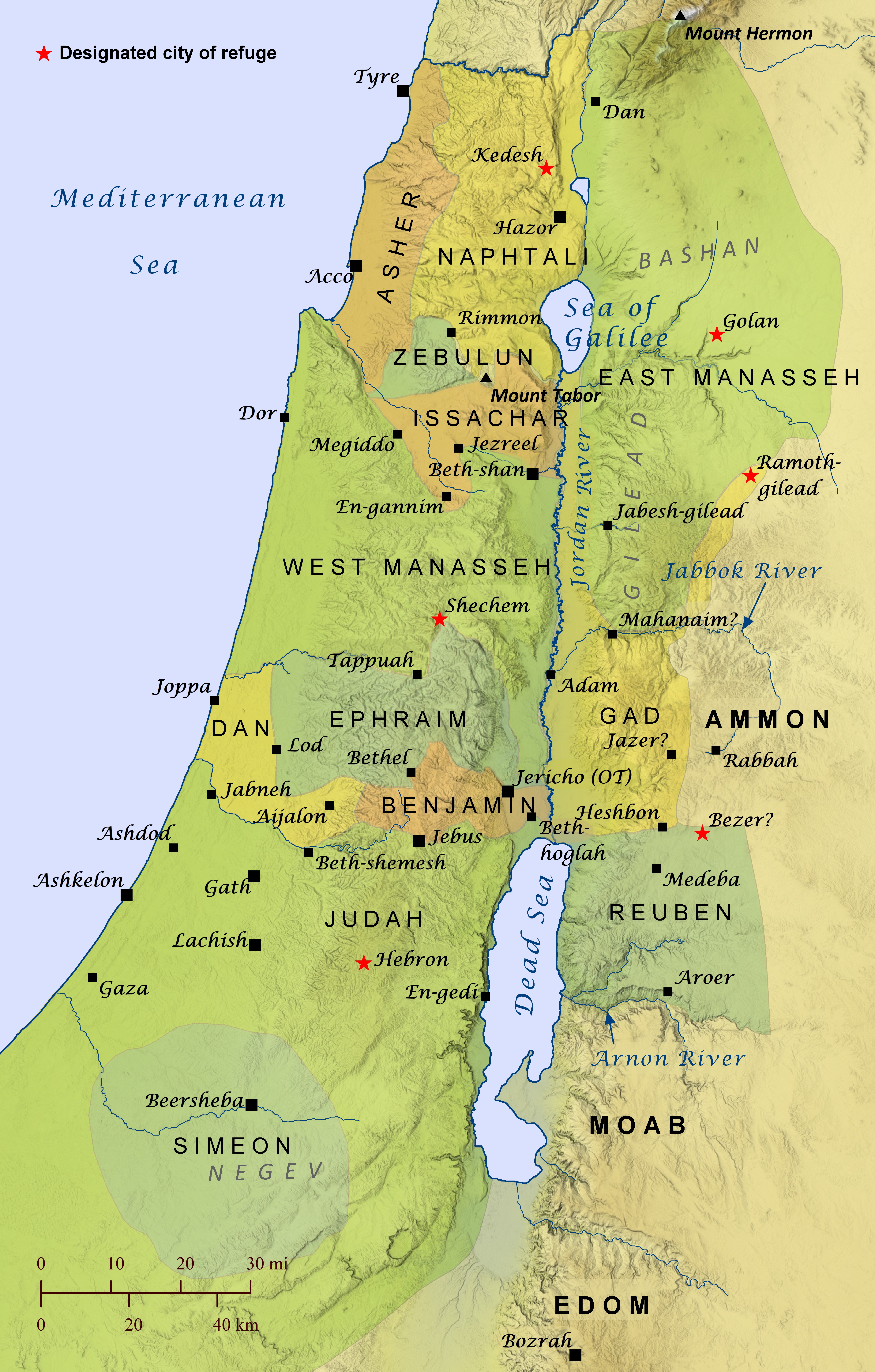
After the Israelites had conquered portions of the Promised Land and Joshua had grown old, the Lord directed him to divide the rest of the land among the tribes of Israel as their inheritance (Joshua 13-20). The eastern tribes had already been allotted their land under Moses’ leadership (Numbers 32), but they continued to help the other tribes drive out the Canaanites from land west of the Jordan River. The Lord also instructed the Israelites to designate several cities of refuge, where someone could flee for protection from an avenger if they accidentally killed someone (Numbers 35; Joshua 20).
Open Bible Data site copyright © 2023–2026 Freely-Given.org.
Python source code for creating these static pages is available on GitHub under an open licence.
For Bible data copyrights, see the details for each displayed Bible version.
The Open English Translation (OET) main site is at OpenEnglishTranslation.Bible or OET.Bible.