
OET OET-RV OET-LV GHT ULT UST BSB MSB BLB AICNT OEB WEBBE WMBB NET LSV FBV TCNT T4T LEB BBE Moff JPS Wymth ASV DRA YLT Drby RV SLT Wbstr KJB-1769 KJB-1611 Bshps Gnva Cvdl TNT Wycl SR-GNT UHB BrLXX BrTr Related Parallel Simple Interlinear Topics Reference Dictionary Search
ParallelVerse GEN EXO LEV NUM DEU JOB JOS JDG RUTH 1 SAM 2 SAM PSA AMOS HOS 1 KI 2 KI 1 CHR 2 CHR PROV ECC SNG JOEL MIC ISA ZEP HAB JER LAM YNA (JNA) NAH OBA DAN EZE EZRA EST NEH HAG ZEC MAL LAO GES LES ESG DNG 2 PS TOB JDT WIS SIR BAR LJE PAZ SUS BEL MAN 1 MAC 2 MAC 3 MAC 4 MAC YHN (JHN) MARK MAT LUKE ACTs YAC (JAM) GAL 1 TH 2 TH 1 COR 2 COR ROM COL PHM EPH PHP 1 TIM TIT 1 PET 2 PET 2 TIM HEB YUD (JUD) 1 YHN (1 JHN) 2 YHN (2 JHN) 3 YHN (3 JHN) REV
Jos Intro C1 C2 C3 C4 C5 C6 C7 C8 C9 C10 C11 C12 C13 C14 C15 C16 C17 C18 C19 C21 C22 C23 C24
Jos 20 V1 V2 V3 V4 V6 V7 V8 V9
Note: This view shows ‘verses’ which are not necessarily natural language units and hence sometimes only part of a sentence will be visible—click on any Bible version abbreviation down the left-hand side to see the verse in more of its context. Normally the OET discourages the reading of individual ‘verses’, but this view is only designed as a tool for Bible-translators and others doing comparisons of different translations—the older translations are further down the page (so you can read up from the bottom to trace the English translation history). The OET segments on this page are still early looks into the drafted texts of the Open English Translation of the Bible—please double-check these texts in advance before using in public.
Text critical issues=none Clarity of original=clear Importance to us=normal Speaker(s)=Narrator (All still tentative.)
OET (OET-RV) Now if a relative of the deceased comes to avenge the death, the city elders won’t hand over the killer because the death was accidental and didn’t happen because of hate or premeditation.
OET-LV And_because/when the_avenger_of (the)_blood he_will_pursue after_him and_not they_will_deliver_up DOM the_killer in_his/its_hand if/because with_not knowledge he_struck_down DOM his/its_neighbour and_not he was_hating to_him/it from_yesterday the_third_day.
UHB וְכִ֨י יִרְדֹּ֜ף גֹּאֵ֤ל הַדָּם֙ אַֽחֲרָ֔יו וְלֹֽא־יַסְגִּ֥רוּ אֶת־הָרֹצֵ֖חַ בְּיָד֑וֹ כִּ֤י בִבְלִי־דַ֨עַת֙ הִכָּ֣ה אֶת־רֵעֵ֔הוּ וְלֹֽא־שֹׂנֵ֥א ה֛וּא ל֖וֹ מִתְּמ֥וֹל שִׁלְשֽׁוֹם׃ ‡
(vəkiy yirdof goʼēl haddām ʼaḩₐrāyv vəloʼ-yaşgirū ʼet-hāroʦēaḩ bəyādō kiy ⱱiⱱəlī-daˊat hikkāh ʼet-rēˊēhū vəloʼ-sonēʼ hūʼ lō mittəmōl shilshōm.)
Key: khaki:verbs.
Note: Automatic aligning of the OET-RV to the LV is done by some temporary software, hence the OET-RV alignments are incomplete (and may occasionally be wrong).
BrLXX No BrLXX JOS 20:5 verse available
BrTr No BrTr JOS 20:5 verse available
ULT And if the avenger of blood pursues after him, then they shall not deliver the one having killed into his hand. For without knowledge he struck his neighbor, and he was not hating him from yesterday, or the third day.
UST Suppose some relative of the dead person comes to that city to try to take revenge by killing the person who fled. The leaders of that city must not allow the relative to take him away and kill him, because what happened was accidental. He did not hate that person in the past.
BSB & MSB Now if the avenger of blood pursues him, they must not surrender the manslayer into his hand, because [that man] killed his neighbor accidentally without prior malice
OEB and if the next of kin comes in pursuit, they must not hand the killer over, because they killed their neighbour by accident, having had no feud with them previously.
WEBBE & WMBB If the avenger of blood pursues him, then they shall not deliver up the man slayer into his hand; because he struck his neighbour unintentionally, and didn’t hate him before.
NET When the avenger of blood comes after him, they must not hand over to him the one who committed manslaughter, for he accidentally killed his fellow man without premeditation.
LSV And when the redeemer of blood pursues after him, then they do not shut up the manslayer into his hand, for he has struck his neighbor without knowledge, and is not hating him until now;
FBV If the one seeking revenge comes looking for the man, they must not hand the one who committed manslaughter over to him, because he killed someone unintentionally and without deliberate hatred.
T4T If some relative of the one who was killed comes to that city to get revenge, the leaders of that city must not allow the relative to take the killer, because what happened was accidental. He did not hate that person and as a result deliberately kill him.
LEB And if the avenger of blood pursues after him, they will not hand over the killer into his hand, because he killed his neighbor unintentionally, and ⌊he did not hate him previously⌋.[fn]
20:5 Literally “he did not hate him since yesterday and the day before that”
BBE And if the one who has the right of punishment comes after him, they are not to give the taker of life up to him; because he was the cause of his neighbour's death without designing it and not in hate.
Moff and if the avenger of blood pursues him, they shall not hand the homicide over, because he killed his neighbour by accident, having had no feud with him previously.
JPS And if the avenger of blood pursue after him, then they shall not deliver up the manslayer into his hand; because he smote his neighbour unawares, and hated him not beforetime.
ASV And if the avenger of blood pursue after him, then they shall not deliver up the manslayer into his hand; because he smote his neighbor unawares, and hated him not beforetime.
DRA And when the avenger of blood shall pursue him, they shall not deliver him into his hands, because he slew his neighbour unawares, and is not proved to have been his enemy two or three days before.
YLT 'And when the redeemer of blood doth pursue after him, then they do not shut up the man-slayer into his hand, for without knowledge he hath smitten his neighbour, and is not hating him hitherto;
Drby And if the avenger of blood pursue after him, they shall not deliver the slayer up into his hand; for he smote his neighbour unwittingly, and hated him not previously.
RV And if the avenger of blood pursue after him, then they shall not deliver up the manslayer into his hand; because he smote his neighbour unawares, and hated him not beforetime.
SLT And if the nearest relation of blood shall pursue after him, and they shall not deliver over the slayer into his hand; for without knowing he smote his friend, and he hated him not from yesterday the third day.
Wbstr And if the avenger of blood shall pursue him, then they shall not deliver the slayer into his hand; because he smote his neighbor ignorantly, and had not hated him before.
KJB-1769 And if the avenger of blood pursue after him, then they shall not deliver the slayer up into his hand; because he smote his neighbour unwittingly, and hated him not beforetime.
KJB-1611 And if the auenger of blood pursue after him, then they shal not deliuer the slayer vp into his hand: because hee smote his neighbour vnwittingly, and hated him not beforetime.
(Modernised spelling is same as from KJB-1769 above, apart from punctuation)
Bshps And if the auenger of blood folow after him, they shall not deliuer the slear into his hand: because he smote his friend ignorauntly, and hated him not before tyme.
(And if the avenger of blood follow after him, they shall not deliver the slayer/killer into his hand: because he smote his friend ignorantly, and hated him not before time.)
Gnva And if the auenger of blood pursue after him, they shall not deliuer the slaier into his hand because hee smote his neighbour ignorantly, neither hated he him before time:
(And if the avenger of blood pursue after him, they shall not deliver the slayer into his hand because he smote his neighbour ignorantly, neither hated he him before time:)
Cvdl And yf the auenger of bloude folowe vpon him, they shall not delyuer the deedslayer in to his handes, for so moch as he hath slayne his neghboure vnawarres, and was not his enemye afore:
(And if the avenger of blood follow upon him, they shall not deliver the manslayer in to his hands, for so much as he hath/has slain/killed his neighbour unawares, and was not his enemy afore:)
Wycl And whanne the vengere of blood pursueth hym, thei schulen not bitake hym in to the hondis of the vengere; for vnwityngli he killide his neiybore, and is not preued his enemy bifor the secounde dai ethir the thridde dai.
(And when the avenger of blood pursueth him, they should not betake/give/grant him in to the hands of the avenger; for unknowingly he killed his neighbour, and is not proved his enemy before the second day either the third day.)
Luth Und wenn der Bluträcher ihm nachjagt, sollen sie den Totschläger nicht in seine Hände übergeben, weil er unwissend seinen Nächsten geschlagen hat und ist ihm zuvor nicht feind gewesen.
(And if/when the/of_the blood-avenger him chases, should they/she/them the murderer not in his hands hand-over/transfer, because he ignorant his neighbour beaten has and is him before not fined been.)
ClVg Cumque ultor sanguinis eum fuerit persecutus, non tradent in manus ejus: quia ignorans percussit proximum ejus, nec ante biduum triduumve ejus probatur inimicus.
(And_when avenger blood him has_been persecuted, not/no they_will_deliver in/into/on hands his/her: because unaware/ignorant he_struck next_door his/her, but_not before two_days or_three_days his/her approved the_enemy.)
Now if the avenger of blood pursues him,
If the relative who wants to kill him chases after him
And if the relative who wants to get revenge follows after the killer,
Now: The Hebrew conjunction that the BSB translates as Now can also be translated “but” to indicate contrast. It is not a time word. Choose the word that is most natural in this context. Some English versions do not translate this word.
if: The Hebrew conjunction that the BSB translates as if can also be translated as “when.” Choose the conjunction that is most natural in your language.
the avenger of blood: The term avenger of blood was first mentioned in 20:3b. You should translate it the same way here.
pursues him: The Hebrew verb that the BSB translates as pursues can also be translated as “chases” or “follows.”
Here are some other ways to translate this part of the verse:
But if the relative of the person who died chases after the person who killed him
But if the relative of the dead person follows after the killer
they must not surrender the manslayer into his hand,
the elders must not hand him over to that relative.
the town leaders must not give him up.
they: The pronoun they refers to the elders of the town.
must not surrender the manslayer into his hand: The clause must not surrender the manslayer into his hand means that the elders must protect the manslayer (the person who killed someone) from the person who is trying to get revenge. They must not hand him over to that person.
Here are some other ways to translate this part of the verse:
the elders must not hand over the killer to the person trying to avenge the dead man
the town leaders must not give up the person who killed to the relative
because that man killed his neighbor accidentally
They must protect him because he has killed his neighbor without intending it.
They must do this because he killed the other person without planning to do it,
because that man killed his neighbor accidentally: The clause that man killed his neighbor accidentally indicates the reason why the person who killed should be protected from his pursuer.
his neighbor: The Hebrew word that the BSB translates as neighbor can also be translated “friend,” “companion” or “other one.” In this context it refers to a fellow human being.
accidentally: The word accidentally means that the killer did not plan to kill. This is the same Hebrew word as in verse 20:3.
Here are some other ways to translate this part of the verse:
They must protect him because he has killed his fellow man without intending it.
They must do this because he killed the other person without planning to do it.
without prior malice.
He had not hated him in the past.
and not because he was angry with him in past times.
without prior malice: The Hebrew clause that the BSB translates as without prior malice is more literally “and not hating him from yesterday three days ago.” The phrase “from yesterday three days ago” is a Hebrew idiom that means “in the past.”
Here are some other ways to translate this part of the verse:
He had not hated him in the past.
and not because he was angry with him in the past
In the Hebrew and in the BSB verse 5 is a long sentence. It may be more natural in some languages to divide it into more than one sentence. For example:
But if the one who is chasing him follows him to that town, the leaders of the city must not hand over the killer. It was an accident. He did not hate him beforehand or kill him on purpose. (NCV)
Note 1 topic: figures-of-speech / idiom
מִתְּמ֥וֹל שִׁלְשֽׁוֹם
(Some words not found in UHB: and=because/when pursues avenger_of of_(the),blood after,him and=not give_up DOM the,killer in=his/its=hand that/for/because/then/when with,not knowledge killed DOM his/its=neighbour and=not hate he/it to=him/it from,yesterday before )
See how you translated the same expression in [Joshua 3:4](../03/04.md). Alternate translation: [in the past]
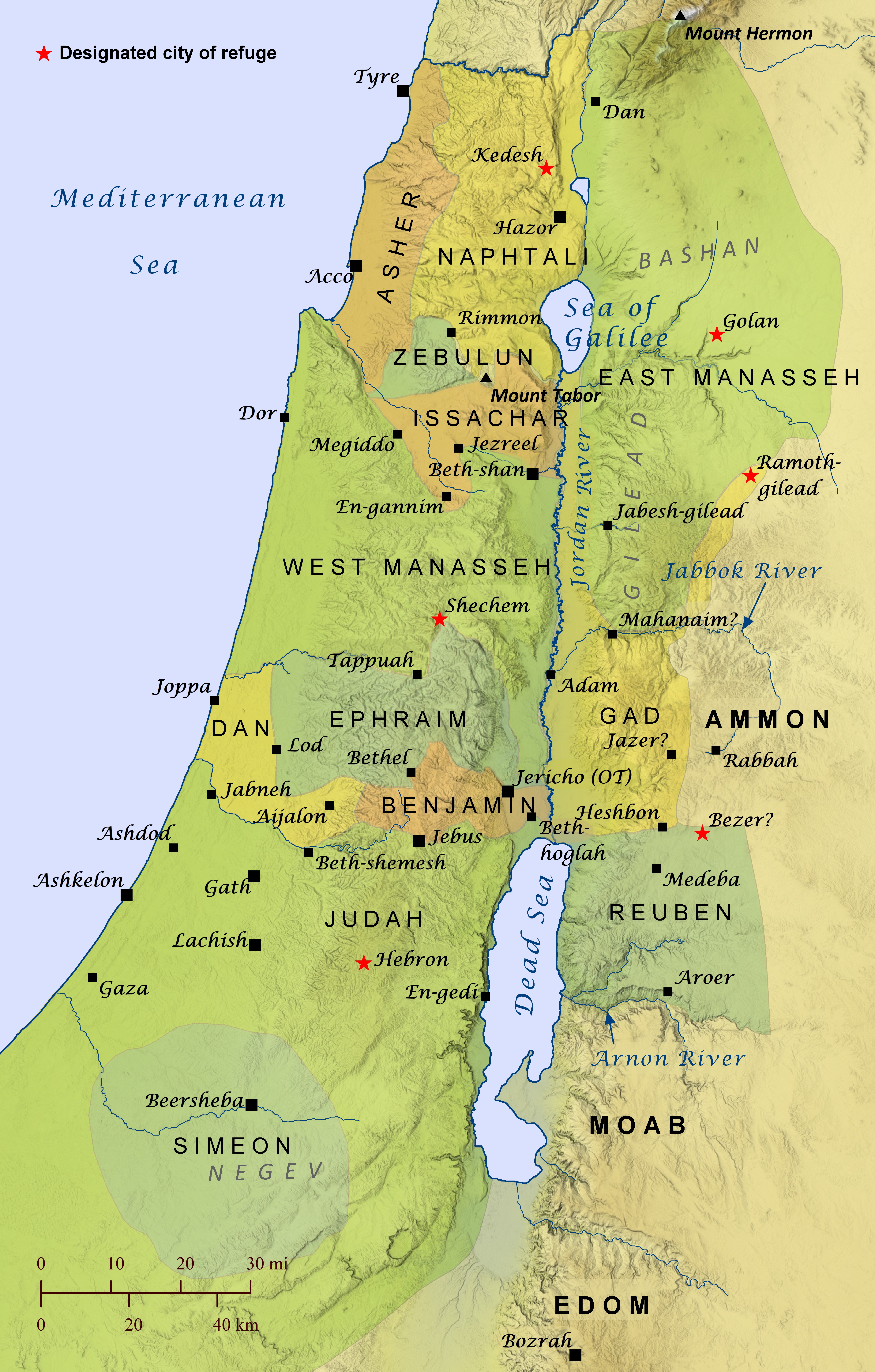
After the Israelites had conquered portions of the Promised Land and Joshua had grown old, the Lord directed him to divide the rest of the land among the tribes of Israel as their inheritance (Joshua 13-20). The eastern tribes had already been allotted their land under Moses’ leadership (Numbers 32), but they continued to help the other tribes drive out the Canaanites from land west of the Jordan River. The Lord also instructed the Israelites to designate several cities of refuge, where someone could flee for protection from an avenger if they accidentally killed someone (Numbers 35; Joshua 20).
Open Bible Data site copyright © 2023–2026 Freely-Given.org.
Python source code for creating these static pages is available on GitHub under an open licence.
For Bible data copyrights, see the details for each displayed Bible version.
The Open English Translation (OET) main site is at OpenEnglishTranslation.Bible or OET.Bible.