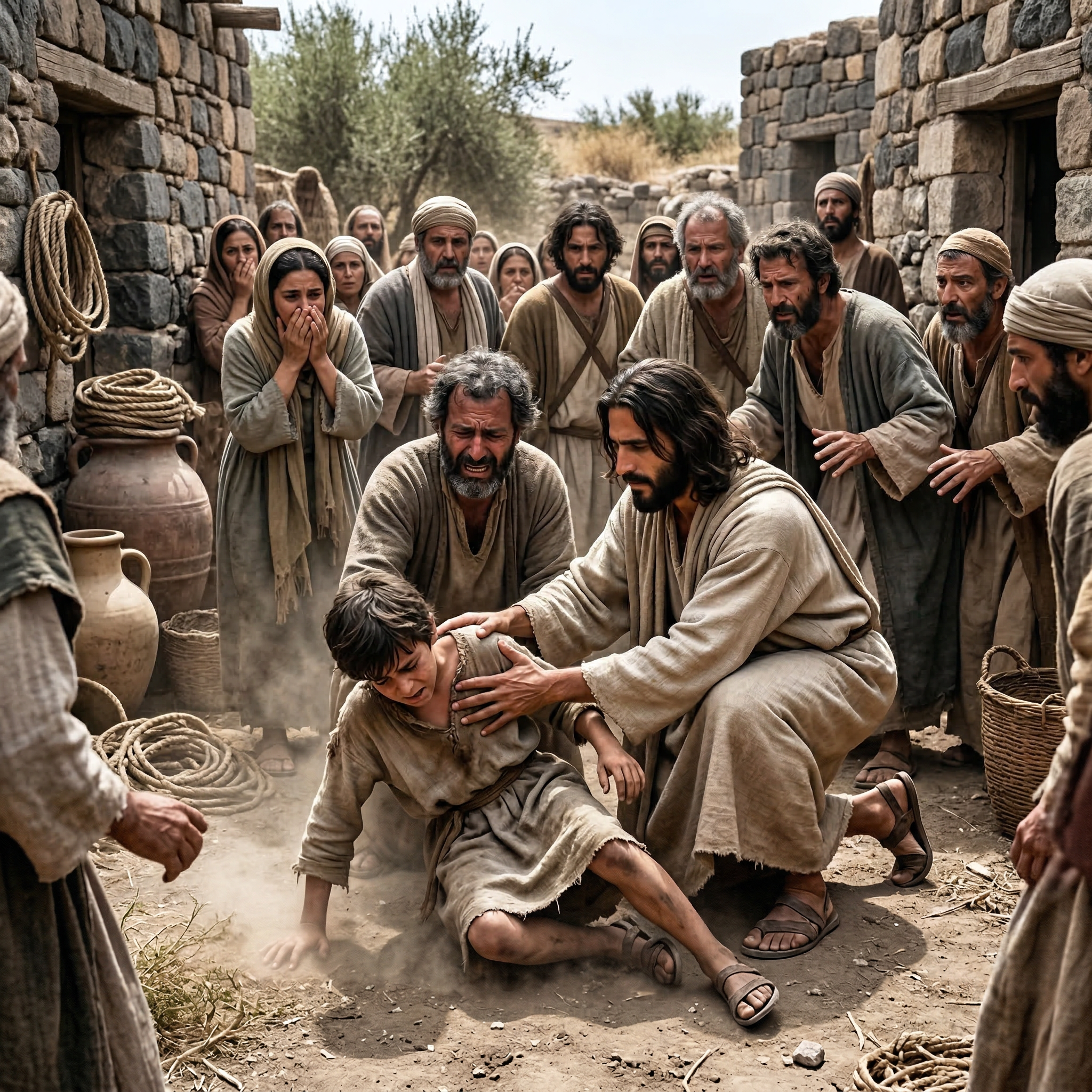
 When they got back to his other followers, Yeshua saw that they were surrounded by a large crowd and the religious teachers were debating with them.
OET OET-RV OET-LV GHT ULT UST BSB MSB BLB AICNT OEB WEBBE WMBB NET LSV FBV TCNT T4T LEB BBE Moff JPS Wymth ASV DRA YLT Drby RV SLT Wbstr KJB-1769 KJB-1611 Bshps Gnva Cvdl TNT Wycl SR-GNT UHB BrLXX BrTr Related Parallel Simple Interlinear Topics Reference Dictionary Search
ParallelVerse GEN EXO LEV NUM DEU JOB JOS JDG RUTH 1 SAM 2 SAM PSA AMOS HOS 1 KI 2 KI 1 CHR 2 CHR PROV ECC SNG JOEL MIC ISA ZEP HAB JER LAM YNA (JNA) NAH OBA DAN EZE EZRA EST NEH HAG ZEC MAL LAO GES LES ESG DNG 2 PS TOB JDT WIS SIR BAR LJE PAZ SUS BEL MAN 1 MAC 2 MAC 3 MAC 4 MAC YHN (JHN) MARK MAT LUKE ACTs YAC (JAM) GAL 1 TH 2 TH 1 COR 2 COR ROM COL PHM EPH PHP 1 TIM TIT 1 PET 2 PET 2 TIM HEB YUD (JUD) 1 YHN (1 JHN) 2 YHN (2 JHN) 3 YHN (3 JHN) REV
Mark Intro C1 C2 C3 C4 C5 C6 C7 C8 C10 C11 C12 C13 C14 C15 C16
Mark 9 V1 V3 V5 V7 V9 V11 V13 V15 V17 V19 V21 V23 V25 V27 V29 V31 V33 V35 V37 V39 V41 V43 V45 V47 V49
Note: This view shows ‘verses’ which are not necessarily natural language units and hence sometimes only part of a sentence will be visible—click on any Bible version abbreviation down the left-hand side to see the verse in more of its context. Normally the OET discourages the reading of individual ‘verses’, but this view is only designed as a tool for Bible-translators and others doing comparisons of different translations—the older translations are further down the page (so you can read up from the bottom to trace the English translation history). The OET segments on this page are still early looks into the drafted texts of the Open English Translation of the Bible—please double-check these texts in advance before using in public.
Text critical issues=small word differences Clarity of original=clear Importance to us=normal Speaker(s)=Narrator (All still tentative.)
OET (OET-RV)
When they got back to his other followers, Yeshua saw that they were surrounded by a large crowd and the religious teachers were debating with them.
OET-LV And having_come to the apprentices/followers, he_saw a_ great _crowd around them, and the_scribes debating with with_them.
SR-GNT Καὶ ἐλθόντες πρὸς τοὺς μαθητὰς, εἶδεν ὄχλον πολὺν περὶ αὐτοὺς, καὶ γραμματεῖς συζητοῦντας πρὸς αὐτούς. ‡
(Kai elthontes pros tous mathaʸtas, eiden oⱪlon polun peri autous, kai grammateis suzaʸtountas pros autous.)
Key: khaki:verbs, orange:accusative/object.
Note: Automatic aligning of the OET-RV to the LV is done by some temporary software, hence the RV alignments are incomplete (and may occasionally be wrong).
GHT and, come[ing] toward the disciples, he-beholds [a] vast crowd around same and scribes, together-seeking to {same},
ULT And having come to the disciples, they saw a great crowd around them and scribes arguing with them.
UST Then Jesus and those three apprentices arrived where the other apprentices were. They saw a large group of people around the other apprentices. Some teachers of the Jewish laws were debating with them.
BSB [When] they returned to the [other] disciples, they saw a large crowd around them, and scribes arguing with them.
MSB [When] [Jesus] returned to the [other] disciples, He saw[fn] a large crowd around them, and scribes arguing with them.
9:14 CT When they returned to the other disciples, they saw
BLB And having come to the disciples, they saw a great crowd around them, and scribes arguing with them.
AICNT And when they came to the disciples, they saw a [large][fn] crowd around them and scribes arguing with them.
9:14, large: Absent from W(032).
OEB When they came to the other disciples, they saw a great crowd round them, and some teachers of the Law arguing with them.
WEBBE & WMBB Coming to the disciples, he saw a great multitude around them, and scribes questioning them.
NET When they came to the disciples, they saw a large crowd around them and experts in the law arguing with them.
LSV And having come to the disciples, He saw a great multitude around them, and scribes questioning with them,
FBV When they returned to the other disciples, they saw them surrounded by a large crowd and some religious teachers arguing with them.
TCNT When [fn]Jesus came back to the other disciples, he saw a large crowd around them, and some scribes arguing with them.
9:14 Jesus came back to the other disciples, he ¦ they came back to the other disciples, they CT
T4T Jesus and those three disciples returned to where the other disciples were. They saw a large crowd around the other disciples and some men who taught the Jewish laws arguing with them.
LEB ¶ And when they[fn] came to the disciples, they saw a large crowd around them and scribes arguing with them.
9:14 *Here “when” is supplied as a component of the participle (“came”) which is understood as temporal
BBE And when they came to the disciples, they saw a great mass of people about them, and scribes questioning them.
Moff On reaching the disciples they saw a large crowd round them, and some scribes arguing with them.
Wymth As they came to rejoin the disciples, they saw an immense crowd surrounding them and a party of Scribes disputing with them.
ASV And when they came to the disciples, they saw a great multitude about them, and scribes questioning with them.
DRA (MRK 9:13) And coming to his disciples, he saw a great multitude about them, and the scribes disputing with them.
YLT And having come unto the disciples, he saw a great multitude about them, and scribes questioning with them,
Drby And when he came to the disciples he saw a great crowd around them, and scribes disputing against them.
RV And when they came to the disciples, they saw a great multitude about them, and scribes questioning with them.
SLT And having come to the disciples, he saw a great crowd about them, and the scribes seeking out with them.
Wbstr And when he came to his disciples, he saw a great multitude about them, and the scribes questioning with them.
KJB-1769 ¶ And when he came to his disciples, he saw a great multitude about them, and the scribes questioning with them.
KJB-1611 ¶ And when he came to his disciples, he saw a great multitude about them, and the Scribes questioning with them.
(Same as from KJB-1769 above, apart from capitalisation)
Bshps And when he came to his disciples, he sawe much people about them, and the scribes disputyng with them.
(And when he came to his disciples, he saw much people about them, and the scribes disputing with them.)
Gnva And when he came to his disciples, he saw a great multitude about them, and the Scribes disputing with them.
Cvdl And he came to his disciples, and sawe moch people aboute them, and the scrybes disputynge with them.
(And he came to his disciples, and saw much people about them, and the scribes disputing with them.)
TNT And he came to his disciples and sawe moche people aboute them and the scribes disputinge with them.
(And he came to his disciples and saw much people about them and the scribes disputing with them.)
Wycl (MRK 9:13) And he comynge to hise disciplis, saiy a greet cumpany aboute hem, and scribis disputynge with hem.
(And he coming to his disciples, saw a great company about hem, and scribes disputing with hem.)
Luth Und, er kam zu seinen Jüngern und sah viel Volks um sie und Schriftgelehrte, die sich mit ihnen befragten.
(And, he came to/for his disciples and saw(v) many peoples around/by/for they/she/them and scribes, the itself/yourself/themselves with to_them interviewed.)
ClVg (MRK 9:13) Et veniens ad discipulos suos, vidit turbam magnam circa eos, et scribas conquirentes cum illis.[fn]
(And coming to disciples his_own, he_saw crowd great around/about them, and scribe/clerks those_who_are_searching when/with to_them.)
9.13 Turbam magnam. HIER. Non est requies sub sole: semper occidit parvulos invidia, magnos percutiunt fulgura montes, alii discentes cum fide, alii invidentes cum fastu, ad Ecclesiam veniunt. Conquirentes. BEDA. Quid conquirant Evangelista non dicit, sed potest intelligi de hoc quæstionem motam fuisse, quare discipuli dæmoniacum qui in medio erat, non possent liberare: hoc enim ex sequentibus concipi potest.
9.13 Crowd great. HIER. Not/No it_is rest/repose under sole: always killed little_ones envy, the_great they_strike lightning mountains, others learning when/with with_faith, others envious when/with arrogance, to assembly/church they_come. Those_who_are_searching. BEDA. What they_may_search Evangelist not/no he_says, but can to_be_understood from/about this question moved to_have_been, why disciples/students demonic who/which in/into/on in_the_middle was, not/no they_could to_free: this because from following to_be_conceived can.
UGNT καὶ ἐλθόντες πρὸς τοὺς μαθητὰς, εἶδον ὄχλον πολὺν περὶ αὐτοὺς, καὶ γραμματεῖς συνζητοῦντας πρὸς αὐτούς.
(kai elthontes pros tous mathaʸtas, eidon oⱪlon polun peri autous, kai grammateis sunzaʸtountas pros autous.)
SBL-GNT Καὶ ⸂ἐλθόντες πρὸς τοὺς μαθητὰς εἶδον⸃ ὄχλον πολὺν περὶ αὐτοὺς καὶ γραμματεῖς συζητοῦντας ⸂πρὸς αὐτούς⸃.
(Kai ⸂elthontes pros tous mathaʸtas eidon⸃ oⱪlon polun peri autous kai grammateis suzaʸtountas ⸂pros autous⸃.)
RP-GNT Καὶ ἐλθὼν πρὸς τοὺς μαθητάς, εἶδεν ὄχλον πολὺν περὶ αὐτούς, καὶ γραμματεῖς συζητοῦντας αὐτοῖς.
(Kai elthōn pros tous mathaʸtas, eiden oⱪlon polun peri autous, kai grammateis suzaʸtountas autois.)
TC-GNT Καὶ [fn]ἐλθὼν πρὸς τοὺς μαθητὰς εἶδεν ὄχλον πολὺν περὶ αὐτοὺς καὶ γραμματεῖς [fn]συζητοῦντας [fn]αὐτοῖς.
(Kai elthōn pros tous mathaʸtas eiden oⱪlon polun peri autous kai grammateis suzaʸtountas autois.)
9:14 ελθων προς τους μαθητας ειδεν ¦ ελθοντες προς τους μαθητας ειδον ɴᴀ ꜱʙʟ ᴛʜ ¦ ελθοντες προς τους μαθητας ειδαν ᴡʜ
9:14 συζητουντας ¦ συνζητουντας ᴛʜ ᴡʜ
9:14 αυτοις ¦ προς αυτους ᴄᴛ
Key for above GNTs: red:words differ (from our SR-GNT base).
Earlier Jesus had given power to his twelve disciples to cast out demons and heal sick people. The disciples divided into groups of two and went and did those things (6:7–13). But here, when Jesus came down from the mountain with Peter, James, and John, he saw the other disciples arguing with the teachers of the Jewish law. They were arguing because the disciples were not able to make an evil spirit leave a man’s son.
When the evil spirit saw Jesus, it took control of the boy. Then Jesus caused the evil spirit to leave him. A large crowd of people was there and saw all these things.
It is good to translate this section before you decide on a heading for it. Here are some other possible headings for this section:
The Healing of a Boy with an Evil Spirit (NIV)
A boy was freed from an evil spirit
The Disciples’ Failure to Heal (NET)
There are parallel passages for this section in Matthew 17:14–21 and Luke 9:37–43.
When they returned to the other disciples,
¶ When they came/returned to the other disciples,
¶ When Jesus and his three followers came down the mountain,
When they returned to the other disciples, they saw: There is a textual issue here. (1) Some Greek manuscripts have plural verb endings. The implied subject of these verbs is Jesus and the three disciples who went up the mountain with him. For example, the GNT says: “When they joined the rest of the disciples, they saw” (BSB, RSV, NIV, GNT, NJB, NASB, NLT, GW, CEV, NET, JBP, REB, NCV, ESV). (2) Other Greek manuscripts have singular verb endings. The implied subject of these verbs is Jesus. For example, the KJV says: “when he came to [his] disciples, he saw” (KJV). It is recommended that you follow option (1). Since a new paragraph begins here, it may be natural to indicate who the word they refers to. For example:
When Jesus and the three disciples came to the other disciples, they saw…
returned to the other disciples: In 9:9a, Jesus and his disciples were descending the mountain. It is implied that they finished descending the mountain and then came to the place where the other disciples were. In some languages it may be necessary to make explicit some of this implied information. For example:
When Jesus and his three disciples had come down the mountain, they reached/approached the place where the other disciples were.
disciples: The Greek word that the BSB translates as disciples means “learners” who are in a relationship with a teacher. The learners commit themselves to their teacher in order to learn from him and live according to his teaching and example. In the New Testament disciples often lived with their teacher and followed him wherever he went.
Some ways to translate disciples are:
Use a term that refers to people who learn from a teacher or an expert. It is helpful if the term also implies that the learners are often with their teacher. For example:
learners/students
apprentices Be careful not to use a term that would refer only to a student in a school or classroom.
Use a term that refers to people who follow a teacher or leader by obeying his teaching. It is helpful if this term also implies learning from the teacher and actually following the teacher wherever he goes. For example:
followers
those who are committed/faithful (to a teacher/leader)
See how you translated this term at 8:34a. See also disciple in the Glossary for more information.
they saw a large crowd around them,
they saw a large crowd standing around them,
they saw/found a large group of people surrounding the other followers.
they saw: In the phrase that the BSB translates as they saw, the word they again refers to Jesus and the three disciples who were with him on the mountain.
around them: The word them here refers to the other disciples who had not gone up the mountain with Jesus.
and scribes arguing with them.
and some teachers of the Law of Moses were arguing/discussing with them.
There were also some experts in the law there who were arguing/discussing with them.
scribes: The Greek word that the BSB translates as scribes is the same word as in 9:11a–b.
In this context the phrase scribes refers to some of the teachers of the law. It does not refer to all of them. In some languages you may need to make this explicit. For example:
and some teachers of religious law (NLT)
There were also teachers of the law who
arguing: The Greek verb that the BSB translates as arguing can also mean “discussing” (as in the RSV in 9:16). It is not known whether the disciples and the teachers of the law were angrily arguing or calmly discussing. If possible, use an expression that allows for either meaning.
with them: The pronoun them here again refers to the disciples who had not gone up the mountain with Jesus.
Note 1 topic: writing-newevent
καὶ
(Some words not found in SR-GNT: Καί ἐλθόντες πρός τούς μαθητάς εἶδεν ὄχλον πολύν περί αὐτούς καί γραμματεῖς συζητοῦντας πρός αὐτούς)
Here, the word And introduces the next major event in the story. If it would be helpful in your language, you could use a word or phrase that introduces the next event, or you could leave And untranslated. Alternate translation: [After that,]
Note 2 topic: figures-of-speech / explicit
ἐλθόντες πρὸς τοὺς μαθητὰς
˓having˒_come (Some words not found in SR-GNT: Καί ἐλθόντες πρός τούς μαθητάς εἶδεν ὄχλον πολύν περί αὐτούς καί γραμματεῖς συζητοῦντας πρός αὐτούς)
Here Mark implies that Jesus, Peter, James, and John returned to the rest of the disciples. If it would be helpful in your language, you could make that idea more explicit. Alternate translation: [when Jesus, Peter, James, and John returned to the rest of the disciples who had not gone with them up the mountain]
Note 3 topic: figures-of-speech / go
ἐλθόντες
˓having˒_come
In a context such as this, your language might say “gone” instead of come. Alternate translation: [having gone]
Note 4 topic: writing-pronouns
αὐτοὺς & αὐτούς
(Some words not found in SR-GNT: Καί ἐλθόντες πρός τούς μαθητάς εἶδεν ὄχλον πολύν περί αὐτούς καί γραμματεῖς συζητοῦντας πρός αὐτούς)
Here, both occurrences of the pronoun them refer to the other disciples of Jesus who had not gone up on the mountain with Jesus, Peter, James, and John.
Open Bible Data site copyright © 2023–2026 Freely-Given.org.
Python source code for creating these static pages is available on GitHub under an open licence.
For Bible data copyrights, see the details for each displayed Bible version.
The Open English Translation (OET) main site is at OpenEnglishTranslation.Bible or OET.Bible.