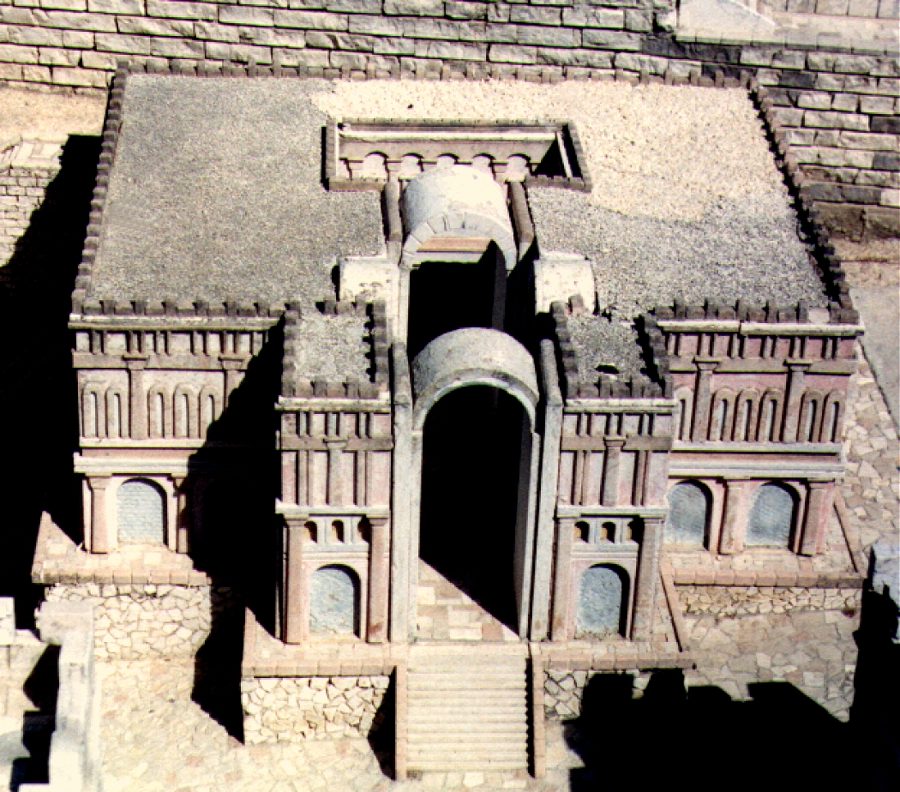
Model of a palace in New Testament times (© Ray Pritz by United Bible Societies)
References
- Hebrew אַרְמוֹן ’armon: 1 KI 16:18, 2 KI 15:25, 2 CHR 36:19
- Hebrew בִּירָה birah: 1 CHR 29:1, 1 CHR 29:19
- Hebrew בַּיִת bayith: GEN 12:15, GEN 12:17, GEN 41:40, GEN 45:2, GEN 45:8, GEN 45:16, GEN 47:14, GEN 50:4
- Hebrew בַּיִת מֶלֶךְ beyth (ha)melek: 2 SAM 11:2, 2 SAM 11:8, 2 SAM 11:9, 2 SAM 15:35, 1 KI 9:1, 1 KI 9:10, 1 KI 10:12, 1 KI 14:26
48 more references
1 KI 14:27, 1 KI 15:18, 1 KI 16:18, 2 KI 11:5, 2 KI 11:16, 2 KI 11:19, 2 KI 11:20, 2 KI 12:18, 2 KI 14:14, 2 KI 15:25, 2 KI 16:8, 2 KI 18:15, 2 KI 24:13, 2 KI 25:9, 2 CHR 7:11, 2 CHR 8:11, 2 CHR 9:11, 2 CHR 12:10, 2 CHR 16:2, 2 CHR 21:17, 2 CHR 23:5, 2 CHR 23:15, 2 CHR 23:20, 2 CHR 25:24, 2 CHR 28:21, NEH 3:25, EST 2:8, EST 2:9, EST 2:13, EST 4:13, EST 5:1, EST 6:4, EST 9:4, YIR 19:13, YIR 21:11, YIR 22:1, YIR 26:10, YIR 27:18, YIR 27:21, YIR 32:2, YIR 33:4, YIR 36:12, YIR 38:7, YIR 38:8, YIR 38:11, YIR 38:22, YIR 39:8, YIR 52:13 - Hebrew בִּיתָן bithan: EST 1:5, EST 7:7, EST 7:8
- Hebrew הֵיכָל heykal: 1 KI 21:1, 2 KI 20:18, 2 CHR 36:7, PSA 45:8, PSA 45:15, PSA 144:12, PROV 30:28, ISA 13:22
- Aramaic הֵיכַל heykal: EZRA 4:14, DAN 4:4, DAN 4:29, DAN 5:5, DAN 6:18
- Greek αὐλή aulē: 1 MAC 11:46
- Greek βασιλεία, βασίλειον, βασίλειος basileia, basileion, basileios: LUKE 7:25, L JER 1:58, 1 MAC 2:10
- Greek οἶκος, βασιλεία, βασιλεύς oiko (basileias), oikos (basileōs): MAT 11:8, JDT 2:1, JDT 2:18, JDT 11:23, JDT 12:13, JDT 14:18, 1 MAC 7:2
- Greek πραιτώριον praitōrion: MAT 27:27, MARK 15:16, YHN 18:28, YHN 18:33, YHN 19:9, ACTs 23:35, PHP 1:13
Description and usage
The palace was the dwelling of a king or ruler. Such a dwelling was usually larger and more elaborate than the dwelling of an average person. Its structure and building materials varied widely.
———
Translation
“Palace” may be rendered “home of a king” or “home of a ruler.”
The Hebrew word ’armon sometimes indicates the fortified part of a king’s residence or other fortified dwellings; see 1 KI 16:18. In such cases it will be better to render it as “citadel” or “stronghold.” See also 3.13.3.2 Fortress, stronghold, castle, citadel, fort<REALIA:3.13.3.2>.
PSA 45:8: “Ivory palaces” (RSV; see also 1 KI 22:39) are not palaces built completely of ivory, but palaces decorated with ivory, either on the building itself or on its furniture (see 1 KI 10:18; AMOS 3:15; AMOS 6:4).
PSA 144:12: The Hebrew word heykal can also mean “temple.” It is almost always clear which meaning is intended, either from the context or from some modifier such as “of Yahweh” or “of the king.” However, the meaning in this verse is in doubt; some translations have “palace” (RSV, GNT) while others have “temple” (NAB, NCV).
There are differences of opinion concerning what building in Yerushalem (Jerusalem) is indicated by the Greek word praitōrion in the Gospels. It may have been either the palace of Herodes (Herod) in the western part of the city or the fortress Antonia northwest of the Temple area. The praitōrion in Kaisareia (Caesarea) (ACTs 23:35) was the palace built by Herodes the Great. In the Gospels it is satisfactory to translate praitōrion as “palace where the governor lived” or “large dwelling where the ruler lived.” In some languages the term for “palace” may suggest a military fortification, and this would be quite appropriate for these New Testament passages.
 Open English Translation (OET)