
OET OET-RV OET-LV GHT ULT UST BSB MSB BLB AICNT OEB WEBBE WMBB NET LSV FBV TCNT T4T LEB BBE Moff JPS Wymth ASV DRA YLT Drby RV SLT Wbstr KJB-1769 KJB-1611 Bshps Gnva Cvdl TNT Wycl SR-GNT UHB BrLXX BrTr Related Parallel Simple Interlinear Topics Reference Dictionary Search
ParallelVerse GEN EXO LEV NUM DEU JOB JOS JDG RUTH 1 SAM 2 SAM PSA AMOS HOS 1 KI 2 KI 1 CHR 2 CHR PROV ECC SNG JOEL MIC ISA ZEP HAB JER LAM YNA (JNA) NAH OBA DAN EZE EZRA EST NEH HAG ZEC MAL LAO GES LES ESG DNG 2 PS TOB JDT WIS SIR BAR LJE PAZ SUS BEL MAN 1 MAC 2 MAC 3 MAC 4 MAC YHN MARK MAT LUKE ACTs YAC (JAM) GAL 1 TH 2 TH 1 COR 2 COR ROM COL PHM EPH PHP 1 TIM TIT 1 PET 2 PET 2 TIM HEB YUD (JUD) 1 YHN (1 JHN) 2 YHN (2 JHN) 3 YHN (3 JHN) REV
Yhn Intro C1 C2 C3 C4 C5 C6 C7 C8 C9 C10 C11 C12 C13 C14 C15 C16 C17 C19 C20 C21
Yhn 18 V1 V2 V3 V4 V5 V6 V7 V8 V9 V10 V11 V12 V13 V14 V15 V16 V17 V18 V19 V20 V21 V22 V23 V24 V25 V26 V27 V28 V29 V30 V31 V32 V34 V35 V36 V37 V38 V39 V40
Note: This view shows ‘verses’ which are not necessarily natural language units and hence sometimes only part of a sentence will be visible—click on any Bible version abbreviation down the left-hand side to see the verse in more of its context. Normally the OET discourages the reading of individual ‘verses’, but this view is only designed as a tool for Bible-translators and others doing comparisons of different translations—the older translations are further down the page (so you can read up from the bottom to trace the English translation history). The OET segments on this page are still early looks into the drafted texts of the Open English Translation of the Bible—please double-check these texts in advance before using in public.
Text critical issues=small word differences Clarity of original=clear Importance to us=normal Speaker(s)=Narrator (All still tentative.)
OET (OET-RV) So Pilate went back into his governor’s residence and called for Yeshua and asked him, “So you’re the king of the Jews?”
OET-LV Therefore the Pilatos came_in again into the residence_of_the_governor, and he_called the Yaʸsous and said to_him:
Are you the king of_the Youdaiōns?
SR-GNT Εἰσῆλθεν οὖν πάλιν εἰς τὸ πραιτώριον ὁ Πιλᾶτος, καὶ ἐφώνησεν τὸν ˚Ἰησοῦν καὶ εἶπεν αὐτῷ, “Σὺ εἶ ὁ βασιλεὺς τῶν Ἰουδαίων;” ‡
(Eisaʸlthen oun palin eis to praitōrion ho Pilatos, kai efōnaʸsen ton ˚Yaʸsoun kai eipen autōi, “Su ei ho basileus tōn Youdaiōn;”)
Key: khaki:verbs, light-green:nominative/subject, orange:accusative/object, pink:genitive/possessor, cyan:dative/indirect object.
Note: Automatic aligning of the OET-RV to the LV is done by some temporary software, hence the RV alignments are incomplete (and may occasionally be wrong).
GHT So, the Pilate comes-into into the praetorium[Latin] again, and sounds the Jesus, and says to {same}, "You are-being the king of {the Judeans}[?]"
ULT Then Pilate entered into the governor’s palace again and summoned Jesus and said to him, “Are you the King of the Jews?”
UST Pilate then went back inside his headquarters. He commanded soldiers to bring Jesus to him, and he asked him, “Are you the King of the Jews?”
BSB Pilate went back into the Praetorium, summoned Jesus, and asked Him, “Are You the King of the Jews?”
MSB Pilate went back into the Praetorium, summoned Jesus, and asked Him, “Are You the King of the Jews?”
BLB Therefore Pilate entered again into the Praetorium, and he called Jesus and said to Him, "Are You the King of the Jews?"
AICNT So {Pilate}[fn] entered the Praetorium again, called [Jesus],[fn] and said to him, “Are you the king of the Jews?”
OEB After that, Pilate went into the Government house again, and calling Jesus up, asked him, ‘Are you the king of the Jews?’
WEBBE Pilate therefore entered again into the Praetorium, called Jesus, and said to him, “Are you the King of the Jews?”
WMBB Pilate therefore entered again into the Praetorium, called Yeshua, and said to him, “Are you the King of the Jews?”
NET So Pilate went back into the governor’s residence, summoned Jesus, and asked him, “Are you the king of the Jews?”
LSV Pilate, therefore, entered into the Praetorium again, and called Jesus, and said to Him, “You are the King of the Jews?”
FBV Pilate went back into the governor's palace. He summoned Jesus, and asked him, “Are you the King of the Jews?”
TCNT Then Pilate went into his headquarters again, called Jesus over, and said to him, “Are yoʋ the king of the Jews?”
T4T Pilate then went back inside his headquarters. He summoned Jesus. Because the Jewish leaders had said that Jesus claimed to be a king, Pilate said to Jesus scornfully, “Are you the king of the Jews?”
LEB ¶ Then Pilate entered again into the governor’s residence and summoned Jesus and said to him, “Are you the king of the Jews?”
BBE Then Pilate went back into the Praetorium and sent for Jesus and said to him, Are you the King of the Jews?
Moff So Pilate went back inside the praetorium and called Jesus, saying, "Then you are king of the Jews?"
Wymth Re-entering the Praetorium, therefore, Pilate called Jesus and asked Him, "Are *you* the King of the Jews?"
ASV Pilate therefore entered again into the Prætorium, and called Jesus, and said unto him, Art thou the King of the Jews?
DRA Pilate therefore went into the hall again, and called Jesus, and said to him: Art thou the king of the Jews?
YLT Pilate, therefore, entered into the praetorium again, and called Jesus, and said to him, 'Thou art the King of the Jews?'
Drby Pilate therefore entered again into the praetorium and called Jesus, and said to him, Thou art the king of the Jews?
RV Pilate therefore entered again into the palace, and called Jesus, and said unto him, Art thou the King of the Jews?
(Pilate therefore entered again into the palace, and called Jesus, and said unto him, Art/Are thou/you the King of the Jews?)
SLT Then came Pilate again into the pretorium, and asked Jesus, and said to him, Art thou the King of the Jews?
Wbstr Then Pilate entered into the judgment-hall again, and called Jesus, and said to him, Art thou the King of the Jews?
KJB-1769 Then Pilate entered into the judgment hall again, and called Jesus, and said unto him, Art thou the King of the Jews?
(Then Pilate entered into the judgement hall again, and called Jesus, and said unto him, Art/Are thou/you the King of the Jews?)
KJB-1611 Then Pilate entred into the Iudgement hall againe, and called Iesus, and saide vnto him, Art thou the King of the Iewes?
(Then Pilate entered into the Judgement hall again, and called Yesus/Yeshua, and said unto him, Art/Are thou/you the King of the Jews?)
Bshps Then Pilate entred into the iudgement hall againe, and called Iesus, and sayde vnto hym: Art thou the kyng of the Iewes?
(Then Pilate entered into the judgement hall again, and called Yesus/Yeshua, and said unto him: Art/Are thou/you the king of the Jews?)
Gnva So Pilate entred into the common hall againe, and called Iesus, and sayde vnto him, Art thou the king of the Iewes?
(So Pilate entered into the common hall again, and called Yesus/Yeshua, and said unto him, Art/Are thou/you the king of the Jews?)
Cvdl Then entred Pilate in to the comon hall agayne, and called Iesus, & sayde vnto him: Art thou the kynge of the Iewes?
(Then entered Pilate in to the common hall again, and called Yesus/Yeshua, and said unto him: Art/Are thou/you the king of the Jews?)
TNT That the wordes of Iesus myght be fulfilled which he spake signifyinge what deeth he shuld dye.
(That the words of Yesus/Yeshua might be fulfilled which he spake signifying what death he should die.)
Wycl Therfor eftsoone Pilat entride in to the moot halle, and clepide Jhesu, and seide to hym, Art thou kyng of Jewis?
(Therefore soon_afterward Pilate entered in to the moot hall, and called Yesus/Yeshua, and said to him, Art/Are thou/you king of Jews?)
Luth Da ging Pilatus wieder hinein ins Richthaus und rief JEsu und sprach zu ihm: Bist du der Juden König?
(So went Pilate again into/inside into_the judgement_house and shouted Yesu and spoke to/for him: Are you(sg) the/of_the Jews king?)
ClVg Introivit ergo iterum in prætorium Pilatus: et vocavit Jesum, et dixit ei: Tu es rex Judæorum?
(Entered therefore again in/into/on governor's_palace Pilate: and he_called Yesus, and he/she_said to_him: You(sg) you_are king Jews?)
UGNT εἰσῆλθεν οὖν πάλιν εἰς τὸ πραιτώριον ὁ Πειλᾶτος, καὶ ἐφώνησεν τὸν Ἰησοῦν καὶ εἶπεν αὐτῷ, σὺ εἶ ὁ βασιλεὺς τῶν Ἰουδαίων?
(eisaʸlthen oun palin eis to praitōrion ho Peilatos, kai efōnaʸsen ton Yaʸsoun kai eipen autōi, su ei ho basileus tōn Youdaiōn?)
SBL-GNT Εἰσῆλθεν οὖν ⸂πάλιν εἰς τὸ πραιτώριον⸃ ὁ Πιλᾶτος καὶ ἐφώνησεν τὸν Ἰησοῦν καὶ εἶπεν αὐτῷ· Σὺ εἶ ὁ βασιλεὺς τῶν Ἰουδαίων;
(Eisaʸlthen oun ⸂palin eis to praitōrion⸃ ho Pilatos kai efōnaʸsen ton Yaʸsoun kai eipen autōi; Su ei ho basileus tōn Youdaiōn;)
RP-GNT Εἰσῆλθεν οὖν εἰς τὸ πραιτώριον πάλιν ὁ Πιλάτος, καὶ ἐφώνησεν τὸν Ἰησοῦν, καὶ εἶπεν αὐτῷ, Σὺ εἶ ὁ βασιλεὺς τῶν Ἰουδαίων;
(Eisaʸlthen oun eis to praitōrion palin ho Pilatos, kai efōnaʸsen ton Yaʸsoun, kai eipen autōi, Su ei ho basileus tōn Youdaiōn;)
TC-GNT Εἰσῆλθεν οὖν [fn]εἰς τὸ πραιτώριον πάλιν ὁ [fn]Πιλᾶτος, καὶ ἐφώνησε τὸν Ἰησοῦν, καὶ εἶπεν αὐτῷ, Σὺ εἶ ὁ βασιλεὺς τῶν Ἰουδαίων;
(Eisaʸlthen oun eis to praitōrion palin ho Pilatos, kai efōnaʸse ton Yaʸsoun, kai eipen autōi, Su ei ho basileus tōn Youdaiōn;)
Key for above GNTs: yellow:punctuation differs, red:words differ (from our SR-GNT base).
This section tells how the soldiers took Jesus to the Roman governor, Pilate. Pilate questioned Jesus to find out why the Jews wanted him to punish Jesus with death. He could find no reason to do that. But the Jewish leaders there insisted that Pilate crucify him. Finally, Pilate agreed that Jesus could be crucified.
Here are other possible section headings:
Pilate questioned the Jews and Jesus and sent Jesus to be crucified
Pilate investigated Jesus and decided that he could be punished with death
Jesus’ trial and judgment before Pilate
This section can be divided into seven smaller pieces, where each piece is a separate event. Jews often arranged written materials to include seven related pieces, where the first and last pieces relate, and the second and sixth relate, and the third and fifth relate. Then the middle piece, the fourth, stands alone and is emphasized. That happens in this section as well. Here is a chart showing the seven pieces of this section and how they relate:
18:28–32: Outside the house; Jews ask for Jesus’ death
18:33–38a: Inside the house; Pilate asks Jesus if he is King of the Jews
18:38b–40: Outside the house; Pilate says, “I find no case against him.”
19:1–3: The soldiers beat Jesus with a whip and pretend that he is the king of the Jews
19:4–8: Outside the house; Pilate says, “I find no case against him.”
19:8–11: Inside the house; Pilate asks Jesus where he came from
19:12–16a: Outside the house; Pilate allows Jews to crucify Jesus
The middle piece, 19:1–3, is different from all the other pieces. Pilate is only mentioned and is not an important person in this event. That is different from all the other pieces. This middle piece therefore is emphasized. The only ones who seem to worship Jesus in the whole section do so in this middle piece. However, they only pretend to worship and are very cruel as they mock Jesus.
In your translation, you may want to find ways to emphasize 19:1–3. Also, try to translate this section in ways that make it possible to see the connections between the pieces.
Pilate was trying to decide what to do with Jesus, so he asked him questions.
Pilate went back into the Praetorium,
¶ Then Pilate went back inside his headquarters/house.
¶ Pilate returned to his palace/mansion
The Greek begins this verse with a conjunction that indicates a return to the main story after the parenthetical information in 18:32. Indicate the return to the main story in a way that is natural in your language. If you put 18:32 in parentheses, that may be all that you need to do. It can also indicate that 18:33 is the result of what happened in 18:31, before the parenthetical information. Here are other ways to translate this word to indicate a result:
So (NET)
As a result
Pilate went back into the Praetorium: Pilate had been outside talking to Jesus’ accusers. He now went back into the building where he lived. Translate the Praetorium as you did in 18:28. For example:
Pilate then went back inside the palace (NIV)
Pilate then returned to his own house/palace/mansion.
summoned Jesus,
He ordered Jesus brought to him
and told his servants/soldiers to bring/lead Jesus to him.
summoned Jesus: This phrase indicates that Pilate told some of the soldiers or guards to bring Jesus to him. Here are other ways to translate this phrase:
called Jesus to him (NCV)
called for Jesus to be brought to him (NLT)
ordered that Jesus be brought to him
and asked Him, “Are You the King of the Jews?”
and then he asked him, “Are you the king who rules the Jews?”
Then when he arrived he asked Jesus, “Are you the king/ruler of the Jewish people/nation?”
Are You the King of the Jews?: This question of Pilate is exactly the same in all four gospels (see also Matthew 27:11, Mark 15:2, and Luke 23:3). John does not report that Jesus’ accusers said that Jesus said that he was the King of the Jews. However, Luke reports that they said that (Luke 23:2). In saying that, they accused Jesus of rebelling against Roman rule. Pilate wanted to know if Jesus really called himself the King of the Jews. This is a real question. Use the type of question that a judge might ask an accused person in court.
You: This pronoun is singular and refers to Jesus. The Greek text emphasizes this pronoun, which indicates surprise and perhaps scorn.
the King of the Jews: This phrase means “the ruler of the Jewish people.” A person who called himself this would be declaring his right and authority to rule the Jews. The Roman authorities could not allow this to happen. See how you translated this phrase in Matthew 27:37, Mark 15:9, and Luke 23:3, and the similar title in 1:49 “the king of Israel.” Here are other ways to translate this phrase:
the king/ruler of the Jewish people
the one who rules the Jews
Note 1 topic: figures-of-speech / explicit
ἐφώνησεν τὸν Ἰησοῦν
˱he˲_called (Some words not found in SR-GNT: εἰσῆλθεν Οὖν πάλιν εἰς τό πραιτώριον ὁ Πιλᾶτος καί ἐφώνησεν τόν Ἰησοῦν καί εἶπεν αὐτῷ σύ Εἶ ὁ βασιλεύς τῶν Ἰουδαίων)
Here, summoned implies that Pilate ordered some of his soldiers to bring Jesus to him inside his headquarters. You could include this information if that would be helpful to your readers. Alternate translation: [ordered his soldiers to bring Jesus inside to him]
Matthew 26-27; Mark 14-15; Luke 22-23; John 13-19
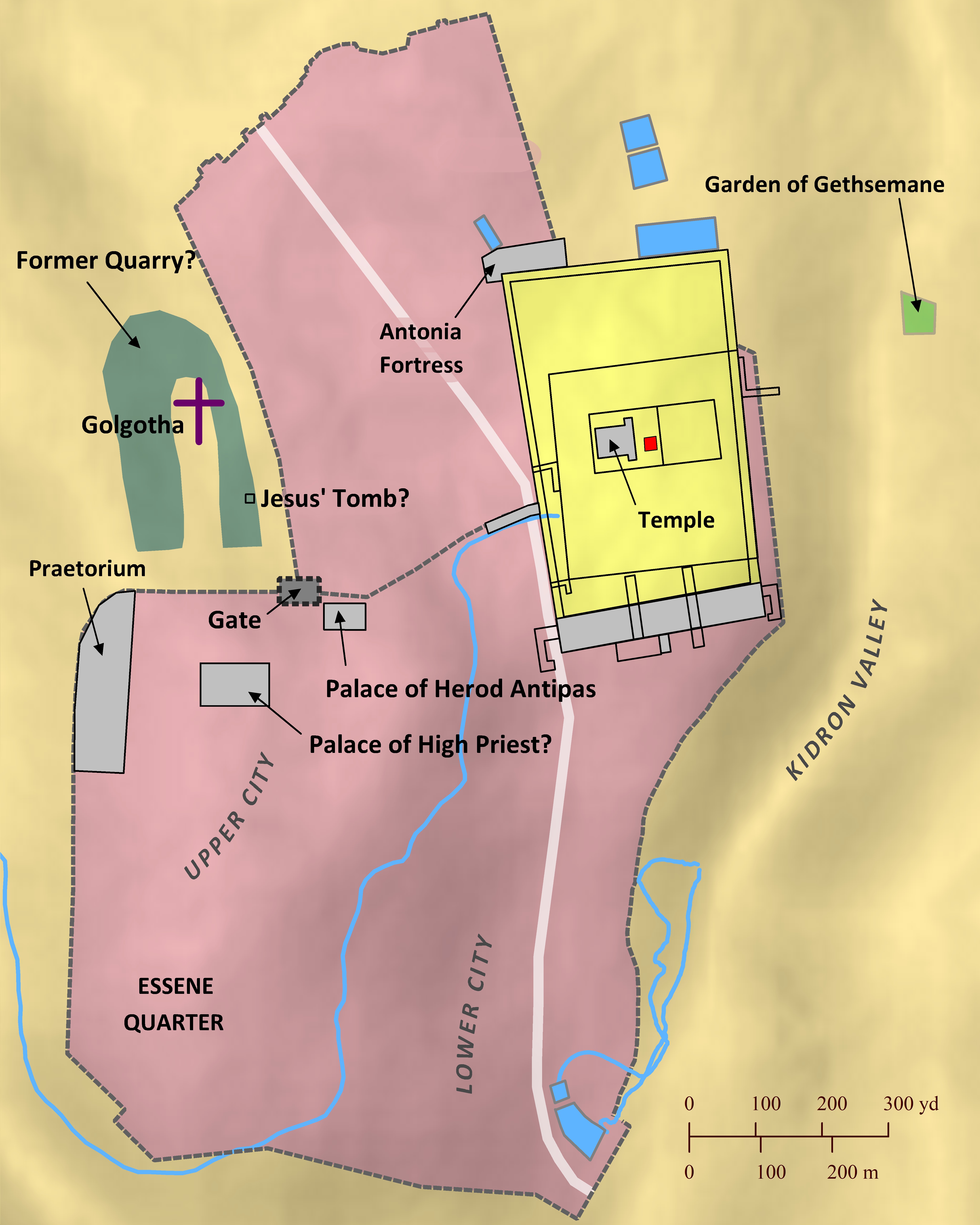
On the Thursday before he was crucified, Jesus had arranged to share the Passover meal with his disciples in an upper room, traditionally thought to be located in the Essene Quarter of Jerusalem. After they finished the meal, they went to the Garden of Gethsemane, where Jesus often met with his disciples. There Judas Iscariot, one of Jesus’ own disciples, betrayed him to soldiers sent from the High Priest, and they took Jesus to the High Priest’s residence. In the morning the leading priests and teachers of the law put Jesus on trial and found him guilty of blasphemy. The council sent Jesus to stand trial for treason before the Roman governor Pontius Pilate, who resided at the Praetorium while in Jerusalem. The Praetorium was likely located at the former residence of Herod the Great, who had died over 30 years earlier. When Pilate learned that Jesus was from Galilee, he sent him to Herod Antipas, who had jurisdiction over Galilee. But when Jesus gave no answer to Herod’s many questions, Herod and his soldiers sent him back to Pilate, who conceded to the people’s demands that Jesus be crucified. Jesus was forced to carry his cross out of the city gate to Golgotha, meaning Skull Hill, referring to what may have been a small unquarried hill in the middle of an old quarry just outside the gate. After Jesus was unable to carry his cross any further, a man named Simon from Cyrene was forced to carry it for him. There at Golgotha they crucified Jesus. After Jesus died, his body was hurriedly taken down before nightfall and placed in a newly cut, rock tomb owned by Joseph of Arimathea, a member of the Jewish high council. This tomb was likely located at the perimeter of the old quarry.
Open Bible Data site copyright © 2023–2026 Freely-Given.org.
Python source code for creating these static pages is available on GitHub under an open licence.
For Bible data copyrights, see the details for each displayed Bible version.
The Open English Translation (OET) main site is at OpenEnglishTranslation.Bible or OET.Bible.