
OET OET-RV OET-LV GHT ULT UST BSB MSB BLB AICNT OEB WEBBE WMBB NET LSV FBV TCNT T4T LEB BBE Moff JPS Wymth ASV DRA YLT Drby RV SLT Wbstr KJB-1769 KJB-1611 Bshps Gnva Cvdl TNT Wycl SR-GNT UHB BrLXX BrTr Related Parallel Simple Interlinear Topics Reference Dictionary Search
ParallelVerse GEN EXO LEV NUM DEU JOB JOS JDG RUTH 1 SAM 2 SAM PSA AMOS HOS 1 KI 2 KI 1 CHR 2 CHR PROV ECC SNG JOEL MIC ISA ZEP HAB JER LAM YNA (JNA) NAH OBA DAN EZE EZRA EST NEH HAG ZEC MAL LAO GES LES ESG DNG 2 PS TOB JDT WIS SIR BAR LJE PAZ SUS BEL MAN 1 MAC 2 MAC 3 MAC 4 MAC YHN (JHN) MARK MAT LUKE ACTs YAC (JAM) GAL 1 TH 2 TH 1 COR 2 COR ROM COL PHM EPH PHP 1 TIM TIT 1 PET 2 PET 2 TIM HEB YUD (JUD) 1 YHN (1 JHN) 2 YHN (2 JHN) 3 YHN (3 JHN) REV
Jos Intro C1 C2 C3 C4 C5 C6 C7 C8 C9 C10 C11 C12 C13 C14 C16 C17 C18 C19 C20 C21 C22 C23 C24
Jos 15 V1 V4 V7 V10 V13 V16 V19 V22 V25 V28 V31 V34 V37 V40 V43 V46 V49 V52 V55 V58 V61
Note: This view shows ‘verses’ which are not necessarily natural language units and hence sometimes only part of a sentence will be visible—click on any Bible version abbreviation down the left-hand side to see the verse in more of its context. Normally the OET discourages the reading of individual ‘verses’, but this view is only designed as a tool for Bible-translators and others doing comparisons of different translations—the older translations are further down the page (so you can read up from the bottom to trace the English translation history). The OET segments on this page are still early looks into the drafted texts of the Open English Translation of the Bible—please double-check these texts in advance before using in public.
Text critical issues=none Clarity of original=clear Importance to us=trivial Speaker(s)=Narrator (All still tentative.)
OET (OET-RV) Maarat, Beyt-Anot, and Eltekon—six cities as well as their villages.
OET-LV And_Maarath and_Bēyt- anoth and_ʼEltəqōn cities six and_villages_of_their.
UHB וּמַעֲרָ֥ת וּבֵית־עֲנ֖וֹת וְאֶלְתְּקֹ֑ן עָרִ֥ים שֵׁ֖שׁ וְחַצְרֵיהֶֽן׃ ‡
(ūmaˊₐrāt ūⱱēyt-ˊₐnōt vəʼeltəqon ˊārim shēsh vəḩaʦrēyhen.)
BrLXX καὶ Μαγαρὼθ, καὶ Βαιθανὰμ, καὶ Θεκούμ· πόλεις ἓξ, καὶ αἱ κῶμαι αὐτῶν·
(kai Magarōth, kai Baithanam, kai Thekoum; poleis hex, kai hai kōmai autōn;)
BrLXX (JOS 15:59a) Θεκὼ, καὶ Ἐφραθὰ, αὕτη ἐστὶ Βαιθλεὲμ, καὶ Φαγὼρ, καὶ Αἰτὰν, καὶ Κουλὸν, καὶ Τατὰμ, καὶ Θωβὴς, καὶ Καρὲμ, καὶ Γαλὲμ καὶ Θεθὴρ, καὶ Μανοχώ· πόλεις ἕνδεκα, καὶ αἱ κῶμαι αὐτῶν·
(Thekō, kai Efratha, hautaʸ esti Baithleem, kai Fagōr, kai Aitan, kai Koulon, kai Tatam, kai Thōbaʸs, kai Karem, kai Galem kai Thethaʸr, kai Manoⱪō; poleis hendeka, kai hai kōmai autōn;)
BrTr and Magaroth, and Bæthanam, and Thecum; six cities, and their villages;
BrTr (JOS 15:59a) Theco, and Ephratha, this is Bæthleem, and Phagor, and Ætan, and Culon, and Tatam, and Thobes, and Carem, and Galem, and Thether, and Manocho: eleven cities, and their villages,
ULT and Maarath and Beth Anoth and Eltekon: six cities and their villages;
UST Maarath, Beth Anoth, and Eltekon. These were the six cities in that area. The people of Judah lived in them and in their surrounding villages.
BSB & MSB Maarath, Beth-anoth, and Eltekon—six cities, along with their villages.
OEB Maarath, Beth-anoth, and Eltekon, six towns with their villages.
WEBBE & WMBB Maarath, Beth Anoth, and Eltekon; six cities with their villages.
NET Maarath, Beth Anoth, and Eltekon – a total of six cities and their towns.
LSV and Maarath, and Beth-Anoth, and Eltekon; six cities and their villages.
FBV Maarath, Beth-anoth, and Eltekon—six towns with their associated villages.
T4T Maarath, Beth-Anoth, and Eltekon. There were six towns altogether with their surrounding villages.
LEB Maarath, Beth Anoth, and Eltekon; six cities and their villages.
BBE And Maarath, and Beth-anoth, and Eltekon; six towns with their unwalled places.
Moff Maarath, Beth-anoth, and Eltékon, six towns with their villages: Tekoa, Ephratha (that is, Bethlehem), Péor, Etam, Kolon, Tatam, Sores, Kerem, Gallim, Bether, and Manahath, eleven towns with their villages :
JPS and Maarath, and Beth-anoth, and Eltekon; six cities with their villages.
ASV and Maarath, and Beth-anoth, and Eltekon; six cities with their villages.
DRA Mareth, and Bethanoth, and Eltecon: six cities and their villages.
YLT and Maarath, and Beth-Anoth, and Eltekon; six cities and their villages.
Drby and Maarath, and Beth-anoth, and Eltekon: six cities and their hamlets.
RV and Maarath, and Beth-anoth, and Eltekon; six cities with their villages.
SLT And Maarath and the House of Anoth, and Eltekon; six cities and their enclosures:
Wbstr And Maarath, and Beth-anoth, and Eltekon; six cities with their villages:
KJB-1769 And Maarath, and Beth-anoth, and Eltekon; six cities with their villages:
KJB-1611 And Maarah, and Bethanoth, & Eltekon: six cities with their villages.
(And Maarah, and Bethanoth, and Eltekon: six cities with their villages.)
Bshps Maarath, Bethanoth, and Elthecon: sixe cities with their villages
(Maarath, Bethanoth, and Elthecon: six cities with their villages)
Gnva And Maarah, and Beth-anoth, and Eltekon: sixe cities with their villages.
(And Maarah, and Beth-anoth, and Eltekon: six cities with their villages.)
Cvdl Maarath, Beth Anoth, Elthekon. These are sixe cities and their vyllages.
(Maarath, Beth Anoth, Elthekon. These are six cities and their villages.)
Wycl and Jodor, Mareth, and Bethanoth, and Bethecen, sixe citees, and the townes of tho;
(and Yodor, Mareth, and Bethanoth, and Bethecen, six cities, and the towns of them;)
Luth Maarath, Beth-Anoth, Elthekon. Das sind sechs Städte und ihre Dörfer.
(Maarath, Beth-anoth, Eltekon. The are six cities and their/her villages.)
ClVg Mareth, et Bethanoth, et Eltecon: civitates sex et villæ earum.
(Maarath, and Bethanoth, and Eltekon: cities six and villages of_them.)
This section describes the boundaries of the tribe of Judah and lists the towns that are within those boundaries.
Here are some other possible section headings:
The boundaries of Judah
The land of the tribe of Judah
This paragraph is a list of more towns that were given to the tribe of Judah.
Maarath, Beth-anoth, and Eltekon—
Maarath, Beth-anoth, and Eltekon.
Maarath Town and Beth-anoth Town and Eltekon Town.
Maarath, Beth-anoth, and Eltekon:
six cities, along with their villages.
In all there were six towns, and there were villages that surrounded them.
The number of these towns was six (6), with the villages that were near them.
six cities, along with their villages: Here are some other ways to translate this part of the verse:
In all there were six towns, and there were villages that surrounded them
The number of these towns was six, with the villages that were near them
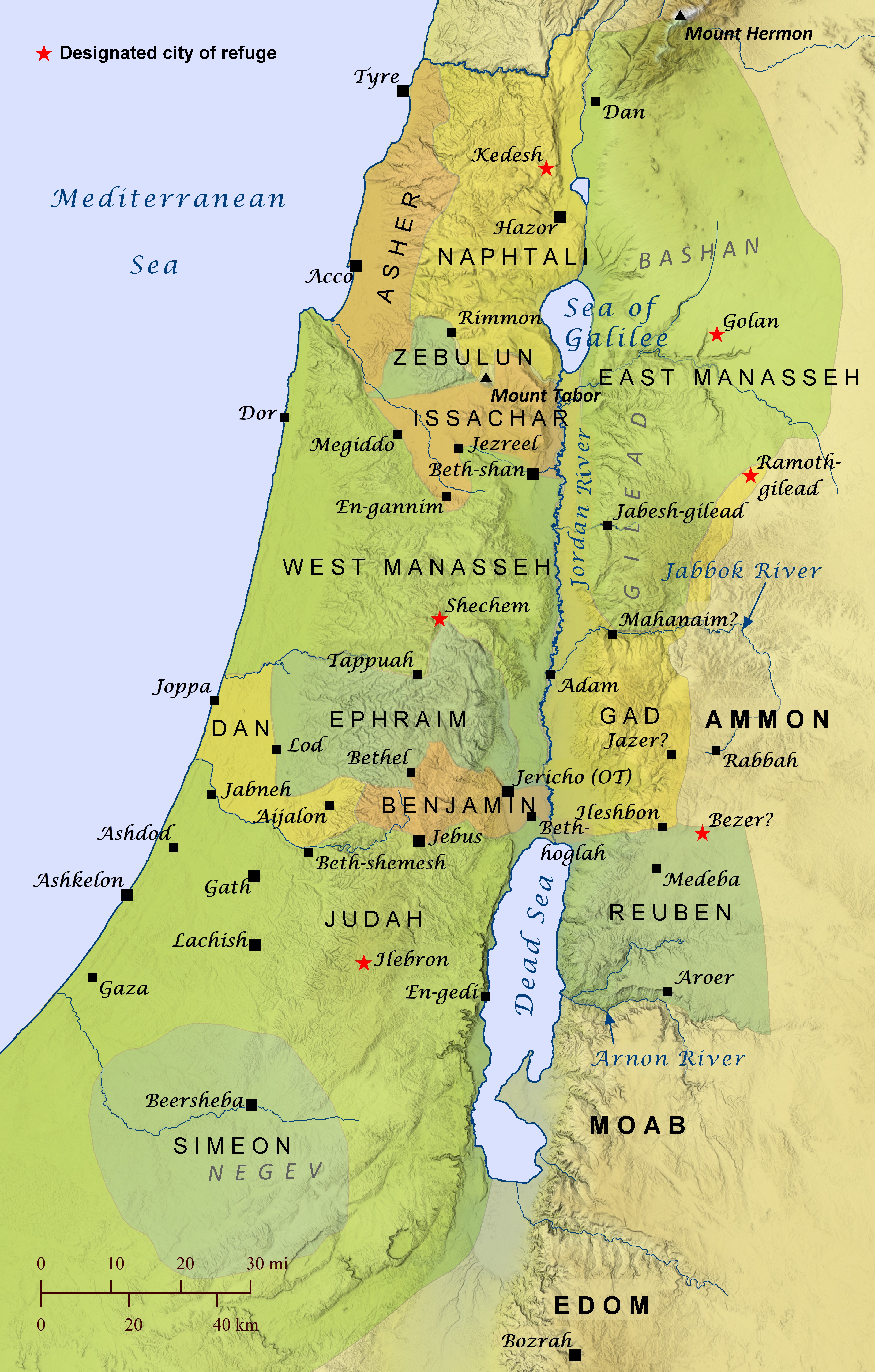
After the Israelites had conquered portions of the Promised Land and Joshua had grown old, the Lord directed him to divide the rest of the land among the tribes of Israel as their inheritance (Joshua 13-20). The eastern tribes had already been allotted their land under Moses’ leadership (Numbers 32), but they continued to help the other tribes drive out the Canaanites from land west of the Jordan River. The Lord also instructed the Israelites to designate several cities of refuge, where someone could flee for protection from an avenger if they accidentally killed someone (Numbers 35; Joshua 20).
The descendants of Jacob’s son Benjamin occupied one of the smallest of the Israelite tribal allotments–measuring a mere 27 miles (43 km) wide by 14 miles (23 km) high–yet the significance of all the biblical events that took place within it is immense. Benjamin was the location of the Israelites’ very first battles to conquer to the Promised Land, beginning with Jericho and moving on to Ai (see “The Israelites Conquer Ai” map). After this, four Gibeonite towns–all located in western Benjaminite territory–deceived the Israelites into forming an alliance with them (see “The Conquest of Canaan: The Southern Campaign” map) in order to avoid being wiped out by them. Two judges (Ehud and Deborah; see “Ehud Rescues Israel” and “Deborah and Barak Defeat Sisera” maps) hailed from Benjamin as did the prophet Samuel (see “The Tribe of Benjamin” map). After the Ark of the Covenant was captured near Aphek and Shiloh was overrun by the Philistines, it appears that the altar was moved to the High Place of Gibeah by the time of Solomon (see “The Ark of the Covenant in the Promised Land” map). In the closing years of the judges, a tragic incident at Gibeah led to a war between Benjamin and the rest of the Israelites tribes (see “Israel Battles Benjamin” map). Saul, the first king of Israel, also hailed from Benjamin (see “Saul Searches for His Father’s Donkeys” map). While King David’s capital was at Hebron, a detachment of his forces attacked those of Saul’s son Ish-bosheth at Gibeon, leading them to flee to the Hill of Ammah (likely the same as Emmaus; see “The Battle at the Pool of Gibeon” map). David later established Jerusalem, technically located within Benjamin’s territory, as his new capital over all Israel (2 Samuel 5:6-9). The borders of Benjamin’s tribal allotment and the adjacent borders of its neighboring tribes are meticulously defined in Joshua 15:1-16:3 and Joshua 18:11-28, demonstrating the biblical writers’ acute awareness of Benjamin’s territory. Several stretches of these borders appear to follow established roads that existed during the settlement era.
Open Bible Data site copyright © 2023–2026 Freely-Given.org.
Python source code for creating these static pages is available on GitHub under an open licence.
For Bible data copyrights, see the details for each displayed Bible version.
The Open English Translation (OET) main site is at OpenEnglishTranslation.Bible or OET.Bible.