
OET OET-RV OET-LV GHT ULT UST BSB MSB BLB AICNT OEB WEBBE WMBB NET LSV FBV TCNT T4T LEB BBE Moff JPS Wymth ASV DRA YLT Drby RV SLT Wbstr KJB-1769 KJB-1611 Bshps Gnva Cvdl TNT Wycl SR-GNT UHB BrLXX BrTr Related Parallel Simple Interlinear Topics Reference Dictionary Search
ParallelVerse GEN EXO LEV NUM DEU JOB JOS JDG RUTH 1 SAM 2 SAM PSA AMOS HOS 1 KI 2 KI 1 CHR 2 CHR PROV ECC SNG JOEL MIC ISA ZEP HAB JER LAM YNA (JNA) NAH OBA DAN EZE EZRA EST NEH HAG ZEC MAL LAO GES LES ESG DNG 2 PS TOB JDT ESA WIS SIR BAR LJE PAZ SUS BEL MAN 1 MAC 2 MAC 3 MAC 4 MAC YHN (JHN) MARK MAT LUKE ACTs YAC (JAM) GAL 1 TH 2 TH 1 COR 2 COR ROM COL PHM EPH PHP 1 TIM TIT 1 PET 2 PET 2 TIM HEB YUD (JUD) 1 YHN (1 JHN) 2 YHN (2 JHN) 3 YHN (3 JHN) REV
Mark Intro C1 C2 C3 C4 C5 C6 C7 C8 C9 C10 C11 C12 C13 C15 C16
Mark 14 V1 V4 V7 V10 V13 V16 V19 V22 V25 V28 V31 V34 V37 V40 V43 V46 V49 V52 V55 V58 V61 V64 V67 V70
Note: This view shows ‘verses’ which are not necessarily natural language units and hence sometimes only part of a sentence will be visible—click on any Bible version abbreviation down the left-hand side to see the verse in more of its context. Normally the OET discourages the reading of individual ‘verses’, but this view is only designed as a tool for Bible-translators and others doing comparisons of different translations—the older translations are further down the page (so you can read up from the bottom to trace the English translation history). The OET segments on this page are still early looks into the drafted texts of the Open English Translation of the Bible—please double-check these texts in advance before using in public.
B I ◄ ← Mark 14:44 ↓ → ► ≡ ═ ©
Text critical issues=small word differences Clarity of original=clear Importance to us=normal Speaker(s)=Narrator (All still tentative.)
OET (OET-RV) Yudas had prearranged a signal with them that the one he greeted with a kiss, they should grab that person and lead him away under guard.
OET-LV And the one giving_ him _over had_given a_signal to_them saying:
Whomever wishfully I_may_kiss, it_is he, apprehend him, and be_leading_away securely.
SR-GNT Δεδώκει δὲ ὁ παραδιδοὺς αὐτὸν σύσσημον αὐτοῖς λέγων, “Ὃν ἂν φιλήσω, αὐτός ἐστιν· κρατήσατε αὐτὸν, καὶ ἀπάγετε ἀσφαλῶς.” ‡
(Dedōkei de ho paradidous auton sussaʸmon autois legōn, “Hon an filaʸsō, autos estin; krataʸsate auton, kai apagete asfalōs.”)
Key: khaki:verbs, light-green:nominative/subject, orange:accusative/object, cyan:dative/indirect object.
Note: Automatic aligning of the OET-RV to the LV is done by some temporary software, hence the RV alignments are incomplete (and may occasionally be wrong).
GHT Moreover, he-had-given, the giving-aside/delivering same, [a] sign-together to {same[plural]}, saying, "Whom supposing I-may-be-fond-of, same is-being. Seize same and lead-off/away unwaveringly/securely,"
ULT Now the one handing him over had given them a signal, saying, “Whomever I kiss is he. Seize him and lead, him away securely.”
UST Previously, Judas, who was helping Jesus’ enemies arrest him, told the group of people how they would know which man was Jesus. He instructed them, “The man you should arrest is the one whom I will greet affectionately. Guard him while you take him away.”
BSB & MSB Now the betrayer had arranged a signal with them: “The One I kiss is [the man]; arrest Him and lead [Him] away securely.”
BLB And the one delivering Him up had given to them a sign, saying: "Whomever I shall kiss is He; seize Him and lead Him away securely."
AICNT Now the one who was betraying him had given them a sign, saying [to them],[fn] “Whomever I kiss, that one is the one; seize him and lead him away securely.”
14:44, to them: Absent from D(05) Latin(a ff2 k).
OEB Now the betrayer had arranged a signal with them. ‘The man whom I kiss,’ he had said, ‘will be the one; arrest him and take him away safely.’
WEBBE & WMBB Now he who betrayed him had given them a sign, saying, “Whomever I will kiss, that is he. Seize him, and lead him away safely.”
NET (Now the betrayer had given them a sign, saying, “The one I kiss is the man. Arrest him and lead him away under guard.”)
LSV and he who is delivering Him up had given a token to them, saying, “Whomsoever I will kiss, it is He, lay hold on Him, and lead Him away safely,”
FBV Now the betrayer had arranged a sign with them: “He's the one that I kiss. Arrest him, and take him away under guard.”
TCNT Now his betrayer had given them a signal, saying, “Whomever I kiss, he is the one; arrest him and lead him away under guard.”
T4T Judas, who was ◄betraying Jesus/helping Jesus’ enemies to seize him►, had previously told this crowd, “The man whom I kiss is the one whom you want. When I kiss him, seize him and lead him away while you guard him carefully.”
LEB Now the one who was betraying him had given them a sign, saying, “The one whom I kiss—he is the one.[fn] Arrest him and lead him[fn] away under guard!”
14:44 *Here the predicate nominative (“the one”) is implied
14:44 *Here the direct object is supplied from context in the English translation
BBE Now he who had been false to him had given them a sign, saying, The one to whom I give a kiss, that is he; take him, and get him away safely.
Moff Now his betrayer had given them a signal; he said, "Whoever I kiss, that is the man. Seize him and get him safely away."
Wymth Now the betrayer had arranged a signal with them. "The one I kiss," he said, "is the man: lay hold of him, and take him safely away."
ASV Now he that betrayed him had given them a token, saying, Whomsoever I shall kiss, that is he; take him, and lead him away safely.
DRA And he that betrayed him, had given them a sign, saying: Whomsoever I shall kiss, that is he; lay hold on him, and lead him away carefully.
YLT and he who is delivering him up had given a token to them, saying, 'Whomsoever I shall kiss, he it is, lay hold on him, and lead him away safely,'
Drby Now he that delivered him up had given them a sign between them, saying, Whomsoever I shall kiss, that is he; seize him, and lead [him] away safely.
RV Now he that betrayed him had given them a token, saying, Whomsoever I shall kiss, that is he; take him, and lead him away safely.
(Now he that betrayed him had given them a token/sign, saying, Whomsoever I shall kiss, that is he; take him, and lead him away safely.)
SLT And he delivering him up gave them a token, saying, Whomsoever I shall kiss, this is he; seize him, and lead away safely.
Wbstr And he that betrayed him, had given them a token, saying, Whomsoever I shall kiss, that same is he; take him, and lead him away safely.
KJB-1769 And he that betrayed him had given them a token, saying, Whomsoever I shall kiss, that same is he; take him, and lead him away safely.
(And he that betrayed him had given them a token/sign, saying, Whomsoever I shall kiss, that same is he; take him, and lead him away safely.)
KJB-1611 And he that betrayed him, had giuen them a token, saying, Whomsoeuer I shall kisse, that same is he; take him, and lead him away safely.
(Modernised spelling is same as from KJB-1769 above, apart from punctuation)
Bshps And he that betrayed hym, had geuen them a general token, saying: Who soeuer I do kysse, that same is he, take hym, and leade hym away warely.
(And he that betrayed him, had given them a general token/sign, saying: Who soever I do kiss, that same is he, take him, and lead him away warily.)
Gnva And he that betraied him, had giuen them a token, saying, Whomsoeuer I shall kisse, he it is: take him and leade him away safely.
(And he that betrayed him, had given them a token/sign, saying, Whomsoever I shall kiss, he it is: take him and lead him away safely.)
Cvdl And the traytoure had geuen them a toke, and sayde: Whom so euer I kysse, that same is he, laye handes vpon him, and lede him awaye warely.
(And the traitor had given them a token/sign, and said: Whom so ever I kiss, that same is he, lay hands upon him, and lead him away warily.)
TNT And he that betrayed him had geven them a generall toke sayinge: whosoever I do kisse he it is: take him and leade him awaye warely.
(And he that betrayed him had given them a general took saying: whosoever I do kiss he it is: take him and lead him away warily.)
Wycl And his traytour hadde youun to hem a tokene, and seide, Whom euer Y kisse, he it is; holde ye hym, and lede ye warli.
(And his traitor had given to them a token/sign, and said, Whom ever I kiss, he it is; hold ye/you_all him, and lead ye/you_all warily.)
Luth Und der Verräter hatte ihnen ein Zeichen gegeben und gesagt: Welchen ich küssen werde, der ist‘s; den greifet und führet ihn gewiß.
(And the/of_the traitor/betrayer had to_them a sign given and said: Which_(ones) I kiss become, the/of_the it_is; the attacks and leads him/it certainly.)
ClVg Dederat autem traditor ejus signum eis, dicens: Quemcumque osculatus fuero, ipse est, tenete eum, et ducite caute.[fn]
(He_had_given however traitor/betrayer his/her sign/signal to_them, saying: Whoever kissed I_will_be, exactly_that/himself it_is, hold_on him, and lead carefully/warily.)
14.44 Signum. HIER. Dat signum osculi cum veneno diaboli: sicut Cain obtulit sacrificium subdolum et reprobatum, unde vinum cum aceto in cruce ponunt.
14.44 Signum. HIER. Dat sign/signal kisses when/with veneno devils: like Cain offered sacrifice deceit and reprobatum, from_where/who wine when/with vinegar in/into/on stake/cross they_put.
UGNT δεδώκει δὲ ὁ παραδιδοὺς αὐτὸν σύσσημον αὐτοῖς λέγων, ὃν ἂν φιλήσω, αὐτός ἐστιν; κρατήσατε αὐτὸν, καὶ ἀπάγετε ἀσφαλῶς.
(dedōkei de ho paradidous auton sussaʸmon autois legōn, hon an filaʸsō, autos estin; krataʸsate auton, kai apagete asfalōs.)
SBL-GNT δεδώκει δὲ ὁ παραδιδοὺς αὐτὸν σύσσημον αὐτοῖς λέγων· Ὃν ἂν φιλήσω αὐτός ἐστιν· κρατήσατε αὐτὸν καὶ ⸀ἀπάγετε ἀσφαλῶς.
(dedōkei de ho paradidous auton sussaʸmon autois legōn; Hon an filaʸsō autos estin; krataʸsate auton kai ⸀apagete asfalōs.)
RP-GNT Δεδώκει δὲ ὁ παραδιδοὺς αὐτὸν σύσσημον αὐτοῖς, λέγων, Ὃν ἂν φιλήσω, αὐτός ἐστιν· κρατήσατε αὐτόν, καὶ ἀπαγάγετε ἀσφαλῶς.
(Dedōkei de ho paradidous auton sussaʸmon autois, legōn, Hon an filaʸsō, autos estin; krataʸsate auton, kai apagagete asfalōs.)
TC-GNT δεδώκει δὲ ὁ παραδιδοὺς αὐτὸν σύσσημον αὐτοῖς λέγων, Ὃν ἂν φιλήσω, αὐτός ἐστι· κρατήσατε αὐτὸν καὶ [fn]ἀπαγάγετε ἀσφαλῶς.
(dedōkei de ho paradidous auton sussaʸmon autois legōn, Hon an filaʸsō, autos esti; krataʸsate auton kai apagagete asfalōs.)
14:44 απαγαγετε ¦ απαγετε ꜱʙʟ ᴛʜ ᴡʜ
Key for above GNTs: yellow:punctuation differs, red:words differ (from our SR-GNT base).
The events in this section, like those in the preceding section, happened at night in the olive grove called Gethsemane.
At the end of 14:42, Jesus told his disciples that the one who would betray him was coming. At the beginning of this section in 14:43, Judas, the betrayer, arrived. He came with a crowd of armed men that the Jewish religious leaders had sent. Judas betrayed Jesus by kissing him. Then the crowd of men arrested Jesus and the disciples fled. As one of them was running away, some people grabbed the linen cloth he had wrapped around himself. He left the cloth in their hands and ran away naked.
In this section Mark referred back to things that happened before the crowd came to arrest Jesus. Before Judas came with the crowd, he went to the chief priests, teachers of the law, and elders. He told them that he would betray Jesus to them. They agreed to send armed men with him to arrest Jesus. These men probably would not recognize which man was Jesus. Judas told them that he would kiss Jesus to show them the man whom they should arrest. Tell about these events in a way that will help people understand why that group of men arrived with Judas.
It is good to translate this section before you decide on a heading for it.
Here are some other possible headings for this section:
The betrayal and arrest of Jesus
Jesus is captured
There are parallel passages for this section in Matthew 26:47–56, Luke 22:47–53, and John 18:3.
Verse 44 provides background information. It describes the plan that Judas had previously made with the Jewish leaders to identify Jesus so that they could arrest him.
Now the betrayer had arranged a signal with them:
The man who was planning to betray Jesus had previously/already arranged a signal with them,
The one who was going to give Jesus into the control of the authorities had already told the crowd how they would know whom to arrest.
Now: In this context the Greek word that the BSB translates as Now introduces background information. It is not a time word here. It explains what Judas had already told the crowd that came to arrest Jesus.
the betrayer: The Greek phrase that the BSB translates as the betrayer is literally “the one giving him over.” In this context it refers to someone who puts someone else into the power of his enemies. He causes that person’s enemies to gain control over him.
Mark uses the phrase the betrayer as another way to refer to Judas. See 14:42b for more discussion of the word betrayer.
In this verse Judas had not yet actually betrayed Jesus. In some languages it might be necessary to indicate that. For example:
the one intending to betray him
the person who was planning to betray him
In some languages it might be necessary to specify who the betrayer was. So you could say:
Judas, the betrayer
had arranged a signal with them: The Greek phrase that the BSB translates as had arranged a signal with them is literally “had given a sign to them.” In this context it indicates that Judas had previously told the crowd what he would do to show them which man they should arrest.
a signal: A signal refers to something that people do or say to communicate a special meaning. Before they do it or say it, they agree on what it will mean. Judas had earlier told the crowd that they should watch for him to greet one man in a certain way. Greeting him with a kiss would be a signal. It would mean that Jesus was the man whom the crowd should arrest.
“The One I kiss is the man;
saying, “The person I kiss is the man whom you want to arrest.
He had said to them, “The man whom I greet affectionately is the person whom you are looking for.
He would greet that person with a kiss.
This part of the verse gives the words that Judas said to the crowd when he arranged the signal with them. In some languages it may be necessary to supply an introduction to these words. For example:
He had said to them, “The one I kiss…”
See the General Comment on 14:44a–c for a suggestion about indirect speech.
The One I kiss is the man: Judas said these words because he knew that there would be other people with Jesus. Judas planned to kiss Jesus to show the crowd that Jesus was the man whom they wanted to arrest. In some languages it may be necessary to make this explicit. For example:
The one I kiss is the man you are looking for
The man I kiss is the person whom you want to arrest
The One: The One means “the person” or “the man.”
kiss: The word kiss means “to touch someone with the lips on one cheek or on both cheeks.” In some cultures it is unusual or inappropriate for a man to kiss another man. If that is true in your culture, here are some options to consider:
Use an appropriate term for “kiss” and indicate the purpose of the kiss. For example:
whom I greet according to custom with a kiss
whom I greet by touching his cheek with my lips
Use a more general expression for an appropriate greeting. For example:
to whom I give an affectionate greeting
whom I greet as my rabbi
whom I embrace respectfully
arrest Him and lead Him away securely.”
Seize(plur) him and lead(plur) him away securely.”
Grab him and guard him carefully as you lead him away.”
Then they should grab him and guard him carefully as they led him away.
arrest: The Greek word that the BSB translates arrest is literally “seize,” as in the RSV. See 14:1c for further discussion of arrest.
lead Him away securely: In this context securely means to watch a prisoner carefully.
Here are some other ways to translate this:
guard him closely as you take him away (GW)
get him safely away (REB)
lead him away under guard (NIV)
In some languages it may be necessary to indicate that this is the end of what Judas said to the crowd before they came to Jesus. For example:
“…lead him away under guard,” Judas told the crowd
In some languages it may be more natural to use indirect speech in these verse parts. For example, you could say:
Now the betrayer had arranged a signal with them. He had told them that the one he kissed was the man they were looking for. They should arrest him and lead him away under guard.
Note 1 topic: writing-background
δεδώκει δὲ ὁ παραδιδοὺς αὐτὸν σύσσημον αὐτοῖς λέγων, ὃν ἂν φιλήσω, αὐτός ἐστιν; κρατήσατε αὐτὸν, καὶ ἀπάγετε ἀσφαλῶς
˓had˒_given (Some words not found in SR-GNT: δεδώκει Δέ ὁ παραδιδούς αὐτόν σύσσημον αὐτοῖς λέγων Ὅν ἄν φιλήσω αὐτός ἐστίν κρατήσατε αὐτόν καί ἀπάγετε ἀσφαλῶς)
To help his readers understand what happens next, Mark provides this background information about how Judas had arranged his betrayal of Jesus with the Jewish leaders. Here Mark uses the word Now to introduce the background information which he gives in the rest of this verse. Use a natural form in your language for expressing background information. Alternate translation: [Earlier, Judas, who was going to hand him over, had given them a signal. He had said, “Whomever I kiss is he. Seize him and lead him away securely.”]
Note 2 topic: figures-of-speech / explicit
σύσσημον
˓a˒_signal
Here Mark is referring to an action by which one person communicates to others. More specifically, Judas arranged with the crowd an action that would communicate to them which person was Jesus. If it would be helpful in your language, you could make that idea more explicit. Alternate translation: [a signal to point out Jesus] or [a cue that would indicate whom to seize]
Note 3 topic: figures-of-speech / quotations
λέγων, ὃν ἂν φιλήσω, αὐτός ἐστιν; κρατήσατε αὐτὸν, καὶ ἀπάγετε ἀσφαλῶς
saying (Some words not found in SR-GNT: δεδώκει Δέ ὁ παραδιδούς αὐτόν σύσσημον αὐτοῖς λέγων Ὅν ἄν φιλήσω αὐτός ἐστίν κρατήσατε αὐτόν καί ἀπάγετε ἀσφαλῶς)
It may be more natural in your language to have an indirect quotation here. Alternate translation: [saying that whomever he kissed was he, and that they should seize him and lead him away securely]
Note 4 topic: writing-quotations
λέγων
saying
If you keep the direct quotation, consider natural ways of introducing it in your language. Alternate translation: [and he said]
Note 5 topic: translate-symaction
ὃν ἂν φιλήσω
(Some words not found in SR-GNT: δεδώκει Δέ ὁ παραδιδούς αὐτόν σύσσημον αὐτοῖς λέγων Ὅν ἄν φιλήσω αὐτός ἐστίν κρατήσατε αὐτόν καί ἀπάγετε ἀσφαλῶς)
In Jesus’ culture, close friends would greet each other with a kiss. In some cultures, a kiss as a greeting is appropriate, but in other cultures it is not appropriate. If it would be helpful in your language, you could explain what the kiss means, or you could refer to how close friends would greet each other in your culture. Alternate translation: [Whomever I greet with a kiss] or [Whomever I hug]
αὐτός
he
Alternate translation: [the one you are seeking]
ἀσφαλῶς
securely
Alternate translation: [under guard]
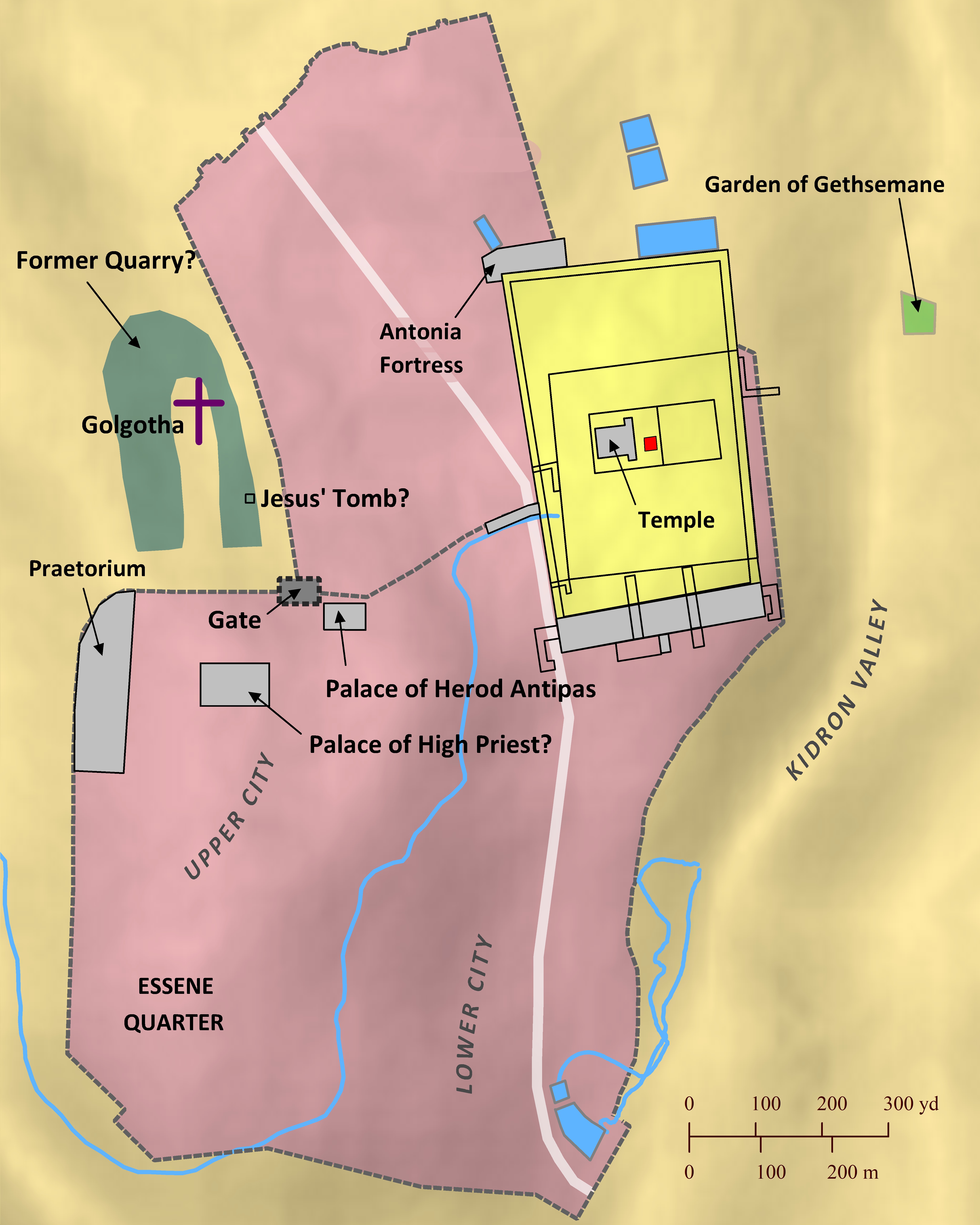
Matthew 26-27; Mark 14-15; Luke 22-23; John 13-19
On the Thursday before he was crucified, Jesus had arranged to share the Passover meal with his disciples in an upper room, traditionally thought to be located in the Essene Quarter of Jerusalem. After they finished the meal, they went to the Garden of Gethsemane, where Jesus often met with his disciples. There Judas Iscariot, one of Jesus’ own disciples, betrayed him to soldiers sent from the High Priest, and they took Jesus to the High Priest’s residence. In the morning the leading priests and teachers of the law put Jesus on trial and found him guilty of blasphemy. The council sent Jesus to stand trial for treason before the Roman governor Pontius Pilate, who resided at the Praetorium while in Jerusalem. The Praetorium was likely located at the former residence of Herod the Great, who had died over 30 years earlier. When Pilate learned that Jesus was from Galilee, he sent him to Herod Antipas, who had jurisdiction over Galilee. But when Jesus gave no answer to Herod’s many questions, Herod and his soldiers sent him back to Pilate, who conceded to the people’s demands that Jesus be crucified. Jesus was forced to carry his cross out of the city gate to Golgotha, meaning Skull Hill, referring to what may have been a small unquarried hill in the middle of an old quarry just outside the gate. After Jesus was unable to carry his cross any further, a man named Simon from Cyrene was forced to carry it for him. There at Golgotha they crucified Jesus. After Jesus died, his body was hurriedly taken down before nightfall and placed in a newly cut, rock tomb owned by Joseph of Arimathea, a member of the Jewish high council. This tomb was likely located at the perimeter of the old quarry.
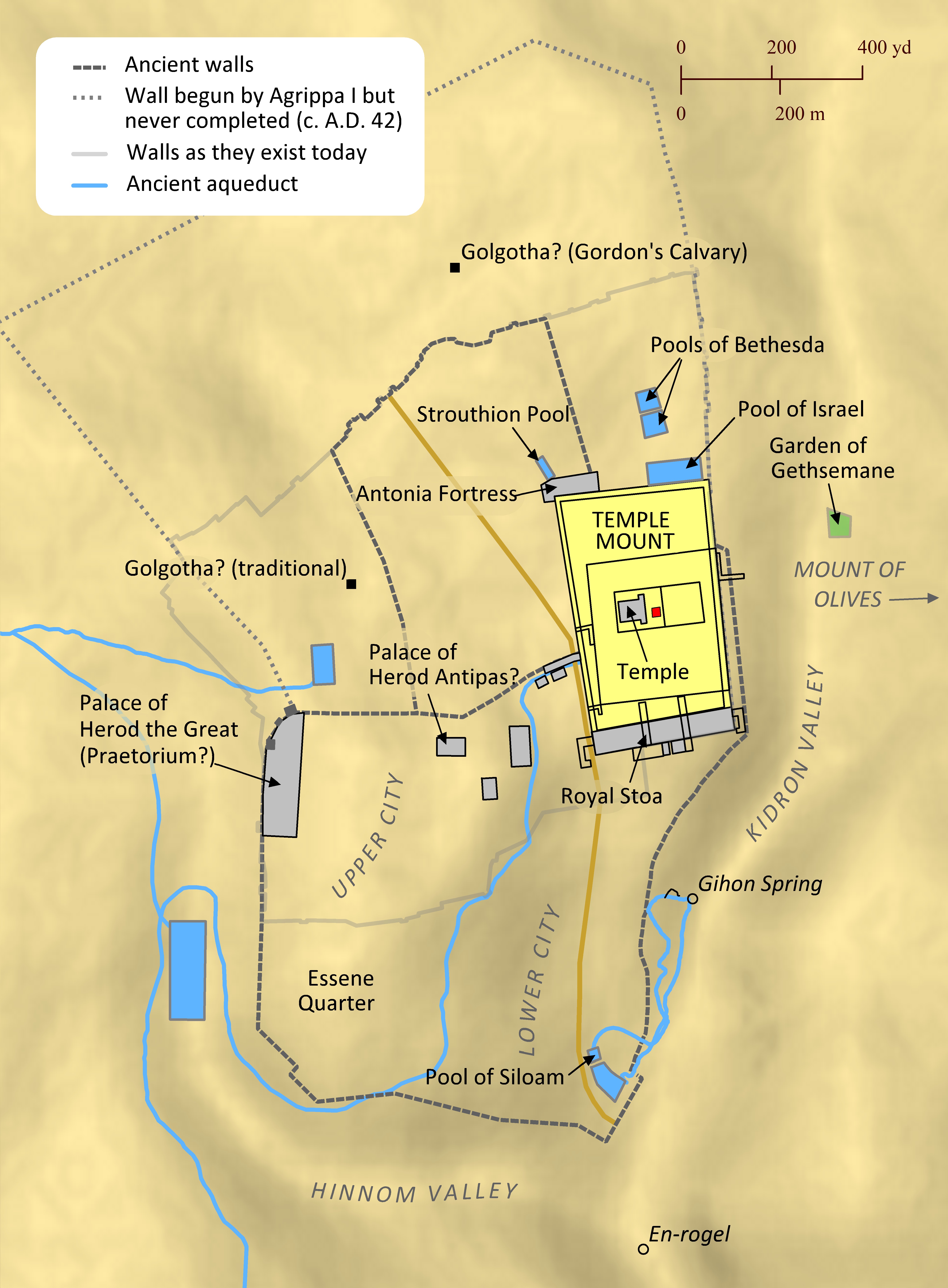
By the time of the New Testament, the ancient city of Jerusalem had been transformed from the relatively small fortress of David’s day (2 Samuel 5:6-10; 1 Chronicles 11:4-9) into a major city with a Temple that rivaled the greatest temples in the Roman world. Just prior to Jesus’ birth, Herod the Great completely renovated and expanded the Temple of the Lord, and he also built a lavish palace for himself, various pools (where Jesus occasionally performed healings), public buildings, and military citadels, including the Antonia Fortress, which overlooked the Temple. Wealthy residents, including the high priest, occupied extravagant houses in the Upper City, while the poorer residents were relegated to less desirable areas like the Lower City. The Essene Quarter was so named because many of its residents belonged to the Essenes, a strict religious sect that was known for its careful attention to the law of Moses. Across the Kidron Valley lay the Garden of Gethsemane, where Jesus often met with his disciples (Matthew 26:36-46; Mark 14:32-53; John 18:1-14). Further east was the Mount of Olives, where Jesus began his triumphal entry one week before his crucifixion (Matthew 21:1-11; Mark 11:1-11; Luke 19:28-40; John 12:12-19), taught his disciples about the last days (Matthew 24-25; Mark 13), and eventually ascended to heaven after his resurrection (Luke 24:50-53; Acts 1:1-11).
Open Bible Data site copyright © 2023–2026 Freely-Given.org.
Python source code for creating these static pages is available on GitHub under an open licence.
For Bible data copyrights, see the details for each displayed Bible version.
The Open English Translation (OET) main site is at OpenEnglishTranslation.Bible or OET.Bible.