
OET OET-RV OET-LV GHT ULT UST BSB MSB BLB AICNT OEB WEBBE WMBB NET LSV FBV TCNT T4T LEB BBE Moff JPS Wymth ASV DRA YLT Drby RV SLT Wbstr KJB-1769 KJB-1611 Bshps Gnva Cvdl TNT Wycl SR-GNT UHB BrLXX BrTr Related Parallel Simple Interlinear Topics Reference Dictionary Search
ParallelVerse GEN EXO LEV NUM DEU JOB JOS JDG RUTH 1 SAM 2 SAM PSA AMOS HOS 1 KI 2 KI 1 CHR 2 CHR PROV ECC SNG JOEL MIC ISA ZEP HAB JER LAM YNA (JNA) NAH OBA DAN EZE EZRA EST NEH HAG ZEC MAL LAO GES LES ESG DNG 2 PS TOB JDT WIS SIR BAR LJE PAZ SUS BEL MAN 1 MAC 2 MAC 3 MAC 4 MAC YHN (JHN) MARK MAT LUKE ACTs YAC (JAM) GAL 1 TH 2 TH 1 COR 2 COR ROM COL PHM EPH PHP 1 TIM TIT 1 PET 2 PET 2 TIM HEB YUD (JUD) 1 YHN (1 JHN) 2 YHN (2 JHN) 3 YHN (3 JHN) REV
Mark Intro C1 C2 C3 C4 C5 C6 C7 C8 C9 C10 C11 C12 C13 C14 C16
Mark 15 V1 V3 V5 V7 V9 V11 V13 V15 V17 V19 V21 V23 V25 V27 V29 V31 V33 V35 V37 V39 V41 V43 V45 V47
Note: This view shows ‘verses’ which are not necessarily natural language units and hence sometimes only part of a sentence will be visible—click on any Bible version abbreviation down the left-hand side to see the verse in more of its context. Normally the OET discourages the reading of individual ‘verses’, but this view is only designed as a tool for Bible-translators and others doing comparisons of different translations—the older translations are further down the page (so you can read up from the bottom to trace the English translation history). The OET segments on this page are still early looks into the drafted texts of the Open English Translation of the Bible—please double-check these texts in advance before using in public.
B I ◄ ← Mark 15:28 ↓ → ► ≡ ═ ©
Text critical issues=small word differences Clarity of original=clear Importance to us=normal Speaker(s)=Narrator (All still tentative.)
SR-GNT No SR-GNT MRK 15:28 verse available
GHT and the scripture is-fulfilled, the saying, "And alongside of {lawless} he-is-word-ized/reckoned/accounted,"
ULT [fn] [And the scripture was fulfilled that says, “And he was counted with lawless ones.”]
Some manuscripts include verse 28.
UST [When those things happened, what someone wrote in the Scriptures came true: “People considered him to be one of the people who do what is wrong.”]
MSB So the Scripture was fulfilled that says, “And He was numbered with [the] transgressors.”[fn]
15:28 CT does not include verse 28; see Isaiah 53:12 and Luke 22:37.
AICNT [[And the scripture was fulfilled, which says, And he was numbered with the transgressors.]][fn]
15:28, And the scripture was fulfilled, which says, And he was numbered with the transgressors: Included in BYZ TR ‖ Absent from ℵ(01) A(02) B(03) C(04) D(05) NA28 SBLGNT THGNT.
15:28 Some later manuscripts add: And the scripture was fulfilled that says, “He was counted among outlaws.”
WEBBE & WMBB The Scripture was fulfilled which says, “He was counted with transgressors.”[fn]
15:28 NU omits verse 28.
15:28 [[EMPTY]]
LSV [[and the Writing was fulfilled that is saying, “And He was numbered with lawless ones.”]]
15:28 Verse 28 is not found in many of the early manuscripts.
TCNT [fn]So the Scripture was fulfilled that says, “He was numbered with the lawless.”
15:28 So the Scripture was fulfilled that says, “He was numbered with the lawless.” 84.9% ¦ — SBL TH WH 11% {Note: NA encloses this text with double brackets.}
T4T 27-28 They also nailed to crosses two men who were bandits. They nailed one to a cross at the right side of Jesus and one to a cross at the left side of Jesus.
LEB No LEB MRK 15:28 verse available
BBE []
Moff No Moff MRK 15:28 verse available
15:28 Many ancient authorities insert v. 28, And the scripture was fulfilled, which saith, And he was reckoned with transgressors. See luk 22:37.
DRA And the scripture was fulfilled, which saith: And with the wicked he was reputed.
YLT and the Writing was fulfilled that is saying, 'And with lawless ones he was numbered.'
Drby [And the scripture was fulfilled which says, And he was reckoned with the lawless.]
15:28 Many ancient authorities add ver. 28 And the scripture was fulfilled, which saith, And he was reckoned with transgressors.
SLT And the writing was completed, saying, And he was reckoned with the lawless.
Wbstr And the scripture was fulfilled, which saith, And he was numbered with the transgressors.
KJB-1769 And the scripture was fulfilled, which saith, And he was numbered with the transgressors.
(And the scripture was fulfilled, which saith/says, And he was numbered with the transgressors.)
KJB-1611 And the Scripture was fulfilled, which sayeth, And hee was numbred with the transgressours.
(Modernised spelling is same as from KJB-1769 above, apart from capitalisation)
Bshps And the Scripture was fulfylled which sayth: He was counted among the wycked.
(And the Scripture was fulfilled which saith/says: He was counted among the wicked.)
Gnva Thus the Scripture was fulfilled, which sayth, And he was counted among the wicked.
(Thus the Scripture was fulfilled, which saith/says, And he was counted among the wicked.)
Cvdl Then was the scrypture fulfilled, which sayeth: He was couted amonge the euell doers.
(Then was the scripture fulfilled, which saith/says: He was counted among the evil doers.)
TNT And the scripture was fulfilled which sayeth: he was counted amonge the wicked.
(And the scripture was fulfilled which saith/says: he was counted among the wicked.)
Wycl And the scripture was fulfillid that seith, And he is ordeyned with wickid men.
(And the scripture was fulfilled that saith/says, And he is ordained with wicked men.)
Luth Da ward die Schrift erfüllet, die da sagt: Er ist unter die Übeltäter gerechnet.
(So what/which the writing fulfilled, the there says: He is under the evil-doer calculated.)
ClVg Et impleta est Scriptura, quæ dicit: Et cum iniquis reputatus est.
(And filled it_is Scripture/Writing, which he_says: And when/with unjust reputed it_is.)
UGNT [fn] [Καὶ ἐπληρώθη ἡ γραφὴ ἡ λέγουσα Καὶ μετὰ ἀνόμων ἐλογίσθη.]
( [Kai eplaʸrōthaʸ haʸ grafaʸ haʸ legousa Kai meta anomōn elogisthaʸ.])
Some ancient manuscripts include verse 28 (compare Luke 22:37).
SBL-GNT No SBL-GNT MRK 15:28 verse available
RP-GNT Καὶ ἐπληρώθη ἡ γραφὴ ἡ λέγουσα, Καὶ μετὰ ἀνόμων ἐλογίσθη.
(Kai eplaʸrōthaʸ haʸ grafaʸ haʸ legousa, Kai meta anomōn elogisthaʸ.)
TC-GNT [fn]καὶ ἐπληρώθη ἡ γραφὴ ἡ λέγουσα, Καὶ μετὰ ἀνόμων ἐλογίσθη.
(kai eplaʸrōthaʸ haʸ grafaʸ haʸ legousa, Kai meta anomōn elogisthaʸ.)
15:28 και επληρωθη η γραφη η λεγουσα και μετα ανομων ελογισθη 84.9% ¦ — ꜱʙʟ ᴛʜ ᴡʜ 11% {Note: ɴᴀ encloses this text with double brackets.}
In this section, Jesus was crucified. This is the climax of the book of Mark. Three times Jesus had predicted these events (8:31, 9:31, and 10:33–34). Now they really happened. Mark has presented Jesus as the Messiah and King who the prophets in the Old Testament predicted would come. By dying on the cross, Jesus did what the Messiah had to do to save his people.
Here are some other possible headings for this section:
The soldiers fastened Jesus to a cross to kill him
Jesus was executed on a cross
The crucifixion of Jesus
There are parallel passages for this section in Matthew 27:32–44, Luke 23:26–43, and John 19:17–27.
[Most English versions do not translate this verse. See the Notes on 15:28.]
There is a textual issue here. Only some Greek manuscripts include 15:28. It is good to include this verse only as a footnote, as many English versions do. Here is an example footnote:
Only some Greek manuscripts include 15:28, which says: “And the Scripture was fulfilled which says, ‘And He was numbered with transgressors.’ ”
If the major language version in your area includes this verse in the text, you may want to include it in brackets. This is what the NASB does.
If you put 15:28 in a footnote, here are several ways to number the verses:
Put the number 28 after the number 27. For example, the CEV says:
27–28The soldiers also nailed two criminals on crosses, one to the right of Jesus and the other to his left.
Put in the number 28 after the last word of 15:27, and have the footnote marker after it. For example, the NCV says:
27They also put two robbers on crosses beside Jesus, one on the right, and the other on the left. 28 ‡ 29People walked by…
Do not include the number 28. Put the footnote after verse 27. For example, the GW says:
27They crucified two criminals with him, one on his right and the other on his left. ‡ 29Those who passed by insulted him.
Because you may need to translate the words of this verse, consider the following notes. (The words cited below are taken from the footnote that the BSB provides for this verse.)
So the Scripture was fulfilled that says: The clause the Scripture…that says refers to a passage in the Old Testament that Isaiah had written (Isaiah 53:12). The clause the Scripture was fulfilled means that this scripture was a prophecy. It predicted something that would happen in the future, and the event that it prophesied was now happening.
Here are some other ways to translate this clause:
The Scripture became true which says
The Scripture was happening which says
The thing/event that the Scripture said would happen was now happening
the Scripture: Here the Scripture refers to a specific sentence in the Old Testament.
Here are some other ways to translate this:
the sacred writing/word/words
this word that Isaiah wrote in God’s book
this part of God’s word/message
And He: In the passage in Isaiah, He refers to the servant of the Lord. Here the servant of the Lord is identified with Jesus. However, it is important to keep the pronoun in this quotation. Do not translate He here as “Jesus.” The pronoun you use should be able to refer both to Jesus and to the servant of the Lord.
was numbered with the transgressors: The phrase was numbered with the transgressors means “was counted/considered a law-breaker” or “was considered to be of the group of those who broke the law of God.” He was both considered a lawbreaker and, as a result, treated as one. Your translation could focus on either aspect. For example:
He was considered a criminal. (CEV from Luke 22:37)
He was treated like a criminal. (NCV from Luke 22:37)
He shared the fate of criminals. (GNT from Luke 22:37)
If you need to change the passive verb into an active verb, you should use a very general subject. For example:
People/they considered/counted him a law-breaker.
the transgressors: The Greek word here translated as the transgressors means “law-breakers” or “those who break the law of God.”
Here are some other ways to translate this:
those who break the law
those who are not concerned to keep/obey the law of God
criminals
This word is similar in meaning to “sinners.” In some languages it may not be easy to find two terms, one for “sinner” and one for “those who break the law of God.” If that is true in your language, you could use the same term for both.
Here are some ways to translate this verse:
And the part of the sacred writings that says “He was considered a law-breaker” became true.
This word that Isaiah, the prophet, wrote in God’s book was happening: “He was treated as a criminal.”
God’s word said “People counted him as a law-breaker.” This thing was now happening just as God’s word said that it would.
Note 1 topic: translate-textvariants
Καὶ ἐπληρώθη ἡ γραφὴ ἡ λέγουσα Καὶ μετὰ ἀνόμων ἐλογίσθη
(Kai eplaʸrōthaʸ haʸ grafaʸ haʸ legousa Kai meta anomōn elogisthaʸ)
See the discussion of textual issues at the end of the introduction to this chapter to decide whether to include this verse in your translation. The notes below discuss translation issues in this verse, for those who decide to include it.
Note 2 topic: writing-quotations
ἐπληρώθη ἡ γραφὴ ἡ λέγουσα
(eplaʸrōthaʸ haʸ grafaʸ haʸ legousa)
Here the author quotes from the Old Testament scriptures, specifically from [Isaiah 53:12](../../isa/53/12.md). If it would be helpful to your readers, you could format these words in a different way and include this information in a footnote. Alternate translation: [the passage in Isaiah was fulfilled that says] or [what Isaiah the prophet wrote was fulfilled. He wrote]
Note 3 topic: figures-of-speech / activepassive
ἐπληρώθη ἡ γραφὴ
(eplaʸrōthaʸ haʸ grafaʸ)
If your language does not use this passive form, you could express the idea in active form or in another way that is natural in your language. If you need to say who did the action, it is clear from the context that it was the soldiers crucifying Jesus with two robbers. Alternate translation: [that fulfilled the scripture] or [when the soldiers crucified those two robbers with Jesus, it fulfilled the scripture]
Note 4 topic: figures-of-speech / activepassive
Καὶ μετὰ ἀνόμων ἐλογίσθη
(Kai meta anomōn elogisthaʸ)
If your language does not use this passive form, you could express the idea in active form or in another way that is natural in your language. If you need to say who did the action, you could use an indefinite subject. Alternate translation: [And they counted him with lawless ones] or [And others counted him with lawless ones]
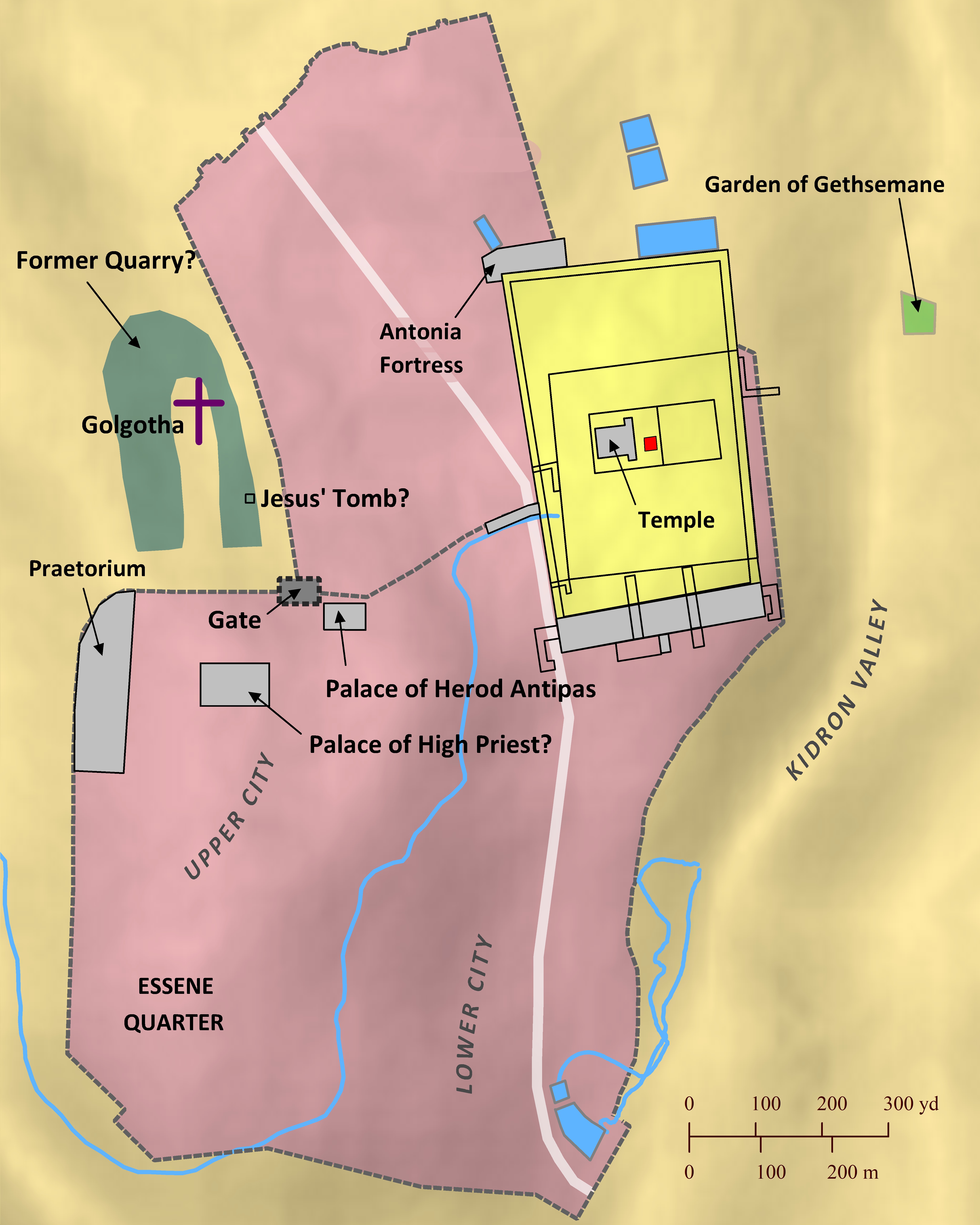
Matthew 26-27; Mark 14-15; Luke 22-23; John 13-19
On the Thursday before he was crucified, Jesus had arranged to share the Passover meal with his disciples in an upper room, traditionally thought to be located in the Essene Quarter of Jerusalem. After they finished the meal, they went to the Garden of Gethsemane, where Jesus often met with his disciples. There Judas Iscariot, one of Jesus’ own disciples, betrayed him to soldiers sent from the High Priest, and they took Jesus to the High Priest’s residence. In the morning the leading priests and teachers of the law put Jesus on trial and found him guilty of blasphemy. The council sent Jesus to stand trial for treason before the Roman governor Pontius Pilate, who resided at the Praetorium while in Jerusalem. The Praetorium was likely located at the former residence of Herod the Great, who had died over 30 years earlier. When Pilate learned that Jesus was from Galilee, he sent him to Herod Antipas, who had jurisdiction over Galilee. But when Jesus gave no answer to Herod’s many questions, Herod and his soldiers sent him back to Pilate, who conceded to the people’s demands that Jesus be crucified. Jesus was forced to carry his cross out of the city gate to Golgotha, meaning Skull Hill, referring to what may have been a small unquarried hill in the middle of an old quarry just outside the gate. After Jesus was unable to carry his cross any further, a man named Simon from Cyrene was forced to carry it for him. There at Golgotha they crucified Jesus. After Jesus died, his body was hurriedly taken down before nightfall and placed in a newly cut, rock tomb owned by Joseph of Arimathea, a member of the Jewish high council. This tomb was likely located at the perimeter of the old quarry.
Open Bible Data site copyright © 2023–2026 Freely-Given.org.
Python source code for creating these static pages is available on GitHub under an open licence.
For Bible data copyrights, see the details for each displayed Bible version.
The Open English Translation (OET) main site is at OpenEnglishTranslation.Bible or OET.Bible.